

Neuroanatomical regions associated with non-progressive dysarthria post-stroke: a systematic review
Open accessThe DOI matches its Crossref record; 59 of the 60 references it cites were found in a registry or an index.
Abstract
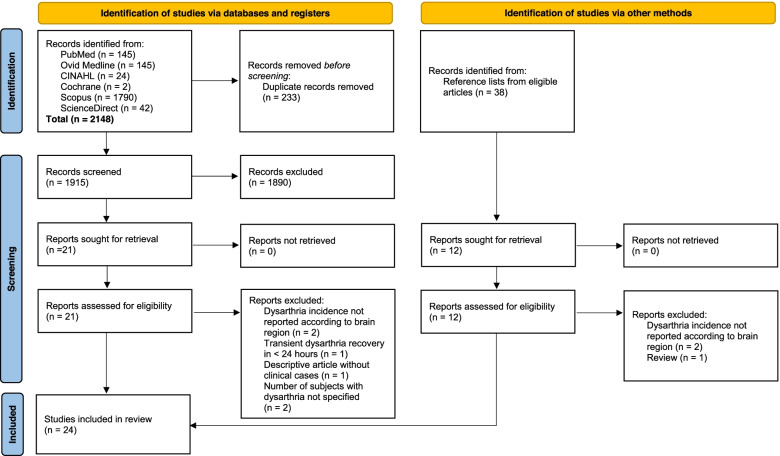
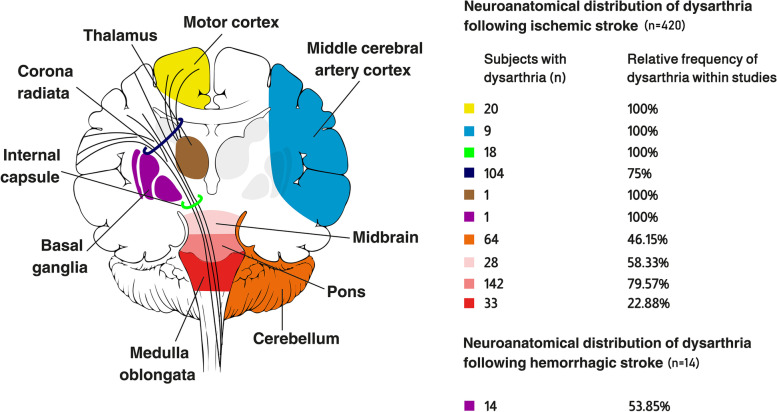
Background: Dysarthria is a common and persisting sequela to stroke. It can have a negative influence on psychological wellbeing, and quality of life. This systematic review aimed to describe and identify the neuroanatomical regions associated with non-progressive dysarthria following stroke. Methods: A systematic search of PubMed, Ovid Medline, CINAHL, Cochrane, Scopus, and ScienceDirect was conducted to identify all relevant articles published in peer-reviewed journals up to December 2021. Following data extraction, the National Institutes of Health (NIH) quality assessment tools were used to evaluate the methodological quality of the included studies. Results: Out of 2186 papers found in the literature related to dysarthria post-stroke, 24 met the inclusion criteria. Eligible articles assessed 1150 post-stroke subjects. Out of them, 420 subjects had dysarthria from isolated lesions. Regarding dysarthric subjects with ischemic strokes, 153 sustained supratentorial infarctions, while 267 had infratentorial infarctions. The majority had pontine infarctions ( n = 142), followed by infarctions in the corona radiata ( n = 104), and the cerebellum ( n = 64). Conclusion: This systematic review is the first step toward establishing a neuroanatomical model of dysarthria throughout the whole brain. Our findings have many implications for clinical practice and provide a framework for implementing guidelines for early detection and management of dysarthria post-stroke.
Overview
The claims and statistics of this paper haven’t been checked yet.
Free: it reads the open-access text and checks the first 5 claims that cite a source we can check. Create a free account to check every claim.
Integrity signals
Registry
Cites
Statistics
Figures
Verification
Claims the paper makes
The claims and statistics of this paper haven’t been checked yet.
Free: it reads the open-access text and checks the first 5 claims that cite a source we can check. Create a free account to check every claim.
Self-check
Percentages, sums and reported differences re-computed from the paper’s own numbers.
The self-check needs the paper’s full text.
Citations
Cites
The PRISMA 2020 statement: An updated guideline for reporting systematic reviews
Page, M. J., McKenzie, J. E., Bossuyt, P. M., Boutron, I., Hoffmann, T. C., Mulrow, C. D., Shamseer, L., Tetzlaff, J. M., Akl, E. A., Brennan, S. E., et al. (2021) · BMJ · doi:10.1136/bmj.n71 · Cited by 108,283
PENFIELD, W., & BOLDREY, E. (1937) · Brain · doi:10.1093/brain/60.4.389 · Cited by 4,188
Ma, L.-L., Wang, Y.-Y., Yang, Z.-H., Huang, D., Weng, H., & Zeng, X.-T. (2020) · Military Medical Research · doi:10.1186/s40779-020-00238-8 · Cited by 1,648
De Cocker, L. J. L., van Veluw, S. J., Fowkes, M., Luijten, P. R., Mali, W. P. T. M., & Hendrikse, J. (2013) · Cerebrovascular Diseases · doi:10.1159/000353668 · Cited by 1,156
Estimates of the Prevalence of Acute Stroke Impairments and Disability in a Multiethnic Population
Lawrence, E. S., Coshall, C., Dundas, R., Stewart, J., Rudd, A. G., Howard, R., & Wolfe, C. D. A. (2001) · Stroke · doi:10.1161/01.str.32.6.1279 · Cited by 950 · cited 1×
“Non-progressive dysarthria is estimated to occur in 20–42% of stroke survivors and two-thirds of all subjects with their first-ever ischemic stroke [5, 6].”
BackgroundKim, J. S. (2003) · Brain · doi:10.1093/brain/awg169 · Cited by 370
Davidoff, M. (1990) · Neurology · doi:10.1212/wnl.40.2.332 · Cited by 361
Ackermann, H., Mathiak, K., & Riecker, A. (2007) · The Cerebellum · doi:10.1080/14734220701266742 · Cited by 318
Alexander, M. P., Benson, D. F., & Stuss, D. T. (1989) · Brain and Language · doi:10.1016/0093-934x(89)90118-1 · Cited by 310
Cerebellar infarction. Clinical and anatomic observations in 66 cases.
Kase, C. S., Norrving, B., Levine, S. R., Babikian, V. L., Chodosh, E. H., Wolf, P. A., & Welch, K. M. (1993) · Stroke · doi:10.1161/01.str.24.1.76 · Cited by 291
Bassetti, C., Bogousslavsky, J., Barth, A., & Regli, F. (1996) · Neurology · doi:10.1212/wnl.46.1.165 · Cited by 261
Flowers, H. L., Silver, F. L., Fang, J., Rochon, E., & Martino, R. (2013) · Journal of Communication Disorders · doi:10.1016/j.jcomdis.2013.04.001 · Cited by 249
AMARENCO, P., & HAUW, J.-J. (1990) · Brain · doi:10.1093/brain/113.1.139 · Cited by 203
Schoch, B., Dimitrova, A., Gizewski, E. R., & Timmann, D. (2006) · NeuroImage · doi:10.1016/j.neuroimage.2005.09.018 · Cited by 183
Clinical study of 227 patients with lacunar infarcts.
Arboix, A., Martí-Vilalta, J. L., & García, J. H. (1990) · Stroke · doi:10.1161/01.str.21.6.842 · Cited by 183
Functional lateralization of speech production at primary motor cortex: a fMRI study
Wildgruber, D., Ackermann, H., Klose, U., Kardatzki, B., & Grodd, W. (1996) · Neuroreport · doi:10.1097/00001756-199611040-00077 · Cited by 175
Speech deficits in ischaemic cerebellar lesions
Ackermann, H., Vogel, M., Petersen, D., & Poremba, M. (1992) · Journal of Neurology · doi:10.1007/bf00839144 · Cited by 162 · cited 1×
“lesions were equally distributed on the left and the right side in ten subjects and bilateral in two [17].”
BackgroundPure midbrain infarction: Clinical, radiologic, and pathophysiologic findings
Kim, J. S., & Kim, J. (2005) · Neurology · doi:10.1212/01.wnl.0000156520.46056.6b · Cited by 161
Amarenco, P., & Hauw, J.-J. (1990) · Neurology · doi:10.1212/wnl.40.9.1383 · Cited by 146
The human basis pontis: motor syndromes and topographic organization
Schmahmann, J. D. (2004) · Brain · doi:10.1093/brain/awh138 · Cited by 143
Paramedian Pontine Infarction: Neurological/Topographical Correlation
Kataoka, S., Hori, A., Shirakawa, T., & Hirose, G. (1997) · Stroke · doi:10.1161/01.str.28.4.809 · Cited by 139
Barth, A., Bogousslavsky, J., & Regli, F. (1993) · Annals of Neurology · doi:10.1002/ana.410330507 · Cited by 139
Lateral and Medial Medullary Infarction: A Comparative Analysis of 214 Patients
Kameda, W., Kawanami, T., Kurita, K., Daimon, M., Kayama, T., Hosoya, T., & Kato, T. (2004) · Stroke · doi:10.1161/01.str.0000117570.41153.35 · Cited by 138
Localization of the pyramidal tract in the internal capsule by whole brain dissection
Ross, E. D. (1980) · Neurology · doi:10.1212/wnl.30.1.59 · Cited by 138
Treatment Efficacy: Dysarthria
Yorkston, K. M. (1996) · Journal of Speech, Language, and Hearing Research · doi:10.1044/jshr.3905.s46 · Cited by 128 · cited 1×
“Background Non-progressive dysarthria is a motor speech disorder characterized by weakness, incoordination, slowness of the speech musculature, and speech intelligibility [1, 2].”
BackgroundThe impact of stroke-related dysarthria on social participation and implications for rehabilitation
Brady, M. C., Clark, A. M., Dickson, S., Paton, G., & Barbour, R. S. (2011) · Disability and Rehabilitation · doi:10.3109/09638288.2010.517897 · Cited by 127
Urban, P. P., Marx, J., Hunsche, S., Gawehn, J., Vucurevic, G., Wicht, S., Massinger, C., Stoeter, P., & Hopf, H. C. (2003) · Archives of Neurology · doi:10.1001/archneur.60.7.965 · Cited by 124
Cerebellar infarcts in the New England Medical Center Posterior Circulation Stroke Registry
Chaves, C. J., Caplan, L. R., Chung, C., Tapía, J., Amarenco, P., Teal, P. A., Wityk, R. J., Estol, C. J., Tettenborn, B., Rosengart, A. J., et al. (1994) · Neurology · doi:10.1212/wnl.44.8.1385 · Cited by 121
Infarction of the lower brainstem: Clinical, aetiological and MRI-topographical correlations
Vuilleumier, P., Bogousslavsky, J., & Regli, F. (1995) · Brain · doi:10.1093/brain/118.4.1013 · Cited by 119
Chung, C.-S. (2000) · Brain · doi:10.1093/brain/123.9.1850 · Cited by 117
Syndromes of Pontine Base Infarction: A Clinical-Radiological Correlation Study
Kim, J. S., Lee, J. H., Im, J. H., & Lee, M. C. (1995) · Stroke · doi:10.1161/01.str.26.6.950 · Cited by 111
Interventions for dysarthria due to stroke and other adult-acquired, non-progressive brain injury
Mitchell, C., Bowen, A., Tyson, S., Butterfint, Z., & Conroy, P. (2017) · Cochrane Database of Systematic Reviews · doi:10.1002/14651858.cd002088.pub3 · Cited by 111 · cited 1×
“Background Non-progressive dysarthria is a motor speech disorder characterized by weakness, incoordination, slowness of the speech musculature, and speech intelligibility [1, 2].”
BackgroundLiving with acquired dysarthria: the speaker's perspective
Walshe, M., & Miller, N. (2011) · Disability and Rehabilitation · doi:10.3109/09638288.2010.511685 · Cited by 110
Urban, P. P., Rolke, R., Wicht, S., Keilmann, A., Stoeter, P., Hopf, H. C., & Dieterich, M. (2006) · Brain · doi:10.1093/brain/awh708 · Cited by 99
Zürcher, E., Richoz, B., Faouzi, M., & Michel, P. (2018) · Journal of Stroke and Cerebrovascular Diseases · doi:10.1016/j.jstrokecerebrovasdis.2018.11.016 · Cited by 96
Dysarthria in acute ischemic stroke: Lesion topography, clinicoradiologic correlation, and etiology
Urban, P. P., Wicht, S., Vukurevic, G., Fitzek, C., Fitzek, S., Stoeter, P., Massinger, C., & Hopf, H. C. (2001) · Neurology · doi:10.1212/wnl.56.8.1021 · Cited by 95
Flowers, H. L., Alharbi, M., Mikulis, D. J., Silver, F. L., Rochon, E. A., Streiner, D. L., & Martino, R. (2017) · Cerebrovascular Diseases Extra · doi:10.1159/000457810 · Cited by 84
Isolated dysarthria due to extracerebellar lacunar stroke: a central monoparesis of the tongue
Urban, P. P., Wicht, S., Hopf, H. C., Fleischer, S., & Nickel, O. (1999) · Journal of Neurology Neurosurgery & Psychiatry · doi:10.1136/jnnp.66.4.495 · Cited by 70
Speech and language therapy for dysarthria due to non-progressive brain damage
Sellars, C., Hughes, T., & Langhorne, P. (2002) · The Cochrane Database of Systematic Reviews · doi:10.1002/14651858.cd002088 · Cited by 68
Moreau, F., Asdaghi, N., Modi, J., Goyal, M., & Coutts, S. B. (2013) · Cerebrovascular Diseases Extra · doi:10.1159/000355024 · Cited by 65
Atherothrombotic Cerebellar Infarction
Min, W. K., Kim, Y. S., Kim, J. Y., Park, S. P., & Suh, C. K. (1999) · Stroke · doi:10.1161/01.str.30.11.2376 · Cited by 61
Urban, P. P., Hopf, H. C., Fleischer, S., Zorowka, P. G., & Müller-Forell, W. (1997) · Brain · doi:10.1093/brain/120.6.1077 · Cited by 60
Relationship Between Quality of Life and Dysarthria in Patients With Multiple Sclerosis
Piacentini, V., Mauri, I., Cattaneo, D., Gilardone, M., Montesano, A., & Schindler, A. (2014) · Archives of Physical Medicine and Rehabilitation · doi:10.1016/j.apmr.2014.04.023 · Cited by 58
Baumann, A., Nebel, A., Granert, O., Giehl, K., Wolff, S., Schmidt, W., Baasch, C., Schmidt, G. U., Witt, K., Deuschl, G., et al. (2018) · Neurorehabilitation and neural repair · doi:10.1177/1545968318812726 · Cited by 55 · cited 1×
“Recent neuroimaging studies showed that dysarthria post-stroke is related to lesions involved in speech-related areas, which include the primary motor cortex, the lateral premotor cortex as well as the prefrontal cortices, the supplementary motor area [12, 13], the corona radiata, the internal capsule, the striatocaps…”
BackgroundPure dysarthria, isolated facial paresis, or dysarthria-facial paresis syndrome.
Kim, J. S. (1994) · Stroke · doi:10.1161/01.str.25.10.1994 · Cited by 55
Kumral, E., Çelebisoy, M., Çelebisoy, N., Canbaz, D. H., & Çallı, C. (2007) · Cerebrovascular Diseases · doi:10.1159/000099131 · Cited by 52
Dysarthria as a predictor of dysphagia following stroke
Bahia, M. M., Mourão, L. F., & Chun, R. Y. S. (2016) · Neurorehabilitation · doi:10.3233/nre-161305 · Cited by 50
Localisation of the corticospinal fibres in the internal capsule in man.
Kretschmann, H. (1988) · PubMed · Cited by 48
Dysarthria and lacunar stroke: Pathophysiologic aspects
Urban, P. P., Hopf, H. C., Zorowka, P., Fleischer, S., & ANDREAS, J. (1996) · Neurology · doi:10.1212/wnl.47.5.1135 · Cited by 43
Rumbach, A. F., Finch, E., & Stevenson, G. (2019) · Journal of Communication Disorders · doi:10.1016/j.jcomdis.2019.03.002 · Cited by 32 · cited 1×
“It is induced by non-progressive diseases of the central nervous system, such as traumatic brain injury (TBI) and stroke [3, 4].”
BackgroundTohgi, H., Takahashi, S., Takahashi, H., Tamura, K., & Yonezawa, H. (2008) · European Neurology · doi:10.1159/000117290 · Cited by 27
Speech motor deficits in cerebellar infarctions
Urban, P. P. (2013) · Brain and Language · doi:10.1016/j.bandl.2013.10.001 · Cited by 27
Superior cerebellar artery territory stroke
Erdemoğlu, A. K., & Duman, T. (1998) · Acta Neurologica Scandinavica · doi:10.1111/j.1600-0404.1998.tb07310.x · Cited by 25
Cerebral Blood Flow in Pure Dysarthria: Role of Frontal Cortical Hypoperfusion
Okuda, B., Kawabata, K., Tachibana, H., & Sugita, M. (1999) · Stroke · doi:10.1161/01.str.30.1.109 · Cited by 25
Summaka, M., Harati, H., Hannoun, S., Zein, H., Koubaisy, N., Fares, Y., & Nasser, Z. (2021) · BMC Neurology · doi:10.1186/s12883-021-02484-2 · Cited by 14
Self-citationTanaka, K., Yamada, T., Torii, T., Yoshimura, T., Takase, K., Togao, O., Wakata, Y., Hiwatashi, A., Nakashima, N., Kira, J., et al. (2015) · BMC Neurology · doi:10.1186/s12883-015-0439-5 · Cited by 13
Clinical and Radiologic Correlations of Small and Large Centrum Ovale Infarcts
Beckmann, Y. Y., Ulukök, M. D., Seçıl, Y., Çelebisoy, M., & Başoğlu, M. (2010) · Journal of Stroke and Cerebrovascular Diseases · doi:10.1016/j.jstrokecerebrovasdis.2009.05.004 · Cited by 9
Kim, D. H., Kyeong, S.-H., Ahn, S. J., & Park, Y. G. (2017) · Neuroscience Letters · doi:10.1016/j.neulet.2017.07.002 · Cited by 8
Computed Tomography in Stroke Diagnosis, Assessment, and Treatment.
Ferrara, A. R. (2020) · PubMed · Cited by 4
Research works printed but not linked: 3
- Flowers Heather L AlHarbi Mohammed A Mikulis D Silver Frank L Rochon E Streiner D MRI-Based Neuroanatomical Predictors of Dysphagia, Dysarthria, and Aphasia in Patients with First Acute Ischemic Stroke Cerebrovasc Dis Extra 2017 7 1 21 34 10.1159/000457810 28208139 PMC5346925 · DOI
- Kumral E Çelebisoy M Çelebisoy N Canbaz DH Çallı C Dysarthria due to supratentorial and infratentorial ischemic stroke: a diffusion-weighted imaging study Cerebrovasc Dis 2007 23 5–6 331 338 10.1159/000099131 17268163 · DOI · Paper page
- Urban P Wicht S Vukurevic G Fitzek C Fitzek S Stoeter P Dysarthria in acute ischemic stroke: lesion topography, clinicoradiologic correlation, and etiology Neurology 2001 56 8 1021 1027 10.1212/WNL.56.8.1021 11320172 · DOI · Paper page
Cited by
Lin, L.-Y., Yao, S., Chen, Q., Du, M., Kang, X.-H., Jiang, D.-Y., & Peng, Y. J. (2025) · Frontiers in Neurology · doi:10.3389/fneur.2025.1629640 · Cited by 10
Liu, J., Ruzi, R., Jian, C., Wang, Q., Zhao, S., Ng, M. L., Zhao, S., Wang, L., & Yan, N. (2025) · Frontiers in Neuroscience · doi:10.3389/fnins.2024.1455085 · Cited by 6
The Radboud dysarthria assessment: validity and reliability of the Arabic version
Summaka, M., Nasser, Z., Hannoun, S., Daoud, R., Zein, H., Al-Thalaya, Z., Hamadeh, Z. A., Koubaisy, N., Jebahi, F., Naim, I., et al. (2023) · Disability and Rehabilitation · doi:10.1080/09638288.2023.2297809 · Cited by 3
“Dysarthria is a common disorder, with its prevalence ranging between 20 and 42% in stroke survivors [9–11], 10 to 60% in patients following TBIs [2], and 50 to 90% in patients with Parkinson’s disease [12].”
Self-citationPerfil dos pacientes acometidos por AVC no sul de Santa Catarina
Angelo, L. V., Domingos, N. B., Negrello, C. A., Frassetto, M. D., Sipriano, É. D. S., Mendes, J. V. S., Machado, L. V., & Madeira, K. (2023) · Revista Neurociências · doi:10.34024/rnc.2023.v31.14960 · Cited by 3
Seizures as presentation of shunt malfunction: tertiary paediatric neurosurgery experience
Goel, A., Najmi, V. S., Herbert, K., Drew, A., Rodrigues, D., & Afshari, F. T. (2024) · Child s Nervous System · doi:10.1007/s00381-024-06388-7 · Cited by 2
Metadata
- Authors
- Summaka, M., Hannoun, S., Harati, H., Daoud, R., Zein, H., Estephan, E., Naim, I., & Nasser, Z.
- Affiliations
- Lebanese University (LB)
- American University of Beirut (LB)
- Corresponding author
- Nasser, Zeina
- Venue
- BMC Neurology
- Published
- 2022-09-16
- Volume
- 22
- Issue
- 1
- Pages
- 353-353
- ISSN
- 1471-2377 (ISSN-L)
- PMC
- PMC9479301
- OpenAlex
- W4296041616
- Cited by
- 16
- References
- 60
- Citations by year
- 2026: 8 · 2025: 2 · 2024: 3 · 2023: 3
- FWCI
- 0.28
- Type
- journal article
- Language
- en
- Open access
- gold
- doi.org
- Licence
- cc-by
- creativecommons.org/licenses/by/4.0 (tdm)
- creativecommons.org/licenses/by/4.0 (vor)
- Locations
- BMC Neurology (publishedVersion, cc-by)
- PubMed Central (publishedVersion, cc-by)
- PubMed (publishedVersion)
- HAL (submittedVersion, cc-by)
- DOAJ (DOAJ: Directory of Open Access Journals) (submittedVersion, cc-by-sa)
- Topics
- Health Sciences › Health Professions › Speech and Hearing › Voice and Speech Disorders
- Life Sciences › Neuroscience › Cognitive Neuroscience › Neurobiology of Language and Bilingualism
- Health Sciences › Health Professions › Speech and Hearing › Dysphagia Assessment and Management
- Keywords
- dysarthria, stroke, pontine infarction, corona radiata infarction, cerebellar infarction, ischemic stroke, speech motor control
- MeSH terms
- Ischemic Stroke, Dysarthria, Humans, Infarction, Quality of Life, United States, Stroke
About these checks
Registry, retraction, Cites and statistics results are computed, not judged, with one exception: a printed reference that no index lists is read once by a model before it counts as a citation error. Claims are extracted by a model and kept only when their quote appears verbatim in the text; each cited source is then checked, with a model’s help, for whether it says what the claim relies on. Those verdicts can be wrong — read the claim’s quote and the cited source before relying on one.
Statistics and arithmetic are recomputed, not judged.
Confidence bands are shown only for fields calibrated on our annotated test set. None is calibrated yet, so no band is shown.
What counts as a claim ›How we measure confidence ›How we check this ›
Are you an author, or do you see a problem with this page? Request a review
Data sources
Bibliographic data: Semantic Scholar, OpenAlex, Crossref.
Contains information from the Semantic Scholar Academic Graph Datasets, made available under the ODC Attribution License (ODC-BY 1.0).
Semantic Scholar’s data is described in: Kinney, R., et al. (2023). The Semantic Scholar Open Data Platform. arXiv:2301.10140.
