

The DOI matches its Crossref record; 58 of the 58 references it cites were found in a registry or an index.
Predictors of a negative labour and birth experience based on a national survey of Canadian women
Open accessAbstract
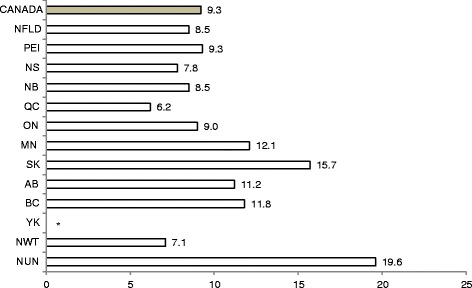
BACKGROUND: A negative birth experience has been shown to have a significant impact on the well-being and future choices of mothers. The objective of this study was to assess the prevalence of, and identify the risk factors associated with a negative birth experience for women in Canada. METHODS: The study was based on secondary data analysis of the Maternity Experiences Survey (MES), a Canadian population database administered to 6,421 Canadian women in 2006. The examined outcome - negative birth experience - was derived from mothers' self-report of overall labour and birth experience. Independent variables were maternal demographics, health characteristics, pregnancy-related characteristics, and birth characteristics. Multivariable logistic regression analysis was performed to determine the significant predictors of negative birth experience. Adjusted Odds Ratios (AOR) and 95 % Confidence Intervals (CI) are reported. RESULTS: Negative birth experience was reported among 9.3 % of women. The main significant predictors of a negative birth experience included older age (AOR 2.29, 95 % CI, 1.03-5.07), violence experienced in the past two years (AOR, 1.62, 95 % CI, 1.21-2.18), poor self-perceived health (adjusted OR, 1.95, 95 % CI, 1.36-2.80), prenatal classes attended (adjusted OR, 1.36, 95 % CI, 1.06-1.76), unintended pregnancy (adjusted OR, 1.30, 95 % CI, 1.03-1.63), caesarean birth (AOR, 1.65, 95 % CI, 1.32-2.06), and neonate admission to intensive care (AOR, 1.40, 95 % CI, 1.08-1.82). CONCLUSION: Significant predictors of a negative labour and birth experience were identified through this study, a first in the Canadian context. These findings suggest future research directions and provide a basis for the design and evaluation of maternal health policy and prevention programs.
Overview
The claims and statistics of this paper haven’t been checked yet.
Run the check — free, no account needed. It reads the open-access text and checks the sources it cites.
Integrity signals
Registry
Cites
Statistics
Figures
Verification
Claims the paper makes
The claims and statistics of this paper haven’t been checked yet.
Run the check — free, no account needed. It reads the open-access text and checks the sources it cites.
Claims other papers make about this one
Each is checked against this paper’s own text: does it say what the citing paper says it does?
The source backs part of the claim, not all of it — or backs it for a different population, condition or comparison.
In the citing paper
“Spontaneous childbirth, compared to childbirth involving instrumentation or Caesarean section, is positively associated with satisfaction, which is consistent with previous reports. 32,34”
From Comprehensive maternity support and shared care in Switzerland: Comparison of levels of satisfaction (2018) · cites this paper as [34]
Experimental — accuracy not yet measuredThe cited source says what the claim attributes to it.
In the citing paper
“Age is associated with greater satisfaction in young women compared to older women during childbirth, which is consistent with previous Canadian results, 34 but con fl icting results have been reported in the past. 8,32,33”
From Comprehensive maternity support and shared care in Switzerland: Comparison of levels of satisfaction (2018) · cites this paper as [34]
Self-check
Percentages, sums and reported differences re-computed from the paper’s own numbers.
The self-check needs the paper’s full text.
Citations
Cites
Canadian Institute for Health Information.
Lalonde, A. (1994) · PubMed · Cited by 4,730
What is self-rated health and why does it predict mortality? Towards a unified conceptual model
Jylhä, M. (2009) · Social Science & Medicine · doi:10.1016/j.socscimed.2009.05.013 · Cited by 2,578
Maternal Morbid Obesity and the Risk of Adverse Pregnancy Outcome
Cedergren, M. (2004) · Obstetrics and Gynecology · doi:10.1097/01.aog.0000107291.46159.00 · Cited by 1,352
Major risk factors for stillbirth in high-income countries: a systematic review and meta-analysis
Flenady, V., Koopmans, L., Middleton, P., Frøen, J. F., Smith, G. C., Gibbons, K., Coory, M., Gordon, A., Ellwood, D., McIntyre, H. D., et al. (2011) · The Lancet · doi:10.1016/s0140-6736(10)62233-7 · Cited by 1,247
Pain and women's satisfaction with the experience of childbirth: A systematic review
Hodnett, E. D. (2002) · American Journal of Obstetrics and Gynecology · doi:10.1016/s0002-9378(02)70189-0 · Cited by 967 · cited 2×
“Of these, the four factors – fulfilled expectations, support, relationship between caregiver and patient, and involvement in decision-making – were more predictive of birth experience than others such as pain, medical intervention, and birth setting [32].”
BackgroundPrevalence and Predictors of Women's Experience of Psychological Trauma During Childbirth
Soet, J. E., Brack, G., & DiIorio, C. K. (2003) · Birth · doi:10.1046/j.1523-536x.2003.00215.x · Cited by 778
A Negative Birth Experience: Prevalence and Risk Factors in a National Sample
Waldenström, U., Hildingsson, I., Rubertsson, C., & Rådestad, I. (2004) · Birth · doi:10.1111/j.0730-7659.2004.0270.x · Cited by 657 · cited 7×
“However, inconsistencies have been reported in previous research that produced similar results [6, 51].”
BackgroundResultInfluentialChildbirth and the development of acute trauma symptoms: incidence and contributing factors.
Creedy, D., Shochet, I. M., & Horsfall, J. (2000) · Birth · doi:10.1046/j.1523-536x.2000.00104.x · Cited by 644
Factors related to childbirth satisfaction
Goodman, P., Mackey, M. C., & Tavakoli, A. S. (2004) · Journal of Advanced Nursing · doi:10.1111/j.1365-2648.2003.02981.x · Cited by 630
Patra, J., Bakker, R., Irving, H., Jaddoe, V., Malini, S., & Rehm, J. (2011) · BJOG: An International Journal of Obstetrics & Gynaecology · doi:10.1111/j.1471-0528.2011.03050.x · Cited by 555
Cited by
Sorted by citations
Factors related to a negative birth experience – A mixed methods study
Henriksen, L., Grimsrud, E., Schei, B., & Lukasse, M. (2017) · Midwifery · doi:10.1016/j.midw.2017.05.004 · Cited by 241
Prevalence and factors affecting the negative childbirth experiences: a systematic review
Hosseini-Tabaghdehi, M., Kolahdozan, S., Keramat, A., Shahhossein, Z., Moosazadeh, M., & Motaghi, Z. (2019) · Journal of Maternal-Fetal & Neonatal Medicine · doi:10.1080/14767058.2019.1583740 · Cited by 121
Ghanbari-Homayi, S., Fardiazar, Z., Meedya, S., Mohammad-Alizadeh-Charandabi, S., Asghari-Jafarabadi, M., Mohammadi, E., & Mirghafourvand, M. (2019) · BMC Pregnancy and Childbirth · doi:10.1186/s12884-019-2333-4 · Cited by 121
Falk, M., Nelson, M., & Blomberg, M. (2019) · BMC Pregnancy and Childbirth · doi:10.1186/s12884-019-2633-8 · Cited by 109
Leinweber, J., Kuipers, Y., Karlsdóttir, S. I., Ekström, A., Nilsson, C., Stramrood, C. A. I., & Thomson, G. (2022) · Birth · doi:10.1111/birt.12666 · Cited by 112
Metadata
- Authors
- Smarandache, A., Kim, T. H. M., Bohr, Y., & Tamim, H.
- Affiliations
- York University (CA)
- Corresponding author
- Kim, Theresa H. M.
- Venue
- BMC Pregnancy and Childbirth
- Published
- 2016-05-18
- Volume
- 16
- Issue
- 1
- Pages
- 114-114
- ISSN
- 1471-2393 (ISSN-L)
- PMC
- PMC4870779
- OpenAlex
- W2394938726
- Cited by
- 166
- References
- 58
- Citations by year
- 2026: 6 · 2025: 19 · 2024: 27 · 2023: 17 · 2022: 27 · 2021: 22 · 2020: 20 · 2019: 13 · 2018: 7 · 2017: 7
- FWCI
- 11.63
- Type
- journal article
- Language
- en
- Open access
- gold
- doi.org
- Licence
- cc-by
- Locations
- BMC Pregnancy and Childbirth (publishedVersion, cc-by)
- PubMed Central (publishedVersion, cc-by)
- PubMed (publishedVersion)
- Funders
- Public Health Agency of Canada
- Public Health Agency
- Canadian Institutes of Health Research
- Social Sciences and Humanities Research Council of Canada
- Topics
- Health Sciences › Medicine › Obstetrics and Gynecology › Maternal and Perinatal Health Interventions
- Health Sciences › Medicine › Pediatrics, Perinatology and Child Health › Maternal and Neonatal Healthcare
- Health Sciences › Medicine › Public Health, Environmental and Occupational Health › Reproductive Health and Contraception
- Keywords
- negative birth experience, risk factors, maternal violence, health perception, prenatal classes, unintended pregnancy, caesarean birth, neonatal intensive care, maternal health policy, Canadian women
- MeSH terms
- Adolescent, Adult, Canada, Cesarean Section, Cross-Sectional Studies, Female, Humans, Labor, Obstetric, Obstetric Labor Complications, Maternal Age, Mothers, Pregnancy, Prenatal Care, Surveys and Questionnaires, Risk Factors, Violence, Odds Ratio, Parturition, Pregnancy, Unplanned, Young Adult
About these checks
Registry, retraction, Cites and statistics results are computed, not judged, with one exception: a printed reference that no index lists is read once by a model before it counts as a citation error. Claims are extracted by a model and kept only when their quote appears verbatim in the text; each cited source is then checked, with a model’s help, for whether it says what the claim relies on. Those verdicts can be wrong — read the claim’s quote and the cited source before relying on one.
Statistics and arithmetic are recomputed, not judged.
Confidence bands are shown only for fields calibrated on our annotated test set. None is calibrated yet, so no band is shown.
What counts as a claim ›How we measure confidence ›How we check this ›
Are you an author, or do you see a problem with this page? Request a review
