

The diagnosis of pre-eclampsia using two revised classifications in the Finnish Pre-eclampsia Consortium (FINNPEC) cohort
Open accessThe DOI matches its Crossref record; 12 of the 12 references it cites were found in a registry or an index.
Abstract
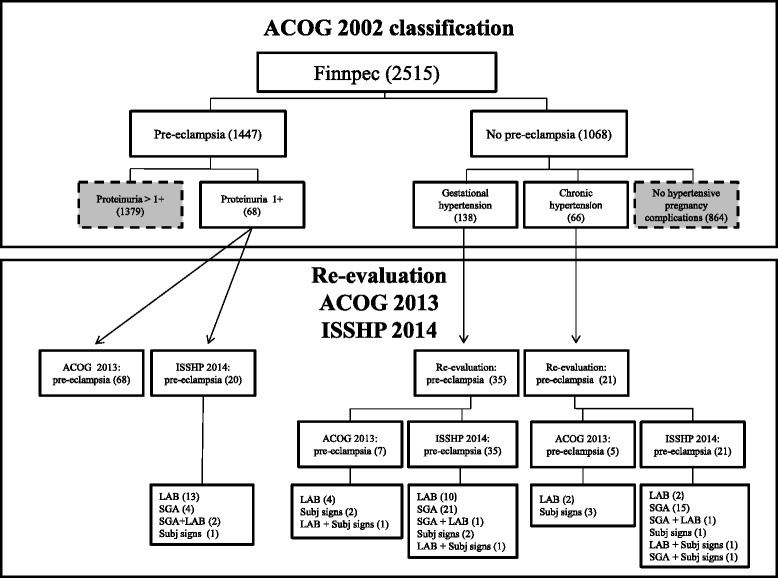
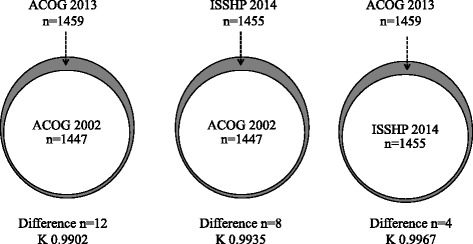
BACKGROUND: The Finnish Pre-eclampsia Consortium (FINNPEC) case-control cohort consisting of 1447 pre-eclamptic and 1068 non-pre-eclamptic women was recruited during 2008-2011 to study genetic background of pre-eclampsia and foetal growth. Pre-eclampsia was defined by hypertension and proteinuria according to the American College of Obstetricians and Gynecologists (ACOG) 2002 classification. The ACOG Task Force Report on Hypertension in Pregnancy (2013) and The International Society for the Study of Hypertension in Pregnancy (ISSHP) (2014) have published new classifications, in which proteinuria is not necessary for diagnosis when specific symptoms are present. For diagnoses based on proteinuria, the ISSHP 2014 criteria raised its threshold to 2+ on dipstick. We studied how the new classifications would affect pre-eclampsia diagnoses in the FINNPEC cohort. METHODS: We re-evaluated pre-eclampsia diagnosis using the ACOG 2013 and the ISSHP 2014 classifications in pre-eclamptic women whose proteinuria did not exceed 1+ on dipstick (n = 68), in women with gestational hypertension (n = 138) and in women with chronic hypertension (n = 66). RESULTS: The number of women with pre-eclampsia increased 0.8 % (1459/1447) according to the ACOG 2013 criteria and 0.6 % (1455/1447) according to the ISSHP 2014 criteria. All 68 women with the amount of proteinuria not exceeding 1+ on dipstick diagnosed originally pre-eclamptic met the ACOG 2013 criteria but only 20 women (29.4 %) met the ISSHP 2014 criteria. Seven (5.1 %) and 35 (25.4 %) women with gestational hypertension were diagnosed with pre-eclampsia according to the ACOG 2013 and the ISSHP 2014 criteria, respectively. Correspondingly five (7.6 %) and 21 (31.8 %) women with chronic hypertension were diagnosed with pre-eclampsia according to the ACOG 2 013 and the ISSHP 2014 criteria. CONCLUSIONS: Only minor changes were observed in the total number of pre-eclamptic women in the FINNPEC cohort when comparing the ACOC 2002 classification with the ACOG 2013 and ISSHP 2014 classifications.
Overview
The claims and statistics of this paper haven’t been checked yet.
Free: it reads the open-access text and checks the first 5 claims that cite a source we can check. Create a free account to check every claim.
Integrity signals
Registry
Cites
Statistics
Figures
Verification
Claims the paper makes
The claims and statistics of this paper haven’t been checked yet.
Free: it reads the open-access text and checks the first 5 claims that cite a source we can check. Create a free account to check every claim.
Claims other papers make about this one
Each is checked against this paper’s own text: does it say what the citing paper says it does?
The cited source says what the claim attributes to it.
In the citing paper
“The application of these broad definitions of pre-eclampsia means patients once diagnosed with gestational hypertension or chronic hypertension were recategorized as pre-eclampsia or chronic hypertension with superimposed pre-eclampsia, respectively17–21.”
From A global view of hypertensive disorders and diabetes mellitus during pregnancy (2022) · cites this paper as [19]
Self-check
Percentages, sums and reported differences re-computed from the paper’s own numbers.
The self-check needs the paper’s full text.
Citations
Cites
(2013) · doi:10.1097/01.aog.0000437382.03963.88 · Cited by 3,961
Bellamy, L., Casas, J.-P., Hingorani, A. D., & Williams, D. J. (2007) · BMJ · doi:10.1136/bmj.39335.385301.be · Cited by 2,552
Onuegbu, A. J., Olisekodiaka, J. M., Udo, J. U., Umeononihu, O., Amah, U. K., Okwara, J. E., & Atuegbu, C. (2015) · Medical Principles and Practice · doi:10.1159/000381778 · Cited by 2,044
The “Great Obstetrical Syndromes” are associated with disorders of deep placentation
Brosens, I., Pijnenborg, R., Vercruysse, L., & Romero, R. (2011) · American Journal of Obstetrics and Gynecology · doi:10.1016/j.ajog.2010.08.009 · Cited by 1,568 · cited 1×
“PE is characterised by vascular endothelial dysfunction and placental implantation abnormalities, causing perfusion problems and in some cases intrauterine growth restriction [2].”
BackgroundTranquilli, A. L., Dekker, G., Magee, L., Roberts, J., Sibai, B. M., Steyn, W., Zeeman, G. G., & Brown, M. A. (2014) · Pregnancy Hypertension: An International Journal of Women's Cardiovascular Health · doi:10.1016/j.preghy.2014.02.001 · Cited by 1,417 · cited 3×
“Proteinuria has been questioned as a sine qua non [7].”
BackgroundInfluentialDiagnosis and management of preeclampsia and eclampsia
(2002) · International Journal of Gynecology & Obstetrics · doi:10.1016/s0020-7292(02)80002-9 · Cited by 703
If we know so much about preeclampsia, why haven’t we cured the disease?
Roberts, J. M., & Bell, M. J. (2013) · Journal of Reproductive Immunology · doi:10.1016/j.jri.2013.05.003 · Cited by 189 · cited 1×
“Prediction and prevention have proven to be difficult due to the complex nature of the disease [3].”
BackgroundRoberts, J. M., & Hubel, C. A. (2010) · Women s Health Issues · doi:10.1016/j.whi.2010.05.004 · Cited by 154 · cited 1×
“Women with early onset (requiring delivery before 34 weeks of gestation), recurrent, or preterm PE are at the highest risk for cardiovascular diseases [4, 10].”
BackgroundSibai, B. M. (2011) · Seminars in Perinatology · doi:10.1053/j.semperi.2011.05.010 · Cited by 69 · cited 1×
“Symptoms appear usually late in the third trimester [1].”
Background
Cited by
A global view of hypertensive disorders and diabetes mellitus during pregnancy
Jiang, L., Tang, K., Magee, L. A., von Dadelszen, P., Ekeroma, A., Li, X., Zhang, E., & Bhutta, Z. A. (2022) · Nature Reviews Endocrinology · doi:10.1038/s41574-022-00734-y · Cited by 314
Cameron, N. A., Everitt, I., Seegmiller, L. E., Yee, L. M., Grobman, W. A., & Khan, S. S. (2022) · Journal of the American Heart Association · doi:10.1161/jaha.121.023791 · Cited by 125
Verlohren, S., & Dröge, L.-A. (2020) · American Journal of Obstetrics and Gynecology · doi:10.1016/j.ajog.2020.09.046 · Cited by 96
Piccoli, G. B., Zakharova, E., Attini, R., Ibarra-Hernández, M., Orozco-Guillén, A., Alrukhaimi, M. N., Liu, Z.-H., Ashuntantang, G., Covella, B., Cabiddu, G., et al. (2018) · Journal of Clinical Medicine · doi:10.3390/jcm7110415 · Cited by 85
Evaluation of the clinical impact of the revised ISSHP and ACOG definitions on preeclampsia
Bouter, A. R., & Duvekot, J. J. (2020) · Pregnancy Hypertension · doi:10.1016/j.preghy.2019.11.011 · Cited by 77
Healthy dietary patterns and common pregnancy complications: A prospective and longitudinal study
Li, M., Grewal, J., Hinkle, S. N., Yisahak, S. F., Grobman, W. A., Newman, R. B., Skupski, D. W., Chien, E. K., Wing, D. A., Grantz, K. L., et al. (2021) · The American Journal of Clinical Nutrition · doi:10.1093/ajcn/nqab145 · Cited by 76
“time of study data collection, clinicians at participating centers typically followed the 2002 American College of Obstetrician and Gynecologists (ACOG) criteria (28) for the diagnosis of hypertensive disorders of pregnancy; a previous study demonstrated that ACOG 2002 criteria and the more recent ACOG 2013 criteria d…”
ResultReddy, M., Fenn, S., Rolnik, D. L., Mol, B. W., da Silva Costa, F., Wallace, E. M., & Palmer, K. R. (2021) · American Journal of Obstetrics and Gynecology · doi:10.1016/j.ajog.2020.08.019 · Cited by 61
Impact of new definitions of pre‐eclampsia on incidence and performance of first‐trimester screening
Khan, N., Andrade, W., De Castro, H., Wright, A., Wright, D., & Nicolaides, K. H. (2020) · Ultrasound in Obstetrics & Gynecology · doi:10.1002/uog.21867 · Cited by 59
Piccoli, G. B., Zakharova, E., Attini, R., Ibarra-Hernández, M., Covella, B., Alrukhaimi, M. N., Liu, Z., Ashuntantang, G., Orozco-Guillén, A., Cabiddu, G., et al. (2018) · Journal of Clinical Medicine · doi:10.3390/jcm7100318 · Cited by 60
Fetal growth patterns in pregnancy-associated hypertensive disorders: NICHD Fetal Growth Studies
Mateus, J., Newman, R., Zhang, C., Pugh, S. J., Grewal, J., Kim, S., Grobman, W. A., Owen, J., SCISCIONE, A. C., Wapner, R. J., et al. (2019) · American Journal of Obstetrics and Gynecology · doi:10.1016/j.ajog.2019.06.028 · Cited by 62
Gyselaers, W. (2019) · Journal of Clinical Medicine · doi:10.3390/jcm8030335 · Cited by 37
Zhang, Z., Huang, C., Wang, P., Gao, J., Liu, X., Li, Y., Yan, S., & Shi, Y. (2020) · Molecular Medicine Reports · doi:10.3892/mmr.2020.11050 · Cited by 31
“Women who were from the chinese Han population selected cesarean sections. inclusion and exclusion criteria for early onset severe Pe were strictly based on guidelines of the american college of Gynecologists, Task Force on Hypertension, published in 2013 (17).”
Sakowicz, A., Lisowska, M., Biesiada, L., Rybak-Krzyszkowska, M., Gach, A., Sakowicz, B., Grzesiak, M., Huras, H. K., & Pietrucha, T. (2018) · Disease Markers · doi:10.1155/2018/1371425 · Cited by 28
“3 g in a 24-hour collection of urine or ≥1+ in occasional urine samples, noticed after 20 weeks of gestation [1, 2].”
BackgroundThakur, S. K., Sharma, V., Kaur, D., & Purkait, P. (2022) · Journal of the Renin-Angiotensin-Aldosterone System · doi:10.1155/2022/1695769 · Cited by 23
“PE is characterized by high blood pressure, the onset of proteinuria usually after the 20th week of gestation, and new-onset hypertension in the absence of proteinuria combined with hematological complications, renal insufficiency, impaired liver function, and neurological symptoms [61].”
BackgroundRole of ACE I/D polymorphism in pathological assessment of preeclampsia in Pakistan
Shaheen, G., Sajid, S., Razak, S., Mazhar, S. B., Afsar, T., Almajwal, A. M., Alam, I., & Jahan, S. (2019) · Molecular Genetics & Genomic Medicine · doi:10.1002/mgg3.799 · Cited by 19
“…week of gestation., while according to revised definition of PE new onset of hypertension in the absence of proteinuria but combined with hematological complications, renal insufficiency, impaired liver function, neurological symptoms also fulfil diagnostic criteria for PE (Kallela et al., 2016).”
BackgroundInfluentialKivelä, A., Heinonen, S. T., Kivinen, K., Kere, J., Kajantie, E., Jääskeläinen, T. J., & Laivuori, H. M. (2023) · Pregnancy Hypertension · doi:10.1016/j.preghy.2023.09.001 · Cited by 17
Self-citationMMP-2 and MMP-9 Polymorphisms and Preeclampsia Risk in Tunisian Arabs: A Case-Control Study
Gannoun, M. B. A., Raguema, N., Zitouni, H., Mehdi, M., Šeda, O., Mahjoub, T., & Lavoie, J. L. (2021) · Journal of Clinical Medicine · doi:10.3390/jcm10122647 · Cited by 16
“This syndrome complicates 5–7% of pregnancies worldwide and is responsible for 60,000 maternal deaths annually, and a far greater number of fetal and neonatal deaths [1].”
BackgroundShinar, S., Melamed, N., Abdulaziz, K. E., Ray, J. G., Riddell, C., Barrett, J. F. R., Murray‐Davis, B., Mawjee, K., McDonald, S. D., Geary, M. P., et al. (2021) · Acta Obstetricia Et Gynecologica Scandinavica · doi:10.1111/aogs.14199 · Cited by 13
Binder, J., Kalafat, E., Palmrich, P., Pateisky, P., & Khalil, A. A. (2022) · Ultrasound in Obstetrics and Gynecology · doi:10.1002/uog.23711 · Cited by 12
Epidemiology of hypertensive disorders in pregnancy
Stuart, J. J., Gray, K. J., Rich-Edwards, J. W., & Roberts, J. M. (2022) · Chesley's Hypertensive Disorders in Pregnancy · doi:10.1016/b978-0-12-818417-2.00023-3 · Cited by 11
Venou, T. M., Vetsiou, E., Varelas, C., Daniilidis, A., Psarras, K. K., Koravou, E., Koutra, M., Touloumenidou, T., Tsolakidis, V., Papalexandri, A., et al. (2024) · Journal of Personalized Medicine · doi:10.3390/jpm14040387 · Cited by 10
Li, R., Qiu, X., He, M., Qiao, J., He, J., & Zhong, M. (2021) · Cell Cycle · doi:10.1080/15384101.2021.1982527 · Cited by 10
RetractedDiagnosis and treatment of hypertensive disorders of pregnancy: a narrative review
Равилевич, Г. И., & Iskhakova, A. S. (2021) · Arterial’naya Gipertenziya (Arterial Hypertension) · doi:10.18705/1607-419x-2021-27-2-146-169 · Cited by 16
Toivonen, E., Taurio, K., Kortelainen, E., Havulinna, A. S., Jääskeläinen, T. J., & Laivuori, H. M. (2023) · Pregnancy Hypertension · doi:10.1016/j.preghy.2023.12.001 · Cited by 7
Self-citationShahid, S., Khalid, E., Fatima, S. S., & Khān, G. M. (2019) · European Journal of Obstetrics & Gynecology and Reproductive Biology · doi:10.1016/j.ejogrb.2019.01.020 · Cited by 7
“3gm/l or >1) were taken as a 134 reference (24).”
BackgroundUse of the angiogenic biomarker profile to risk stratify patients with fetal growth restriction
Arenas, G. A., Tang, N. Y., Mueller, A., Perdigao, J. L., Kaur, H., Abramowicz, J. S., Mussatt, K., Yeo, K.-T. J., & Rana, S. (2021) · American Journal of Obstetrics & Gynecology MFM · doi:10.1016/j.ajogmf.2021.100394 · Cited by 7
Bertagnolli, T. V., Machado, M. D. S. R., Ferreira, C. H. J., Machado, J. D. S. R., Duarte, G. G., & Cavalli, R. D. C. (2018) · Hypertension in Pregnancy · doi:10.1080/10641955.2018.1439059 · Cited by 6
“The classification of the severity of PE was based on ACOG and ISSHP criteria that recommend blood pressure higher than 140/90 mmHg associated with proteinuria and in the absence of proteinuria with thrombocytopenia, renal alterations, hepatic enzyme alterations, and/or the appearance of neurological symptoms such as…”
MethodPreeclampsia: New Decade, New Diagnostic Efforts
Palmer, O. M. P., & Das, S. (2020) · The Journal of Applied Laboratory Medicine · doi:10.1093/jalm/jfaa124 · Cited by 6
“ACOG subjective symptomatology and ISSHP description of uteroplacental dysfunction round out the criteria differences among the societies (10).”
BackgroundTRIB3-Regulated Akt Signal Pathway Affects Trophoblast Invasion in the Development of Preeclampsia
Sui, X., Zhang, L., Zhang, X.-F., & Zhang, Y. (2021) · American Journal of Perinatology · doi:10.1055/s-0041-1735872 · Cited by 4
Современные подходы к превенции гипертензивных состояний во время беременности: обзор литературы
Курманова, А. М., Salimbayeva, D., Мамедалиева, Н. М., Уразбаева, Г. Т., Terlikbayeva, A., Kypshakbayeva, Z., & Smailov, M. (2023) · Репродуктивная медицина · doi:10.37800/rm.4.2023.37-42 · Cited by 3
Langen, I., Langesæter, E., Gunnes, N., Almaas, V. M., Haugen, G. N., Estensen, M. E., & Sørbye, I. K. (2024) · Acta Obstetricia Et Gynecologica Scandinavica · doi:10.1111/aogs.14841 · Cited by 4
“30,31 Although HDP contains different presentations of placental dysfunction, our study suggests that the risk of pre-eclampsia was increased but not the risk of gestational hypertension alone.”
BackgroundHauptman, I., Gill, K. S., Lim, T. X. Z., Mack, W. J., & Wilson, M. L. (2024) · Archives of Gynecology and Obstetrics · doi:10.1007/s00404-024-07684-y · Cited by 3
“…for PE were updated by the American College of Obstetricians and Gynecologists (ACOG) in 2020 and The International Society for the Study of Hypertension in Pregnancy (ISSHP) in 2014 to include hypertension in the absence of proteinuria if there is also evidence of systemic dysfunction [17].”
Urinary biomarkers of preeclampsia: An update
Leal, C. R. V., Botezelli, H., Casas, J. F. D. C. L., Silva, A. C. S. E., & dos Reis, F. M. (2024) · Advances in clinical chemistry · doi:10.1016/bs.acc.2024.11.002 · Cited by 3
Regassa, Y., Lemi, H., & Charkos, T. G. (2024) · Frontiers in Global Women s Health · doi:10.3389/fgwh.2024.1441636 · Cited by 3
Wei, Y., Xu, S., Sun, W., & Hong, F. (2024) · BMC Pregnancy and Childbirth · doi:10.1186/s12884-024-06582-0 · Cited by 2
Paper fluidic platform with dual-optical readouts to detect microRNA-20a (miR-20a) for preeclampsia
Chaturvedi, N., Kunkel, A., Schechinger, M., Mabbott, S. B., Choudhury, M., & Coté, G. L. (2023) · Optical Diagnostics and Sensing: Toward Point-of-Care Diagnostics · doi:10.1117/12.2648423 · Cited by 2
“for PE diagnosis[8], the revised definitions of the International Society for the Study of Hypertension in Pregnancy (ISSHP) and ACOG recognize that this is an add-on (and not standalone) metric[11], as this biomarker may not be elevated at all for some PE cases (‘non-proteinuric pre-eclampsia’)[12-14].”
Rana, M., Cheema, M. A., Khan, R. A., Kanwal, A., Rana, A. M., & Lone, K. P. (2023) · Journal of the Pakistan Medical Association · doi:10.47391/jpma.8218 · Cited by 2
Idigo, F. U., Chiamaka, N. S., Abonyi, O. E., Anakwue, A.-M. C., & Agbo, J. A. (2021) · Journal of diagnostic medical sonography · doi:10.1177/87564793211021094 · Cited by 2
Ferretti, G., Serafini, S., Sarno, L., Palese, M., Abbruzzese, A., Palo, F. R. D., Simone, C. D., Guida, M., & Matrone, C. (2026) · Clinical Science · doi:10.1042/cs20258480 · Cited by 1
Ferreira, A. C. A. (2022) · Digital Library of Theses and Dissertations (Universidade de São Paulo) · doi:10.11606/d.17.2022.tde-06052022-161310 · Cited by 1
Leptin and Hyperlipidemia in Primigrivida Preeclamptic Women and Normotensive Women
Rana, M., Iftikhar, B., Khaliq, S., & Lone, K. P. (2022) · Journal of College of Physicians And Surgeons Pakistan · doi:10.29271/jcpsp.2022.11.1410
Guedes, S. M. D. S. (2022) · Digital Library of Theses and Dissertations (Universidade de São Paulo) · doi:10.11606/d.17.2022.tde-01122022-124144 · Cited by 2
VEGF I/D variant and preeclampsia risk in Turkish women: a case-control study
Nacar, M. C., Yığıt, S., Keskin, A., Kirici, P., & Karaçor, T. (2023) · Nucleosides Nucleotides & Nucleic Acids · doi:10.1080/15257770.2023.2283621
López, M. J. C. (2023) · ARCHIVOS DE MEDICINA SALUD Y EDUCACIÓN MÉDICA · doi:10.29059/amsem.v2i1.53
Maternal and paternal determinants of pre-eclampsia and eclampsia
Jaatinen, N. (2024) · UTUPub (University of Turku)
Multispecialty Consensus Statement on Hypertension in Women in India
Rao, S., Jyotsna, M., Vipperla, S., Chhabra, S. T., & WINCARS Hypertension Working Group (2025) · Indian Journal of Cardiovascular Disease in Women · doi:10.25259/ijcdw_69_2025 · Cited by 1
do Nascimento, R. A. (2018) · LA Referencia (Red Federada de Repositorios Institucionales de Publicaciones Científicas)
Cohort profile update: the Finnish Genetics of Pre-eclampsia Consortium (FINNPEC)
Jääskeläinen, T. J., Kivelä, A., Lokki, A. I., Kaartokallio, T., Kortelainen, E., Tyrmi, J. S., Leinonen, J. T., Kajantie, E., Kere, J., Kivinen, K., et al. (2026) · BMJ Open · doi:10.1136/bmjopen-2026-122347
Self-citation
Metadata
- Authors
- Kallela, J., Jääskeläinen, T., Kortelainen, E., Heinonen, S., Kajantie, E., Kere, J., Kivinen, K., Pouta, A., & Laivuori, H.
- Affiliations
- University of Helsinki (FI)
- University of Cambridge (GB)
- Oulu University Hospital (FI)
- Corresponding author
- Laivuori, Hannele
- Venue
- BMC Pregnancy and Childbirth
- Published
- 2016-08-12
- Volume
- 16
- Issue
- 1
- Pages
- 221-221
- ISSN
- 1471-2393 (ISSN-L)
- PMC
- PMC4983019
- OpenAlex
- W2517243187
- Cited by
- 48
- References
- 12
- Citations by year
- 2026: 2 · 2025: 1 · 2024: 8 · 2023: 7 · 2022: 7 · 2021: 9 · 2020: 4 · 2019: 6 · 2018: 4
- FWCI
- 4.30
- Type
- journal article
- Language
- en
- Open access
- gold
- doi.org
- Licence
- Locations
- BMC Pregnancy and Childbirth (publishedVersion, cc-by)
- Europe PMC (PubMed Central) (publishedVersion, cc-by)
- PubMed Central (publishedVersion, cc-by)
- PubMed (publishedVersion)
- Työväentutkimus Vuosikirja (submittedVersion)
- STM:n Hallinnonalan avoin julkaisuarkisto (Julkari) (submittedVersion)
- Funders
- Jane ja Aatos Erkon Säätiö
- Päivikki ja Sakari Sohlbergin Säätiö
- Terveyden Tutkimuksen Toimikunta
- Research Funds of the University of Helsinki
- Government special state subsidy for health sciences
- Hospital District of Helsinki and Uusimaa
- Novo Nordisk Foundation
- Finnish Foundation for Pediatric Research
- Emil Aaltosen Säätiö
- Sigrid Juséliuksen Säätiö
- Topics
- Health Sciences › Medicine › Obstetrics and Gynecology › Pregnancy and preeclampsia studies
- Health Sciences › Medicine › Clinical Neurology › Neurological Complications and Syndromes
- Health Sciences › Medicine › Obstetrics and Gynecology › Gestational Diabetes Research and Management
- Keywords
- preeclampsia, preeclampsia diagnosis, proteinuria, gestational hypertension, chronic hypertension in pregnancy, case-control cohort, fetal growth
- MeSH terms
- Adult, Female, Finland, Humans, Pre-Eclampsia, Pregnancy, Proteinuria, Reference Values, Cohort Studies, Case-Control Studies, Advisory Committees, Hypertension, Pregnancy-Induced, Symptom Assessment
About these checks
Registry, retraction, Cites and statistics results are computed, not judged, with one exception: a printed reference that no index lists is read once by a model before it counts as a citation error. Claims are extracted by a model and kept only when their quote appears verbatim in the text; each cited source is then checked, with a model’s help, for whether it says what the claim relies on. Those verdicts can be wrong — read the claim’s quote and the cited source before relying on one.
Statistics and arithmetic are recomputed, not judged.
Confidence bands are shown only for fields calibrated on our annotated test set. None is calibrated yet, so no band is shown.
What counts as a claim ›How we measure confidence ›How we check this ›
Are you an author, or do you see a problem with this page? Request a review
Data sources
Bibliographic data: Semantic Scholar, OpenAlex, Crossref.
Contains information from the Semantic Scholar Academic Graph Datasets, made available under the ODC Attribution License (ODC-BY 1.0).
Semantic Scholar’s data is described in: Kinney, R., et al. (2023). The Semantic Scholar Open Data Platform. arXiv:2301.10140.
