

Identifying maternal needs following childbirth: A qualitative study among mothers, fathers and professionals
Open accessThe DOI matches its Crossref record; 35 of the 35 references it cites were found in a registry or an index.
Abstract
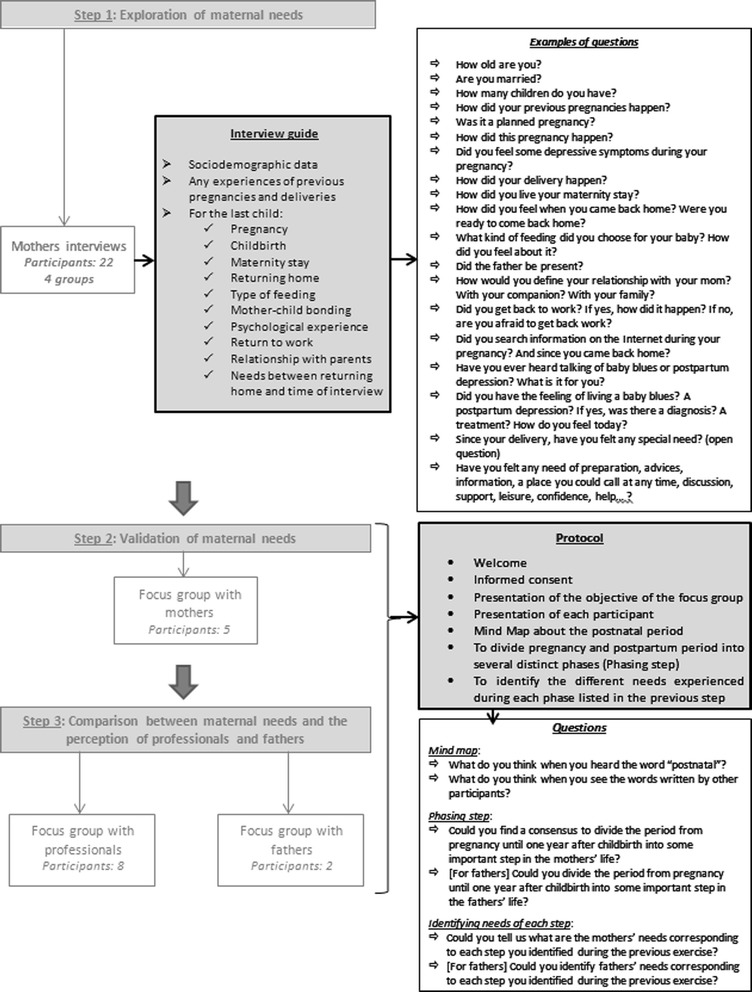
BACKGROUND: Pregnancy and childbirth are two critical stages in a woman's life. Various studies have suggested that psychological distress is common during the year after childbirth. The objectives of this exploratory study were (1) to explore the needs of mothers in the year following childbirth; (2) to compare these needs between mothers who did not have the feeling of living a psychological disorder or a depression and mothers who lived a psychological disorder or had the impression of living a depression; and (3) to compare the needs expressed by mothers with the perception of professionals and fathers about the mothers' needs. METHODS: First, we proceeded to 22 individual qualitative interviews followed by one focus group, with mothers, with and without experience of psychological distress. Then, we conducted 2 focus groups: one with professionals and one with fathers. RESULTS: Needs of mothers after childbirth have been indexed in four categories: need of information, need of psychological support, need to share experience, and need of practical and material support. Women do not feel sufficiently informed about this difficult period of life. They do not feel sufficiently supported, not only from a psychological point of view but also from a more practical point of view, for example with household chores. They need to share their experience of life, they need to be reassured and they need to feel understood. It seems that some differences exist between mothers' and professionals' experiences but also between mothers' and fathers' experiences. CONCLUSION: Young mothers apparently feel a lack of support at different levels in the year following childbirth. This study provides ways to meet women's needs and to try to prevent the risk of postpartum psychological distress during this period of time.
Overview
The claims and statistics of this paper haven’t been checked yet.
Free: it reads the open-access text and checks the first 5 claims that cite a source we can check. Create a free account to check every claim.
Integrity signals
Registry
Cites
Statistics
Figures
Verification
Claims the paper makes
The claims and statistics of this paper haven’t been checked yet.
Free: it reads the open-access text and checks the first 5 claims that cite a source we can check. Create a free account to check every claim.
Claims other papers make about this one
Each is checked against this paper’s own text: does it say what the citing paper says it does?
The source backs part of the claim, not all of it — or backs it for a different population, condition or comparison.
In the citing paper
“Studies state that postnatal care often is so poorly adapted to individual needs that new mothers are unprepared for the physical and psychosocial health problems that can arise [3, 8]”
From Support during the postnatal period: Evaluating new mothers' and midwives' experiences of a new, coordinated postnatal care model in a midwifery clinic in Sweden (2023) · cites this paper as [3]
Experimental — accuracy not yet measuredThe source backs part of the claim, not all of it — or backs it for a different population, condition or comparison.
In the citing paper
“However, many studies have shown that mothers have important physical and emotional needs during the year after childbirth.155,158,160,162–179”
From Consequences of maternal postpartum depression: A systematic review of maternal and infant outcomes (2019) · cites this paper as [162]
Experimental — accuracy not yet measuredThe cited source says what the claim attributes to it.
In the citing paper
“Studies show that pregnant women need to be prepared for the situations and problems that may arise in the postnatal period [1, 3]”
The cited source says what the claim attributes to it.
In the citing paper
“Moreover, they seemed to identify very few unmet needs during the postnatal period, while the mothers tend to feel neglected during this period.162”
From Consequences of maternal postpartum depression: A systematic review of maternal and infant outcomes (2019) · cites this paper as [162]
The cited source says what the claim attributes to it.
In the citing paper
“Nevertheless, one study indicated a discrepancy between professionals’ perceptions of maternal needs and the needs that mothers actually had.162”
From Consequences of maternal postpartum depression: A systematic review of maternal and infant outcomes (2019) · cites this paper as [162]
1 more claim about this paper
Create a free account to see every claim other papers make about this one.
Self-check
Percentages, sums and reported differences re-computed from the paper’s own numbers.
The self-check needs the paper’s full text.
Citations
Cites
The Discovery of Grounded Theory
Glaser, B. G., & Strauss, A. L. (2017) · The Discovery of Grounded Theory · doi:10.4324/9780203793206-1 · Cited by 8,344
Magnitude and risk factors for postpartum symptoms: A literature review
Norhayati, M. N., Nik Hazlina, N. H., Asrenee, A. R., & Wan Emilin, W. M. A. (2015) · Journal of Affective Disorders · doi:10.1016/j.jad.2014.12.041 · Cited by 816 · cited 4×
“1%, with the lowest reported in Germany and the highest in the United States [3, 10].”
BackgroundInfluentialCross-cultural and social diversity of prevalence of postpartum depression and depressive symptoms
Halbreich, U., & Karkun, S. (2006) · Journal of Affective Disorders · doi:10.1016/j.jad.2005.12.051 · Cited by 776 · cited 2×
“1%, with the lowest reported in Germany and the highest in the United States [3, 10].”
BackgroundInfluentialIterative categorization (IC): a systematic technique for analysing qualitative data
Neale, J. (2016) · Addiction · doi:10.1111/add.13314 · Cited by 584
Transition to parenthood: the needs of parents in pregnancy and early parenthood
Deave, T., Johnson, D., & Ingram, J. (2008) · BMC Pregnancy and Childbirth · doi:10.1186/1471-2393-8-30 · Cited by 418
Guedeney, N., & Fermanian, J. (1998) · European Psychiatry · doi:10.1016/s0924-9338(98)80023-0 · Cited by 342
Forster, D. A., McLachlan, H. L., Davey, M.-A., Biro, M. A., Farrell, T., Gold, L., Flood, M., Shafiei, T., & Waldenström, U. (2016) · BMC Pregnancy and Childbirth · doi:10.1186/s12884-016-0798-y · Cited by 251
Forster, D. A., McLachlan, H. L., Rayner, J., Yelland, J., Gold, L., & Rayner, S. (2008) · BMC Pregnancy and Childbirth · doi:10.1186/1471-2393-8-27 · Cited by 193 · cited 2×
“Indeed, women often have a lot of fears and anxieties around the early motherhood and their changing role [4].”
Postpartum Depression: A Review
Patel, M., Bailey, R. K., Jabeen, S., Ali, S., Barker, N. C., & Osiezagha, K. (2012) · Journal of Health Care for the Poor and Underserved · doi:10.1353/hpu.2012.0037 · Cited by 175
Newham, J. J., Wittkowski, A., Hurley, J., Aplin, J. D., & Westwood, M. (2014) · Depression and Anxiety · doi:10.1002/da.22268 · Cited by 167
Research works printed but not linked: 1
- Benahmed N Devos C San Miguel L Vinck I Vankelst L Lauwerier E KCE reports 232B: caring for mothers and newborns after uncomplicated delivery: towards integrated postnatal care 2014
Cited by
Items 101–137 of 137
Izaddoost, N., Parsaie, S., Choobdarnezhad, M., Pezaro, S., & Amiri‐Farahani, L. (2024) · The Open Public Health Journal · doi:10.2174/0118749445342415240910050237
Privação social na transição para a parentalidade
Martins, C. A. (2024) · doi:10.37417/az7vfe39
Pablo, U. C.-S., Vallés, J. E. G., Abad, M. V., de Madrid, U. C., & Solís, F. M. (2024) · doi:10.37417/7a1m4b256
Akbaş, N. B., & Ertürk, D. B. (2025) · Etkili Hemşirelik Dergisi · doi:10.46483/jnef.1620907
Kincaid, S. (2021) · VCU Scholars Compass (Virginia Commonwealth University) · doi:10.25772/89en-zq16
Music therapy as part of postpartum care to support emotional wellbeing
(2024) · UpSpace Institutional Repository (University of Pretoria) · doi:10.25403/upresearchdata.26296567
Alle 25-vuotiaiden haasteet ja tuen tarpeet vanhemmuudessa : kuvaileva kirjallisuuskatsaus
Kivipuro, E., & Pitkälä, K. (2023) · Theseus (Ammattikorkeakoulujen)
The risk factors for developingpostpartum depression : A descriptive literature review
Chen, Y., & Chen, Y. (2025) · DiVA (Digitala Vetenskapliga Arkivet)
Kvinnors upplevelser av förlossningsdepression och stöd från vårdpersonal
Forslin, J., & Karlsson, K. (2024) · Uppsala University Publications (Uppsala University)
The system of medical and psychological support for women at high risk of preterm birh
Grinko, N. (2017) · DSpace BSMU
Malmberg, V., & Nyberg, F. (2021) · Lund University Publications Student Papers (Lund University)
Women’s Experiences of Postpartum Depression : A qualitative literature review
Milosescu, E. L., & Assad, M. (2024) · DiVA (Digitala Vetenskapliga Arkivet)
�뙇�깭�븘 �궛紐⑥쓽 �궛�썑 �슦�슱怨� 嫄닿컯愿�由� �슂援щ룄
�씠��吏� (2018) · YUHSpace (Yonsei University Medical Library)
Kvinnors upplevelser av att leva med postpartumdepression : En deskriptiv litteraturstudie
Alhalabi, B., & Haji Mohamed, S. (2024) · DiVA (University of Gävle)
Curran, H. (2021) · City Research Online (City University London)
Fernandes, D. F. V. (2022) · Portuguese National Funding Agency for Science, Research and Technology (RCAAP Project by FCT)
Sjöstrand, E., & Ekdahl, T. (2024) · DiVA (Linnaeus University)
"Det är så viktigt att se kvinnan bakom depressionen"
Ekberg, A., & Larsson, S. (2024) · DiVA (Mälardalen University College)
Smedman, A., & Öhman, A. (2023) · Publications (Mid Sweden University)
Silva, C. D. S. E. (2025) · Portuguese National Funding Agency for Science, Research and Technology (RCAAP Project by FCT) · doi:10.34626/3h1h-2s44
Ectogenesis, the Value of Pregnancy, and Gender Inequality
Zhou, J. (2025) · Apollo (University of Cambridge) · doi:10.17863/cam.120894
Innovación, tecnología y sociedad
Latorre, P. D. J., Vallés, J. E. G., & Abad, M. V. (2025) · Editorial Comares eBooks · doi:10.55323/9788413804460
Virtanen, S. (2026) · UTUPub (University of Turku)
Personalizing perinatal care for women in vulnerable circumstances
Laureij, L. T. (2025) · EUR Research Repository (Erasmus University Rotterdam)
AKSÜT, G. S. (2026) · Dokuz Eylül Üniversitesi Sosyal Bilimler Enstitüsü Dergisi · doi:10.16953/deusosbil.1528490
Students' Knowledge of Family Planning Methods.
Chodyra, J. (2023) · Lithuanian University of Health Sciences
Walker, L. O., & Murry, N. (2026) · Archives of Psychiatric Nursing · doi:10.1016/j.apnu.2026.152134
Jones‐Hepler, B., Gondwe, K. W., & Brandon, D. (2025) · Advances in Nursing Science · doi:10.1097/ans.0000000000000638
Holla, C., Thomas, B., Kishore, M. T., Prabhu, S. G., & Basavaraju, M. (2026) · Frontiers in Child and Adolescent Psychiatry · doi:10.3389/frcha.2026.1664652
Akpovienehe, E., Odikpo, L. C., & Makata, N. E. (2026) · International Journal of Obstetrics and Gynaecological Nursing · doi:10.33545/26642298.2026.v8.i6a.279
Ssemwanga, N. (2026) · Open University of Cape Town (University of Cape Town)
Jones‐Hepler, B., Brandon, D., Tully, K. P., Stevenson, E., & Docherty, S. L. (2026) · INQUIRY The Journal of Health Care Organization Provision and Financing · doi:10.1177/00469580261480371
Duncanson, K., Jörnvi, A., Ask, S., Högman, M., Vikman, E. B., Ball, R., & Henström, M. (2026) · JMIR Pediatrics and Parenting · doi:10.2196/93565
Online Social Support for Pregnant Women’s Question Resolution and Anxiety Reduction
Tange, S., Nagano, K., & Nishihara, N. (2025) · International Journal for Educational Media and Technology
Leanderz, Å. G., Larsson, M., Henricson, M., Thorstensson, S., & Bäckström, C. (2026) · Reproductive Health · doi:10.1186/s12978-026-02469-9
It takes a village to raise a child: how evolutionary anthropology can inform perinatal psychiatry
Swanepoel, A., Nair, B., & Chaudhary, N. (2026) · The British Journal of Psychiatry · doi:10.1192/bjp.2026.10870
Metadata
- Authors
- Slomian, J., Emonts, P., Vigneron, L., Acconcia, A., Glowacz, F., Reginster, J. Y., Oumourgh, M., & Bruyère, O.
- Affiliations
- University of Liège (BE)
- Centre Hospitalier Universitaire de Liège (BE)
- Corresponding author
- Slomian, J.
- ORCID
- Venue
- BMC Pregnancy and Childbirth
- Published
- 2017-07-03
- Volume
- 17
- Issue
- 1
- Pages
- 213-213
- ISSN
- 1471-2393 (ISSN-L)
- PMC
- PMC5496411
- OpenAlex
- W2733650056
- Semantic Scholar
- 5fbab4d1358fd248e97aa6cdc5807647650cfb94
- Cited by
- 97
- References
- 35
- Citations by year
- 2026: 8 · 2025: 10 · 2024: 13 · 2023: 9 · 2022: 18 · 2021: 18 · 2020: 8 · 2019: 10 · 2018: 2 · 2017: 1
- FWCI
- 5.38
- Type
- journal article
- Language
- en
- Open access
- gold
- doi.org
- Licence
- cc-by
- Locations
- BMC Pregnancy and Childbirth (publishedVersion, cc-by)
- PubMed Central (publishedVersion, cc-by)
- PubMed (publishedVersion)
- ORBi (University of Liège) (submittedVersion, other-oa)
- DOAJ (DOAJ: Directory of Open Access Journals) (submittedVersion, cc-by-sa)
- Topics
- Health Sciences › Medicine › Public Health, Environmental and Occupational Health › Maternal Mental Health During Pregnancy and Postpartum
- Health Sciences › Medicine › Obstetrics and Gynecology › Maternal and Perinatal Health Interventions
- Health Sciences › Medicine › Pediatrics, Perinatology and Child Health › Maternal and Neonatal Healthcare
- Keywords
- postpartum period, maternal needs, postpartum psychological distress, postpartum depression, psychological support, practical support, information needs, experience sharing, fathers' perceptions, health professionals' perceptions, young mothers, postpartum depression prevention
- MeSH terms
- Psychosocial Support Systems, Adult, Fathers, Female, Health Personnel, Humans, Interviews as Topic, Health Knowledge, Attitudes, Practice, Male, Mothers, Perception, Postnatal Care, Social Support, Stress, Psychological, Focus Groups, Depression, Postpartum, Needs Assessment, Qualitative Research, Information Seeking Behavior
About these checks
Registry, retraction, Cites and statistics results are computed, not judged, with one exception: a printed reference that no index lists is read once by a model before it counts as a citation error. Claims are extracted by a model and kept only when their quote appears verbatim in the text; each cited source is then checked, with a model’s help, for whether it says what the claim relies on. Those verdicts can be wrong — read the claim’s quote and the cited source before relying on one.
Statistics and arithmetic are recomputed, not judged.
Confidence bands are shown only for fields calibrated on our annotated test set. None is calibrated yet, so no band is shown.
What counts as a claim ›How we measure confidence ›How we check this ›
Are you an author, or do you see a problem with this page? Request a review
Data sources
Bibliographic data: Semantic Scholar, OpenAlex, Crossref.
Contains information from the Semantic Scholar Academic Graph Datasets, made available under the ODC Attribution License (ODC-BY 1.0).
Semantic Scholar’s data is described in: Kinney, R., et al. (2023). The Semantic Scholar Open Data Platform. arXiv:2301.10140.
