

Treatment resistant depression in women with peripartum depression
Open accessThe DOI matches its Crossref record; 37 of the 37 references it cites were found in a registry or an index.
Abstract
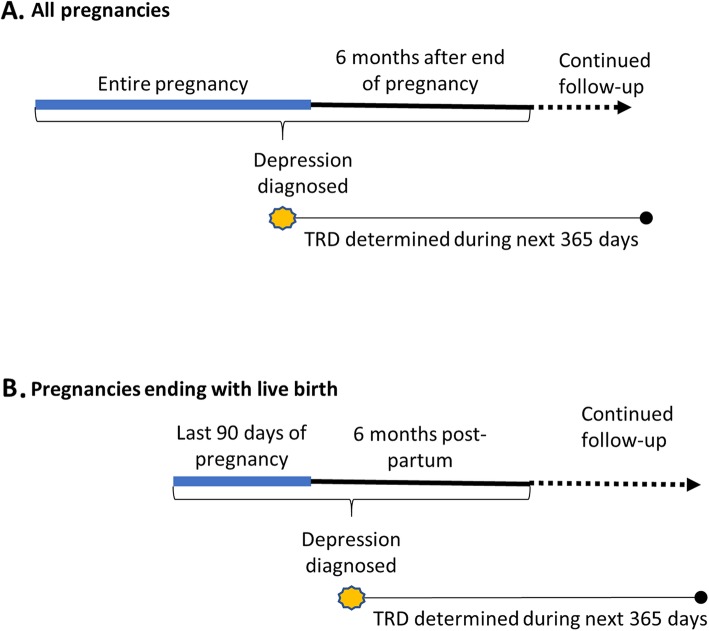
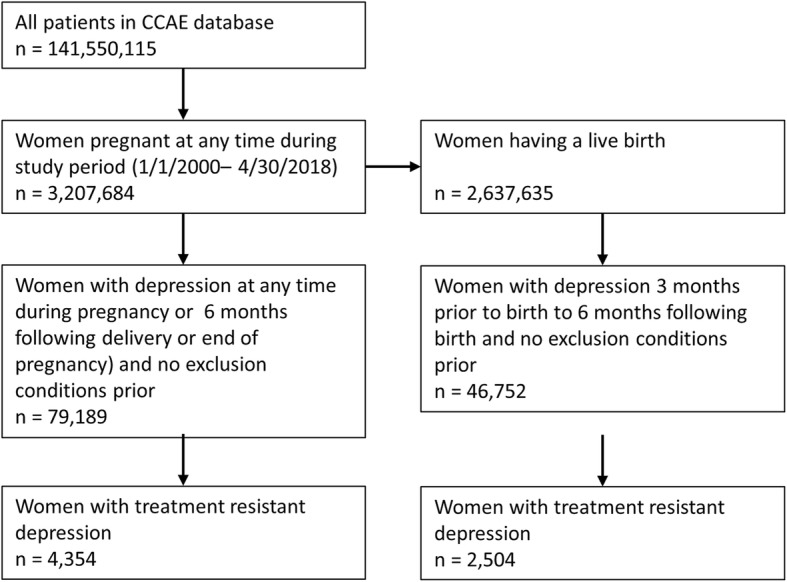
BACKGROUND: Peripartum depression is a leading cause of disease burden for women and yet there is little evidence as to how often peripartum depression does not respond to treatment and becomes treatment resistant depression. We sought to determine the incidence of treatment resistant depression (TRD) in women with peripartum depression. METHODS: Population based retrospective cohort study using a large US claims database. Peripartum depression was defined as having a depression diagnosis during pregnancy or up to 6 months after the end of pregnancy. We included women with prevalent or incident depression. The outcome was the development of TRD within 1 year after the diagnosis of peripartum depression. TRD was defined as having 3 distinct antidepressants or 1 antidepressant and 1 antipsychotic in 1 year. Women with peripartum depression may not be exposed to pharmacological treatments early in pregnancy, therefore we created two groups: 1. women with peripartum depression, and 2. women with peripartum depression diagnosed 3 months before a live birth delivery or within 6 months after that delivery. RESULTS: There were 3,207,684 pregnant women, of whom 2.5% had peripartum depression. Of these women half had incident depression during pregnancy. Five percent of women with peripartum depression developed TRD within 1 year of the depression diagnosis. The risk of developing TRD was 50% higher in women with prevalent depression than in women with incident peripartum depression (P < 0.0001). Results were similar in women with peripartum depression diagnosed later in their pregnancy. Women who went on to develop TRD had more substance use disorders, anxiety, insomnia and painful conditions. CONCLUSIONS: TRD occurs in approximately 5% of women with peripartum depression. The risk of TRD is higher in pregnant women with a history of depression. Women who went on to develop TRD had more psychiatric comorbidities and painful conditions than women who did not.
Overview
The claims and statistics of this paper haven’t been checked yet.
Free: it reads the open-access text and checks the first 5 claims that cite a source we can check. Create a free account to check every claim.
Integrity signals
Registry
Cites
Statistics
Figures
Verification
Claims the paper makes
The claims and statistics of this paper haven’t been checked yet.
Free: it reads the open-access text and checks the first 5 claims that cite a source we can check. Create a free account to check every claim.
Claims other papers make about this one
Each is checked against this paper’s own text: does it say what the citing paper says it does?
The source backs part of the claim, not all of it — or backs it for a different population, condition or comparison.
In the citing paper
“Whether depression during reproductive life events (e.g., peripartum onset depression) is more likely to be treatment- resistant is also not sufficiently established 115 .”
From Treatment‐resistant depression: definition, prevalence, detection, management, and investigational interventions (2023) · cites this paper as [115]
Experimental — accuracy not yet measured
Self-check
Percentages, sums and reported differences re-computed from the paper’s own numbers.
The self-check needs the paper’s full text.
Citations
Cites
Diagnostic and Statistical Manual of Mental Disorders
American Psychiatric Association (2013) · doi:10.1176/appi.books.9780890425596 · Cited by 116,369
Rush, A. J., Trivedi, M. H., Wisniewski, S. R., Nierenberg, A. A., Stewart, J. W., Warden, D., Niederehe, G., Thase, M. E., Lavori, P. W., Lebowitz, B. D., et al. (2006) · American Journal of Psychiatry · doi:10.1176/ajp.2006.163.11.1905 · Cited by 5,643
Perinatal Depression: A Systematic Review of Prevalence and Incidence
Gavin, N. I., Gaynes, B. N., Lohr, K. N., Meltzer-Brody, S., Gartlehner, G., & Swinson, T. (2005) · Obstetrics & Gynecology · doi:10.1097/01.aog.0000183597.31630.db · Cited by 3,282
Antenatal risk factors for postpartum depression: a synthesis of recent literature
Robertson, E., Grace, S., Wallington, T., & Stewart, D. E. (2004) · General Hospital Psychiatry · doi:10.1016/j.genhosppsych.2004.02.006 · Cited by 1,886
Postpartum depression: current status and future directions
O'Hara, M. W., & McCabe, J. E. (2013) · Annual Review of Clinical Psychology · doi:10.1146/annurev-clinpsy-050212-185612 · Cited by 1,750
Epidemiology of Puerperal Psychoses
Kendell, R. E., Chalmers, J. C., & Platz, C. (1987) · British Journal of Psychiatry · doi:10.1192/bjp.150.5.662 · Cited by 1,119
Cohen, L. S. (2006) · JAMA · doi:10.1001/jama.295.5.499 · Cited by 1,031
Daly, E. J., Singh, J. B., Fedgchin, M., Cooper, K., Lim, P., Shelton, R. C., Thase, M. E., Winokur, A., Van Nueten, L., Manji, H., et al. (2018) · JAMA Psychiatry · doi:10.1001/jamapsychiatry.2017.3739 · Cited by 718
Hahn-Holbrook, J., Cornwell-Hinrichs, T., & Anaya, I. (2018) · Frontiers in Psychiatry · doi:10.3389/fpsyt.2017.00248 · Cited by 667 · cited 1×
“Peripartum depression is not only a leading cause of disease burden for women and their families [1], but also has been associated with negative effects on the fetus, infant and young child [2].”
BackgroundImpact of maternal postnatal depression on cognitive development of young children.
Cogill, S. R., Caplan, H. L., Alexandra, H., Robson, K. M., & Kumar, R. (1986) · BMJ · doi:10.1136/bmj.292.6529.1165 · Cited by 580
Cited by
McIntyre, R. S., Alsuwaidan, M., Baune, B. T., Berk, M., Demyttenaere, K., Goldberg, J. F., Gorwood, P., Ho, R., Kasper, S., Kennedy, S. H., et al. (2023) · World Psychiatry · doi:10.1002/wps.21120 · Cited by 836
A unified model of the biology of peripartum depression
Levin, G., & Ein‐Dor, T. (2023) · Translational Psychiatry · doi:10.1038/s41398-023-02439-w · Cited by 53
“, did not respond to at least three different antidepressant treatments or one antidepressant and one antipsychotic treatment within a period of one year [9].”
BackgroundLee, H. J., Kim, S. M., & Kwon, J. Y. (2021) · BMC Pregnancy and Childbirth · doi:10.1186/s12884-021-03600-3 · Cited by 42
Santos, M. L. C., Reis, J. F., Silva, R. D. P., Santos, D. F., & Leite, F. M. C. (2022) · Escola Anna Nery · doi:10.1590/2177-9465-ean-2021-0265 · Cited by 59
Xinzhou, W., Cheng, L., Liu, Y., Zhang, R., Wu, Z., Weng, P., Zhang, P., & Zhang, X. (2022) · Frontiers in Microbiology · doi:10.3389/fmicb.2022.807076 · Cited by 30
Putnick, D. L., Bell, E. M., Ghassabian, A., Mendola, P., Sundaram, R., & Yeung, E. H. (2022) · Journal of Affective Disorders · doi:10.1016/j.jad.2022.12.059 · Cited by 25
Craemer, K. A., Garland, C. E., Sayah, L., Duffecy, J. L., GELLER, S. E., & Maki, P. M. (2023) · General Hospital Psychiatry · doi:10.1016/j.genhosppsych.2023.05.007 · Cited by 15
Postpartum depression: A role for psychedelics?
Jairaj, C., & Rucker, J. (2022) · Journal of Psychopharmacology · doi:10.1177/02698811221093793 · Cited by 17
“With emerging evidence for treatment resistance, there is a need for innovative and efficacious treat-ment for PPD in order to improve wellbeing in the mother– infant dyad (Cepeda et al., 2019).”
BackgroundPharmacokinetics of Ketamine Transfer Into Human Milk
Majdinasab, E. J., Datta, P., Krutsch, K., Baker, T. E., & Hale, T. W. (2023) · Journal of Clinical Psychopharmacology · doi:10.1097/jcp.0000000000001711 · Cited by 14
Welander, N. Z., Mwinyi, J., Asif, S., Schiöth, H. B., Skalkidou, A., & Fransson, E. (2021) · Journal of Affective Disorders · doi:10.1016/j.jad.2021.08.119 · Cited by 13
Millard, S. J., Lum, J. S., Fernandez, F., Weston–Green, K., & Newell, K. A. (2020) · Progress in Neuro-Psychopharmacology and Biological Psychiatry · doi:10.1016/j.pnpbp.2020.110174 · Cited by 12
The Fibrinolytic System in Peripartum Depression
Hoirisch-Clapauch, S. (2022) · Seminars in Thrombosis and Hemostasis · doi:10.1055/s-0042-1756194 · Cited by 7
Ciolac, L., Bernad, E. S., Tudor, A., Nițu, D.-R., Buleu, F. N., Popa, D. I., Toc, T., Haivas, C. C., & Craina, M. L. (2025) · Journal of Clinical Medicine · doi:10.3390/jcm14124286 · Cited by 4
“…depression experience depression that is resistant to treatment within one year of their PPD diagnosis, meaning they remain unresponsive to at least three different antidepressant treatments or a combination therapy involving one antidepressant and one antipsychotic within that year [20].”
Baldaçara, L., Rocha, G. A., Ismael, F., Gomes, I. E. V. E. M., Ribeiro, C. C., Calfat, E. L. D. B., Rosa, C. E., Leite, V. D. S., Barros, M. E. L., Motta, L. S., et al. (2022) · Debates em Psiquiatria · doi:10.25118/2763-9037.2022.v12.389 · Cited by 5
Exploring Psychedelics for Unmet Needs in Women’s Reproductive Health
Shoar, S., Bazinet, A. D., & Jairaj, C. (2025) · Psychedelic Medicine · doi:10.1089/psymed.2024.0033 · Cited by 6
Miller, D. C., Chawla, D., Taber, K. J., Payne, J. L., & Tredici, A. L. D. (2025) · BMC Psychiatry · doi:10.1186/s12888-025-06977-z · Cited by 5
“A similar approach, i.e., considering codes for both PPD and MDD used during the postpartum period as indicative of a PPD diagnosis, has been used by several other claims-based studies [15, 16, 23–25].”
Martínez‐Gras, I., Barba, R. J., Sánchez-Pastor, L., Rubio, G., & Prieto-Montalvo, J. (2021) · Actas Españolas de Psiquiatría · Cited by 3
Risk factors for treatment resistance among women with postpartum depression in a nationwide study
Chen, Y., Bränn, E., Bendix, M., Joyce, E. E., Fransson, E., Lu, Y., Skalkidou, A., & Lu, D. (2026) · Nature Mental Health · doi:10.1038/s44220-026-00587-8 · Cited by 4
“The exclusive report, to our knowledge, a descriptive study in the United States with 3.2 million pregnant women, reported that about 5% of the patients with perinatal depression developed treatment resistance within 1 year 22 .”
InfluentialGriffiths, C., da Silva, K. M., Mobee-Dumi, A., Gill, A. K., & Ibrahim, D. (2025) · Open Journal of Depression · doi:10.4236/ojd.2025.142003 · Cited by 3
Maternal self-efficacy and peripartum depression amidst the COVID-19 pandemic
Ali, N. A., & Nair, M. (2021) · Asian Journal of Psychiatry · doi:10.1016/j.ajp.2021.102736 · Cited by 2
“Peripartum depression is a foremost reason of disease burden among women and their families (Cepeda et al., 2019).”
BackgroundSchwangerschaft und Postpartalzeit
Leutritz, A. L., & Kittel‐Schneider, S. (2022) · Springer eBooks · doi:10.1007/978-3-662-65734-8_30 · Cited by 2
Ein‐Dor, T. (2025) · Springer eBooks · doi:10.1007/978-3-031-73368-0_29 · Cited by 1
Dyndał, K., Pańczyszyn-Trzewik, P., Jakubowska, B., & Sowa-Kućma, M. (2026) · International Journal of Molecular Sciences · doi:10.3390/ijms27052449 · Cited by 2
“Such strategies may be particularly valuable in specific patient populations, including women with peri-partum depression (approximately 5% develop TRD) as well as older adults with MDD, in whom up to half of patients may progress to TRD [83,84].”
Nard, N., Moulier, V., Januel, D., Guillin, O., & Rothärmel, M. (2021) · L Encéphale · doi:10.1016/j.encep.2021.02.020 · Cited by 2
Attachment classification and early adversity predict perinatal partial hospital treatment response
Hart, A., Weiss-Goldman, N., Halpern, J. J., Bennett, F., White, L., Birndorf, C. A., Nortwick, N. V., Osborne, L. M., & Robakis, T. K. (2024) · Journal of Affective Disorders · doi:10.1016/j.jad.2024.09.139 · Cited by 1
Treatment Repetitive Transcranial Magnetic Stimulation to Peripartum Depression: Systematic ReviewPreprint
Lee, H., Kim, S., & Kwon, J. Y. (2020) · Research Square · doi:10.21203/rs.3.rs-52104/v1
“5% of mothers who suffer from treatment resistant depression and these have to choose a different treatment method [86].”
MethodEin‐Dor, T. (2024) · Springer eBooks · doi:10.1007/978-3-031-32035-4_29-1
Challenges in management of treatment-resistant depression
Piech, G. M., & Lis, I. (2024) · Biuletyn Głównej Biblioteki Lekarskiej · doi:10.2478/bgbl-2024-0032
Antidepressants in the treatment of depressive disorder during pregnancy: to treat or not to treat?
Sušilová, L. (2025) · Klinická farmakologie a farmacie · doi:10.36290/far.2025.038
Lee, H. J., Kim, S. M., & Kwon, J. Y. (2021) · Figshare · doi:10.6084/m9.figshare.13843840
Lee, H. J., Kim, S. M., & Kwon, J. Y. (2021) · Figshare · doi:10.6084/m9.figshare.13843843
Metadata
- Authors
- Cepeda, M. S., Kern, D. M., & Nicholson, S.
- Affiliations
- Johnson & Johnson (United States) (US)
- Corresponding author
- Cepeda, M. Soledad
- Venue
- BMC Pregnancy and Childbirth
- Published
- 2019-09-02
- Volume
- 19
- Issue
- 1
- Pages
- 323-323
- ISSN
- 1471-2393 (ISSN-L)
- PMC
- PMC6721276
- OpenAlex
- W2971817732
- Cited by
- 31
- References
- 37
- Citations by year
- 2026: 2 · 2025: 6 · 2024: 3 · 2023: 4 · 2022: 7 · 2021: 7 · 2020: 2
- FWCI
- 3.68
- Type
- journal article
- Language
- en
- Open access
- gold
- doi.org
- Licence
- cc-by
- creativecommons.org/licenses/by/4.0/ (tdm)
- creativecommons.org/licenses/by/4.0/ (vor)
- Locations
- BMC Pregnancy and Childbirth (publishedVersion, cc-by)
- PubMed Central (publishedVersion, cc-by)
- PubMed (publishedVersion)
- DOAJ (DOAJ: Directory of Open Access Journals) (submittedVersion, cc-by-sa)
- Topics
- Health Sciences › Medicine › Public Health, Environmental and Occupational Health › Maternal Mental Health During Pregnancy and Postpartum
- Health Sciences › Medicine › Pharmacology (medical) › Treatment of Major Depression
- Social Sciences › Psychology › Clinical Psychology › Personality Disorders and Psychopathology
- Keywords
- treatment-resistant depression, perinatal depression, pregnancy, antidepressant treatment, antipsychotic drugs, depression incidence, psychiatric comorbidity, substance use disorders, insomnia, pain conditions, maternal mental health
- MeSH terms
- Adolescent, Adult, Antidepressive Agents, Anxiety Disorders, Female, Humans, Sleep Initiation and Maintenance Disorders, Middle Aged, Pain, Pregnancy, Pregnancy Complications, Retrospective Studies, Antipsychotic Agents, United States, Cohort Studies, Comorbidity, Incidence, Prevalence, Depression, Postpartum, Young Adult, Peripartum Period, Depressive Disorder, Treatment-Resistant
About these checks
Registry, retraction, Cites and statistics results are computed, not judged, with one exception: a printed reference that no index lists is read once by a model before it counts as a citation error. Claims are extracted by a model and kept only when their quote appears verbatim in the text; each cited source is then checked, with a model’s help, for whether it says what the claim relies on. Those verdicts can be wrong — read the claim’s quote and the cited source before relying on one.
Statistics and arithmetic are recomputed, not judged.
Confidence bands are shown only for fields calibrated on our annotated test set. None is calibrated yet, so no band is shown.
What counts as a claim ›How we measure confidence ›How we check this ›
Are you an author, or do you see a problem with this page? Request a review
Data sources
Bibliographic data: Semantic Scholar, OpenAlex, Crossref.
Contains information from the Semantic Scholar Academic Graph Datasets, made available under the ODC Attribution License (ODC-BY 1.0).
Semantic Scholar’s data is described in: Kinney, R., et al. (2023). The Semantic Scholar Open Data Platform. arXiv:2301.10140.
