

Treatment resistant depression in women with peripartum depression
Open accessThe DOI matches its Crossref record; 37 of the 37 references it cites were found in a registry or an index.
Abstract
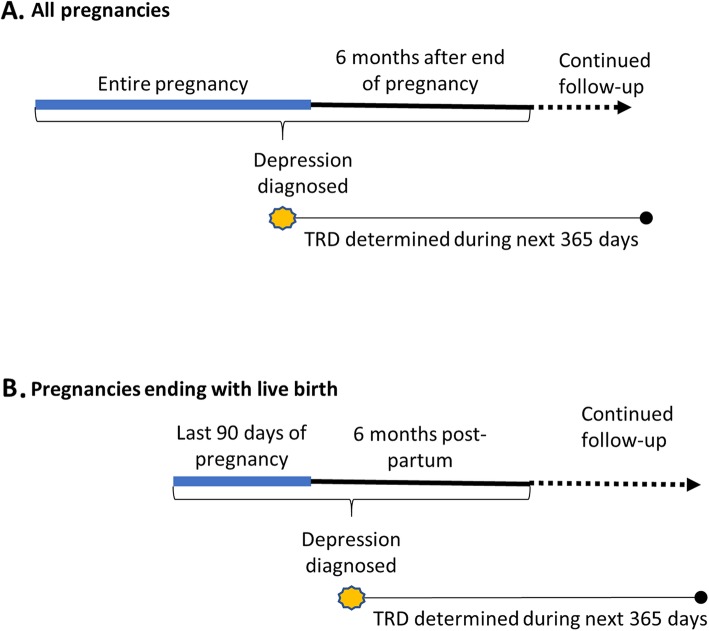
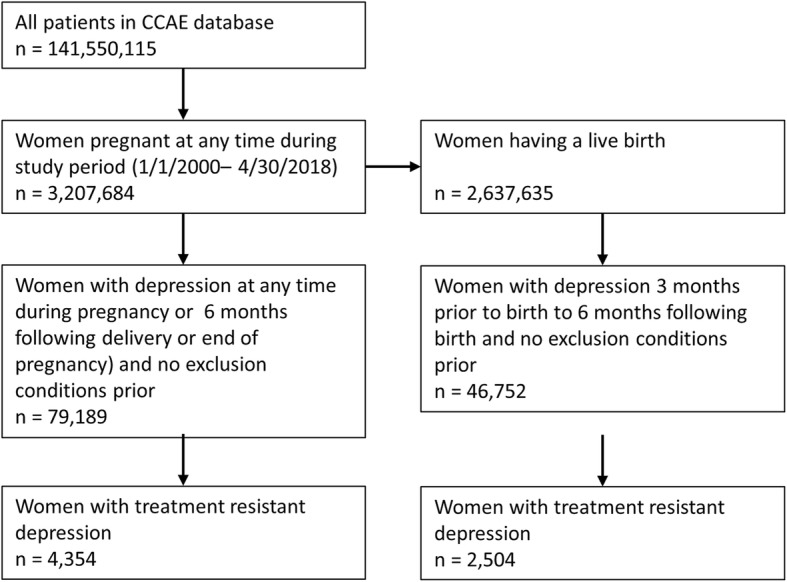
BACKGROUND: Peripartum depression is a leading cause of disease burden for women and yet there is little evidence as to how often peripartum depression does not respond to treatment and becomes treatment resistant depression. We sought to determine the incidence of treatment resistant depression (TRD) in women with peripartum depression. METHODS: Population based retrospective cohort study using a large US claims database. Peripartum depression was defined as having a depression diagnosis during pregnancy or up to 6 months after the end of pregnancy. We included women with prevalent or incident depression. The outcome was the development of TRD within 1 year after the diagnosis of peripartum depression. TRD was defined as having 3 distinct antidepressants or 1 antidepressant and 1 antipsychotic in 1 year. Women with peripartum depression may not be exposed to pharmacological treatments early in pregnancy, therefore we created two groups: 1. women with peripartum depression, and 2. women with peripartum depression diagnosed 3 months before a live birth delivery or within 6 months after that delivery. RESULTS: There were 3,207,684 pregnant women, of whom 2.5% had peripartum depression. Of these women half had incident depression during pregnancy. Five percent of women with peripartum depression developed TRD within 1 year of the depression diagnosis. The risk of developing TRD was 50% higher in women with prevalent depression than in women with incident peripartum depression (P < 0.0001). Results were similar in women with peripartum depression diagnosed later in their pregnancy. Women who went on to develop TRD had more substance use disorders, anxiety, insomnia and painful conditions. CONCLUSIONS: TRD occurs in approximately 5% of women with peripartum depression. The risk of TRD is higher in pregnant women with a history of depression. Women who went on to develop TRD had more psychiatric comorbidities and painful conditions than women who did not.
Overview
The claims and statistics of this paper haven’t been checked yet.
Free: it reads the open-access text and checks the first 5 claims that cite a source we can check. Create a free account to check every claim.
Integrity signals
Registry
Cites
Statistics
Figures
Verification
Claims the paper makes
The claims and statistics of this paper haven’t been checked yet.
Free: it reads the open-access text and checks the first 5 claims that cite a source we can check. Create a free account to check every claim.
Claims other papers make about this one
Each is checked against this paper’s own text: does it say what the citing paper says it does?
The source backs part of the claim, not all of it — or backs it for a different population, condition or comparison.
In the citing paper
“Whether depression during reproductive life events (e.g., peripartum onset depression) is more likely to be treatment- resistant is also not sufficiently established 115 .”
From Treatment‐resistant depression: definition, prevalence, detection, management, and investigational interventions (2023) · cites this paper as [115]
Experimental — accuracy not yet measured
Self-check
Percentages, sums and reported differences re-computed from the paper’s own numbers.
The self-check needs the paper’s full text.
Citations
Cites
Diagnostic and Statistical Manual of Mental Disorders
American Psychiatric Association (2013) · doi:10.1176/appi.books.9780890425596 · Cited by 116,369
Rush, A. J., Trivedi, M. H., Wisniewski, S. R., Nierenberg, A. A., Stewart, J. W., Warden, D., Niederehe, G., Thase, M. E., Lavori, P. W., Lebowitz, B. D., et al. (2006) · American Journal of Psychiatry · doi:10.1176/ajp.2006.163.11.1905 · Cited by 5,643
Perinatal Depression: A Systematic Review of Prevalence and Incidence
Gavin, N. I., Gaynes, B. N., Lohr, K. N., Meltzer-Brody, S., Gartlehner, G., & Swinson, T. (2005) · Obstetrics & Gynecology · doi:10.1097/01.aog.0000183597.31630.db · Cited by 3,282
Antenatal risk factors for postpartum depression: a synthesis of recent literature
Robertson, E., Grace, S., Wallington, T., & Stewart, D. E. (2004) · General Hospital Psychiatry · doi:10.1016/j.genhosppsych.2004.02.006 · Cited by 1,886
Postpartum depression: current status and future directions
O'Hara, M. W., & McCabe, J. E. (2013) · Annual Review of Clinical Psychology · doi:10.1146/annurev-clinpsy-050212-185612 · Cited by 1,750
Epidemiology of Puerperal Psychoses
Kendell, R. E., Chalmers, J. C., & Platz, C. (1987) · British Journal of Psychiatry · doi:10.1192/bjp.150.5.662 · Cited by 1,119
Cohen, L. S. (2006) · JAMA · doi:10.1001/jama.295.5.499 · Cited by 1,031
Daly, E. J., Singh, J. B., Fedgchin, M., Cooper, K., Lim, P., Shelton, R. C., Thase, M. E., Winokur, A., Van Nueten, L., Manji, H., et al. (2018) · JAMA Psychiatry · doi:10.1001/jamapsychiatry.2017.3739 · Cited by 718
Hahn-Holbrook, J., Cornwell-Hinrichs, T., & Anaya, I. (2018) · Frontiers in Psychiatry · doi:10.3389/fpsyt.2017.00248 · Cited by 667 · cited 1×
“Peripartum depression is not only a leading cause of disease burden for women and their families [1], but also has been associated with negative effects on the fetus, infant and young child [2].”
BackgroundImpact of maternal postnatal depression on cognitive development of young children.
Cogill, S. R., Caplan, H. L., Alexandra, H., Robson, K. M., & Kumar, R. (1986) · BMJ · doi:10.1136/bmj.292.6529.1165 · Cited by 580
The Perinatal Depression Treatment Cascade: Baby Steps Toward Improving Outcomes
Cox, E. Q., Sowa, N. A., Meltzer-Brody, S. E., & Gaynes, B. N. (2016) · The Journal of Clinical Psychiatry · doi:10.4088/jcp.15r10174 · Cited by 426
The impact of maternal depression on familial relationships
Burke, L. (2003) · International Review of Psychiatry · doi:10.1080/09540260305192 · Cited by 382
Trends in postpartum depressive symptoms- 27 States, 2004, 2008, and 2012
Ko, J. Y., Rockhill, K. M., Tong, V. T., Morrow, B., & Farr, S. L. (2017) · MMWR. Morbidity and Mortality Weekly Report · doi:10.15585/mmwr.mm6606a1 · Cited by 334
Putnam, K. T., Wilcox, M., Robertson-Blackmore, E., Sharkey, K., Bergink, V., Munk-Olsen, T., Deligiannidis, K. M., Payne, J., Altemus, M., Newport, J., et al. (2017) · The Lancet Psychiatry · doi:10.1016/s2215-0366(17)30136-0 · Cited by 308
Berlim, M. T., & Turecki, G. (2007) · European Neuropsychopharmacology · doi:10.1016/j.euroneuro.2007.03.009 · Cited by 249
Conway, C. R., George, M. S., & Sackeim, H. A. (2017) · JAMA Psychiatry · doi:10.1001/jamapsychiatry.2016.2586 · Cited by 244
The Impact of Antenatal Depression on Perinatal Outcomes in Australian Women
Eastwood, J., Ogbo, F. A., Hendry, A., Noble, J., Page, A., & for the Early Years Research Group (EYRG) (2017) · PLOS ONE · doi:10.1371/journal.pone.0169907 · Cited by 199
Solberg, L. I., Engebretson, K. I., Sperl-Hillen, J. M., Hroscikoski, M. C., & O'Connor, P. J. (2006) · American Journal of Medical Quality · doi:10.1177/1062860606288243 · Cited by 167
Flynn, H. A., Blow, F. C., & Marcus, S. M. (2006) · General Hospital Psychiatry · doi:10.1016/j.genhosppsych.2006.04.002 · Cited by 158
The Cost Consequences of Treatment-Resistant Depression
Russell, J. M., Hawkins, K., Ozminkowski, R. J., Orsini, L., Crown, W. H., Kennedy, S., Finkelstein, S., Berndt, E., & Rush, A. J. (2004) · The Journal of Clinical Psychiatry · doi:10.4088/jcp.v65n0309 · Cited by 117
Inferring pregnancy episodes and outcomes within a network of observational databases
Matcho, A., Ryan, P. B., Fife, D., Gifkins, D., Knoll, C., & Friedman, A. (2018) · PLoS ONE · doi:10.1371/journal.pone.0192033 · Cited by 111
Finding factors that predict treatment-resistant depression: results of a cohort study
Cepeda, M. S., Reps, J., & Ryan, P. (2018) · Depression and Anxiety · doi:10.1002/da.22774 · Cited by 80 · cited 3×
“Women with bipolar disorder were excluded because when TRD is studied and defined this type of depression is often excluded [19, 20].”
BackgroundMethodSelf-citationReich, C., Ryan, P. B., Stang, P., & Rocca, M. (2012) · Journal of Biomedical Informatics · doi:10.1016/j.jbi.2012.05.002 · Cited by 74
Pharmacological Approaches for Treatment-resistant Bipolar Disorder
Poon, S. H., Sim, K., & Baldessarini, R. J. (2015) · Current Neuropharmacology · doi:10.2174/1570159x13666150630171954 · Cited by 74
Antidepressant Use During Pregnancy: Current Controversies and Treatment Strategies
PAYNE, J. L., & MELTZER-BRODY, S. (2009) · Clinical Obstetrics & Gynecology · doi:10.1097/grf.0b013e3181b52e20 · Cited by 64
Antecedent Trauma Exposure and Risk of Depression in the Perinatal Period
Robertson-Blackmore, E., Putnam, F. W., Rubinow, D. R., Matthieu, M., Hunn, J. E., Putnam, K. T., Moynihan, J. A., & O’Connor, T. G. (2013) · The Journal of Clinical Psychiatry · doi:10.4088/jcp.13m08364 · Cited by 62
Definition of Treatment-Resistant Depression in the Medicare Population
Bradley N. Gaynes, M. D., Gary Asher, M. D., Gerald Gartlehner, M. D., Valerie Hoffman, P. D., Josh Green, B. A., Erin Boland, M. S. P. H., Linda Lux, M. P. A., Charlotte Randolph, B. A., Carla Bann, P. D., Emmanuel Cokker-Schwimmer, M. P. H., et al. (2018) · Systematic Review Data Repository · doi:10.26300/4j7h-jk02 · Cited by 58
Pharmacologic Treatment of Dimensional Anxious Depression: A Review
Ionescu, D. F., Niciu, M. J., Richards, E. M., & Zarate, C. A. (2014) · The Primary Care Companion For CNS Disorders · doi:10.4088/pcc.13r01621 · Cited by 56
Cepeda, M. S., Reps, J., Fife, D., Blacketer, C., Stang, P., & Ryan, P. (2018) · Depression and Anxiety · doi:10.1002/da.22705 · Cited by 50
Self-citationAntidepressant Treatment for Postnatal Depression
Molyneaux, E., Trevillion, K., & Howard, L. M. (2015) · JAMA · doi:10.1001/jama.2015.2276 · Cited by 46
Suri, R., Stowe, Z. N., Cohen, L. S., Newport, D. J., Burt, V. K., Aquino-Elias, A. R., Knight, B. T., Mintz, J., & Altshuler, L. L. (2017) · The Journal of Clinical Psychiatry · doi:10.4088/jcp.15m10427 · Cited by 38
Trends in Postpartum Depressive Symptoms
Hunt, S. (2017) · Nursing for Women s Health · doi:10.1016/s1751-4851(17)30144-7 · Cited by 26
Fife, D., Reps, J., Cepeda, M. S., Stang, P., Blacketer, M., & Singh, J. (2018) · Heliyon · doi:10.1016/j.heliyon.2018.e00707 · Cited by 22
Self-citationInsomnia, postpartum depression and estradiol in women after delivery
Drozdowicz, E., Skalski, M., Gdańska, P., Mach, A., Januszko, P., Nowak, R. J., Węgrzyn, P., Wielgoś, M., & Radziwoń-Zaleska, M. (2017) · Metabolic Brain Disease · doi:10.1007/s11011-017-0079-0 · Cited by 21
Halter, M. J., Rolin-Kenny, D., & Grund, F. J. (2013) · Journal of Psychosocial Nursing and Mental Health Services · doi:10.3928/02793695-20130226-03 · Cited by 6
Bipolar mood disorder and treatment-resistant depression
RYBAKOWSKI, J. K. (2010) · Annals of General Psychiatry · doi:10.1186/1744-859x-9-s1-s14 · Cited by 2
Decline in Postpartum Depression
(2017) · JAMA · doi:10.1001/jama.2017.2008 · Cited by 1
Cited by
McIntyre, R. S., Alsuwaidan, M., Baune, B. T., Berk, M., Demyttenaere, K., Goldberg, J. F., Gorwood, P., Ho, R., Kasper, S., Kennedy, S. H., et al. (2023) · World Psychiatry · doi:10.1002/wps.21120 · Cited by 836
A unified model of the biology of peripartum depression
Levin, G., & Ein‐Dor, T. (2023) · Translational Psychiatry · doi:10.1038/s41398-023-02439-w · Cited by 53
“, did not respond to at least three different antidepressant treatments or one antidepressant and one antipsychotic treatment within a period of one year [9].”
BackgroundLee, H. J., Kim, S. M., & Kwon, J. Y. (2021) · BMC Pregnancy and Childbirth · doi:10.1186/s12884-021-03600-3 · Cited by 42
Santos, M. L. C., Reis, J. F., Silva, R. D. P., Santos, D. F., & Leite, F. M. C. (2022) · Escola Anna Nery · doi:10.1590/2177-9465-ean-2021-0265 · Cited by 59
Xinzhou, W., Cheng, L., Liu, Y., Zhang, R., Wu, Z., Weng, P., Zhang, P., & Zhang, X. (2022) · Frontiers in Microbiology · doi:10.3389/fmicb.2022.807076 · Cited by 30
Metadata
- Authors
- Cepeda, M. S., Kern, D. M., & Nicholson, S.
- Affiliations
- Johnson & Johnson (United States) (US)
- Corresponding author
- Cepeda, M. Soledad
- Venue
- BMC Pregnancy and Childbirth
- Published
- 2019-09-02
- Volume
- 19
- Issue
- 1
- Pages
- 323-323
- ISSN
- 1471-2393 (ISSN-L)
- PMC
- PMC6721276
- OpenAlex
- W2971817732
- Cited by
- 31
- References
- 37
- Citations by year
- 2026: 2 · 2025: 6 · 2024: 3 · 2023: 4 · 2022: 7 · 2021: 7 · 2020: 2
- FWCI
- 3.68
- Type
- journal article
- Language
- en
- Open access
- gold
- doi.org
- Licence
- cc-by
- creativecommons.org/licenses/by/4.0/ (tdm)
- creativecommons.org/licenses/by/4.0/ (vor)
- Locations
- BMC Pregnancy and Childbirth (publishedVersion, cc-by)
- PubMed Central (publishedVersion, cc-by)
- PubMed (publishedVersion)
- DOAJ (DOAJ: Directory of Open Access Journals) (submittedVersion, cc-by-sa)
- Topics
- Health Sciences › Medicine › Public Health, Environmental and Occupational Health › Maternal Mental Health During Pregnancy and Postpartum
- Health Sciences › Medicine › Pharmacology (medical) › Treatment of Major Depression
- Social Sciences › Psychology › Clinical Psychology › Personality Disorders and Psychopathology
- Keywords
- treatment-resistant depression, perinatal depression, pregnancy, antidepressant treatment, antipsychotic drugs, depression incidence, psychiatric comorbidity, substance use disorders, insomnia, pain conditions, maternal mental health
- MeSH terms
- Adolescent, Adult, Antidepressive Agents, Anxiety Disorders, Female, Humans, Sleep Initiation and Maintenance Disorders, Middle Aged, Pain, Pregnancy, Pregnancy Complications, Retrospective Studies, Antipsychotic Agents, United States, Cohort Studies, Comorbidity, Incidence, Prevalence, Depression, Postpartum, Young Adult, Peripartum Period, Depressive Disorder, Treatment-Resistant
About these checks
Registry, retraction, Cites and statistics results are computed, not judged, with one exception: a printed reference that no index lists is read once by a model before it counts as a citation error. Claims are extracted by a model and kept only when their quote appears verbatim in the text; each cited source is then checked, with a model’s help, for whether it says what the claim relies on. Those verdicts can be wrong — read the claim’s quote and the cited source before relying on one.
Statistics and arithmetic are recomputed, not judged.
Confidence bands are shown only for fields calibrated on our annotated test set. None is calibrated yet, so no band is shown.
What counts as a claim ›How we measure confidence ›How we check this ›
Are you an author, or do you see a problem with this page? Request a review
Data sources
Bibliographic data: Semantic Scholar, OpenAlex, Crossref.
Contains information from the Semantic Scholar Academic Graph Datasets, made available under the ODC Attribution License (ODC-BY 1.0).
Semantic Scholar’s data is described in: Kinney, R., et al. (2023). The Semantic Scholar Open Data Platform. arXiv:2301.10140.
