

Well-being in high-risk pregnancy: an integrative review
Open accessPublished version of a preprint
The DOI matches its Crossref record; 117 of the 120 references it cites were found in a registry or an index.
Abstract
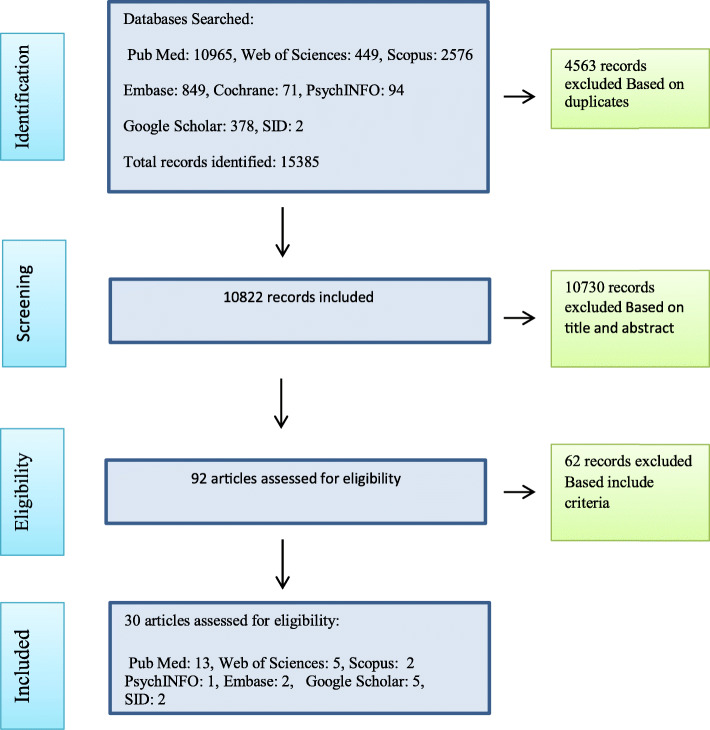
Background: A prerequisite to the interventions for well-being improvement in high-risk pregnancy (HRP) is to make the concept clear, objective, and measurable. Despite the wealth of studies into the concept of well-being in HRP, there is no clear definition for it. This study aimed to explore the concept of well-being in HRP. Methods: This integrative review was conducted using the Whittemore and Knafl’s approach. A literature search was done without any data limitation in dictionaries, thesauruses, encyclopedias, well-being-related textbooks, midwifery, psychology, and mental health journals, and Iranian and international databases. The most primary inclusion criterion was relevance to well-being in HRP. The full-texts of all these articles were assessed using the checklists of the Joanna Briggs Institute. Data were analyzed through the constant comparison method and were managed using the MAXQDA 10 software. Meaning units were identified and coded. The codes were grouped into subcategories and categories according to the attributes, antecedents, and consequences of well-being in HRP. Results: Thirty articles were included in the review, from which 540 codes were extracted. The codes were grouped into seven main attributes, eight main antecedents, and five main consequences of well-being in HRP. The four unique dimensions of well-being in HRP are physical, mental-emotional, social, and spiritual well-being. These dimensions differentiate well-being in HRP from well-being in low-risk pregnancy and in non-pregnancy conditions. Conclusion: As a complex and multidimensional concept, well-being in HRP refers to the pregnant woman’s evaluation of her life during HRP. It includes physical, hedonic, and eudaimonic components. The assessment of well-being in HRP should include all these components.
Overview
The claims and statistics of this paper haven’t been checked yet.
Free: it reads the open-access text and checks the first 5 claims that cite a source we can check. Create a free account to check every claim.
Integrity signals
Registry
Cites
Statistics
Figures
Verification
Claims the paper makes
The claims and statistics of this paper haven’t been checked yet.
Free: it reads the open-access text and checks the first 5 claims that cite a source we can check. Create a free account to check every claim.
Claims other papers make about this one
Each is checked against this paper’s own text: does it say what the citing paper says it does?
The source backs part of the claim, not all of it — or backs it for a different population, condition or comparison.
In the citing paper
“Thus, it can lead to inadequate prenatal care, shortened gestational periods, structural fetal abnormalities, and the birth of low-birthweight infants, among other obstetric complications [20, 21].”
From High-risk Pregnancy Nursing: Analyzing the Impact of Prenatal Stress, Maternal-Fetal Attachment, and Social Support on Prenatal Depression (2024) · cites this paper as [21]
Experimental — accuracy not yet measured
Self-check
Percentages, sums and reported differences re-computed from the paper’s own numbers.
The self-check needs the paper’s full text.
Citations
Cites
The satisfaction with life scale
Diener, E., Emmons, R. A., Larsen, R. J., & Griffin, S. (1985) · Journal of Personality Assessment · doi:10.1207/s15327752jpa4901_13 · Cited by 31,768
Liberati, A., Altman, D. G., Tetzlaff, J., Mulrow, C., Gøtzsche, P. C., Ioannidis, J. P. A., Clarke, M., Devereaux, P. J., Kleijnen, J., & Moher, D. (2009) · PLoS Medicine · doi:10.1371/journal.pmed.1000100 · Cited by 28,164
Happiness is everything, or is it? Explorations on the meaning of psychological well-being.
Ryff, C. D. (1989) · Journal of Personality and Social Psychology · doi:10.1037/0022-3514.57.6.1069 · Cited by 14,847
On Happiness and Human Potentials: A Review of Research on Hedonic and Eudaimonic Well-Being
Ryan, R. M., & Deci, E. L. (2001) · Annual Review of Psychology · doi:10.1146/annurev.psych.52.1.141 · Cited by 11,567
Diener, E. (1984) · Psychological Bulletin · doi:10.1037/0033-2909.95.3.542 · Cited by 11,023
Diener, E. (2009) · Social Indicators Research Series · doi:10.1007/978-90-481-2350-6_2 · Cited by 10,950
Liberati, A., Altman, D. G., Tetzlaff, J., Mulrow, C., Gøtzsche, P. C., Ioannidis, J. P. A., Clarke, M., Devereaux, P. J., Kleijnen, J., & Moher, D. (2009) · Annals of Internal Medicine · doi:10.7326/0003-4819-151-4-200908180-00136 · Cited by 10,349
The structure of psychological well-being revisited.
Ryff, C. D., & Keyes, C. L. M. (1995) · Journal of Personality and Social Psychology · doi:10.1037//0022-3514.69.4.719 · Cited by 10,285
The integrative review: updated methodology
Whittemore, R., & Knafl, K. (2005) · Journal of Advanced Nursing · doi:10.1111/j.1365-2648.2005.03621.x · Cited by 10,241
Взаимосвязь статуса занятости и пола с уровнем психологического благополучия
М.Р., Н., & С.И., Б. (2026) · Cifra LLC Journals · doi:10.60797/irj.2026.170.43 · Cited by 7,950
Research works printed but not linked: 3
- WMhasow-b mheaM. Mental health: a state of well-being [cited Mental health: a state of well-being]. Mental health: a state of well-being 2018
- Broome ME Integrative literature reviews for the development of concepts. Concept development in nursing: foundations, techniques and applications 2000 Philadelphia WB Saunders Company 231 250
- Amorim TV Souza ÍEO Moura M Vasconcelos A ABA Q Salimena AMO Nursing care perspectives in high-risk pregnancy: integrative review Enfermería Glob 2017 16 2 530 543
Cited by
Neonates at Risk: Understanding the Impact of High-Risk Pregnancies on Neonatal Health
Sokou, R., Lianou, A., Lampridou, M., Panagiotounakou, P., Kafalidis, G., Paliatsiou, S., Volaki, P., Tsantes, A. G., Boutsikou, Τ., Iliodromiti, Z., et al. (2025) · Medicina · doi:10.3390/medicina61061077 · Cited by 65
“These conditions significantly contribute to elevated perinatal mortality and are linked to neurodevelopmental disorders and increased risk of chronic diseases in adult life [1,2].”
Yaseen, I., & Rather, R. A. (2024) · International Journal of Women s Health · doi:10.2147/ijwh.s454127 · Cited by 54
Mirzakhani, K., Shoorab, N. J., Akbari, A., & Khadivzadeh, T. (2022) · BMC Pregnancy and Childbirth · doi:10.1186/s12884-022-04676-1 · Cited by 48
“According to research, coping strategies, reliance on spirituality, and risk-control behaviors during pregnancy are all prerequisites for well-being in high risk pregnancy [47].”
BackgroundSelf-citationCoronel-Santos, M. A., & Rodríguez-Macías, J. C. (2022) · Frontiers in Sociology · doi:10.3389/fsoc.2022.978804 · Cited by 24
“…(2017) X X Luijten et al. (2019) X X Lupano-Perugini et al. (2017) X X McFadden et al. (2021) X X Mehrotra and Swami (2018) X Mesurado et al. (2021) X Mirzakhani et al. (2020) X X Na and Lim (2020) X Noorbala et al. (2012) X X Pawar (2016) X Pellerin and Raufaste (2020) X Petrič and Zupančič…”
BackgroundAspectos psicossociais da gestação de alto risco: Análise de mulheres grávidas hospitalizadas
de Carvalho, L. L., Fernandes, N. D. S., Fernandes, N. M. D. S., & Grincenkov, F. R. D. S. (2021) · Psico · doi:10.15448/1980-8623.2021.4.36341 · Cited by 58
Metadata
- Authors
- Mirzakhani, K., Ebadi, A., Faridhosseini, F., & Khadivzadeh, T.
- Affiliations
- Mashhad University of Medical Sciences (IR)
- Baqiyatallah University of Medical Sciences (IR)
- Corresponding author
- Khadivzadeh, Talaat
- Venue
- BMC Pregnancy and Childbirth
- Published
- 2020-09-11
- Volume
- 20
- Issue
- 1
- Pages
- 526-526
- ISSN
- 1471-2393 (ISSN-L)
- PMC
- PMC7488451
- OpenAlex
- W3084138861
- Cited by
- 93
- References
- 120
- Citations by year
- 2026: 10 · 2025: 28 · 2024: 19 · 2023: 13 · 2022: 18 · 2021: 4 · 2020: 1
- FWCI
- 1.50
- Type
- journal article
- Language
- en
- Open access
- gold
- doi.org
- Licence
- cc-by
- creativecommons.org/licenses/by/4.0 (tdm)
- creativecommons.org/licenses/by/4.0 (vor)
- Locations
- BMC Pregnancy and Childbirth (publishedVersion, cc-by)
- Research Square (acceptedVersion, cc-by)
- PubMed Central (publishedVersion, cc-by)
- PubMed (publishedVersion)
- DOAJ (DOAJ: Directory of Open Access Journals) (submittedVersion, cc-by-sa)
- Funders
- Vice Chancellor for Research in Mashhad University of Medical Sciences (970007)
- Topics
- Health Sciences › Medicine › Public Health, Environmental and Occupational Health › Maternal Mental Health During Pregnancy and Postpartum
- Health Sciences › Medicine › Obstetrics and Gynecology › Maternal and Perinatal Health Interventions
- Social Sciences › Psychology › Social Psychology › Psychological Well-being and Life Satisfaction
- Keywords
- well-being, high-risk pregnancy, conceptual analysis, physical well-being, social well-being, spiritual well-being, hedonic well-being, eudaimonic well-being, pregnant women
- MeSH terms
- Female, Health Status, Humans, Pregnancy, Quality of Life, Pregnancy, High-Risk
About these checks
Registry, retraction, Cites and statistics results are computed, not judged, with one exception: a printed reference that no index lists is read once by a model before it counts as a citation error. Claims are extracted by a model and kept only when their quote appears verbatim in the text; each cited source is then checked, with a model’s help, for whether it says what the claim relies on. Those verdicts can be wrong — read the claim’s quote and the cited source before relying on one.
Statistics and arithmetic are recomputed, not judged.
Confidence bands are shown only for fields calibrated on our annotated test set. None is calibrated yet, so no band is shown.
What counts as a claim ›How we measure confidence ›How we check this ›
Are you an author, or do you see a problem with this page? Request a review
How to cite
Cite CoChat for the checks on this page, and the paper for its own findings.
- This page
- CoChat. (2026). Citation check: Well-being in high-risk pregnancy: an integrative review. https://app.cochat.ai/papers/10.1186/s12884-020-03190-6
- The paper
- Mirzakhani, K., Ebadi, A., Faridhosseini, F., & Khadivzadeh, T. (2020). Well-being in high-risk pregnancy: an integrative review. BMC Pregnancy and Childbirth. https://doi.org/10.1186/s12884-020-03190-6
Data sources
Bibliographic data: Semantic Scholar, OpenAlex, Crossref.
Contains information from the Semantic Scholar Academic Graph Datasets, made available under the ODC Attribution License (ODC-BY 1.0).
Semantic Scholar’s data is described in: Kinney, R., et al. (2023). The Semantic Scholar Open Data Platform. arXiv:2301.10140.
