

The DOI matches its Crossref record; 29 of the 35 references it cites were found in a registry or an index.
Cannabis exposure and risk of testicular cancer: a systematic review and meta-analysis
Open accessAbstract
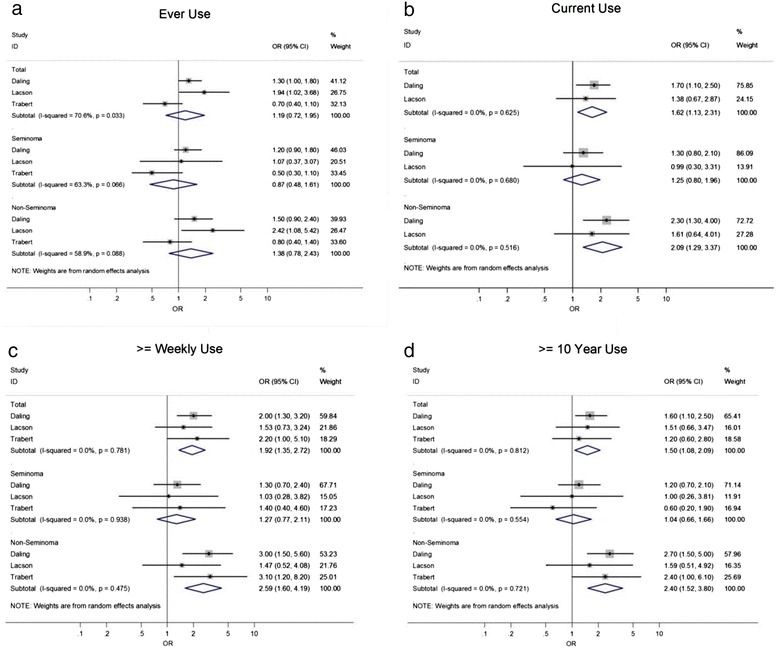
BACKGROUND: The aetiology of testicular cancer remains elusive. In this manuscript, we review the evidence regarding the association between cannabis use and testicular cancer development. METHODS: In this systematic review and meta-analysis, we reviewed literature published between 1(st) January 1980 and 13(th) May 2015 and found three case-control studies that investigated the association between cannabis use and development of testicular germ cell tumours (TGCTs). RESULTS/CONCLUSIONS: Using meta-analysis techniques, we observed that a) current, b) chronic, and c) frequent cannabis use is associated with the development of TGCT, when compared to never-use of the drug. The strongest association was found for non-seminoma development--for example, those using cannabis on at least a weekly basis had two and a half times greater odds of developing a non-seminoma TGCT compared those who never used cannabis (OR: 2.59, 95% CI 1.60-4.19). We found inconclusive evidence regarding the relationship between cannabis use and the development of seminoma tumours. It must be noted that these observations were derived from three studies all conducted in the United States; and the majority of data collection occurred during the 1990's.
Overview
The claims and statistics of this paper haven’t been checked yet.
Run the check — free, no account needed. It reads the open-access text and checks the sources it cites.
Integrity signals
Registry
Cites
Statistics
Figures
Verification
Claims the paper makes
The claims and statistics of this paper haven’t been checked yet.
Run the check — free, no account needed. It reads the open-access text and checks the sources it cites.
Claims other papers make about this one
Each is checked against this paper’s own text: does it say what the citing paper says it does?
The source backs part of the claim, not all of it — or backs it for a different population, condition or comparison.
In the citing paper
“The evidence is inconclusive for testicular seminomas, and lung cancer, neck and head cancers because of the possible roles of tobacco use, and other confounders.”
From Cannabis, cannabinoids and health: a review of evidence on risks and medical benefits (2025) · cites this paper as [67]
Experimental — accuracy not yet measuredThe cited source says what the claim attributes to it.
In the citing paper
“The strongest association was found for non-seminoma development and weekly cannabis use.”
From Cannabis, cannabinoids and health: a review of evidence on risks and medical benefits (2025) · cites this paper as [67]
Self-check
Percentages, sums and reported differences re-computed from the paper’s own numbers.
The self-check needs the paper’s full text.
Citations
Cites
Sanderson, S., Tatt, I. D., & Higgins, J. P. (2007) · International Journal of Epidemiology · doi:10.1093/ije/dym018 · Cited by 1,531 · cited 1×
“In the absence of such a gold standard, it has been recommended that any tools used to measure study quality should be as specific as possible to the given topic, and involve a simple checklist as opposed to a scale or score [14].”
MethodSchulenberg, J., Johnston, L. D., O'Malley, P., Bachman, J., Miech, R., & Patrick, M. (2008) · doi:10.3998/2027.42/146531 · Cited by 1,143
Katzman, M. A., Bleau, P., Blier, P., Chokka, P., Kjernisted, K., Van Ameringen, M., & the Canadian Anxiety Guidelines Initiative Group on behalf of the Anxiety Disorders Association of Canada/Association Canadienne des troubles anxieux and McGill University (2014) · BMC Psychiatry · doi:10.1186/1471-244x-14-s1-s1 · Cited by 1,090
Cannabinoids: potential anticancer agents
Guzmán, M. (2003) · Nature reviews. Cancer · doi:10.1038/nrc1188 · Cited by 721 · cited 1×
“tion; however, these receptors are also expressed in peripheral locations, including the testis [22].”
BackgroundIncreasing incidence of testicular cancer worldwide: a review.
Huyghe, É., Matsuda, T., & Thonneau, P. (2003) · Journal of Urology · doi:10.1097/01.ju.0000053866.68623.da · Cited by 624 · cited 2×
“Non-seminoma tumours are typically diagnosed seven [11] to ten [12] years earlier than seminoma tumours.”
BackgroundResultLev-Ran, S., Roerecke, M., Le Foll, B., George, T. P., McKenzie, K., & Rehm, J. (2014) · Psychological Medicine · doi:10.1017/s0033291713001438 · Cited by 589 · cited 1×
“Marihuana [29, 30] Testi cancer”
Cannabis, the mind and society: the hash realities
Murray, R. M., Morrison, P. D., Henquet, C., & Forti, M. D. (2007) · Nature reviews. Neuroscience · doi:10.1038/nrn2253 · Cited by 329 · cited 1×
“The cannabis plant has been ingested or inhaled by humans for more than 4000 years [1].”
BackgroundSterne, J., Bradburn, M., & Egger, M. (2008) · doi:10.1002/9780470693926.ch18 · Cited by 319
Kedzior, K. K., & Laeber, L. T. (2014) · BMC Psychiatry · doi:10.1186/1471-244x-14-136 · Cited by 309
The effects of state and local antidiscrimination policies on earnings for gays and lesbians
Klawitter, M., & Flatt, V. (1998) · Journal of Policy Analysis and Management · doi:10.1002/(sici)1520-6688(199823)17:4 · Cited by 245
Research works printed but not linked: 5
- UNODC. World drug report. New York: United Nations; 2014.
- McGlynn KA, Cook MB. The epidemiology of testicular cancer. Male reproductive cancers: epidemiology, pathology and genetics. New York: Springer; 2009.
- Lacson JCA, Carroll JD, Tuazon E, Castelao EJ, Bernstein L, Cortessis VK. Population-based case–control study of recreational drug use and testis cancer risk confirms an association between marijuana use and nonseminoma risk. Cancer. 2012;118(21):5374–83. doi: 10.1002/cncr.27554 . · DOI
- Stroup D, Berlin J, Morton S, Olkin I, Williamson G, Rennie D, et al. Meta-analysis of observational studies in epidemiology: a proposal for reporting. JAMA. 2000;283(15):2008–12. doi: 10.1001/jama.283.15.2008 . · DOI · Paper page
- Kirkwood BR, Sterne JA. Essential medical statistics. 2nd ed. Malden: Blackwell Science Ltd; 2003.
Cited by
Sorted by citations
Items 101–109 of 109
Cannabis sativa – A matter of physical, mental, and social health
Cortez, C. M., Cortez-Calderini, A., & Silva, D. (2022) · Eastern Journal of Medical Sciences · doi:10.32677/ejms.v7i3.3524
“development of testicular germ cell cancers [97-100].”
Cannabis as an Alternative Treatment for 11 Medical Conditions: a Literature Review
Noppawat, T. (2021) · International Journal of Current Science Research and Review · doi:10.47191/ijcsrr/v4-i9-02
“Due to the deficiency in the quality of the studies, there was not enough evidence to suggest that cannabis use could cause testicular cancer [67].”
BackgroundInfluentialTumormarker Humanes Choriongonadotropin (HCG) in der Diagnostik von Hodentumoren
Passek, K., Zulauf, N., Ohlendorf, D., Bendels, M., Bauer, J., Volante, G., & Oremek, G. M. (2019) · Zentralblatt für Arbeitsmedizin Arbeitsschutz und Ergonomie · doi:10.1007/s40664-018-0277-6
Epidemiology, Risk Factors, and Histopathology in Testicular Cancer
Nestler, T., & Schmelz, H. (2018) · Urologic Oncology · doi:10.1007/978-3-319-42603-7_1-1
Mas, J. L., Talarico, E., & Jones, J. (2018) · The FASEB Journal · doi:10.1096/fasebj.2019.33.1_supplement.lb104
“Research has suggested risk factors that include genetics, environment, recreational drug use and occupation (Cook et al., 2009, 2010; Hanna and Einhorn, 2014; Gurney et al., 2015).”
BackgroundPassek, K., Ohlendorf, D., Bundschuh, M., Bendels, M., Oremek, G., & Quarcoo, D. (2018) · Zentralblatt für Arbeitsmedizin Arbeitsschutz und Ergonomie · doi:10.1007/s40664-017-0260-7
Cannabiskonsum zum Freizeitgebrauch
Schneider, M., Friemel, C. M., von Keller, R., Adorjan, K., Bonnet, U., Hasan, A., Hermann, D., Kambeitz, J., Koethe, D., Kraus, L., et al. (2018) · Springer eBooks · doi:10.1007/978-3-662-57291-7_3 · Cited by 2
Meyts, E. R.-D. (2019) · Encyclopedia of Endocrine Diseases · doi:10.1016/b978-0-12-801238-3.64917-6
Metadata
- Authors
- Gurney, J., Shaw, C., Stanley, J., Signal, V., & Sarfati, D.
- Affiliations
- University of Otago (NZ)
- Corresponding author
- Gurney, J.
- Venue
- BMC Cancer
- Published
- 2015-11-11
- Volume
- 15
- Issue
- 1
- Pages
- 897-897
- ISSN
- 1471-2407 (ISSN-L)
- PMC
- PMC4642772
- OpenAlex
- W2118479499
- Cited by
- 137
- References
- 35
- Citations by year
- 2026: 2 · 2025: 10 · 2024: 9 · 2023: 25 · 2022: 16 · 2021: 15 · 2020: 19 · 2019: 18 · 2018: 14 · 2017: 7 · 2016: 2
- FWCI
- 1.47
- Type
- journal article
- Language
- en
- Open access
- gold
- doi.org
- Licence
- cc-by
- Locations
- BMC Cancer (publishedVersion, cc-by)
- Europe PMC (PubMed Central) (publishedVersion, cc-by)
- PubMed Central (publishedVersion, cc-by)
- PubMed (publishedVersion)
- Funders
- Health Research Council of New Zealand (NZ) (14/052)
- Topics
- Health Sciences › Medicine › Surgery › Testicular diseases and treatments
- Health Sciences › Medicine › Pharmacology (medical) › Cannabis and Cannabinoid Research
- Health Sciences › Medicine › Oncology › Global Cancer Incidence and Screening
- Keywords
- cannabis use, testicular cancer, testicular germ cell tumors, non-seminoma, seminoma, cancer risk factors, chronic cannabis use, case-control study
- MeSH terms
- Cannabis, Humans, Male, Neoplasms, Germ Cell and Embryonal, Risk Factors, Testicular Neoplasms, United States, Case-Control Studies
About these checks
Registry, retraction, Cites and statistics results are computed, not judged, with one exception: a printed reference that no index lists is read once by a model before it counts as a citation error. Claims are extracted by a model and kept only when their quote appears verbatim in the text; each cited source is then checked, with a model’s help, for whether it says what the claim relies on. Those verdicts can be wrong — read the claim’s quote and the cited source before relying on one.
Statistics and arithmetic are recomputed, not judged.
Confidence bands are shown only for fields calibrated on our annotated test set. None is calibrated yet, so no band is shown.
What counts as a claim ›How we measure confidence ›How we check this ›
Are you an author, or do you see a problem with this page? Request a review
