

The association of aspirin use with overall survival of patients with inoperable non-small cell lung cancer: a retrospective study
Open accessThe DOI matches its Crossref record; 50 of the 50 references it cites were found in a registry or an index.
Abstract
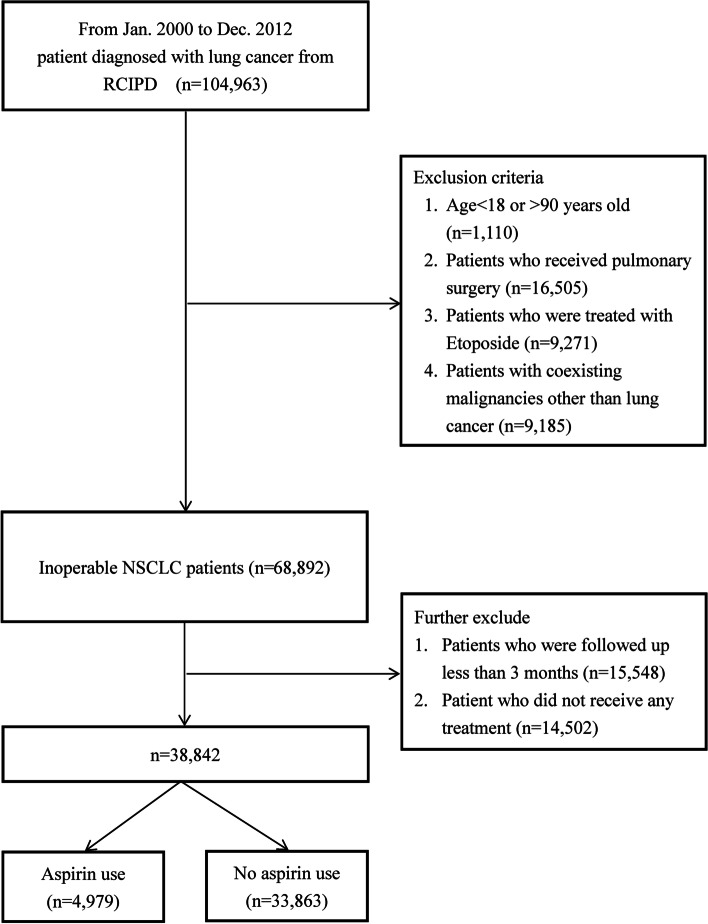
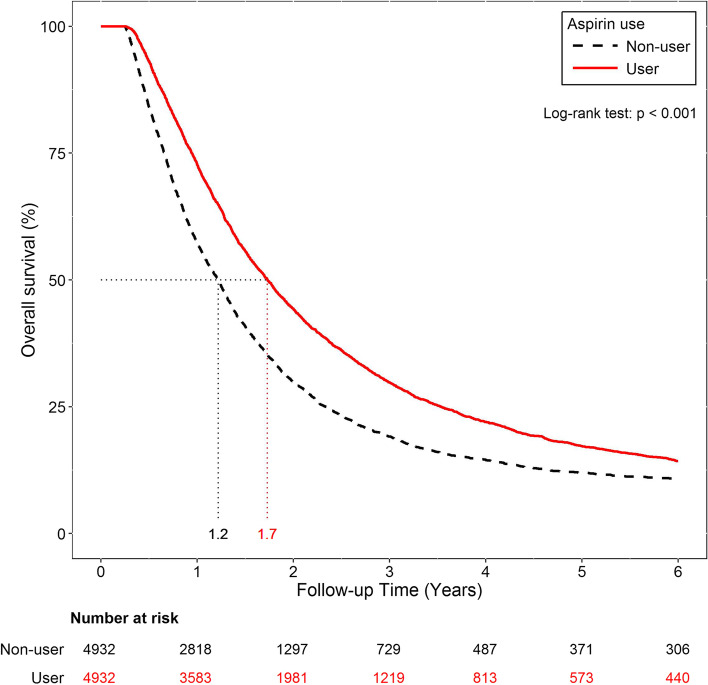
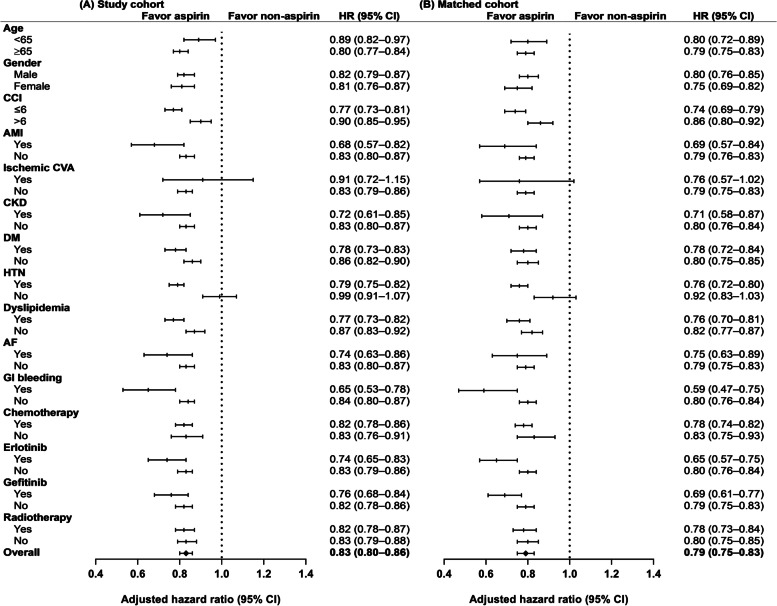
Background: Studies have indicated that individuals taking aspirin have a reduced risk of cancers and have also established chemo-preventive benefit of aspirin in colorectal cancer. However, research on the association between aspirin use and the survival in patients with lung cancer has revealed inconsistent results. In this study, we investigated the effect of aspirin use on the survival of inoperable non-small cell lung cancer (NSCLC) patients. Methods: We identified a cohort of 38,842 patients diagnosed with NSCLC between 2000 and 2012 using the Taiwan’s National Health Insurance Research Database and used propensity score matching to reduce possible confounding factors. In total, 9864 patients (4932 matched pairs) were included in the matched cohort. Aspirin exposure was analyzed to identify a possible association with mortality in patients with inoperable NSCLC. Time-dependent Cox regression models were used to calculate the hazard ratios (HRs) and the 95% confidence intervals (95% CIs) that corresponded with aspirin exposure. Results: A total of 4979 patients used aspirin at the time of diagnosis of NSCLC. The median overall survival (OS) of the aspirin users was 1.73 (interquartile range, 0.94–3.53) years compared with the 1.30 (interquartile range, 0.69–2.62) years of the non-aspirin users. The Cox proportional hazard model with the time-dependent covariate revealed that aspirin use was associated with a significantly longer OS (HR: 0.83, 95.0% CI: 0.80–0.86). After controlling the sociodemographic characteristics (age, sex, income, and level of urbanization) and lung cancer treatments by propensity score matching, the aspirin users still had a significantly longer OS than the non-aspirin users (HR: 0.79, 95.0% CI: 0.75–0.83). Conclusion: Aspirin use is associated with a longer OS in patients with inoperable NSCLC, suggesting that aspirin has a potential anticancer effect. These results warrant further randomized clinical trials to evaluate the actual role of aspirin in the treatment of NSCLC patients.
Overview
The claims and statistics of this paper haven’t been checked yet.
Free: it reads the open-access text and checks the first 5 claims that cite a source we can check. Create a free account to check every claim.
Integrity signals
Registry
Cites
Statistics
Figures
Verification
Claims the paper makes
The claims and statistics of this paper haven’t been checked yet.
Free: it reads the open-access text and checks the first 5 claims that cite a source we can check. Create a free account to check every claim.
Self-check
Percentages, sums and reported differences re-computed from the paper’s own numbers.
The self-check needs the paper’s full text.
Citations
Cites
Sung, H., Ferlay, J., Siegel, R. L., Laversanne, M., Soerjomataram, I., Jemal, A., & Bray, F. (2021) · CA: A Cancer Journal for Clinicians · doi:10.3322/caac.21660 · Cited by 108,699 · cited 1×
“4% of all cancer cases) worldwide in 2020 [1].”
BackgroundInhibition of Prostaglandin Synthesis as a Mechanism of Action for Aspirin-like Drugs
VANE, J. R. (1971) · Nature New Biology · doi:10.1038/newbio231232a0 · Cited by 8,605 · cited 4×
“Notably, the anti-neoplastic effect of aspirin was mediated through its inhibition of COX enzymes that promote carcinogeneis through the synthesis of PG. [44] Apart from inhibiting the synthesis of PG, aspirin has also been shown to upregulate tumor-suppression genes and inhibit NF-kB activation, thus illustrating its…”
BackgroundInfluentialRothwell, P. M., Fowkes, F. G. R., Belch, J. F., Ogawa, H., Warlow, C. P., & Meade, T. W. (2011) · The Lancet · doi:10.1016/s0140-6736(10)62110-1 · Cited by 1,497 · cited 1×
“89) [41], which is consistent with the result of our study, which showed that aspirin use is associated with an improved OS in inoperable NSCLC patients.”
ResultRothwell, P. M., Wilson, M., Elwin, C.-E., Norrving, B., Algra, A., Warlow, C. P., & Meade, T. W. (2010) · The Lancet · doi:10.1016/s0140-6736(10)61543-7 · Cited by 1,351 · cited 1×
“Nonetheless, further studies established the chemopreventive effect of aspirin in colorectal cancer [32, 33] and these inspired numerous studies on the potential preventive role of aspirin on other cancers [34–36], contributing to the publication of abundant systematic reviews and meta-analyses [37–39].”
BackgroundValidation of the national health insurance research database with ischemic stroke cases in Taiwan
Cheng, C., Kao, Y. Y., Lin, S., Lee, C., & Lai, M. L. (2011) · Pharmacoepidemiology and Drug Safety · doi:10.1002/pds.2087 · Cited by 1,277 · cited 1×
“The diagnostic accuracy of the NHIRD has been validated previously for major diseases [23], and its clinical consistency in cancer research had been proved [24].”
Taiwan’s National Health Insurance Research Database: past and future
Hsieh, C.-Y., Su, C.-C., Shao, S.-C., Sung, S.-F., Lin, S.-J., Yang Kao, Y.-H., & Lai, E. C.-C. (2019) · Clinical Epidemiology · doi:10.2147/clep.s196293 · Cited by 1,213 · cited 1×
“Therefore, the diagnosis of cancer can be considered to be accurate [25].”
BackgroundSelf-citationRandomised trial of prophylactic daily aspirin in British male doctors
Peto, R., Gray, R., Collins, R., Wheatley, K., Hennekens, C., Jamrozik, K., Warlow, C., Hafner, B., Thompson, E., Norton, S., et al. (1988) · BMJ · doi:10.1136/bmj.296.6618.313 · Cited by 1,166 · cited 1×
“While a case-control study of 700 patients with colorectal cancer conducted in Melbourne, Australia was the first to show a possible anti-cancer effect in human cancer [9], randomized controlled trials showed no association between aspirin use and cancer incidence [11, 30, 31].”
BackgroundWu, C.-Y., Chen, Y.-J., Ho, H. J., Hsu, Y.-C., Kuo, K. N., Wu, M.-S., & Lin, J.-T. (2012) · JAMA · doi:10.1001/2012.jama.11975 · Cited by 818 · cited 1×
“This definition was used in a previous study [26].”
MethodEffect of Aspirin on All-Cause Mortality in the Healthy Elderly
McNeil, J. J., Nelson, M. R., Woods, R. L., Lockery, J. E., Wolfe, R., Reid, C. M., Kirpach, B., Shah, R. C., Ives, D. G., Storey, E., et al. (2018) · New England Journal of Medicine · doi:10.1056/nejmoa1803955 · Cited by 813 · cited 1×
“Moreover, the results of the Aspirin in Reducing Events in the Elderly trial showed an increased risk of cancer-related mortality in the aspirin group [14].”
ResultCook, N. R., Lee, I.-M., Gaziano, J. M., Gordon, D., Ridker, P. M., Manson, J. E., Hennekens, C. H., & Buring, J. E. (2005) · JAMA · doi:10.1001/jama.294.1.47 · Cited by 796
Aspirin and the Risk of Colorectal Cancer in Relation to the Expression of COX-2
Chan, A. T., Ogino, S., & Fuchs, C. S. (2007) · New England Journal of Medicine · doi:10.1056/nejmoa067208 · Cited by 781 · cited 1×
“[44] Apart from inhibiting the synthesis of PG, aspirin has also been shown to upregulate tumor-suppression genes and inhibit NF-kB activation, thus illustrating its anticancer activities in a COX independent pathway [45, 46].”
BackgroundPrecision Diagnosis and Treatment for Advanced Non–Small-Cell Lung Cancer
Reck, M., & Rabe, K. F. (2017) · New England Journal of Medicine · doi:10.1056/nejmra1703413 · Cited by 725 · cited 1×
“Even with the use of aggressive multimodality therapy, the prognosis in patients with advanced stage NSCLC has been far from satisfactory [4].”
BackgroundAntimetastatic effects associated with platelet reduction.
Gasic, G. J., Gasic, T. B., & Stewart, C. C. (1968) · Proceedings of the National Academy of Sciences · doi:10.1073/pnas.61.1.46 · Cited by 720 · cited 1×
“The first experimental animal models that proposed that aspirin could be of benefit against cancer were developed more than half a century ago, when Gasic and colleagues observed that thrombocytopenia in tumorbearing mice was associated with a 50% reduction in lung metastases [42, 43].”
BackgroundManagement of non-small-cell lung cancer: recent developments
Reck, M., Heigener, D. F., Mok, T., Soria, J.-C., & Rabe, K. F. (2013) · The Lancet · doi:10.1016/s0140-6736(13)61502-0 · Cited by 714 · cited 1×
“Non-small cell lung cancer (NSCLC) accounts for the majority of all lung cancer cases, and approximately 65% of patients present with locally advanced or metastatic disease at the time of diagnosis [3].”
BackgroundKune, G. A., Kune, S., & Watson, L. F. (2007) · International Journal of Epidemiology · doi:10.1093/ije/dym193 · Cited by 654 · cited 2×
“In 1988, a case-control study of 700 patients with colorectal cancer was the first to show that the use of aspirin was beneficial in reducing the risk of cancer [9].”
BackgroundAspirin Use and Survival After Diagnosis of Colorectal Cancer
Chan, A. T. (2009) · JAMA · doi:10.1001/jama.2009.1112 · Cited by 557 · cited 1×
“Nonetheless, further studies established the chemopreventive effect of aspirin in colorectal cancer [32, 33] and these inspired numerous studies on the potential preventive role of aspirin on other cancers [34–36], contributing to the publication of abundant systematic reviews and meta-analyses [37–39].”
The role of aspirin in cancer prevention
Thun, M. J., Jacobs, E. J., & Patrono, C. (2012) · Nature Reviews Clinical Oncology · doi:10.1038/nrclinonc.2011.199 · Cited by 481
Low-Dose Aspirin and Incidence of Colorectal Tumors in a Randomized Trial
Gann, P. H., Manson, J. E., Glynn, R. J., Buring, J. E., & Hennekens, C. H. (1993) · JNCI Journal of the National Cancer Institute · doi:10.1093/jnci/85.15.1220 · Cited by 422 · cited 1×
“Two large randomized controlled trials with 5-year and 10-year interventions, the Women’s Health Study and the Physicians’ Health Study, demonstrated no association between the use of aspirin and the incidence of any cancer [11, 12].”
BackgroundAspirin Intake and Survival After Breast Cancer
Holmes, M. D., Chen, W. Y., Li, L., Hertzmark, E., Spiegelman, D., & Hankinson, S. E. (2010) · Journal of Clinical Oncology · doi:10.1200/jco.2009.22.7918 · Cited by 365
Kune, G. A., Kune, S., & Watson, L. F. (1988) · PubMed · Cited by 352
Takada, Y., Bhardwaj, A., Potdar, P., & Aggarwal, B. B. (2004) · Oncogene · doi:10.1038/sj.onc.1208169 · Cited by 310
Effect of Aspirin or Resistant Starch on Colorectal Neoplasia in the Lynch Syndrome
Burn, J., Bishop, D. T., Mecklin, J.-P., Macrae, F., Möslein, G., Olschwang, S., Bisgaard, M.-L., Ramesar, R., Eccles, D., Maher, E. R., et al. (2008) · New England Journal of Medicine · doi:10.1056/nejmoa0801297 · Cited by 300
Aspirin, salicylates, and cancer
Elwood, P. C., Gallagher, A. M., Duthie, G. G., Mur, L. A., & Morgan, G. (2009) · The Lancet · doi:10.1016/s0140-6736(09)60243-9 · Cited by 282
Bellosillo, B., Piqué, M., Barragán, M., Castaño, E., Villamor, N., Colomer, D., Montserrat, E., Pons, G., & Gil, J. (1998) · Blood · doi:10.1182/blood.v92.4.1406 · Cited by 185
Chubak, J., Whitlock, E. P., Williams, S. B., Kamineni, A., Burda, B. U., Buist, D. S. M., & Anderson, M. L. (2016) · Annals of Internal Medicine · doi:10.7326/m15-2117 · Cited by 160 · cited 1×
“The earliest clinical studies on the association between aspirin and cancer dates back to 1980; however these studies failed to establish the protective effect of aspirin on cancer incidence and mortality [8].”
BackgroundElwood, P. C., Morgan, G., Pickering, J. E., Galante, J., Weightman, A. L., Morris, D., Kelson, M., & Dolwani, S. (2016) · PLOS ONE · doi:10.1371/journal.pone.0152402 · Cited by 152
ANTI-METASTATIC EFFECT OF ASPIRIN
Gasic, G. J., Gasic, T. B., & Murphy, S. (1972) · The Lancet · doi:10.1016/s0140-6736(72)92581-0 · Cited by 137
Aspirin use and mortality from cancer in a prospective cohort study.
Ratnasinghe, L. D., Graubard, B. I., Kahle, L., Tangrea, J. A., Taylor, P. R., & Hawk, E. (2004) · PubMed · Cited by 124
Non-COX-2 targets and cancer: Expanding the molecular target repertoire of chemoprevention
Kashfi, K., & Rigas, B. (2005) · Biochemical Pharmacology · doi:10.1016/j.bcp.2005.05.004 · Cited by 119 · cited 1×
“On the other hand, mounting preclinical evidence suggests that aspirin may exhibit anti-neoplastic effects by inducing apoptosis [47, 48] suppressing angiogenesis [49], and inhibiting the proliferation of tumor cells [50].”
BackgroundTsoi, K. K. F., Ho, M.-W., Chan, F. C. H., & Sung, J. J. �. (2018) · International Journal of Cancer · doi:10.1002/ijc.32083 · Cited by 119
Kao, W., Hong, J., See, L., Yu, H., Hsu, J., Chou, I., Chou, W., Chiou, M., Wang, C., & Kuo, C. (2017) · Pharmacoepidemiology and Drug Safety · doi:10.1002/pds.4267 · Cited by 117 · cited 1×
“The diagnostic accuracy of the NHIRD has been validated previously for major diseases [23], and its clinical consistency in cancer research had been proved [24].”
Choe, K. S., Cowan, J. E., Chan, J. M., Carroll, P. R., D'Amico, A. V., & Liauw, S. L. (2012) · Journal of Clinical Oncology · doi:10.1200/jco.2011.41.0308 · Cited by 110
Acetylsalicylic acid, possible preventive of coronary thrombosis.
Ll, C. (1950) · PubMed · Cited by 106
Kang, J., Jeong, S., Shin, D. W., Cho, M. H., Cho, J. H., & Kim, J. (2020) · Journal of Thoracic Oncology · doi:10.1016/j.jtho.2020.08.021 · Cited by 100 · cited 1×
“[22] 2020 Korea N/A N/A Retrospective cohort Population‐based 5938 1.”
Old wine in new bottles: Drug repurposing in oncology
Antoszczak, M., Markowska, A., Markowska, J., & Huczyński, A. (2019) · European Journal of Pharmacology · doi:10.1016/j.ejphar.2019.172784 · Cited by 94 · cited 1×
“Repurposing aspirin as antineoplastic agents has gathered momentum because of its potential anti-cancer effect both in vitro and in vivo [5].”
BackgroundNonsteroidal Antiinflammatory Drug Use and Lung Cancer
Khuder, S., Herial, N. A., Mutgi, A. B., & Federman, D. J. (2005) · CHEST Journal · doi:10.1378/chest.127.3.748 · Cited by 67 · cited 1×
“[44] Apart from inhibiting the synthesis of PG, aspirin has also been shown to upregulate tumor-suppression genes and inhibit NF-kB activation, thus illustrating its anticancer activities in a COX independent pathway [45, 46].”
BackgroundStatistical methods for elimination of guarantee-time bias in cohort studies: a simulation study
Cho, I. S., Chae, Y. R., Kim, J. H., Yoo, H. R., Jang, S., Kim, G. R., & Nam, C. M. (2017) · BMC Medical Research Methodology · doi:10.1186/s12874-017-0405-6 · Cited by 66 · cited 1×
“Statistical analyses While both time-dependent Cox regression models and landmark analyses are useful in resolving the problem of immortal time bias, the time-dependent Cox regression is the most appropriate method for analyzing cumulative and long-term drug exposure [27], and this method was used in a previous study…”
MethodAspirin and non-small cell lung cancer resections: effect on long-term survival☆
Fontaine, E., McShane, J., Page, R., Shackcloth, M., Mediratta, N., Carr, M., Soorae, A., & Poullis, M. (2010) · European Journal of Cardio-Thoracic Surgery · doi:10.1016/j.ejcts.2010.01.015 · Cited by 51
Elwood, P. C., Pickering, J. E., Morgan, G., Galante, J., Weightman, A. L., Morris, D., Longley, M., Mason, M., Adams, R., Dolwani, S., et al. (2018) · PLOS ONE · doi:10.1371/journal.pone.0203957 · Cited by 43
Wang, H., Liao, Z. X., Zhuang, Y., Liu, Y., Levy, L. B., Xu, T., Yusuf, S. W., & Gomez, D. R. (2014) · Clinical Lung Cancer · doi:10.1016/j.cllc.2014.09.006 · Cited by 41 · cited 2×
“not population-based [16, 18, 21], while four studies used a cohort design to investigate other issues.”
BackgroundAspirin use and pancreatic cancer risk
Bonifazi, M., Gallus, S., Bosetti, C., Polesel, J., Serraino, D., Talamini, R., Negri, E., & La Vecchia, C. (2010) · European Journal of Cancer Prevention · doi:10.1097/cej.0b013e32833b48a4 · Cited by 40
Aspirin reduces lung cancer metastasis to regional lymph nodes
Ogawa, F., Amano, H., Ito, Y., Matsui, Y., Hosono, K., Kitasato, H., Satoh, Y., & Majima, M. (2013) · Biomedicine & Pharmacotherapy · doi:10.1016/j.biopha.2013.11.006 · Cited by 35 · cited 1×
“The studies focused more on the role of aspirin in lung cancer incidence [8–14, 39] and despite promising in vivo experimental data [40], few attempts were made to study the association between the use of aspirin and lung cancer survival (Table 1).”
BackgroundMeta-analysis of aspirin use and risk of lung cancer shows notable results
Hochmuth, F., Jochem, M., & Schlattmann, P. (2015) · European Journal of Cancer Prevention · doi:10.1097/cej.0000000000000176 · Cited by 33
Ma, W. Y., Huang, C., & Dong, Z. (1998) · International Journal of Oncology · doi:10.3892/ijo.12.3.565 · Cited by 32 · cited 1×
“On the other hand, mounting preclinical evidence suggests that aspirin may exhibit anti-neoplastic effects by inducing apoptosis [47, 48] suppressing angiogenesis [49], and inhibiting the proliferation of tumor cells [50].”
BackgroundLow-dose aspirin and survival from lung cancer: a population-based cohort study
McMenamin, Ú. C., Cardwell, C. R., Hughes, C. M., & Murray, L. M. (2015) · BMC Cancer · doi:10.1186/s12885-015-1910-9 · Cited by 26 · cited 2×
“Statistical analyses While both time-dependent Cox regression models and landmark analyses are useful in resolving the problem of immortal time bias, the time-dependent Cox regression is the most appropriate method for analyzing cumulative and long-term drug exposure [27], and this method was used in a previous study…”
MethodAspirin suppresses tumor cell-induced angiogenesis and their incongruity
Maity, G., Chakraborty, J., Ghosh, A., Haque, I., Banerjee, S., & Banerjee, S. K. (2019) · Journal of Cell Communication and Signaling · doi:10.1007/s12079-018-00499-y · Cited by 25 · cited 1×
“On the other hand, mounting preclinical evidence suggests that aspirin may exhibit anti-neoplastic effects by inducing apoptosis [47, 48] suppressing angiogenesis [49], and inhibiting the proliferation of tumor cells [50].”
BackgroundVeitonmäki, T., Murtola, T. J., Talala, K. M., Taari, K., Tammela, T. L. J., & Auvinen, A. P. (2016) · PLoS ONE · doi:10.1371/journal.pone.0153413 · Cited by 20
Prediagnostic Nonsteroidal Anti-Inflammatory Drug Use and Lung Cancer Survival in the VITAL Study
Brasky, T. M., Baik, C. S., Slatore, C. G., Alvarado, M., & White, E. (2012) · Journal of Thoracic Oncology · doi:10.1097/jto.0b013e3182641bdc · Cited by 15 · cited 2×
“Aspirin use on lung cancer survival was not the primary endpoint of these trials [11, 15, 17, 20].”
BackgroundKibel, A. S. (2013) · Yearbook of Urology · doi:10.1016/j.yuro.2012.11.001 · Cited by 11
Effects of aspirin on small-cell lung cancer mortality and metastatic presentation
Maddison, P. (2017) · Lung Cancer · doi:10.1016/j.lungcan.2017.01.018 · Cited by 11
Research works printed but not linked: 1
- Gann PH Manson JE Glyn RJ Buring JE Hennekens CH Low-dose aspirin and incidence of colorectal tumors in a randomised trial J Natl Cancer Inst. 1993 85 1220 4 10.1093/jnci/85.15.1220 8331682 · DOI · Paper page
Cited by
Benjamin, D. J., Haslam, A., & Prasad, V. (2024) · Cancer Medicine · doi:10.1002/cam4.7049 · Cited by 30
Aiad, M., Tahir, A., Fresco, K., Prenatt, Z., Ramos-Feliciano, K., Walia, J., Stoltzfus, J. C., & Albandar, H. J. (2022) · Cureus · doi:10.7759/cureus.25891 · Cited by 17
Role of aspirin in cancer prevention
Sun, M., Yu, J., Wan, J., Dou, X., Chen, X., & Ye, F. (2025) · Cancer Treatment and Research Communications · doi:10.1016/j.ctarc.2025.100884 · Cited by 18
Cai, R., Liao, X., Gao, L., Xiang, J., Ye, Q., Chen, M., & Feng, S. (2023) · World Journal of Surgical Oncology · doi:10.1186/s12957-023-03247-8 · Cited by 7
“…cancer, Chuang et al. in a large retrospective study with 38,842 inoperable NSCLC patients found the use of aspirin correlated with improved OS [26]; Kanda et al. in a study with 217 stages IIIB and IV NSCLC patients also found the use of loxoprofen sodium that could extend the survival in…”
BackgroundPlatelet inhibition delays cerebral metastasis in non-small cell lung cancer
Wasilewski, D., Onken, J., Won, S., Rafaelian, A., Hempelmann, A., Bernstock, J. D., Maletzki, C., Freiman, T. M., Vajkoczy, P., Gessler, F. A., et al. (2025) · Brain and Spine · doi:10.1016/j.bas.2025.105475
Metadata
- Authors
- Chuang, M.-C., Yang, Y.-H., Hsieh, M.-J., Lin, Y.-C., Yang, T.-M., Chen, P.-C., & Hung, M.-S.
- Affiliations
- Chang Gung University (TW)
- National Taiwan University (TW)
- Chang Gung University of Science and Technology (TW)
- Corresponding author
- Hung, Ming-Szu
- ORCID
- Venue
- BMC Cancer
- Published
- 2021-11-22
- Volume
- 21
- Issue
- 1
- Pages
- 1257-1257
- ISSN
- 1471-2407 (ISSN-L)
- PMC
- PMC8607685
- OpenAlex
- W3217003007
- Semantic Scholar
- ae5737e352d1273de7d4822e50d7a5d3d7623ec6
- Cited by
- 9
- References
- 50
- Citations by year
- 2026: 2 · 2025: 4 · 2024: 1 · 2023: 1 · 2022: 1
- FWCI
- 0.44
- Type
- journal article
- Language
- en
- Open access
- gold
- doi.org
- Licence
- cc-by
- creativecommons.org/licenses/by/4.0 (tdm)
- creativecommons.org/licenses/by/4.0 (vor)
- Locations
- BMC Cancer (publishedVersion, cc-by)
- PubMed Central (publishedVersion, cc-by)
- PubMed (publishedVersion)
- DOAJ (DOAJ: Directory of Open Access Journals) (submittedVersion, cc-by-sa)
- Funders
- Chang Gung Medical Foundation
- Topics
- Health Sciences › Medicine › Pharmacology (medical) › Inflammatory mediators and NSAID effects
- Health Sciences › Medicine › Pulmonary and Respiratory Medicine › Lung Cancer Diagnosis and Treatment
- Health Sciences › Medicine › Oncology › Lung Cancer Research Studies
- Keywords
- aspirin, non-small cell lung cancer, inoperable lung cancer, overall survival, mortality, chemoprevention, nonsteroidal anti-inflammatory drugs
- MeSH terms
- Age Factors, Aged, Anti-Inflammatory Agents, Non-Steroidal, Antineoplastic Agents, Aspirin, Carcinoma, Non-Small-Cell Lung, Female, Humans, Income, Lung Neoplasms, Male, Middle Aged, National Health Programs, Retrospective Studies, Sex Factors, Taiwan, Urbanization, Cohort Studies, Confidence Intervals, Proportional Hazards Models, Propensity Score
About these checks
Registry, retraction, Cites and statistics results are computed, not judged, with one exception: a printed reference that no index lists is read once by a model before it counts as a citation error. Claims are extracted by a model and kept only when their quote appears verbatim in the text; each cited source is then checked, with a model’s help, for whether it says what the claim relies on. Those verdicts can be wrong — read the claim’s quote and the cited source before relying on one.
Statistics and arithmetic are recomputed, not judged.
Confidence bands are shown only for fields calibrated on our annotated test set. None is calibrated yet, so no band is shown.
What counts as a claim ›How we measure confidence ›How we check this ›
Are you an author, or do you see a problem with this page? Request a review
Data sources
Bibliographic data: Semantic Scholar, OpenAlex, Crossref.
Contains information from the Semantic Scholar Academic Graph Datasets, made available under the ODC Attribution License (ODC-BY 1.0).
Semantic Scholar’s data is described in: Kinney, R., et al. (2023). The Semantic Scholar Open Data Platform. arXiv:2301.10140.
