

Determining direct, indirect healthcare and social costs for diabetic retinopathy management: a systematic review
Open accessPublished version of a preprint
The DOI matches its Crossref record; 26 of the 26 references it cites were found in a registry or an index.
Abstract
Introduction: Diabetic retinopathy (DR) is a rapidly growing global public health threat; it affects 1 in 3 people with diabetes and is still the leading cause of blindness among the working-age population. The management of diabetic retinopathy is becoming more advanced and effective but is highly expensive compared to other ocular diseases. Aim: To report direct medical, indirect medical, and nonmedical costs of diabetic retinopathy in developed and developing countries through a systematic review. Methods: Related articles published in the PubMed, Google Scholar, and EMBASE electronic databases from 1985 to 2022 were identified using the keywords direct medical and indirect medical and social costs of diabetic retinopathy. However, previous systematic reviews, abstracts, and case reports were excluded. Results: Thirteen articles were eligible for assessing the economic burden of diabetes management and its complications. Our analysis revealed that increasing prevalence and severity of diabetic retinopathy (DR) are associated with higher direct and indirect healthcare expenditures. The impact of DR on working-age adults, leading to irreversible blindness in advanced stages, underscores the urgent need for cost-effective prevention and management strategies. Discussion: This study systematically reviewed the direct medical, indirect medical, and nonmedical costs of DR in developed and developing countries. Our findings highlight the significant economic burden of DR, emphasizing the importance of implementing effective prevention and management measures to alleviate costs and enhance patient outcomes. Conclusion: The substantial financial burden of DR necessitates a re-evaluation of current screening and management programs. Revision of these programs is crucial to improve quality of care, reduce costs, and ultimately achieve Sustainable Development Goal 3, which aims to ensure good health and well-being for all.
Overview
The claims and statistics of this paper haven’t been checked yet.
Free: it reads the open-access text and checks the first 5 claims that cite a source we can check. Create a free account to check every claim.
Integrity signals
Registry
Cites
Statistics
Figures
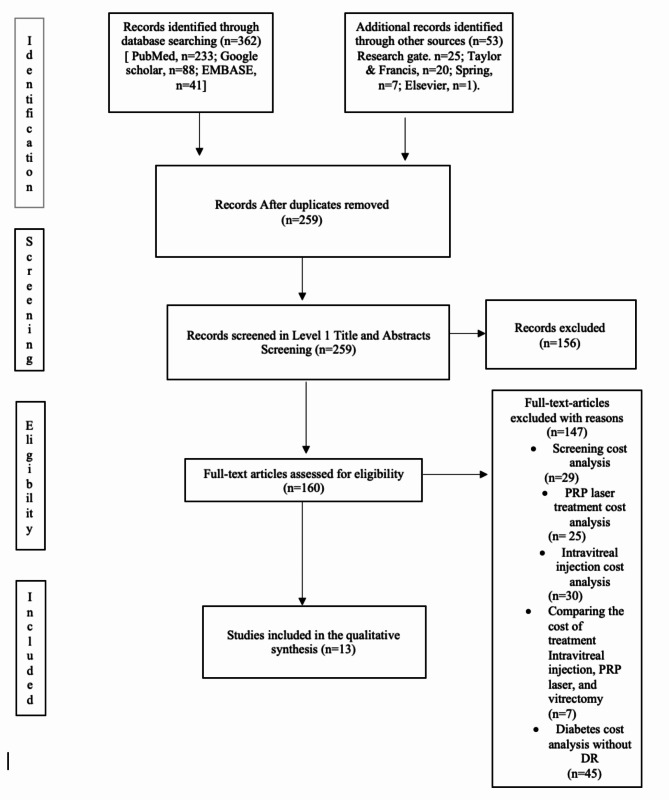
Verification
Claims the paper makes
The claims and statistics of this paper haven’t been checked yet.
Free: it reads the open-access text and checks the first 5 claims that cite a source we can check. Create a free account to check every claim.
Claims other papers make about this one
Each is checked against this paper’s own text: does it say what the citing paper says it does?
The source backs part of the claim, not all of it — or backs it for a different population, condition or comparison.
In the citing paper
“The review identified 28 studies that varied in terms of disease of interest, sample size, methodology, as well as how costs were reported and valued, thus concurring with previous literature that found a high degree of heterogeneity across these types of studies [17, 21–23].”
From The economic impact of retinal diseases for which gene therapy is emerging: a systematic literature review (2025) · cites this paper as [23]
Experimental — accuracy not yet measuredThe cited source says what the claim attributes to it.
In the citing paper
“Previous literature reviews analysing costs associated with vision impairment and blindness found a high degree of heterogeneity across these studies in terms of size, methodology, as well as the way in which costs were defined and reported [17, 21–23].”
From The economic impact of retinal diseases for which gene therapy is emerging: a systematic literature review (2025) · cites this paper as [23]
Self-check
Percentages, sums and reported differences re-computed from the paper’s own numbers.
The self-check needs the paper’s full text.
Citations
Cites
Preferred reporting items for systematic reviews and meta-analyses: The PRISMA statement
Moher, D., Liberati, A., Tetzlaff, J., Altman, D. G., & the PRISMA Group* (2009) · Annals of Internal Medicine · doi:10.7326/0003-4819-151-4-200908180-00135 · Cited by 37,554
Preferred reporting items for systematic reviews and meta-analyses: The PRISMA statement
Moher, D., Liberati, A., Tetzlaff, J., & Altman, D. G. (2010) · International Journal of Surgery · doi:10.1016/j.ijsu.2010.02.007 · Cited by 12,156 · cited 1×
“A systematic review was conducted based on the Pre-ferred Reporting Items for Systematic Reviews and Meta-Analyses (PRISMA) criteria [7].”
MethodStandards of medical care in diabetes 2010
American Diabetes Association (2010) · Diabetes Care · doi:10.2337/dc10-s011 · Cited by 3,470 · cited 1×
“However, it can be prevented if appropriate management is introduced early, which could reduce the risk of vision loss by 60% [4].”
BackgroundEconomic Costs of Diabetes in the U.S. in 2022
(2023) · doi:10.2337/dci23-0085 · Cited by 808 · cited 1×
“This cost encompasses direct medical costs, amounting to 306.6 billion US dollars, and lost productivity costs, totalling 106.3 billion US dollars [20].”
BackgroundInfluentialThe Economic Burden of Major Adult Visual Disorders in the United States
Rein, D. B. (2006) · Archives of Ophthalmology · doi:10.1001/archopht.124.12.1754 · Cited by 635 · cited 4×
“Total healthcare costs for DR in the United States were estimated to be US$ 490 million in 2004, and the average annual total cost per DR patient was about US$ 629 [5].”
BackgroundInfluentialThe worldwide epidemic of diabetic retinopathy
Congdon, N., Zheng, Y., & He, M. (2012) · Indian Journal of Ophthalmology · doi:10.4103/0301-4738.100542 · Cited by 632
Wong, T. Y., & Sabanayagam, C. (2020) · Ophthalmologica · doi:10.1159/000502387 · Cited by 310 · cited 1×
“It affects 1 in 3 people with diabetes [1] and is still the leading cause of blindness among the working-age population.”
BackgroundThe Prevalence of NIDDM and Associated Risk Factors in Native Canadians
Harris, S. B., Gittelsohn, J., Hanley, A., Barnie, A., Wolever, T. M. S., Gao, J., Logan, A., & Zinman, B. (1997) · Diabetes Care · doi:10.2337/diacare.20.2.185 · Cited by 260 · cited 1×
“It has been widely acknowledged that a considerable portion of the public healthcare budget is allocated to healthcare expenditures associated with the complications of diabetes [23].”
BackgroundCost of managing complications resulting from type 2 diabetes mellitus in Canada
O'Brien, J. A., Patrick, A. R., & Caro, J. J. (2003) · BMC Health Services Research · doi:10.1186/1472-6963-3-7 · Cited by 118
Prevalence and healthcare costs of diabetic retinopathy: a population-based register study in Sweden
Heintz, E., Wiréhn, A.-B., Peebo, B. B., Rosenqvist, U., & Levin, L.-Å. (2010) · Diabetologia · doi:10.1007/s00125-010-1836-3 · Cited by 107 · cited 3×
“In Sweden, the annual average healthcare costs of DR, proliferative diabetic retinopathy (PDR), and diabetic macular edema (DMO) were (US$ 93.6, US$ 334.1 and US$ 280.8) respectively [6].”
BackgroundInfluential
Cited by
Sivaprasad, S., Wong, T. Y., Gardner, T. W., Sun, J. K., & Bressler, N. M. (2025) · Nature Reviews Disease Primers · doi:10.1038/s41572-025-00646-x · Cited by 77
“…owing to refractive errors or cataract, the economic cost of managing diabetic retinopathy is substantial, especially drug-related costs 40,41 Direct healthcare costs related to diabetic retinopathy in the USA were estimated at US$493 million per year in 2004 even before the availability…”
Yang, Q., Bee, Y. M., Lim, C. C., Sabanayagam, C., Yim-Lui Cheung, C., Wong, T. Y., Ting, D. S. W., Lim, L.-L., Li, H., He, M., et al. (2025) · eClinicalMedicine · doi:10.1016/j.eclinm.2025.103089 · Cited by 38
Chen, K.-Y., Chan, H.-C., & Chan, C.-M. (2025) · The journal of nutrition health & aging · doi:10.1016/j.jnha.2025.100632 · Cited by 33
“In addition, there are indirect costs associated with lost productivity, decreased quality of life, and caregiver burden [9].”
Financial Toxicity in Diabetes: The State of What We Know
Patel, M. R. (2025) · Current Diabetes Reports · doi:10.1007/s11892-025-01588-0 · Cited by 28
Kaštelan, S., Konjevoda, S., Sarić, A., Urlić, I., Lovrić, I., Čanović, S., Matejić, T., & Perišin, A. Š. (2025) · Molecules · doi:10.3390/molecules30153262 · Cited by 23
“DR affects one in three individuals with diabetes and remains the leading cause of blindness among the adult working population, necessitating the provision of comprehensive eye care services for individuals living with diabetes [1,2].”
Cardona, M., Alwenya, K., Rehman, A. U., Olalo, S. P., Thai, A., Rangi, M., Hazel, Y. P., & Lee, L. (2025) · Frontiers in Public Health · doi:10.3389/fpubh.2025.1578848 · Cited by 21
“…economic burden to patients in developing countries, given that out-of-pocket expenses also include loss income per visit and accommodation away from home (69) or that surgery acceptance might be higher for people with worse visual acuity and people with prior good post-operative outcome.”
Wang, L., Liu, L., Luo, H., Wu, Y., & Zhu, L. (2025) · Diabetes Metabolic Syndrome and Obesity · doi:10.2147/dmso.s504308 · Cited by 9
Depression and diabetic retinopathy: an underexplored connection
Li, J., Sun, H., Li, L., Xin, X., Zhang, X., Lv, W., & Tan, S. (2025) · Frontiers in Nutrition · doi:10.3389/fnut.2025.1557105 · Cited by 9
Jabbar, R. M., Al‐Jumaili, A. A., Alkhatib, N. S., & Jaafar, A. D. (2025) · International Journal of Pharmacy Practice · doi:10.1093/ijpp/riaf075 · Cited by 5
Lopukhova, E. A., Маратовна, И. Г., Рафаэльевич, М. Т., Voronkov, G. S., Kutluyarov, R. V., & Topolskaya, E. P. (2026) · Journal of Imaging · doi:10.3390/jimaging12010036 · Cited by 5
Liang, L., Yu, L., He, Y., Liu, L., Yuan, H., Hu, Y., & Sun, J. (2025) · Canadian Journal of Ophthalmology · doi:10.1016/j.jcjo.2025.08.009 · Cited by 7
Hong, A. T., Chwa, J. S., Humayun, L. L., & Ameri, H. (2025) · Eye · doi:10.1038/s41433-025-04071-y · Cited by 6
“Finally, as the database includes only patients who engage with healthcare systems, it may overrepresent those with higher disease burden and access, underestimating disparities amongst more margin-alised populations.”
Advances in diagnosing and treating diabetic retinopathy
Sivaprasad, S., & Vujosevic, S. (2026) · Nature Reviews Endocrinology · doi:10.1038/s41574-026-01257-6 · Cited by 8
“Beyond visual loss and substantial emotional and psychological burden for patients and their families, the long-term health-care costs are escalating 3 .”
Revolutionizing Diabetic Macular Edema Treatment: FDA Approval of Susvimo
Kumar, D., Gupta, V., Tanwar, R., & Jaiswal, N. K. (2025) · SN Comprehensive Clinical Medicine · doi:10.1007/s42399-025-01971-8 · Cited by 2
“The reduced need for frequent clinical visits may ensure that more people have access to the advanced care they need [47, 48].”
Yin, Z. Q., Dong, J., Meng, Y., Yang, Z., Zhao, C., & Wu, Q.-Y. (2025) · Journal of Diabetes Investigation · doi:10.1111/jdi.70091 · Cited by 2
“As the prevalence of DM increases, more individuals will be susceptible to retinopathy, and DR will become a more signi fi cant problem in the future, resulting in a substantial economic and social burden worldwide 6 .”
Jabbar, R. M., Al‐Jumaili, A. A., & Jaafar, A. D. (2026) · Cost Effectiveness and Resource Allocation · doi:10.1186/s12962-026-00717-0 · Cited by 3
“The economic burden of DR is substantial, encompassing direct medical and non-medical costs, indirect costs such as care-giver burden [6].”
Joseph, S., Hu, W., Jan, C. L., Sundar, B., Zhu, Z., Shang, X., Taylor, H. R., Ravilla, T., & He, M. (2025) · Journal of Diabetes & Metabolic Disorders · doi:10.1007/s40200-025-01763-w · Cited by 1
Kim, M. S., Nam, S., Lee, J., & Woo, S. J. (2025) · Journal of Korean Medical Science · doi:10.3346/jkms.2026.41.e31 · Cited by 2
Willmington, C., Kirby, A., & Murphy, A. (2025) · Health Economics Review · doi:10.1186/s13561-025-00707-7
“The review identified 28 studies that varied in terms of disease of interest, sample size, methodology, as well as how costs were reported and valued, thus concurring with previous literature that found a high degree of heterogeneity across these types of studies [17, 21–23].”
Prevalence of Diabetes Among First-Time Ophthalmology Patients at a Nonprofit Hospital in Mexico
Sánchez-Huerta, V., González-Suriel, M. L., Randolph, H., Álvarez, M. J. B., & Aleman-Castilla, B. (2025) · Diagnostics · doi:10.3390/diagnostics15222922
“Beyond its physical consequences, vision loss severely impacts an individual’s independence, productivity, and psychological well-being [13–15].”
Sung, Y.-C., Chen, Y.-Y., Chen, C. M., Liu, P., Cheng, K., Chang, W., Tseng, C., Hsieh, H., & Sheu, S. (2025) · The Kaohsiung Journal of Medical Sciences · doi:10.1002/kjm2.70148 · Cited by 1
Felfeli, T., Glazier, R. H., Gozdyra, P., Wilson, M. K., Presseau, J., & Brent, M. H. (2026) · Canadian Journal of Ophthalmology · doi:10.1016/j.jcjo.2025.12.021
Patient awareness about diabetic retinopathy and visual health
Stanimirova, D., Mitkova, Z. E., & Petrova, G. I. (2026) · Pharmacia · doi:10.3897/pharmacia.73.e177932
“Advanced stages of DR are treated with costly and painful intravitreal injections, often required throughout the patient’s lifetime (Benhamza et al. 2024).”
Jeyananthan, P., Chandrasiri, H. V. B. L., & Ashfa, A. G. F. (2026) · Experimental Eye Research · doi:10.1016/j.exer.2026.110988
Shang, F., Dholakia, K. Y., & Schallek, J. B. (2026) · PLoS ONE · doi:10.1371/journal.pone.0348363
“DR has a high societal and economic impact, with medical expenses alone estimated to be ~ $500 million in direct costs [2] with the worst outcomes leading to blindness in the working-age population [3].”
A portable potentiostat integrated with a Pt/ZnO/LIG electrode for non-enzymatic glucose detection
Aviha, R., & Slaughter, G. E. (2026) · RSC Advances · doi:10.1039/d6ra04298h
Angers, S., Wykoff, C. C., Antonetti, D. A., Junge, H. J., Nudleman, E., Nagiel, A., Schlottmann, P. G., D’Amico, D. J., Prenner, J. L., Guyer, D. R., et al. (2026) · Ophthalmology and Therapy · doi:10.1007/s40123-026-01476-0 · Cited by 1
“Diabetic retinopathy is the leading cause of blindness among working-age adults in many developed countries [33].”
Marcus, W. B., Lavine, J. A., Stein, J. D., Rivera, A. S., Zhou, X., Chaudhury, A. S., Andrews, C. A., Li, Y., Marwah, S., Mohamedali, A., et al. (2026) · Journal of Racial and Ethnic Health Disparities · doi:10.1007/s40615-026-03026-7
Adamuthe, A. C., Bhagat, S. R., & Kalmani, V. H. (2026) · Cureus Journal of Computer Science. · doi:10.7759/s44389-026-00226-4
Basanta, H., Singh, T. H., Singh, P. T., Wu, W.-C., Kang, E. Y., Singh, S. A., Laikhuram, A., Huang, C., Huang, W.-C., Chun, P.-P., et al. (2026) · Survey of Ophthalmology · doi:10.1016/j.survophthal.2026.10.008
Zekaj, D., Grezda, K., Morina, K., Bok, M., Altman, P., Zekaj, F. K., & Hoxha, I. S. (2026) · Diabetes Research and Clinical Practice · doi:10.1016/j.diabres.2026.113614
Metadata
- Authors
- Benhamza, M., Dahlui, M., & Said, M. A.
- Affiliations
- University of Malaya (MY)
- University Malaya Medical Centre (MY)
- Corresponding author
- Said, Mas Ayu
- Venue
- BMC Ophthalmology
- Published
- 2024-09-30
- Volume
- 24
- Issue
- 1
- Pages
- 424-424
- ISSN
- 1471-2415 (ISSN-L)
- PMC
- PMC11441148
- OpenAlex
- W4402991720
- Cited by
- 32
- References
- 26
- Citations by year
- 2026: 13 · 2025: 19
- FWCI
- 2.62
- Type
- journal article
- Language
- en
- Open access
- gold
- doi.org
- Licence
- cc-by
- creativecommons.org/licenses/by/4.0 (tdm)
- creativecommons.org/licenses/by/4.0 (vor)
- Locations
- BMC Ophthalmology (publishedVersion, cc-by)
- Research Square (acceptedVersion, cc-by)
- PubMed Central (publishedVersion, cc-by)
- PubMed (publishedVersion)
- DOAJ (DOAJ: Directory of Open Access Journals) (submittedVersion)
- Funders
- Universiti Malaya
- Topics
- Health Sciences › Medicine › Ophthalmology › Retinal Diseases and Treatments
- Health Sciences › Medicine › Ophthalmology › Ophthalmology and Visual Impairment Studies
- Health Sciences › Medicine › Radiology, Nuclear Medicine and Imaging › Retinal Imaging and Analysis
- Keywords
- diabetic retinopathy, economic burden, health care costs, indirect costs, social costs, blindness, diabetes complications, retinopathy screening, cost-effectiveness
- MeSH terms
- Developing Countries, Diabetic Retinopathy, Humans, Health Care Costs, Cost of Illness
About these checks
Registry, retraction, Cites and statistics results are computed, not judged, with one exception: a printed reference that no index lists is read once by a model before it counts as a citation error. Claims are extracted by a model and kept only when their quote appears verbatim in the text; each cited source is then checked, with a model’s help, for whether it says what the claim relies on. Those verdicts can be wrong — read the claim’s quote and the cited source before relying on one.
Statistics and arithmetic are recomputed, not judged.
Confidence bands are shown only for fields calibrated on our annotated test set. None is calibrated yet, so no band is shown.
What counts as a claim ›How we measure confidence ›How we check this ›
Are you an author, or do you see a problem with this page? Request a review
Data sources
Bibliographic data: Semantic Scholar, OpenAlex, Crossref.
Contains information from the Semantic Scholar Academic Graph Datasets, made available under the ODC Attribution License (ODC-BY 1.0).
Semantic Scholar’s data is described in: Kinney, R., et al. (2023). The Semantic Scholar Open Data Platform. arXiv:2301.10140.
