

The DOI matches its Crossref record; 34 of the 37 references it cites were found in a registry or an index.
Stunting and severe stunting among children under-5 years in Nigeria: A multilevel analysis
Open accessAbstract
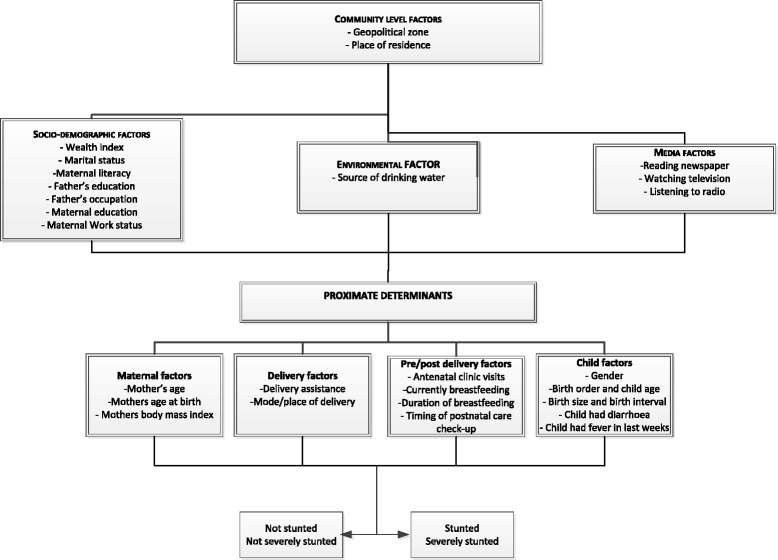
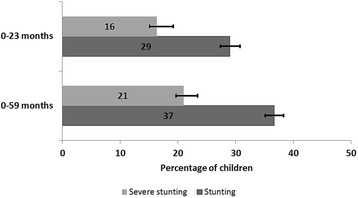
BACKGROUND: Stunting has been identified as one of the major proximal risk factors for poor physical and mental development of children under-5 years. Stunting predominantly occurs in the first 1000 days of life (0-23 months) and continues to the age of five. This study examines factors associated with stunting and severe stunting among children under-5 years in Nigeria. METHODS: The sample included 24,529 children aged 0-59 months from the 2013 Nigeria Demographic and Health Survey (NDHS). Height-for-age z-scores (HFAz), generated using the 2006 World Health Organisation (WHO) growth reference, were used to define stunting (HFAz < -2SD) and severe stunting (HFAz < -3SD). Multilevel logistic regression analyses that adjusted for cluster and survey weights were used to determine potential risk factors associated with stunting and severe stunting among children under-5 years in Nigeria. RESULTS: The prevalence of stunting and severe stunting were 29% [95% Confidence interval (Cl): 27.4, 30.8] and 16.4% [95%Cl: 15.1, 17.8], respectively for children aged 0-23 months, and 36.7% [95%Cl: 35.1, 38.3] and 21% [95%Cl: 19.7, 22.4], respectively for children aged 0-59 months. Multivariate analysis revealed that the most consistent significant risk factors for stunting and severe stunting among children aged 0-23 months and 0-59 months are: sex of child (male), mother's perceived birth size (small and average), household wealth index (poor and poorest households), duration of breastfeeding (more than 12 months), geopolitical zone (North East, North West, North Central) and children who were reported to having had diarrhoea in the 2 weeks prior to the survey [Adjusted odds ratio (AOR) for stunted children 0-23 months = 1.22 (95%Cl: 0.99, 1.49)];[AOR for stunted children 0-59 months = 1.31 (95%Cl: 1.16, 1.49)], [AOR for severely stunted children 0-23 months = 1.31 (95%Cl: 1.03, 1.67)]; [AOR for severely stunted children 0-59 months = 1.58 (95%Cl: 1.38, 1.82)]. CONCLUSIONS: In order to meet the post-2015 sustainable development goals, policy interventions to reduce stunting in Nigeria should focus on poverty alleviation as well as improving women's nutrition, child feeding practices and household sanitation.
Overview
The claims and statistics of this paper haven’t been checked yet.
Run the check — free, no account needed. It reads the open-access text and checks the sources it cites.
Integrity signals
Registry
Cites
Statistics
Figures
Verification
Claims the paper makes
The claims and statistics of this paper haven’t been checked yet.
Run the check — free, no account needed. It reads the open-access text and checks the sources it cites.
Claims other papers make about this one
Each is checked against this paper’s own text: does it say what the citing paper says it does?
In the citing paper
“Concretely, studies showed that maternal, or household access to clean water significantly reduced the risk of under-five mortality (Ahmed et al., 2016;Acheampong et al., 2017Acheampong et al., , 2018)), child stunting (Akombi et al., 2017;Vos et al., 2017;Marinda et al., 2018), schistosomiasis (Atalabi et al., 2016;Donohue et al., 2017), and hookworm infections (Baker et al., 2018).”
From A Systematic Review of Water and Gender Interlinkages: Assessing the Intersection With Health (2020) · cites this paper as Akombi et al., 2017
Self-check
Percentages, sums and reported differences re-computed from the paper’s own numbers.
The self-check needs the paper’s full text.
Citations
Cites
Maternal and child undernutrition and overweight in low-income and middle-income countries
Black, R. E., Victora, C. G., Walker, S. P., Bhutta, Z. A., Christian, P., de Onis, M., Ezzati, M., Grantham-McGregor, S., Katz, J., Martorell, R., et al. (2013) · The Lancet · doi:10.1016/s0140-6736(13)60937-x · Cited by 8,475
Filmer, D. P., & Pritchett, L. H. (2001) · Demography · doi:10.2307/3088292 · Cited by 5,992
Nigeria Demographic and Health Survey 2008
Macro, I. (2009) · Cited by 2,131
Contextualising complementary feeding in a broader framework for stunting prevention
Stewart, C. P., Iannotti, L. L., Dewey, K. G., Michaelsen, K. F., & Onyango, A. W. (2013) · Maternal and Child Nutrition · doi:10.1111/mcn.12088 · Cited by 834
Multilevel Modelling of Complex Survey Data
Rabe‐Hesketh, S., & Skrondal, A. (2006) · Journal of the Royal Statistical Society Series A (Statistics in Society) · doi:10.1111/j.1467-985x.2006.00426.x · Cited by 642
Hadgraft, N. T., Lynch, B. M., Clark, B., Healy, G. N., Owen, N. G., & Dunstan, D. W. (2015) · BMC Public Health · doi:10.1186/s12889-015-2243-y · Cited by 553
de Onís, M., Dewey, K. G., Borghi, E., Onyango, A. W., Blössner, M., Daelmans, B. M. E. G., Piwoz, E., & Branca, F. (2013) · Maternal and Child Nutrition · doi:10.1111/mcn.12075 · Cited by 404
Asfaw, M., Wondaferash, M., Taha, M., & Dube, L. (2015) · BMC Public Health · doi:10.1186/s12889-015-1370-9 · Cited by 329
Undernutrition in Sub‐Saharan Africa: Is there a gender bias?
Svedberg, P. (1990) · The Journal of Development Studies · doi:10.1080/00220389008422165 · Cited by 320
Ramli, R., Agho, K., Inder, K., Bowe, S. J., Jacobs, J., & Dibley, M. J. (2009) · BMC Pediatrics · doi:10.1186/1471-2431-9-64 · Cited by 266
Self-citation
Research works printed but not linked: 4
- UNICEF. State of the World’s Children Statistical Report. 2015.
- UNICEF, WHO, World Bank. Child Nutrition interactive dashboard. 2014.
- WHO, UNICEF. Progress on drinking water and sanitation: 2014 Update. Geneva: World Health Organization; 2014.
- Biswas S, Bose K. Association between place of delivery and undernutrition. Nutr Segment. 2011;1(1):154.
Cited by
Sorted by citations
Items 301–323 of 323
Marlinae, L., Arifin, S., Husaini, H., Muhayah, R., Hidayah, A. K., Khairiyati, L., Waskito, A., Berliana, J. D., & Setiyawan, B. (2024) · River Studies · doi:10.61848/rst.v2i2.81
Nweke, C. J., Odom, E. O., Nweke, C. B., & Elejere, A. E. (2024) · World Nutrition · doi:10.26596/wn.202415413-20
Kizito, M., Kansiime, N., Cherop, C., & Bagenda, F. N. (2025) · Journal of Food Innovation, Nutrition, and Environmental Sciences · doi:10.70851/jfines.2025.2(1).41.50
Rahman, M., Mia, M., Sadia, H., Emon, H. H., Khan, R., & Hossain, M. M. (2025) · SSRN Electronic Journal · doi:10.2139/ssrn.5122506
Yavuz, C. M., & Özer, B. K. (2025) · Ecology of Food and Nutrition · doi:10.1080/03670244.2025.2462907
Calgaro, S., Avagnina, I., Vettor, A., Zin, A., Girotto, C., Cebola, B. R., Muhelo, A. R., Rosato, I., Dalt, L. D., Putoto, G., et al. (2025) · Frontiers in Nutrition · doi:10.3389/fnut.2025.1553572
Mutiga, B. K., Njogu, E. W., & Kiio, J. (2025) · International Journal of Community Medicine and Public Health · doi:10.18203/2394-6040.ijcmph20252522
Rahman, M., Islam, M. W., Dutta, S., Rashid, M. M., Liza, F. A., Hossen, I., Mondal, A. P., Tabashsum, A., Mahdee, C. M., & Shahriar, F. (2025) · American Journal of Human Biology · doi:10.1002/ajhb.70156
Hastuti, A. P., Wahyusari, S., & Servitia, A. E. (2025) · Journal of Applied Nursing and Health · doi:10.55018/janh.v7i3.449
Vitamin A supplementation and nutritional status among children 6–36 months in Northern Ghana
Nonterah, E. W., Christian, A. K., Welaga, P., Chatio, S., Dalaba, M., Oduro, A. R., Bawah, A., & Nonterah, E. (2025) · Academia Nutrition and Dietetics · doi:10.20935/acadnutr8006
Mkungudza, J., Twabi, H. S., & Manda, S. (2024) · Figshare · doi:10.6084/m9.figshare.26758715
Mbae-Mugambi, U. K., Onyango, A. C., & Okeyo, D. O. (2023) · Figshare · doi:10.6084/m9.figshare.24264635
Anik, A. I., Chowdhury, M. R. K., Khan, H. T. A., Mondal, M. N. I., Perera, N. K. P., & Kader, M. (2021) · Figshare · doi:10.6084/m9.figshare.17073266
Rivadeneira, M. F., Moncayo, A. L., Cóndor, J. D., Tello, B., Buitrón, J., Astudillo, F., Caicedo-Gallardo, J. D., Estrella-Proaño, A., Naranjo-Estrella, A., & Torres, A. L. (2022) · Figshare · doi:10.6084/m9.figshare.21430887
Sanni, A. E., Sanni, O. F., Onyeagwaibe, C. I., Akeju, O. P., & Ahamuefula, T. (2025) · MGM Journal of Medical Sciences · doi:10.4103/mgmj.mgmj_48_25
Adeomi, A. A., & Ikujenlola, P. T. (2026) · Discover Public Health · doi:10.1186/s12982-026-01755-y
Ahmed, E., & Rahman, A. (2026) · Research Square · doi:10.21203/rs.3.rs-8871095/v1
Mekonnen, E. D., Birhan, N. A., & Belay, D. B. (2026) · Annals of Global Health · doi:10.5334/aogh.5256
Impact of Trust-Fund Credit Model on food security of farm families in Osun State
Kehinde, A. D., & Salawu, M. K. (2026) · Next research. · doi:10.1016/j.nexres.2026.102124
Akinsulie, J., Eshofonie, F., & Gayawan, E. (2026) · Discover Public Health · doi:10.1186/s12982-026-02457-1
Alim, V. I. A., Iriany, A., Fernandes, A. A. R., Nurdin, M. R. H., Zuhdi, M. R., & Yulianto, S. A. (2026) · Research in Statistics · doi:10.1080/27684520.2026.2719697
Nchanji, E. B., Ouya, F. O., Ketema, D. M., Waswa, B., Karanja, D., Muriithi, C., Ooro, P., Njiru, E., & Lutomia, C. K. (2026) · SSRN Electronic Journal · doi:10.2139/ssrn.7624962
Metadata
- Authors
- Akombi, B. J., Agho, K. E., Hall, J. J., Merom, D., Astell-Burt, T., & Renzaho, A. M. N.
- Affiliations
- Western Sydney University (AU)
- University of Newcastle Australia (AU)
- Venue
- BMC Pediatrics
- Published
- 2017-01-13
- Volume
- 17
- Issue
- 1
- Pages
- 15-15
- ISSN
- 1471-2431 (ISSN-L)
- PMC
- PMC5237247
- OpenAlex
- W2575304420
- Cited by
- 322
- References
- 37
- Citations by year
- 2026: 10 · 2025: 17 · 2024: 51 · 2023: 73 · 2022: 56 · 2021: 44 · 2020: 37 · 2019: 21 · 2018: 7 · 2017: 6
- FWCI
- 16.15
- Type
- journal article
- Language
- en
- Open access
- gold
- doi.org
- Licence
- cc-by
- Locations
- BMC Pediatrics (publishedVersion, cc-by)
- PubMed Central (publishedVersion, cc-by)
- PubMed (publishedVersion)
- NOVA (University of Newcastle Australia) (submittedVersion, cc-by)
- Research Online (University of Wollongong) (submittedVersion)
- Figshare (submittedVersion)
- Figshare (submittedVersion, cc-by)
- Funders
- Western Sydney University
- Topics
- Health Sciences › Nursing › Nutrition and Dietetics › Child Nutrition and Water Access
- Health Sciences › Medicine › Pediatrics, Perinatology and Child Health › Public Health and Nutrition
- Health Sciences › Medicine › Pediatrics, Perinatology and Child Health › Global Maternal and Child Health
- Keywords
- child stunting, severe stunting, children under five, risk factors for stunting, breastfeeding duration, diarrhea, household wealth, sex of child, Nigeria, height-for-age z-score, first 1000 days, under-five malnutrition, geopolitical zones, multilevel analysis
- MeSH terms
- Child, Preschool, Cross-Sectional Studies, Female, Growth Disorders, Health Surveys, Humans, Infant, Infant, Newborn, Male, Nigeria, Risk Factors, Severity of Illness Index, Prevalence, Multivariate Analysis, Logistic Models
About these checks
Registry, retraction, Cites and statistics results are computed, not judged, with one exception: a printed reference that no index lists is read once by a model before it counts as a citation error. Claims are extracted by a model and kept only when their quote appears verbatim in the text; each cited source is then checked, with a model’s help, for whether it says what the claim relies on. Those verdicts can be wrong — read the claim’s quote and the cited source before relying on one.
Statistics and arithmetic are recomputed, not judged.
Confidence bands are shown only for fields calibrated on our annotated test set. None is calibrated yet, so no band is shown.
What counts as a claim ›How we measure confidence ›How we check this ›
Are you an author, or do you see a problem with this page? Request a review
