

Determinants of dropout in a community-based mental health crisis centre
Open accessThe DOI matches its Crossref record; 34 of the 34 references it cites were found in a registry or an index; 5 of the 22 sources its claims cite were checked for support.
Abstract
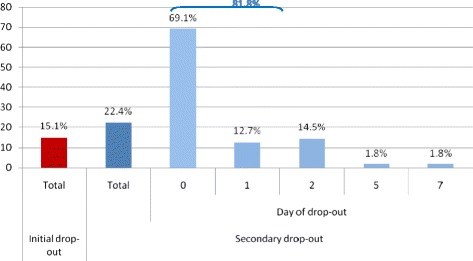
Background: Dropping out during the course of medical follow up is defined as an early therapy withdrawal without the agreement of the therapist. In a psychiatric crisis unit in Geneva, we empirically observed that almost 50 % of the patients were not showing up to their first appointments, which were scheduled for 3 to 7 days post discharge. Methods: The aim of this naturalistic descriptive cohort study is to identify the demographic, patient and care-related predictive factors of dropout in a community-based psychiatric crisis centre. We included 245 consecutive outpatients followed-up for 4 to 6 weeks of intensive outpatient psychiatric treatment. Logistic regression models were built to examine the association between dropout and demographic, care and patient-related variables. Results: Among the 245 outpatients, dropout occurred in 37.5 % of cases, and it most frequently occurred (81.8 %) in the first 2 days of follow-up. Among care-related variables, referral by hospital units or private psychiatrists led to significantly lower levels of dropout compared to patients referred by the psychiatric emergency unit (respectively: OR = .32; p = .04; 95 % CI [.10,.93]; OR = .36; p = .04; 95 % CI [.13,.96]; OR = .22; p = .002; 95 % CI [.08,.58]). Among patient-related variables, younger age increased the risk of dropout (OR = .96; 95 %; p = .002; 95 % CI [.94,.99]). Anxiety and personality but not mood disorders were also related to higher rates of dropout (respectively: OR = 2.40; p = .02; 95 % CI [1.14, 4.99]; and OR = 1.98; p = .02; 95 % CI [1.09, 3.59]). Unipolar depression (72.2 %; OR = 1.47; p = .48; 95 % CI [.34, 1.21]) was the most frequent primary diagnosis in this sample. Conclusions: This study makes clear the need for increased efforts to improve care adherence in young patients with anxious or personality disorders seen in emergency rooms because they are prone to early discontinuation of treatments. Future studies in this field are warranted to gain a better understanding into the complex reasons that surround discontinuation of care in outpatient settings. © 2016 Henzen et al.
Overview
CoChat Summary
## TL;DR
This naturalistic cohort study of 245 consecutive outpatients in a Geneva psychiatric crisis centre found a 37.5% dropout rate, with 81.8% of dropouts occurring in the first 2 days of follow-up. Younger age, anxiety or personality disorder, and referral via psychiatric emergency services were associated with higher dropout risk, while referral by private psychiatrists was protective in multivariable analysis.
## Key findings
- Among 245 outpatients, dropout occurred in 37.5% of cases, and 81.8% of dropouts happened within the first 2 days of follow-up.
- In univariate analyses, referral by the hospital crisis unit, psychiatric hospital, or private psychiatrists was associated with lower dropout than referral by psychiatric emergency services (ORs 0.32, 0.36, and 0.22, respectively; all p values ≤ .04).
- Younger age increased dropout risk (OR 0.96 per year; p = .002), and in a one-way analysis the “less than 30 years” group differed significantly from the 50–60 and >60 groups.
- Anxiety disorders (OR 2.40, p = .02) and personality disorders (OR 1.98, p = .02) were associated with higher dropout, while mood disorders were not; in multivariable analysis, only referral by private psychiatrists remained significant (OR 0.26, p = .005).
## Methods
- Naturalistic descriptive cohort study in the crisis unit of a public psychiatry centre in Geneva; 245 consecutive outpatients received 4 to 6 weeks of intensive outpatient psychiatric treatment.
- Dropout was defined as initial non-attendance for the first appointment or care discontinuation after the first or second consultation; if follow-up reached 7 days, early discontinuation was not counted as dropout.
- The authors compared demographic, care-related, and patient-related variables using chi-square tests, ANOVA, and logistic regression; diagnoses were made by two independent board-certified psychiatrists using ICD-10 criteria.
## Limitations
- The paper states that limitations include lack of clinical data for initial non-attendance patients and their social functioning, absence of structured interviews to support the diagnoses, and that the crisis-setting sample is not representative of the whole spectrum of patients followed-up in community-based facilities.
- From the text, the study is limited to a single centre in Geneva and a short follow-up period of 4 to 6 weeks; this constrains generalizability beyond this setting.
Model-written summary. Check it against the paper before relying on it.
Integrity signals
Registry
Cites
Statistics
Figures
Verification
Claims the paper makes
5 Valid · 0 Not valid · 10 Not checked · 31 Own results and interpretations
The cited sources support only part of this claim — read each source’s verdict below.
In the paper
“Personality disorders are one of the main predictive factors of dropout [17].”
§ Determinants of dropout in a community-based mental health crisis centre > Background
What the sources say
- Partly supportedcites [17] Martino F Menchetti M Pozzi E Berardi D Predictors of dropout among personality disorders in a specialist outpatients psychosocial treatment: A preliminary study Psychiatry Clin Neurosci 2012 66 3 180 6 10.1111/j.1440-1819.2012.02329.x 22443241 sourceExperimental — accuracy not yet measured
The Abstract and Results (paper pp. 180–186) identify borderline personality disorder (BPD) diagnosis as associated with dropout among patients already diagnosed with a personality disorder. They do not establish that personality disorders generally predict dropout compared with having no personality disorder; the claim broadens a finding about BPD within this sample. (LLM, conf=0.87)
plainstates an association- Asserted: passes — The authors put it forward as true.
- Checkable: passes — It can be checked against evidence.
- Load-bearing: unclear — It is unclear whether the paper’s conclusions depend on it.
- Based: passes — The paper gives a reason why it holds.
- Partly supported
A result the paper reports from its own data — it cites no other source for it, so there is none to check. The quote shows it is in the paper.
In the paper
“The dropout rate was not significantly influenced by the patient’s psychiatric history, past suicide thoughts, past history of suicide attempts, or substance abuse-related disorders.”
§ Determinants of dropout in a community-based mental health crisis centre > Results > Univariate regression analysis
plain- Asserted: passes — The authors put it forward as true.
- Checkable: passes — It can be checked against evidence.
- Load-bearing: unclear — It is unclear whether the paper’s conclusions depend on it.
- Based: passes — The paper gives a reason why it holds.
A result the paper reports from its own data — it cites no other source for it, so there is none to check. The quote shows it is in the paper.
In the paper
“Among patient-related variables, younger age raised the risk of dropout (OR = .96; 95 %; p = .002; 95 % CI [.94, .99]).”
§ Determinants of dropout in a community-based mental health crisis centre > Results > Univariate regression analysis
plainstates a cause- Asserted: passes — The authors put it forward as true.
- Checkable: passes — It can be checked against evidence.
- Load-bearing: passes — The paper’s conclusions depend on it.
- Based: passes — The paper gives a reason why it holds.
A result the paper reports from its own data — it cites no other source for it, so there is none to check. The quote shows it is in the paper.
In the paper
“There was no effect of gender, education, or other demographic variables on the risk of dropout.”
§ Determinants of dropout in a community-based mental health crisis centre > Results > Univariate regression analysis
plain- Asserted: passes — The authors put it forward as true.
- Checkable: passes — It can be checked against evidence.
- Load-bearing: unclear — It is unclear whether the paper’s conclusions depend on it.
- Based: passes — The paper gives a reason why it holds.
A result the paper reports from its own data — it cites no other source for it, so there is none to check. The quote shows it is in the paper.
In the paper
“Only referral by private psychiatrists was associated with lower rates of dropout, compared to patients sent by psychiatric emergencies (OR = .26; p = .005; 95 % CI [.09, .67]).”
§ Determinants of dropout in a community-based mental health crisis centre > Results > Multivariate regression analysis
plainstates an association- Asserted: passes — The authors put it forward as true.
- Checkable: passes — It can be checked against evidence.
- Load-bearing: passes — The paper’s conclusions depend on it.
- Based: passes — The paper gives a reason why it holds.
22 more claims
Create a free account to see all 46 claims and to verify the 1 reference still open.
- Probably not a substantial claim. 18
- It may state two separate claims as one. 5
Statistics recomputed
Every reported test result, recomputed from its test statistic and degrees of freedom. A result shows as not adding up only once an independent check has confirmed it.
- Consistentt(96.75) = 2.38reported p = .02 · recomputed p = .019
“t (96.75) = 2.38, p = .020”
- Consistentt(27.97) = 2.41reported p = .023 · recomputed p = .023
“t (27.97) = 2.41, p = .023”
Self-check
Percentages, sums and reported differences re-computed from the paper’s own numbers.
Self-check results appear here once an independent check has confirmed them.
Citations
Cites
Development and validation of the working alliance inventory
Horvath, A. O., & Greenberg, L. S. (1989) · Journal of Counseling Psychology · doi:10.1037//0022-0167.36.2.223 · Cited by 3,520 · cited 1×
“It is likely that once the medical follow up is organized, dropout is rare, possibly due to an increase of the therapeutic alliance: patients who did not feel they established a positive relationship with the therapist are unlikely to come back and they may end therapy prematurely [33].”
BackgroundThe role of the therapeutic alliance in psychotherapy.
Horvath, A. O., & Luborsky, L. (1993) · Journal of Consulting and Clinical Psychology · doi:10.1037/0022-006x.61.4.561 · Cited by 1,279 · cited 1×
“Among the care-related predictors, delay between referral and first consultation (less or more than 24 h) and referral type were considered to explore whether treatment timeliness and the referring provider impact on dropout occurrence in this community-based setting [24–29].”
BackgroundA meta-analysis of psychotherapy dropout
Wierzbicki, M., & Pekarik, G. (1993) · Professional Psychology: Research and Practice · doi:10.1037/0735-7028.24.2.190 · Cited by 1,118 · cited 5×
“Kolb et al. [10] defined dropout as missing two consecutive sessions; Hatchett et al. [11] defined it as not attending the last scheduled session; Longo et al. [12] defined it as not returning after a preliminary interview; and Pekarik [13] defined it as cessation of therapy without the agreement of the therapist, reg…”
BackgroundInfluentialPremature discontinuation in adult psychotherapy: A meta-analysis
Swift, J. K., & Greenberg, R. P. (2012) · Journal of Consulting and Clinical Psychology · doi:10.1037/a0028226 · Cited by 978 · cited 2×
“5 % rate of dropout in the present sample, a percentage in line with those reported previously in community-based outpatient settings [3–6, 30].”
ResultEarly withdrawal from mental health treatment: Implications for psychotherapy practice.
Barrett, M. S., Chua, W.-J., Crits-Christoph, P., Gibbons, M. B., & Thompson, D. (2008) · Psychotherapy: Theory, Research, Practice, Training · doi:10.1037/0033-3204.45.2.247 · Cited by 564 · cited 1×
“[15] reported that among 100 patients in a care centre, only half of them would return after a first assessment, no more than one-third would return after the first therapy session, only 20 of them would come to the third meeting, and under 17 would complete more than * Correspondence: o.”
BackgroundEdlund, M. J., Wang, P. S., Berglund, P. A., Katz, S. J., Lin, E., & Kessler, R. C. (2002) · American Journal of Psychiatry · doi:10.1176/appi.ajp.159.5.845 · Cited by 439 · cited 4×
“Estimated prevalence varies from 15 to 60 % [3–6] and is even higher among young people [4, 7–9], particularly in the age group of 15–24 years [4].”
BackgroundResultInfluentialThe concept of the alliance and its role in psychotherapy: Theoretical and empirical considerations.
Gaston, L. (1990) · Psychotherapy: Theory, Research, Practice, Training · doi:10.1037/0033-3204.27.2.143 · Cited by 410 · cited 1×
“Among the care-related predictors, delay between referral and first consultation (less or more than 24 h) and referral type were considered to explore whether treatment timeliness and the referring provider impact on dropout occurrence in this community-based setting [24–29].”
BackgroundProspective controlled study of psychiatric out-patient non-attendance: Characteristics and outcome
Killaspy, H., Banerjee, S., King, M., & Lloyd, M. (2000) · British Journal of Psychiatry · doi:10.1192/bjp.176.2.160 · Cited by 325
CASTELNUOVO-TEDESCO, P. (1977) · American Journal of Psychiatry · doi:10.1176/ajp.134.10.1173 · Cited by 185
Are Adolescent Suicide Attempters Noncompliant with Outpatient Care?
TRAUTMAN, P. D., STEWART, N., & MORISHIMA, A. (1993) · Journal of the American Academy of Child & Adolescent Psychiatry · doi:10.1097/00004583-199301000-00013 · Cited by 155 · cited 2×
“Estimated prevalence varies from 15 to 60 % [3–6] and is even higher among young people [4, 7–9], particularly in the age group of 15–24 years [4].”
BackgroundResult
Research works printed but not linked: 2
- Freud S Le début de traitement. 1913. « Sur l’engagement du traitement », Œuvres complètes, 12 2005 Paris P.U.F
- Etchegoyen H Fondements de la technique psychanalytique 2005 Paris Hermann
Cited by
Ensuring mental health care during the SARS-CoV-2 epidemic in France: A narrative review
Chevance, A., Gourion, D., Hoertel, N., Llorca, P.-M., Thomas, P., Bocher, R., Moro, M.-R., Laprévote, V., Benyamina, A., Fossati, P., et al. (2020) · L'Encéphale · doi:10.1016/j.encep.2020.04.005 · Cited by 273
“Les ruptures de soins en psychiatrie sont fréquentes en contexte de fonctionnement habituel du système de soins psychiatriques (38,39).”
Chevance, A., Gourion, D., Hoertel, N., Llorca, P.-M., Thomas, P., Bocher, R., Moro, M.-R., Laprévote, V., Benyamina, A., Fossati, P., et al. (2020) · L'Encéphale · doi:10.1016/j.encep.2020.03.001 · Cited by 218
Seidler, Z. E., Wilson, M. J., Kealy, D., Oliffe, J. L., Ogrodniczuk, J. S., & Rice, S. (2021) · American Journal of Men s Health · doi:10.1177/15579883211014776 · Cited by 96
“Younger age, unemployment, low income, ethnic minority status, lower educational attainment, more severe symptoms, and doubt regarding the effectiveness of therapy have consistently been linked to greater risk of dropout among mixed-gender samples (Edlund et al., 2002; Egan & Kenny, 2005; Henzen et al., 2016; Linardon…”
BackgroundResultMobile Telemedicine for Buprenorphine Treatment in Rural Populations With Opioid Use Disorder
Weintraub, E., Seneviratne, C., Anane, J. S., et al. (2021) · JAMA Network Open · doi:10.1001/jamanetworkopen.2021.18487 · Cited by 59
Seo, J. H., Kim, S. J., Lee, M., & Kang, J. I. (2021) · Journal of Affective Disorders · doi:10.1016/j.jad.2021.04.070 · Cited by 66
Understanding Men’s Engagement and Disengagement When Seeking Support for Mental Health
Kwon, M., Lawn, S., & Kaine, C. (2023) · American Journal of Men s Health · doi:10.1177/15579883231157971 · Cited by 64
“There are non-gender-specific papers and literature reviews addressing the issue of ‘‘dropout,’’ which highlight the importance of therapeutic alliance, systematic approaches, and patient-centered holistic care (Barrett et al., 2008; Chen et al., 2017; Cooper & Colkins, 2015; Henzen et al., 2016).”
BackgroundCarpallo-González, M., Muñoz‐Navarro, R., González‐Blanch, C., & Vindel, A. C. (2023) · International Journal of Clinical and Health Psychology · doi:10.1016/j.ijchp.2023.100379 · Cited by 21
Smith, M. J., Francq, B., McConnachie, A., Wetherall, K., Pelosi, A. J., & Morrison, J. (2020) · BMC Psychiatry · doi:10.1186/s12888-020-02532-0 · Cited by 11
Discrimination challenges and psychological well-being of black African queer employees
Tshisa, N., & van der Walt, F. (2021) · SA Journal of Industrial Psychology · doi:10.4102/sajip.v47i0.1835 · Cited by 13
Elugbadebo, O. O., Ojagbemi, A., Adefolarin, A. O., & Gureje, O. (2021) · Community Mental Health Journal · doi:10.1007/s10597-020-00768-4 · Cited by 14
Merius, H. N., & Rohan, A. (2017) · Journal of Community Health Nursing · doi:10.1080/07370016.2017.1369811 · Cited by 7
Hoej, M., Johansen, K. S., Olesen, B. R., & Arnfred, S. (2017) · Qualitative Health Research · doi:10.1177/1049732317717962 · Cited by 7
Bonnier, R., Beames, J. R., Kiekens, G., van Aubel, E., Schirmbeck, F. N., de Haan, L., Marcelis, M. C., van der Gaag, M., van Winkel, R., van Amelsvoort, T., et al. (2025) · Translational Psychiatry · doi:10.1038/s41398-024-03214-1 · Cited by 7
Khan, J., Khan, J., Kumari, S., & Charan, D. (2024) · Cureus · doi:10.7759/cureus.54495 · Cited by 10
“Contrary to our study, the majority of previous studies involving individuals with mental illness found that younger age was a prominent factor contributing to treatment non-adherence [33,34].”
BackgroundResultFactors influencing emerging adults' use of outpatient mental health services
Black, S. R., Fristad, M. A., Arnold, L. E., Birmaher, B., Findling, R. L., Youngstrom, E. A., & Horwitz, S. M. (2019) · Evidence-Based Practice in Child and Adolescent Mental Health · doi:10.1080/23794925.2018.1501328 · Cited by 4
“Anxiety, substance use, and personality disorders have also been shown to be associated with treatment discontinuation in adults, as well as psychiatric comorbidities (diagnosis of two or more classes of psychiatric disorders; Henzen et al., 2016; Olfson et al., 2009).”
BackgroundGao, L., Keller, F. M., Becker, P., Dahmen, A., & Lippke, S. (2023) · Journal of Medical Internet Research · doi:10.2196/43584 · Cited by 5
“Participants experiencing mental health problems such as anxiety and depression [30,31] were more likely to drop out of the study because they could have difficulties (eg, motivational deficits) in completing the surveys.”
Zanello, A., Berthoud, L., & Bacchetta, J.-P. (2017) · BMC Psychiatry · doi:10.1186/s12888-017-1293-3 · Cited by 4
“The majority of patients was addressed to the CIC by the emergency unit of the hospital or by private practitioners which is in accordance with previous findings [15, 22, 50, 51, 53], because the patients had attempted to commit suicide, had suicidal ideation or presented depressed mood due to relational difficulties…”
ResultBartolomei, J., Baeriswyl-Cottin, R., Framorando, D., Zanello, A., Bacchetta, J.-P., Herrmann, F. R., & Sentissi, O. (2020) · Journal of Psychiatric Practice · doi:10.1097/pra.0000000000000442 · Cited by 3
Self-citationSidana, A. K., Agrawal, A., & Kaur, J. (2023) · World Social Psychiatry · doi:10.4103/wsp.wsp_12_22 · Cited by 3
Grammeniati, A., Mantziou, A., & Peritogiannis, V. (2024) · International Journal of Social Psychiatry · doi:10.1177/00207640231212097 · Cited by 2
“This finding is also in line with previous research (Henzen et al., 2016; Shamir et al., 2010).”
ResultDeciding to Leave Care Is Not Dropout: The Emerging Adult Perspective
Green, S., Boothroyd, R. A., Armstrong, M. I., Levin, B. L., Tyson, D. M., & Massey, O. T. (2022) · Families in Society The Journal of Contemporary Social Services · doi:10.1177/10443894211062646 · Cited by 2
“Between 30% and 50% of clients who attend an initial therapy session never return (Henzen et al., 2016) and emerging adults are more likely to drop out of behavioral health treatment when compared with both adolescents and older adults (Edlund et al.”
BackgroundDalrymple, K. L., Wahrer, K. S., Walsh, E., Rosenstein, L., & Zimmerman, M. (2023) · Journal of Cognitive Psychotherapy · doi:10.1891/jcp-2022-0014 · Cited by 1
Ettman, C. K., Lupton‐Smith, C., Goicoechea, E. B., Dohlman, P., Ringlein, G., Straub, J., Sthapit, S., Mojtabai, R., Spivak, S., Albert, M., et al. (2025) · Psychiatry Research · doi:10.1016/j.psychres.2025.116354 · Cited by 1
Stajić, M., & Maksimović, Ž. (2019) · Scripta Medica · doi:10.5937/scriptamed50-22410 · Cited by 1
Estudo sobre abandono e não adesão ao tratamento em Centros de Atenção Psicossocial
Bandeira, N., Treichel, C. A. D. S., & Campos, R. T. O. (2020) · Saúde em Debate · doi:10.1590/0103-11042020e310 · Cited by 1
Experiencing some Improvement is Associated with Premature Therapy Dropout
Romero, M., Casadevante, C., & Luque, A. (2022) · Escritos de Psicología / Psychological Writings · doi:10.24310/espsiescpsi.v15i2.14736 · Cited by 2
“However, there are significant difficulties among researchers in finding consensus on the definition of therapeutic dropout (Hamilton et al., 2011; Henzen et al., 2016; Kareckla et al., 2019; Wierzbicki & Pekarik, 1993).”
Hobden, B., Pollock, L., Lau, V., Leask, S., & Fakes, K. (2025) · Behaviour Research and Therapy · doi:10.1016/j.brat.2025.104875 · Cited by 1
Panek, A., Butler, E. J., Jensen‐Doss, A., Ehrenreich, J. T., & Ginsburg, G. S. (2025) · Child and Adolescent Psychiatry and Mental Health · doi:10.1186/s13034-025-00970-w · Cited by 1
“Two understudied reasons for the lack of response in community settings are high dropout rates and low compliance with treatment expectations [27, 48].”
Kirk, A., King, C. S., Gallop, R., Doan, B. D., Rowe, L. S., Rivera, M., & Randa, L. E. (2026) · doi:10.2196/preprints.92448
Kirk, A., King, C. S., Gallop, R., Doan, B. D., Rowe, L. S., Rivera, M., & Randa, L. E. (2026) · JMIR Human Factors · doi:10.2196/92448
“In addition, the 100% retention rate also speaks to the acceptability and engagement of the treatment itself, given that treatment retention is often an issue both in research [65] and clinical [66] settings.”
Identifying Patients at Risk for Psychotherapy Dropout in Community Settings
Giber, B., Sharma, A., Broadie, D., McCoy, T. H., Gunning, F. M., Perlis, R. H., Doshi‐Velez, F., & Solomonov, N. (2026) · JAMA Network Open · doi:10.1001/jamanetworkopen.2026.31565 · Cited by 1
Metadata
- Authors
- Henzen, A., Moeglin, C., Giannakopoulos, P., & Sentissi, O.
- Affiliations
- University Hospital of Geneva (CH)
- Corresponding author
- Sentissi, Othman
- Venue
- BMC Psychiatry
- Published
- 2016-04-19
- Volume
- 16
- Issue
- 1
- Pages
- 111-111
- ISSN
- 1471-244X (ISSN-L)
- PMC
- PMC4837516
- OpenAlex
- W2341193100
- Cited by
- 31
- References
- 34
- Citations by year
- 2026: 3 · 2025: 4 · 2024: 2 · 2023: 5 · 2022: 2 · 2021: 5 · 2020: 5 · 2019: 1 · 2018: 1 · 2017: 3
- FWCI
- 2.23
- Type
- journal article
- Language
- en
- Open access
- gold
- doi.org
- Licence
- cc-by
- Locations
- BMC Psychiatry (publishedVersion, cc-by)
- PubMed Central (publishedVersion, cc-by)
- PubMed (publishedVersion)
- Topics
- Social Sciences › Psychology › Clinical Psychology › Psychiatric care and mental health services
- Health Sciences › Medicine › Psychiatry and Mental health › Mental Health Treatment and Access
- Social Sciences › Psychology › Clinical Psychology › Psychotherapy Techniques and Applications
- Keywords
- dropout, medication adherence, psychiatric emergency unit, referral sources, anxiety disorders, personality disorders, major depressive disorder, young patients, predictors of dropout, community mental health services, follow-up visits, Switzerland, Geneva
- MeSH terms
- Adult, Aged, Mental Disorders, Community Mental Health Centers, Female, Follow-Up Studies, Humans, Male, Middle Aged, Outpatients, Patient Acceptance of Health Care, Patient Dropouts, Cohort Studies
About these checks
Registry, retraction, Cites and statistics results are computed, not judged, with one exception: a printed reference that no index lists is read once by a model before it counts as a citation error. Claims are extracted by a model and kept only when their quote appears verbatim in the text; each cited source is then checked, with a model’s help, for whether it says what the claim relies on. Those verdicts can be wrong — read the claim’s quote and the cited source before relying on one.
The claim verdicts this report counts are experimental: their accuracy is not yet measured.
A language model drew the claims from the paper on 2026-10-11, under version 3 of the claim definition (model deepseek-v4.1-flash, prompt extract-v3).
A second model labelled each claim on 2026-10-11 (model jev-1.13-20260917, definition revision gold-guideline-v0.2).
Cited sources are checked with a language model’s help (gpt-6-sol).
Statistics and arithmetic are recomputed, not judged.
Confidence bands are shown only for fields calibrated on our annotated test set. None is calibrated yet, so no band is shown.
What counts as a claim ›How we measure confidence ›How we check this ›
Are you an author, or do you see a problem with this page? Request a review
Data sources
Bibliographic data: Semantic Scholar, OpenAlex, Crossref.
Contains information from the Semantic Scholar Academic Graph Datasets, made available under the ODC Attribution License (ODC-BY 1.0).
Semantic Scholar’s data is described in: Kinney, R., et al. (2023). The Semantic Scholar Open Data Platform. arXiv:2301.10140.
