

The DOI matches its Crossref record; 79 of the 80 references it cites were found in a registry or an index.
Gut to brain interaction in Autism Spectrum Disorders: a randomized controlled trial on the role of probiotics on clinical, biochemical and neurophysiological parameters
Open accessAbstract
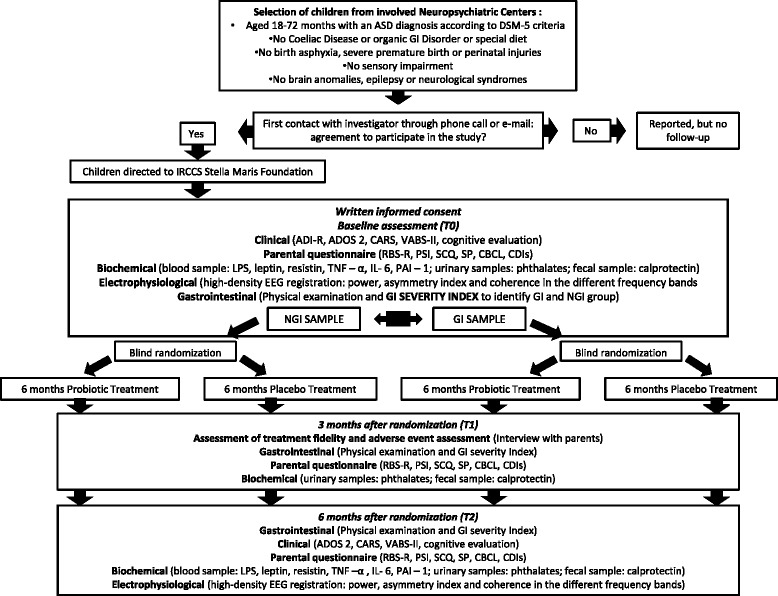
BACKGROUND: A high prevalence of a variety of gastrointestinal (GI) symptoms is frequently reported in patients with Autism Spectrum Disorders (ASD). The GI disturbances in ASD might be linked to gut dysbiosis representing the observable phenotype of a "gut-brain axis" disruption. The exploitation of strategies which can restore normal gut microbiota and reduce the gut production and absorption of toxins, such as probiotics addition/supplementation in a diet, may represent a non-pharmacological option in the treatment of GI disturbances in ASD. The aim of this randomized controlled trial is to determine the effects of supplementation with a probiotic mixture (Vivomixx®) in ASD children not only on specific GI symptoms, but also on the core deficits of the disorder, on cognitive and language development, and on brain function and connectivity. An ancillary aim is to evaluate possible effects of probiotic supplementation on urinary concentrations of phthalates (chemical pollutants) which have been previously linked to ASD. METHODS: A group of 100 preschoolers with ASD will be classified as belonging to a GI group or to a Non-GI (NGI) group on the basis of a symptom severity index specific to GI disorders. In order to obtain four arms, subjects belonging to the two groups (GI and NGI) will be blind randomized 1:1 to regular diet with probiotics or with placebo for 6 months. All participants will be assessed at baseline, after three months and after six months from baseline in order to evaluate the possible changes in: (1) GI symptoms; (2) autism symptoms severity; (3) affective and behavioral comorbid symptoms; (4) plasmatic, urinary and fecal biomarkers related to abnormal intestinal function; (5) neurophysiological patterns. DISCUSSION: The effects of treatments with probiotics on children with ASD need to be evaluated through rigorous controlled trials. Examining the impact of probiotics not only on clinical but also on neurophysiological patterns, the current trial sets out to provide new insights into the gut-brain connection in ASD patients. Moreover, results could add information to the relationship between phthalates levels, clinical features and neurophysiological patterns in ASD. TRIAL REGISTRATION: ClinicalTrials.gov Identifier: NCT02708901 . Retrospectively registered: March 4, 2016.
Overview
The claims and statistics of this paper haven’t been checked yet.
Run the check — free, no account needed. It reads the open-access text and checks the sources it cites.
Integrity signals
Registry
Cites
Statistics
Figures
Verification
Claims the paper makes
The claims and statistics of this paper haven’t been checked yet.
Run the check — free, no account needed. It reads the open-access text and checks the sources it cites.
Claims other papers make about this one
Each is checked against this paper’s own text: does it say what the citing paper says it does?
The source backs part of the claim, not all of it — or backs it for a different population, condition or comparison.
In the citing paper
“In the case of impaired BBB, which can be observed in certain (but not all) autistic subjects [37,254], LPS or SCFAs may cause brain inflammation and thus, further facilitate access to the brain for harmful substances, like heavy metals, that can accumulate there [228,246,255].”
From The Role of Microbiota-Gut-Brain Axis in Neuropsychiatric and Neurological Disorders (2021) · cites this paper as [255]
Experimental — accuracy not yet measured
Self-check
Percentages, sums and reported differences re-computed from the paper’s own numbers.
The self-check needs the paper’s full text.
Citations
Cites
Diagnostic and Statistical Manual of Mental Disorders
American Psychiatric Association (2013) · doi:10.1176/appi.books.9780890425596 · Cited by 116,369
Diagnostic and Statistical Manual of Mental Disorders
Williams, J. B. W., & First, M. B. (2013) · Oxford University Press eBooks · doi:10.1093/acrefore/9780199975839.013.104 · Cited by 109,845
Changes of Intestinal Functions in Liver Cirrhosis
Fukui, H., & Wiest, R. (2016) · Inflammatory Intestinal Diseases · doi:10.1159/000444436 · Cited by 6,820
Mind-altering microorganisms: the impact of the gut microbiota on brain and behaviour
Cryan, J. F., & Dinan, T. G. (2012) · Nature Reviews Neuroscience · doi:10.1038/nrn3346 · Cited by 4,572
Gut microbiota in health and disease
Sekirov, I., Russell, S. L., Antunes, L. C. M., & Finlay, B. B. (2010) · Physiological Reviews · doi:10.1152/physrev.00045.2009 · Cited by 4,182
Normal gut microbiota modulates brain development and behavior
Heijtz, R. D., Wang, S., Anuar, F., Qian, Y., Björkholm, B., Samuelsson, A., Hibberd, M. L., Forssberg, H., & Pettersson, S. (2011) · Proceedings of the National Academy of Sciences · doi:10.1073/pnas.1010529108 · Cited by 3,228
Cyclosporine in Severe Ulcerative Colitis Refractory to Steroid Therapy
Lichtiger, S., Present, D. H., Kornbluth, A. A., Gelernt, I. M., Bauer, J. J., Galler, G. W., Michelassi, F., & Hanauer, S. B. (1994) · New England Journal of Medicine · doi:10.1056/nejm199406303302601 · Cited by 1,715
Autism Diagnostic Observation Schedule
Lord, C., Rutter, M. L., Goode, S., Heemsbergen, J., Jordan, H., Mawhood, L., & Schopler, E. (1989) · PsycTESTS Dataset · doi:10.1037/t54175-000 · Cited by 1,697
Standardizing ADOS Scores for a Measure of Severity in Autism Spectrum Disorders
Gotham, K., Pickles, A., & Lord, C. (2009) · Journal of Autism and Developmental Disorders · doi:10.1007/s10803-008-0674-3 · Cited by 1,605
Gut/brain axis and the microbiota
Mayer, E. A., Tillisch, K., & Gupta, A. (2015) · Journal of Clinical Investigation · doi:10.1172/jci76304 · Cited by 1,503
Research works printed but not linked: 5
- Lord C, Rutter M, Di Lavore PC, Risi S, Gotham K, Bishop SL. Autism and Diagnostic Observation Schedule, Second Edition (ADOS-2) Manual (Part I): Modules 1–4. Torrance, CA: Western Psychological Services; 2012.
- Rutter M, Le Couteur A, Lord C. ADI-R: The autism diagnostic interview-revised. Los Angeles, CA: Western Psychological Services; 2003.
- Rutter M, Bailey A, Lord C. Social communication questionnaire (SCQ). Los Angeles: Western Psychological Services; 2003.
- Abidin RR. Parenting Stress Index - Short Form (3rd edition). Odessa, FL: Psychological Assessment Resources Inc; 1995.
- Fenson L, Dale PS, Reznick JS, Thal D, Bates E, Hartung JP, Pethick S, Reilly JS. MacArthur Communicative Development Inventories: User’s guide and technical manual. San Diego, CA: Singular Press; 1993.
Cited by
Sorted by citations
The gut microbiota–brain axis in behaviour and brain disorders
Morais, L. H., Schreiber, H. L., & Mazmanian, S. K. (2021) · Nature Reviews Microbiology · doi:10.1038/s41579-020-00460-0 · Cited by 2,149
Identification, Evaluation, and Management of Children With Autism Spectrum Disorder
Hyman, S. L., Levy, S. E., Myers, S. M., COUNCIL ON CHILDREN WITH DISABILITIES, S. O. D. A. B. P., Kuo, D. Z., Apkon, S., Davidson, L. F., Ellerbeck, K. A., Foster, J. E. A., Noritz, G. H., et al. (2020) · Pediatrics · doi:10.1542/peds.2019-3447 · Cited by 1,798
The Role of Microbiota-Gut-Brain Axis in Neuropsychiatric and Neurological Disorders
Socała, K., Doboszewska, U., Szopa, A., Serefko, A., Włodarczyk, M., Zielińska, A., Poleszak, E., Fichna, J., & Wlaź, P. (2021) · Pharmacological Research · doi:10.1016/j.phrs.2021.105840 · Cited by 857
A Comprehensive Review on the Role of the Gut Microbiome in Human Neurological Disorders
Sorboni, S. G., Moghaddam, H. S., Esfehani, R. J., & Soleimanpour, S. (2022) · Clinical Microbiology Reviews · doi:10.1128/cmr.00338-20 · Cited by 586
Autism Spectrum Disorders and the Gut Microbiota
Fattorusso, A., Di Genova, L., Dell’Isola, G., Mencaroni, E., & Esposito, S. (2019) · Nutrients · doi:10.3390/nu11030521 · Cited by 484
Metadata
- Authors
- Santocchi, E., Guiducci, L., Fulceri, F., Billeci, L., Buzzigoli, E., Apicella, F., Calderoni, S., Grossi, E., Morales, M. A., & Muratori, F.
- Affiliations
- Fondazione Stella Maris (IT)
- Istituto di Fisiologia Clinica (IT)
- University of Pisa (IT)
- Corresponding author
- Santocchi, Elisa
- ORCID
- Venue
- BMC Psychiatry
- Published
- 2016-06-04
- Volume
- 16
- Issue
- 1
- Pages
- 183-183
- ISSN
- 1471-244X (ISSN-L)
- PMC
- PMC4893248
- OpenAlex
- W2415115978
- Cited by
- 213
- References
- 80
- Citations by year
- 2026: 11 · 2025: 20 · 2024: 25 · 2023: 16 · 2022: 30 · 2021: 21 · 2020: 33 · 2019: 21 · 2018: 14 · 2017: 14 · 2016: 7
- FWCI
- 11.88
- Type
- journal article
- Language
- en
- Open access
- gold
- doi.org
- Licence
- Locations
- BMC Psychiatry (publishedVersion, cc-by)
- Europe PMC (PubMed Central) (publishedVersion, cc-by)
- PubMed Central (publishedVersion, cc-by)
- PubMed (publishedVersion)
- CINECA IRIS Institutial research information system (University of Pisa) (submittedVersion, cc-by)
- Funders
- Ministero della Salute (GR-2011-02348280, Ricerca Corrente, and the “5x1000” voluntary contributions)
- Tuscany Region (GR- 2010-2317873, Bando FAS Salute Sviluppo Toscana (ARIANNA Project))
- Topics
- Life Sciences › Neuroscience › Cognitive Neuroscience › Autism Spectrum Disorder Research
- Life Sciences › Biochemistry, Genetics and Molecular Biology › Molecular Biology › Gut microbiota and health
- Life Sciences › Agricultural and Biological Sciences › Food Science › Probiotics and Fermented Foods
- Keywords
- autism spectrum disorder, probiotics, gut-brain axis, gut dysbiosis, gastrointestinal symptoms, probiotic supplementation, phthalates, urinary biomarkers, autism severity, behavioral comorbidities, preschool children, language and cognitive development, fecal biomarkers
- MeSH terms
- Autism Spectrum Disorder, Gastrointestinal Microbiome, Brain, Child, Child, Preschool, Female, Gastrointestinal Diseases, Humans, Male, Comorbidity, Prevalence, Dietary Supplements, Probiotics
About these checks
Registry, retraction, Cites and statistics results are computed, not judged, with one exception: a printed reference that no index lists is read once by a model before it counts as a citation error. Claims are extracted by a model and kept only when their quote appears verbatim in the text; each cited source is then checked, with a model’s help, for whether it says what the claim relies on. Those verdicts can be wrong — read the claim’s quote and the cited source before relying on one.
Statistics and arithmetic are recomputed, not judged.
Confidence bands are shown only for fields calibrated on our annotated test set. None is calibrated yet, so no band is shown.
What counts as a claim ›How we measure confidence ›How we check this ›
Are you an author, or do you see a problem with this page? Request a review
