

Long-term disability in anxiety disorders
Open accessThe DOI matches its Crossref record; 46 of the 46 references it cites were found in a registry or an index.
Abstract
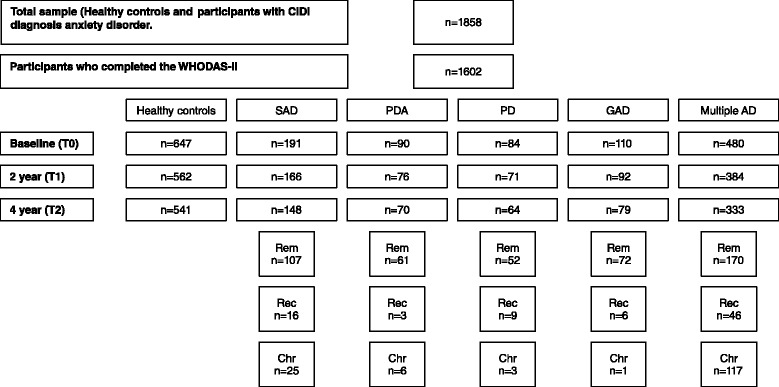
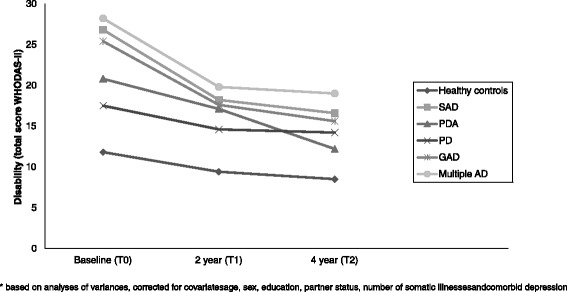
BACKGROUND: This longitudinal study aims to investigate differences in long-term disability between social anxiety disorder (SAD), panic disorder with agoraphobia (PDA), panic disorder without agoraphobia (PD), generalized anxiety disorder (GAD) and multiple anxiety disorders (multiple AD), focusing on the effects of different course trajectories (remission, recurrence and chronic course) and specific symptom dimensions (anxiety arousal and avoidance behaviour). METHODS: Data were used from participants with no psychiatric diagnosis (healthy controls, n = 647) or with a current anxiety disorder (SAD, n = 191; PDA, n = 90; PD, n = 84; GAD, n = 110; multiple AD, n = 480). Severity of anxiety arousal and avoidance behaviour symptoms was measured using the Beck Anxiety Inventory and the Fear Questionnaire. The World Health Organization Disability Assessment Schedule II was used to measure disability. RESULTS: Long-term disability was most prevalent in participants with SAD and multiple AD, and lowest in PDA and PD. GAD had an intermediate position. Anxiety arousal and avoidance behaviour were associated with more long-term disability in anxiety disorders than course trajectories. CONCLUSIONS: Various anxiety disorders have different disability levels over 4 years of time, therefore diagnostic distinction is important for treatment focus. Anxiety arousal and avoidance behaviour are major predictors for long-term disability in anxiety disorders.
Overview
The claims and statistics of this paper haven’t been checked yet.
Free: it reads the open-access text and checks the first 5 claims that cite a source we can check. Create a free account to check every claim.
Integrity signals
Registry
Cites
Statistics
Figures
Verification
Claims the paper makes
The claims and statistics of this paper haven’t been checked yet.
Free: it reads the open-access text and checks the first 5 claims that cite a source we can check. Create a free account to check every claim.
Claims other papers make about this one
Each is checked against this paper’s own text: does it say what the citing paper says it does?
The source backs part of the claim, not all of it — or backs it for a different population, condition or comparison.
In the citing paper
“Anxiety disorders are associated with high socioeconomic costs and often a chronic, debilitating course for the affected person [5–7].”
From Results of a randomized controlled superiority trial of the effect of modified collaborative assessment vs. standard assessment on patients’ readiness for psychotherapy (CO-ASSM-RCT) (2024) · cites this paper as [7]
Experimental — accuracy not yet measuredThe cited source says what the claim attributes to it.
In the citing paper
“Prior research has shown that avoidance behavior was a significant predictor of disability for individuals with anxiety disorders, both concurrently and 4 years later [26, 28].”
From Correlates of Quality of Life in Anxiety Disorders: Review of Recent Research (2021) · cites this paper as [28]
The cited source says what the claim attributes to it.
In the citing paper
“Comorbidity in anxiety disorders is associated with more severe symptoms, a more chronic course, and greater functional impairment [11, 26, 28].”
From Correlates of Quality of Life in Anxiety Disorders: Review of Recent Research (2021) · cites this paper as [28]
The check wasn’t confident either way, so it gives no verdict — never disputed.
In the citing paper
“Wilner and colleagues found that the number of comorbid diagnoses — broadly defined — did not predict change in QOL following CBT for anxiety [28].”
From Correlates of Quality of Life in Anxiety Disorders: Review of Recent Research (2021) · cites this paper as [28]
Experimental — accuracy not yet measured
Self-check
Percentages, sums and reported differences re-computed from the paper’s own numbers.
The self-check needs the paper’s full text.
Citations
Cites
An inventory for measuring clinical anxiety: Psychometric properties.
Beck, A. T., Epstein, N., Brown, G., & Steer, R. A. (1988) · Journal of Consulting and Clinical Psychology · doi:10.1037/0022-006x.56.6.893 · Cited by 14,407 · cited 5×
“As done before, [11, 19, 20] the Beck Anxiety Inventory (BAI) [28] and the Fear Questionnaire (Fear Q) [29]”
MethodInfluentialKessler, R. C., Chiu, W. T., Demler, O., & Walters, E. E. (2005) · Archives of General Psychiatry · doi:10.1001/archpsyc.62.6.617 · Cited by 12,052 · cited 1×
“major depressive disorder) [5, 38–41].”
Wittchen, H.-U. (1994) · Journal of Psychiatric Research · doi:10.1016/0022-3956(94)90036-1 · Cited by 2,348 · cited 1×
“1) was used to diagnose the presence of SAD, PDA, PD, GAD and multiple AD, a highly reliable and valid instrument for assessing anxiety disorders [27].”
MethodBrief standard self-rating for phobic patients
Marks, I. M., & Mathews, A. M. (1979) · Behaviour Research and Therapy · doi:10.1016/0005-7967(79)90041-x · Cited by 1,801 · cited 1×
“As done before, [11, 19, 20] the Beck Anxiety Inventory (BAI) [28] and the Fear Questionnaire (Fear Q) [29]”
MethodInternational Classification of Impairments, Disabilities and Handicaps
Ford, B. (1984) · Medical Journal of Australia · doi:10.5694/j.1326-5377.1984.tb103888.x · Cited by 1,284
&NA; (1980) · International Journal of Rehabilitation Research · doi:10.1097/00004356-198012000-00032 · Cited by 1,197
Kessler, R. C., Nelson, C. B., McGonagle, K. A., Liu, J., Swartz, M., & Blazer, D. G. (1996) · British Journal of Psychiatry · doi:10.1192/s0007125000298371 · Cited by 1,081
Bruce, S. E., Yonkers, K. A., Otto, M. W., Eisen, J. L., Weisberg, R. B., Pagano, M., Shea, M. T., & Keller, M. B. (2005) · American Journal of Psychiatry · doi:10.1176/appi.ajp.162.6.1179 · Cited by 963 · cited 1×
“Our finding that long-term disability is more prevalent in SAD and multiple AD compared to other anxiety disorders, is in line with previous results [36, 37] Because SAD and multiple AD are more associated with a chronic course than other anxiety disorders [20, 22, 23] and a chronic course is associated with more disa…”
ResultQuality of Life in Individuals With Anxiety Disorders
Mendlowicz, M. V., & Stein, M. B. (2000) · American Journal of Psychiatry · doi:10.1176/appi.ajp.157.5.669 · Cited by 955 · cited 1×
“Anxiety disorders are associated with severe disability [2–6] and the negative impact of anxiety is substantial [3, 7, 8].”
BackgroundThe Netherlands Study of Depression and Anxiety (NESDA): rationale, objectives and methods
Penninx, B. W. J. H., Beekman, A. T. F., Smit, J. H., Zitman, F. G., Nolen, W. A., Spinhoven, P., Cuijpers, P., De Jong, P. J., Van Marwijk, H. W. J., Assendelft, W. J. J., et al. (2008) · International Journal of Methods in Psychiatric Research · doi:10.1002/mpr.256 · Cited by 927 · cited 1×
“The Netherlands Study of Depression and Anxiety (NESDA) is a naturalistic cohort study to examine the long-term course and consequences of anxiety and depressive disorders [26].”
BackgroundSelf-citation
Research works printed but not linked: 1
- World Health Organization. Disability Assessment Schedule II. Geneva: World Health Organization; 2000.
Cited by
Items 101–200 of 234
Lévy, A., Nittas, V., & Wray, T. B. (2023) · JMIR Formative Research · doi:10.2196/47443 · Cited by 23
“Anxiety disorders cause a significant personal and public health burden, often leading to various degrees of disability, increased risk for comorbidities (eg, cardiovascular diseases), and premature mortality [2-4].”
BackgroundAssociations of age, sex, sexual abuse, and genotype with monoamine oxidase a gene methylation
Checknita, D., Tiihonen, J., Hodgins, S., & Nilsson, K. W. (2021) · Journal of Neural Transmission · doi:10.1007/s00702-021-02403-2 · Cited by 17
Methylphenidate modulates interactions of anxiety with cognition
Gaillard, C., Lago, T. R., Gorka, A. X., Balderston, N. L., Fuchs, B. A., Reynolds, R. C., Grillon, C., & Ernst, M. (2021) · Translational Psychiatry · doi:10.1038/s41398-021-01621-2 · Cited by 14
Lin, S.-L., Wu, S.-L., Huang, H.-T., Lung, F., Chi, T.-C., & Yang, J. (2017) · Journal of Oral and Maxillofacial Surgery · doi:10.1016/j.joms.2017.02.024 · Cited by 17
Dean, B., Gibbons, A. S., Gogos, A., Udawela, M., Thomas, E. A., & Scarr, E. (2017) · The International Journal of Neuropsychopharmacology · doi:10.1093/ijnp/pyx092 · Cited by 15
McNair, R., Pennay, A. E., Hughes, T. L., Love, S., Valpied, J., & Lubman, D. I. (2018) · BJGP Open · doi:10.3399/bjgpopen18x101565 · Cited by 21
The Positive and Negative Experiences of 342 Antidepressant Users
Read, J., Grigoriu, M., Gee, A., Diggle, J., & Butler, H. (2020) · Community Mental Health Journal · doi:10.1007/s10597-019-00535-0 · Cited by 14
Elbaz, H., Schulz, A., Ponto, K. A., Nickels, S., Pfeiffer, N., Mirshahi, A., & Pető, T. (2019) · Graefe s Archive for Clinical and Experimental Ophthalmology · doi:10.1007/s00417-019-04416-w · Cited by 14
Difficulty in initiating sleep is associated with poor morning cardiovascular function
Tsai, H.-J., Kuo, T. B. J., Yang, A. C., Tsai, S., & Yang, C. C. H. (2020) · Psychiatry Research · doi:10.1016/j.psychres.2020.113518 · Cited by 16
McNair, R., Parkinson, S., Dempsey, D., & Andrews, C. (2021) · Health & Social Care in the Community · doi:10.1111/hsc.13439 · Cited by 17
Development of the Risk of Relapse Assessment Scale for methamphetamine abusers in China
Xu, S., Zhang, K., & Luo, T. (2021) · Drug and Alcohol Dependence · doi:10.1016/j.drugalcdep.2021.108992 · Cited by 15
Long, X., Liu, F., Huang, N., Liu, N., Zhang, J., Chen, J., Qi, A., Guan, X., & Lu, Z. (2018) · BMC Psychiatry · doi:10.1186/s12888-018-1954-x · Cited by 15
Huneke, N. T. M., Rowlatt, H., Hyde, J., McEwan, A., Maryan, L., Baldwin, D. S., & Garner, M. J. (2022) · Psychiatry Research · doi:10.1016/j.psychres.2022.114770 · Cited by 18
Khazaie, H., Najafi, F., Hamzeh, B., Chehri, A., Rahimi‐Movaghar, A., Amin‐Esmaeili, M., Moradinazar, M., Zakiei, A., Komasi, S., & Pasdar, Y. (2018) · Social Psychiatry and Psychiatric Epidemiology · doi:10.1007/s00127-018-1580-4 · Cited by 14
Development of dynamic interpersonal therapy in complex care (DITCC): a pilot study
Rao, A., Lemma, A., Fonagy, P., Sosnowska, M., Constantinou, M., Fijak-Koch, M., & Gelberg, G. (2019) · Psychoanalytic Psychotherapy · doi:10.1080/02668734.2019.1622147 · Cited by 18
Thielecke, J., Buntrock, C., Titzler, I., Braun, L., Freund, J., Berking, M., Baumeister, H., & Ebert, D. D. (2020) · Frontiers in Psychiatry · doi:10.3389/fpsyt.2020.00125 · Cited by 14
Zhang, Y., An, H., Xu, L., & Tao, N. (2020) · Medicine · doi:10.1097/md.0000000000022027 · Cited by 14
Kristensen, T. D., Glenthøj, L. B., Raghava, J. M., Syeda, W. T., Mandl, R. C. W., Wenneberg, C., Krakauer, K., Fagerlund, B., Pantelis, C., Glenthoj, B. Y., et al. (2021) · Schizophrenia Research · doi:10.1016/j.schres.2021.09.014 · Cited by 15
Childhood violence exposure and anxiety and depression of children and adolescents
Wang, R., Zhu, B., Yu, X., Tan, W., & Shi, Q. (2024) · Journal of Affective Disorders · doi:10.1016/j.jad.2024.10.044 · Cited by 17
Park, S., Lee, Y. A., Seong, S. J., Chang, S. M., Lee, J., Hahm, B., & Hong, J. P. (2017) · BMC Psychiatry · doi:10.1186/s12888-017-1322-2 · Cited by 17
Jarczok, M. N., Buckley, T. A., Guendel, H. O., Boeckelmann, I., Mauss, D., Thayer, J. F., & Balint, E. M. (2021) · Frontiers in Neuroscience · doi:10.3389/fnins.2021.600865 · Cited by 14
Patriota, L. L. D. S., de Lima, B. R. F., Marinho, A. D. O., da Costa, J. A., Coelho, L. C. B. B., Paiva, P. M. G., da Rosa, M. M., & Napoleão, T. H. (2023) · Brain Disorders · doi:10.1016/j.dscb.2023.100066 · Cited by 15
Stecz, P., Slezáčková, A., Millová, K., & Nowakowska‐Domagała, K. (2019) · Journal of Happiness Studies · doi:10.1007/s10902-019-00163-1 · Cited by 13
Monk, N. J., McLeod, G. F. H., Mulder, R., Spittlehouse, J. K., & Boden, J. M. (2021) · Psychological Medicine · doi:10.1017/s0033291721002889 · Cited by 16
“Anxiety disorders (ADs) are a leading cause of disability worldwide (Vigo, Thornicroft, & Atun, 2016; Whiteford, Ferrari, Degenhardt, Feigin, & Vos, 2015), and are associated with substantial losses in function and quality of life (Alonso et al., 2004; Hendriks et al., 2016).”
BackgroundChildhood methylphenidate adherence as a predictor of antidepressants use during adolescence
Madjar, N., Shlosberg, D., Leventer‐Roberts, M., Akriv, A., Ghilai, A., Hoshen, M., Krivoy, A., Zalsman, G., & Shoval, G. (2019) · European Child & Adolescent Psychiatry · doi:10.1007/s00787-019-01301-z · Cited by 13
Simonetti, A., Kurian, S. R., Saxena, J. E., Verrico, C. D., Soares, J. C., Sani, G., & Saxena, K. (2021) · Journal of Affective Disorders · doi:10.1016/j.jad.2021.03.044 · Cited by 13
Cadri, A., Nagumsi, B. A. A., Twi-Yeboah, A., Yeboah, L., Adomah-Afari, A., Loglo, M.-G., & Aboagye, R. G. (2021) · BioMed Research International · doi:10.1155/2021/2868953 · Cited by 12
Wogan, R., Enrique, Á., Adegoke, A., Earley, C., Sollesse, S., Gale, S., Chellingsworth, M., & Richards, D. (2021) · Internet Interventions · doi:10.1016/j.invent.2021.100443 · Cited by 13
Five Efficacious Treatments for Posttraumatic Stress Disorder: An Empirical Review
Blankenship, D. M. (2017) · Journal of Mental Health Counseling · doi:10.17744/mehc.39.4.01 · Cited by 15
Β‐actin does not show the characteristics of a reference protein in human cortex
Parkin, G. M., Udawela, M., Gibbons, A. S., & Dean, B. (2018) · Electrophoresis · doi:10.1002/elps.201800328 · Cited by 13
Bush, R., Brown, R., McNair, R., Orellana, L., Lubman, D. I., & Staiger, P. K. (2019) · BMC Women s Health · doi:10.1186/s12905-019-0729-y · Cited by 11
Han, C., & Cumming, T. M. (2019) · International Journal of Inclusive Education · doi:10.1080/13603116.2019.1629120 · Cited by 18
Pizzirani, B., Cox), R. G. (., O’Donnell, R., & Skouteris, H. (2020) · Australian Social Work · doi:10.1080/0312407x.2020.1716260 · Cited by 13
Development of a guideline for the treatment of generalized anxiety disorder with the ADAPTE method
Hurtado, M. M., Nogueras, E. V., Cantero, N., Gálvez, L., García‐Herrera, J. M., & Morales‐Asencio, J. M. (2020) · International Journal for Quality in Health Care · doi:10.1093/intqhc/mzaa053 · Cited by 16
LaMontagne, A. D., Martin, A. J., Page, K. M., Papas, A., Reavley, N. J., Noblet, A. J., Milner, A. J., Keegel, T. G., Allisey, A., Witt, K., et al. (2020) · American Journal of Industrial Medicine · doi:10.1002/ajim.23217 · Cited by 11
Pilkington, P. D., Rominov, H., Milne, L. C., Giallo, R., & Whelan, T. A. (2016) · Advances in Mental Health · doi:10.1080/18387357.2016.1173517 · Cited by 17
Meyer, T. D., Castelao, E., Gholam‐Rezaee, M., Angst, J., & Preisig, M. (2017) · Acta Psychiatrica Scandinavica · doi:10.1111/acps.12715 · Cited by 11
Rudenstine, S., Schulder, T., Ettman, C. K., & Galea, S. (2022) · Psychological Reports · doi:10.1177/00332941221074038 · Cited by 11
“Such trajectories have been shown to be negatively affected by the onset of anxiety disorders (ElGabalawy et al., 2011; Hendriks et al., 2016; Van Ameringen et al., 2003).”
BackgroundThe prevalence of anxiety in respiratory and sleep diseases: A systematic review and meta-analysis
Storer, B., Holden, M., Kershaw, K. A., Braund, T. A., Chakouch, C., Coleshill, M. J., Haffar, S., Harvey, S. B., Sicouri, G., Newby, J. M., et al. (2024) · Respiratory Medicine · doi:10.1016/j.rmed.2024.107677 · Cited by 12
Bunt, S., Mérelle, S. Y. M., Steenhuis, I. H., & Kroeze, W. (2017) · BMC Health Services Research · doi:10.1186/s12913-017-2759-1 · Cited by 12
de Vries, B., Pijnenborg, G. H. M., van der Stouwe, E. C. D., Visser, E., de Jong, S., Pharmaco therapy and outcome survey (PHAMOUS)-investigators, Bartels‐Velthuis, A. A., Bruggeman, R., Castelein, S., Jörg, F., et al. (2019) · PLoS ONE · doi:10.1371/journal.pone.0219056 · Cited by 13
White matter microstructure in youth at risk for serious mental illness: A comparative analysis
Shakeel, M. K., Hassel, S., Davis, A. D., Metzak, P. D., MacQUEEN, G. M., Arnott, S. R., Bray, S., Frey, B. N., Goldstein, B. I., Hall, G. B., et al. (2021) · Psychiatry Research Neuroimaging · doi:10.1016/j.pscychresns.2021.111289 · Cited by 10
Glück, V. M., Zwosta, K., Wolfensteller, U., Ruge, H., & Pittig, A. (2021) · Behaviour Research and Therapy · doi:10.1016/j.brat.2021.103964 · Cited by 11
What can be done to lessen morbidity associated with fetal alcohol spectrum disorders?
Mukherjee, R., Cook, P. A., Fleming, K. M., & Norgate, S. (2016) · Archives of Disease in Childhood · doi:10.1136/archdischild-2016-310822 · Cited by 11
Lago, T. R., Blair, K. S., Alvarez, G., Thongdarong, A., Blair, J., Ernst, M., & Grillon, C. (2019) · European Journal of Neuroscience · doi:10.1111/ejn.14624 · Cited by 11
Estradiol and progesterone as resilience markers? – Findings from the Swiss Perimenopause Study
Süss, H., Willi, J., Grub, J., & Ehlert, U. (2021) · Psychoneuroendocrinology · doi:10.1016/j.psyneuen.2021.105177 · Cited by 10
Platell, M., Cook, A. G., Fisher, C. M., & Martin, K. (2019) · International Journal of Mental Health and Addiction · doi:10.1007/s11469-019-00135-9 · Cited by 11
Attention-training with children from socioeconomically disadvantaged backgrounds in Cape Town
Schrieff, L. E., Ockhuizen, J.-R. H., During, G., & Thomas, K. G. F. (2017) · Journal of Child and Adolescent Mental Health · doi:10.2989/17280583.2017.1372285 · Cited by 12
Ritzert, T. R., Brodt, M., Kelly, M. M., Menard, W. E., & Phillips, K. A. (2019) · Cognitive Therapy and Research · doi:10.1007/s10608-019-10069-0 · Cited by 10
Mental health street triage: Comparing experiences of delivery across three sites
Callender, M., Knight, L., Moloney, D. P., & Lugli, V. (2019) · Journal of Psychiatric and Mental Health Nursing · doi:10.1111/jpm.12584 · Cited by 12
White Matter Connectivity in Youth at Risk for Serious Mental Illness: A Longitudinal Analysis
Shakeel, M. K., MacQUEEN, G. M., Addington, J., Metzak, P. D., Georgopoulos, G., Bray, S., Goldstein, B. I., MacIntosh, B. J., Wang, J., Kennedy, S. H., et al. (2020) · Psychiatry Research Neuroimaging · doi:10.1016/j.pscychresns.2020.111106 · Cited by 9
Impulsivity in persons with epilepsy: Association with seizure severity and suicide risk
Lee, S., Choi, E. J., Jeon, J.-Y., Han, S., Kim, H.-W., Lee, G.-H., Ryu, H. U., Im, K., & Yang, H.-R. (2021) · Epilepsy Research · doi:10.1016/j.eplepsyres.2021.106825 · Cited by 10
de Vries, B., van der Stouwe, E. C. D., Waarheid, C. O., Poel, S. H. J., van der Helm, E., Aleman, A., Arends, J., Pijnenborg, G. H. M., & van Busschbach, J. T. (2018) · BMC Psychiatry · doi:10.1186/s12888-018-1958-6 · Cited by 11
Glenthøj, L. B., Mariegaard, L. S., Kristensen, T. D., Wenneberg, C., Medalia, A. A., & Nordentoft, M. (2020) · Schizophrenia · doi:10.1038/s41537-020-00124-1 · Cited by 9
Krzikalla, C., Morina, N., Andor, T., Nohr, L., & Buhlmann, U. (2023) · PLoS ONE · doi:10.1371/journal.pone.0282902 · Cited by 8
Pizzirani, B., O’Donnell, R., Bruce, L. J., Breman, R., Smales, M., Xie, J., Hu, H., Skouteris, H., & Cox), R. G. (. (2019) · International Journal of Adolescence and Youth · doi:10.1080/02673843.2019.1662317 · Cited by 9
Haq, R., Molteni, L., & Huneke, N. T. M. (2024) · Acta Psychiatrica Scandinavica · doi:10.1111/acps.13741 · Cited by 8
“2,3 Considering this burden, improved treatments for anxiety disorders are needed.”
Kristensen, T. D., Ebdrup, B. H., Hjorthøj, C. R., Mandl, R. C. W., Raghava, J. M., Jepsen, J. R. M., Fagerlund, B., Glenthøj, L. B., Wenneberg, C., Krakauer, K., et al. (2020) · Frontiers in Psychiatry · doi:10.3389/fpsyt.2020.00873 · Cited by 9
Roy, L., Crocker, A. G., Hurtubise, R., Latimer, E. A., Côté, M., Billette, I., & Boissy, F. (2020) · Canadian Journal of Criminology and Criminal Justice/La Revue canadienne de criminologie et de justice pénale · doi:10.3138/cjccj.2019-0056 · Cited by 10
Kusumadewi, A. F., Marchira, C. R., Widyandana, D., & Wirasto, R. T. (2023) · Trends in Psychiatry and Psychotherapy · doi:10.47626/2237-6089-2023-0713 · Cited by 5
Dickson, K. S., & Suhrheinrich, J. (2021) · Journal of Child and Family Studies · doi:10.1007/s10826-020-01877-0 · Cited by 7
Munro, O. E., & Sellbom, M. (2021) · Psychology Crime and Law · doi:10.1080/1068316x.2021.1929976 · Cited by 8
Costs and Savings Associated With the Police Use of the interRAI Brief Mental Health Screener
Hoffman, R., Harman, J. S., Kinsell, H. S., & Brown, G. P. (2021) · Frontiers in Psychiatry · doi:10.3389/fpsyt.2021.726469 · Cited by 8
Empirical evidence of the effect of personality pathology on the outcome of panic disorder
Reich, J. H., Schatzberg, A. F., & Delucchi, K. (2018) · Journal of Psychiatric Research · doi:10.1016/j.jpsychires.2018.10.005 · Cited by 8
Robinson, L. D., Kelly, P. J., Larance, B., Griffiths, S., & Deane, F. P. (2021) · International Journal of Mental Health and Addiction · doi:10.1007/s11469-021-00497-z · Cited by 6
Zech, J. M., Patel, T. A., & Cougle, J. R. (2025) · Journal of Anxiety Disorders · doi:10.1016/j.janxdis.2025.103060 · Cited by 6
Placebo Effects Are Small on Average in the 7.5% CO2 Inhalational Model of Generalized Anxiety
Huneke, N. T. M., Cross, C., Fagan, H. A., Molteni, L., Phillips, N., Garner, M. J., & Baldwin, D. S. (2024) · The International Journal of Neuropsychopharmacology · doi:10.1093/ijnp/pyae019 · Cited by 5
“Anxiety disorders cause impairments in social and occupational functioning and are frequently comorbid with other psychiatric and physical illnesses (Hendriks et al., 2016; Bokma et al., 2017).”
Zhang, Y., Li, M., Yin, H., Ma, C., Huang, Z., Yan, Y., Kou, C., Hu, M., Wen, J., Chen, S., et al. (2022) · BMC Psychiatry · doi:10.1186/s12888-022-04382-4 · Cited by 6
“Moreover, there are few longitudinal follow-up studies in China that discuss the relationship between mental disorders and long-term disability [15, 17].”
BackgroundHutschemaekers, M. H. M., de Kleine, R. A., Kampman, M., Smits, J. A. J., & Roelofs, K. (2023) · Psychoneuroendocrinology · doi:10.1016/j.psyneuen.2023.106372 · Cited by 6
Baniak, L. M., Chasens, E. R., Luyster, F. S., Strollo, P. J., Thunström, E. Ö., & Peker, Y. (2018) · Sleep And Breathing · doi:10.1007/s11325-018-1733-4 · Cited by 6
Atikasari, A. F., & Imanti, V. (2019) · al-Balagh Jurnal Dakwah dan Komunikasi · doi:10.22515/balagh.v4i1.1608 · Cited by 10
Perhoniemi, R., Tuulio-Henriksson, A., Blomgren, J., & Laaksonen, M. (2020) · Social Psychiatry and Psychiatric Epidemiology · doi:10.1007/s00127-020-01850-8 · Cited by 5
Gay men’s stress response to a general and a specific social stressor
Sattler, F. A., Nater, U. M., & Mewes, R. (2021) · Journal of Neural Transmission · doi:10.1007/s00702-021-02380-6 · Cited by 7
Lua, P. L., Nasrulddin, N. A. A., Mohamad, A. M., Makhtar, M., Jusoh, J. A., Abdullah, R., & Hassan, A. (2018) · Alcoholism Treatment Quarterly · doi:10.1080/07347324.2018.1424594 · Cited by 6
Guimarães, G., D'Angelo, F., Brouillette, K., Souza, L., da Silva, R. D., Mondin, T., Moreira, F., Kapczinski, F., Cardoso, T. D. A., & Jansen, K. (2022) · L'Encephale · doi:10.1016/j.encep.2022.08.012 · Cited by 3
Procedural monsters: rhetoric, commonplace and ‘heroic madness’ in video games
Grimwood, T. (2018) · Journal for Cultural Research · doi:10.1080/14797585.2018.1553672 · Cited by 6
Gauging Perceptions and Attitudes About Student Anxiety and Supports Among School-Based Providers
Conroy, K., Salem, H., Georgiadis, C., Hong, N., Herrera, A., Furr, J. M., Green, J. G., & Comer, J. S. (2021) · School Mental Health · doi:10.1007/s12310-021-09470-6 · Cited by 5
Liu, Z., Li, P., Yin, H., Li, M., Yan, J., Ma, C., Ding, H., Li, Q., Huang, Z., Yan, Y., et al. (2021) · Frontiers in Psychiatry · doi:10.3389/fpsyt.2021.777236 · Cited by 4
“It should be noted that our findings are different from the Dutch study, which showed that the long-term disability was most prevalent in participants with SO and lowest in AGP and PD (14).”
BackgroundResultInfluentialLiu, C. H., Koire, A. M., Feldman, N., Erdei, C., & Mittal, L. P. (2022) · Psychiatry Research · doi:10.1016/j.psychres.2022.114918 · Cited by 5
Trauma Exposure: Consequences to Maternal and Offspring Stress Systems
Martinez‐Torteya, C., D’Amico, J., & Gilchrist, M. (2017) · Integrating psychiatry and primary care · doi:10.1007/978-3-319-65724-0_6 · Cited by 3
Neural correlates of victimization in psychosis: differences in brain response to angry faces
van der Stouwe, E. C. D., van Busschbach, J. T., Opmeer, E. M., de Vries, B., Marsman, J.-B. C., Aleman, A., & Pijnenborg, G. H. M. (2019) · Schizophrenia · doi:10.1038/s41537-019-0082-z · Cited by 4
Lago-Gonzalez, L., Bronchain, J., & Chabrol, H. (2020) · Personality and Individual Differences · doi:10.1016/j.paid.2020.110390 · Cited by 5
Hovmand, O. R., Reinholt, N., Dichmann, K., Borisov, R., & Arnfred, S. (2023) · Pilot and Feasibility Studies · doi:10.1186/s40814-023-01332-z · Cited by 3
Quality of Life in Mental Disorders
Enea, V., & Diaconu‐Gherasim, L. R. (2025) · Springer eBooks · doi:10.1007/978-3-031-73368-0_2 · Cited by 3
Zanello, A., Berthoud, L., & Bacchetta, J.-P. (2017) · BMC Psychiatry · doi:10.1186/s12888-017-1293-3 · Cited by 4
Liu, D., Zhang, Q., Zhao, Z., Chen, M., Hou, Y., Wang, G., Shen, H., Zhu, H., Ji, Y., Ruan, L., et al. (2023) · Healthcare · doi:10.3390/healthcare11040554 · Cited by 5
“Anxiety disorders are one of the most common mental disorders, inflicting great physical and psychological suffering, severely reducing the quality of life of the sufferers [2,3], and imposing a tremendous economic burden on the global economy [4,5].”
BackgroundPositive feedback loop between vision-related anxiety and self-reported visual difficulty
Popova, L., Abuzaitoun, R., Fresco, D. M., Abalem, M. F., Andrews, C., Musch, D. C., Ehrlich, J. R., & Jayasundera, T. (2023) · Ophthalmic Genetics · doi:10.1080/13816810.2023.2208211 · Cited by 3
“An extensive body of literature on this topic exists; for example, patients with multiple anxiety disorders have more long-term disability than those with just one anxiety disorder (42), self-reported dual sensory loss of hearing and vision predicts higher future depression scores than self-reported single sensory los…”
BackgroundVally, Z., AlKhanji, R., & Helmy, M. S. (2024) · International Journal of Mental Health and Addiction · doi:10.1007/s11469-024-01274-4 · Cited by 4
“A plethora of preceding research has pointed to a significant association between psychological avoidance and disability in individuals grappling with anxiety issues, both in the present moment and over an extended period of four years (Hendriks et al., 2016).”
CBT-I for patients with depression
Goldschmied, J., & Gehrman, P. (2021) · Elsevier eBooks · doi:10.1016/b978-0-12-822872-2.00006-2 · Cited by 3
Carpenter, J. K., Conroy, K., & Hofmann, S. G. (2018) · Cambridge University Press eBooks · doi:10.1017/9781108140416.029 · Cited by 5
Editorial: Approaches for Severe and Persistent Mental Illness
Westermair, A. L., Irwin, S. A., Schweiger, U., & Trachsel, M. (2021) · Frontiers in Psychiatry · doi:10.3389/fpsyt.2021.722496 · Cited by 4
ZDHHC5 Mediates Immune Dysregulation Driving Generalized Anxiety Disorder Risk
Fuqiang, S., Lu, G., Li, N., Dai, K., Ren, Z., Ma, R., Feng, Y., Zong, S., & Cheng, B. (2025) · Brain and Behavior · doi:10.1002/brb3.70818 · Cited by 4
“GAD imposes a considerable burden in terms of disability, psychological distress, and societal economic costs (Hendriks et al. 2016).”
Anxiety Disorders in Childhood and Adolescence: Prevalence and Diagnostic Considerations
Sanchez, A. L., Becker‐Haimes, E. M., & Wolk, C. B. (2022) · Springer eBooks · doi:10.1007/978-3-031-12737-3_10 · Cited by 6
Faruk Caner, Y. A. M., Köksal, B., & YILDIRIM, O. (2024) · Journal of Rational-Emotive & Cognitive-Behavior Therapy · doi:10.1007/s10942-024-00564-z · Cited by 2
“Furthermore, attempts to avoid distressing events generated by the individual as a solution to their anxiety contribute to the intensity and persistence of anxiety (Hayes et al., 2006; Hendriks et al., 2016; Kashdan et al., 2006).”
Незнанов, Н. Г., Tanashyan, M. М., Akarachkova, E. S., Amelin, A. V., Bogolepova, A. N., Vasileva, A. V., Ермоленко, Н. А., Zakharov, V. V., Лебедева, А. В., Maksimova, M. Y., et al. (2024) · S S Korsakov Journal of Neurology and Psychiatry · doi:10.17116/jnevro2024124121126 · Cited by 3
Detection of social anxiety using multiple simultaneous biosignals: A pilot study
Tremmel, C., Huneke, N. T. M., Hobson, D., & schraefel, M. C. (2025) · PLoS ONE · doi:10.1371/journal.pone.0330603 · Cited by 2
“Quantifying these economic burdens highlights the significant impact of anxiety disorders on public health systems and underscores the urgency sion after four years, the lowest remission rate of all the anxiety disorders [8–10], indicating a need for more effective treatments.”
Barrow, P., Parrott, N. J., Alberati, D., Paehler, A., & Koerner, A. (2016) · Birth Defects Research Part B Developmental and Reproductive Toxicology · doi:10.1002/bdrb.21179 · Cited by 3
Can mental health legal representation and advocacy contribute to personal recovery?
Milbourn, B. T., Martin, R., Mental Health Law Centre, Overheu, H., & Schalk, D. (2018) · Advances in Mental Health · doi:10.1080/18387357.2018.1480397 · Cited by 2
A pilot study of interpersonal process group therapy for PTSD in Canadian Veterans
van Reekum, E. A., & Watt, M. C. (2019) · Journal of Military Veteran and Family Health · doi:10.3138/jmvfh.2018-0001 · Cited by 2
Bertrams, A., & Minkley, N. (2020) · Frontiers in Psychiatry · doi:10.3389/fpsyt.2020.00580 · Cited by 2
Metadata
- Authors
- Hendriks, S. M., Spijker, J., Licht, C. M. M., Hardeveld, F., de Graaf, R., Batelaan, N. M., Penninx, B. W. J. H., & Beekman, A. T. F.
- Affiliations
- Pro Persona (NL)
- Radboud University Nijmegen (NL)
- Amsterdam Public Health (NL)
- Corresponding author
- Hendriks, Sanne M.
- ORCID
- Venue
- BMC Psychiatry
- Published
- 2016-07-19
- Volume
- 16
- Issue
- 1
- Pages
- 248-248
- ISSN
- 1471-244X (ISSN-L)
- PMC
- PMC4950589
- OpenAlex
- W2505590685
- Semantic Scholar
- 5f901e220b157c2c2a19316d4e7cb224705122c5
- Cited by
- 234
- References
- 46
- Citations by year
- 2026: 3 · 2025: 7 · 2024: 15 · 2023: 15 · 2022: 13 · 2021: 69 · 2020: 23 · 2019: 31 · 2018: 24 · 2017: 23 · 2016: 11
- FWCI
- 42.11
- Type
- journal article
- Language
- en
- Open access
- gold
- doi.org
- Licence
- cc-by
- Locations
- BMC Psychiatry (publishedVersion, cc-by)
- PubMed Central (publishedVersion, cc-by)
- PubMed (publishedVersion)
- Pure Amsterdam UMC (publishedVersion, other-oa)
- Amsterdam UMC (VU Amsterdam) - Institutional Repository (publishedVersion)
- Radboud Repository (Radboud University) (submittedVersion)
- Radboud Repository (Radboud University) (submittedVersion, other-oa)
- Data Archiving and Networked Services (DANS) (submittedVersion)
- Funders
- Netherlands Organisation for Health Research and Development (10-000-1002)
- Topics
- Social Sciences › Psychology › Experimental and Cognitive Psychology › Anxiety, Depression, Psychometrics, Treatment, Cognitive Processes
- Health Sciences › Medicine › Psychiatry and Mental health › Mental Health Treatment and Access
- Social Sciences › Psychology › Clinical Psychology › Child and Adolescent Psychosocial and Emotional Development
- Keywords
- long-term disability, anxiety disorders, social anxiety disorder, panic disorder with agoraphobia, generalized anxiety disorder, remission, recurrence, chronic course, anxiety arousal, avoidance behavior, disability assessment
- MeSH terms
- Adolescent, Adult, Aged, Agoraphobia, Anxiety Disorders, Arousal, Avoidance Learning, Disability Evaluation, Female, Persons with Disabilities, Humans, Longitudinal Studies, Male, Middle Aged, Phobic Disorders, Prognosis, Surveys and Questionnaires, Recurrence, Panic Disorder, Young Adult
About these checks
Registry, retraction, Cites and statistics results are computed, not judged, with one exception: a printed reference that no index lists is read once by a model before it counts as a citation error. Claims are extracted by a model and kept only when their quote appears verbatim in the text; each cited source is then checked, with a model’s help, for whether it says what the claim relies on. Those verdicts can be wrong — read the claim’s quote and the cited source before relying on one.
Statistics and arithmetic are recomputed, not judged.
Confidence bands are shown only for fields calibrated on our annotated test set. None is calibrated yet, so no band is shown.
What counts as a claim ›How we measure confidence ›How we check this ›
Are you an author, or do you see a problem with this page? Request a review
Data sources
Bibliographic data: Semantic Scholar, OpenAlex, Crossref.
Contains information from the Semantic Scholar Academic Graph Datasets, made available under the ODC Attribution License (ODC-BY 1.0).
Semantic Scholar’s data is described in: Kinney, R., et al. (2023). The Semantic Scholar Open Data Platform. arXiv:2301.10140.
