

Long-term disability in anxiety disorders
Open accessThe DOI matches its Crossref record; 46 of the 46 references it cites were found in a registry or an index.
Abstract
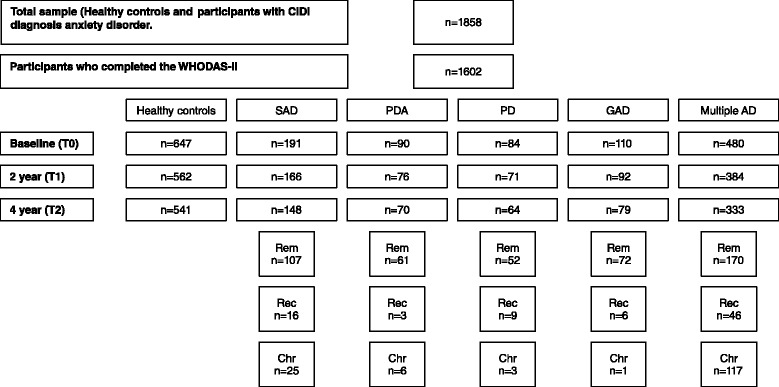
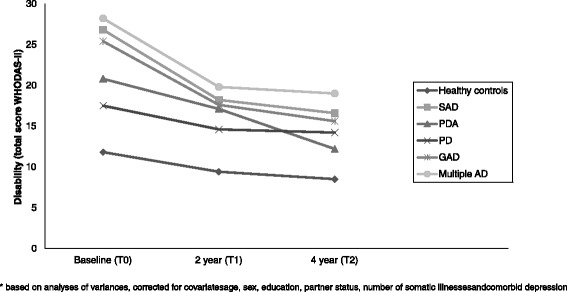
BACKGROUND: This longitudinal study aims to investigate differences in long-term disability between social anxiety disorder (SAD), panic disorder with agoraphobia (PDA), panic disorder without agoraphobia (PD), generalized anxiety disorder (GAD) and multiple anxiety disorders (multiple AD), focusing on the effects of different course trajectories (remission, recurrence and chronic course) and specific symptom dimensions (anxiety arousal and avoidance behaviour). METHODS: Data were used from participants with no psychiatric diagnosis (healthy controls, n = 647) or with a current anxiety disorder (SAD, n = 191; PDA, n = 90; PD, n = 84; GAD, n = 110; multiple AD, n = 480). Severity of anxiety arousal and avoidance behaviour symptoms was measured using the Beck Anxiety Inventory and the Fear Questionnaire. The World Health Organization Disability Assessment Schedule II was used to measure disability. RESULTS: Long-term disability was most prevalent in participants with SAD and multiple AD, and lowest in PDA and PD. GAD had an intermediate position. Anxiety arousal and avoidance behaviour were associated with more long-term disability in anxiety disorders than course trajectories. CONCLUSIONS: Various anxiety disorders have different disability levels over 4 years of time, therefore diagnostic distinction is important for treatment focus. Anxiety arousal and avoidance behaviour are major predictors for long-term disability in anxiety disorders.
Overview
The claims and statistics of this paper haven’t been checked yet.
Free: it reads the open-access text and checks the first 5 claims that cite a source we can check. Create a free account to check every claim.
Integrity signals
Registry
Cites
Statistics
Figures
Verification
Claims the paper makes
The claims and statistics of this paper haven’t been checked yet.
Free: it reads the open-access text and checks the first 5 claims that cite a source we can check. Create a free account to check every claim.
Claims other papers make about this one
Each is checked against this paper’s own text: does it say what the citing paper says it does?
The source backs part of the claim, not all of it — or backs it for a different population, condition or comparison.
In the citing paper
“Anxiety disorders are associated with high socioeconomic costs and often a chronic, debilitating course for the affected person [5–7].”
From Results of a randomized controlled superiority trial of the effect of modified collaborative assessment vs. standard assessment on patients’ readiness for psychotherapy (CO-ASSM-RCT) (2024) · cites this paper as [7]
Experimental — accuracy not yet measuredThe cited source says what the claim attributes to it.
In the citing paper
“Prior research has shown that avoidance behavior was a significant predictor of disability for individuals with anxiety disorders, both concurrently and 4 years later [26, 28].”
From Correlates of Quality of Life in Anxiety Disorders: Review of Recent Research (2021) · cites this paper as [28]
The cited source says what the claim attributes to it.
In the citing paper
“Comorbidity in anxiety disorders is associated with more severe symptoms, a more chronic course, and greater functional impairment [11, 26, 28].”
From Correlates of Quality of Life in Anxiety Disorders: Review of Recent Research (2021) · cites this paper as [28]
The check wasn’t confident either way, so it gives no verdict — never disputed.
In the citing paper
“Wilner and colleagues found that the number of comorbid diagnoses — broadly defined — did not predict change in QOL following CBT for anxiety [28].”
From Correlates of Quality of Life in Anxiety Disorders: Review of Recent Research (2021) · cites this paper as [28]
Experimental — accuracy not yet measured
Self-check
Percentages, sums and reported differences re-computed from the paper’s own numbers.
The self-check needs the paper’s full text.
Citations
Cites
An inventory for measuring clinical anxiety: Psychometric properties.
Beck, A. T., Epstein, N., Brown, G., & Steer, R. A. (1988) · Journal of Consulting and Clinical Psychology · doi:10.1037/0022-006x.56.6.893 · Cited by 14,407 · cited 5×
“As done before, [11, 19, 20] the Beck Anxiety Inventory (BAI) [28] and the Fear Questionnaire (Fear Q) [29]”
MethodInfluentialKessler, R. C., Chiu, W. T., Demler, O., & Walters, E. E. (2005) · Archives of General Psychiatry · doi:10.1001/archpsyc.62.6.617 · Cited by 12,052 · cited 1×
“major depressive disorder) [5, 38–41].”
Wittchen, H.-U. (1994) · Journal of Psychiatric Research · doi:10.1016/0022-3956(94)90036-1 · Cited by 2,348 · cited 1×
“1) was used to diagnose the presence of SAD, PDA, PD, GAD and multiple AD, a highly reliable and valid instrument for assessing anxiety disorders [27].”
MethodBrief standard self-rating for phobic patients
Marks, I. M., & Mathews, A. M. (1979) · Behaviour Research and Therapy · doi:10.1016/0005-7967(79)90041-x · Cited by 1,801 · cited 1×
“As done before, [11, 19, 20] the Beck Anxiety Inventory (BAI) [28] and the Fear Questionnaire (Fear Q) [29]”
MethodInternational Classification of Impairments, Disabilities and Handicaps
Ford, B. (1984) · Medical Journal of Australia · doi:10.5694/j.1326-5377.1984.tb103888.x · Cited by 1,284
&NA; (1980) · International Journal of Rehabilitation Research · doi:10.1097/00004356-198012000-00032 · Cited by 1,197
Kessler, R. C., Nelson, C. B., McGonagle, K. A., Liu, J., Swartz, M., & Blazer, D. G. (1996) · British Journal of Psychiatry · doi:10.1192/s0007125000298371 · Cited by 1,081
Bruce, S. E., Yonkers, K. A., Otto, M. W., Eisen, J. L., Weisberg, R. B., Pagano, M., Shea, M. T., & Keller, M. B. (2005) · American Journal of Psychiatry · doi:10.1176/appi.ajp.162.6.1179 · Cited by 963 · cited 1×
“Our finding that long-term disability is more prevalent in SAD and multiple AD compared to other anxiety disorders, is in line with previous results [36, 37] Because SAD and multiple AD are more associated with a chronic course than other anxiety disorders [20, 22, 23] and a chronic course is associated with more disa…”
ResultQuality of Life in Individuals With Anxiety Disorders
Mendlowicz, M. V., & Stein, M. B. (2000) · American Journal of Psychiatry · doi:10.1176/appi.ajp.157.5.669 · Cited by 955 · cited 1×
“Anxiety disorders are associated with severe disability [2–6] and the negative impact of anxiety is substantial [3, 7, 8].”
BackgroundThe Netherlands Study of Depression and Anxiety (NESDA): rationale, objectives and methods
Penninx, B. W. J. H., Beekman, A. T. F., Smit, J. H., Zitman, F. G., Nolen, W. A., Spinhoven, P., Cuijpers, P., De Jong, P. J., Van Marwijk, H. W. J., Assendelft, W. J. J., et al. (2008) · International Journal of Methods in Psychiatric Research · doi:10.1002/mpr.256 · Cited by 927 · cited 1×
“The Netherlands Study of Depression and Anxiety (NESDA) is a naturalistic cohort study to examine the long-term course and consequences of anxiety and depressive disorders [26].”
BackgroundSelf-citationQuality of life in the anxiety disorders: a meta-analytic review
Olatunji, B. O., Cisler, J. M., & Tolin, D. F. (2007) · Clinical Psychology Review · doi:10.1016/j.cpr.2007.01.015 · Cited by 808
Reliability and validity of the Beck anxiety inventory
Fydrich, T., Dowdall, D., & Chambless, D. L. (1992) · Journal of Anxiety Disorders · doi:10.1016/0887-6185(92)90026-4 · Cited by 776 · cited 1×
“The BAI and the Fear Q are both widely used and have proven to be highly valid and reliable [30, 31].”
MethodDisability and Quality of Life in Social Phobia: Epidemiologic Findings
Stein, M. B., & Kean, Y. M. (2000) · American Journal of Psychiatry · doi:10.1176/appi.ajp.157.10.1606 · Cited by 685 · cited 1×
“Our finding that long-term disability is more prevalent in SAD and multiple AD compared to other anxiety disorders, is in line with previous results [36, 37] Because SAD and multiple AD are more associated with a chronic course than other anxiety disorders [20, 22, 23] and a chronic course is associated with more disa…”
ResultAnxiety disorders and comorbid medical illness
Roy-Byrne, P. P., Davidson, K. W., Kessler, R. C., Asmundson, G. J. G., Goodwin, R. D., Kubzansky, L., Lydiard, R. B., Massie, M. J., Katon, W., Laden, S. K., et al. (2008) · General Hospital Psychiatry · doi:10.1016/j.genhosppsych.2007.12.006 · Cited by 668 · cited 1×
“Previous studies showed that these covariates are associated with both anxiety and disability [33, 34].”
BackgroundThe ESEMeD/MHEDEA 2000 investigators, Alonso, J., Angermeyer, M. C., Bernert, S., Bruffaerts, R., Brugha, T. S., Bryson, H., de Girolamo, G., de Graaf, R., Demyttenaere, K., et al. (2004) · Acta Psychiatrica Scandinavica · doi:10.1111/j.1600-0047.2004.00329.x · Cited by 580 · cited 1×
“Anxiety disorders are associated with severe disability [2–6] and the negative impact of anxiety is substantial [3, 7, 8].”
BackgroundWood, P. H. N. (1990) · Health Systems Research · doi:10.1007/978-3-642-75593-4_7 · Cited by 514
Kessler, R. C., Gruber, M., Hettema, J. M., Hwang, I., Sampson, N., & Yonkers, K. A. (2008) · Psychological Medicine · doi:10.1017/s0033291707002012 · Cited by 493 · cited 1×
“major depressive disorder) [5, 38–41].”
Merikangas, K. R., Zhang, H., Avenevoli, S., Acharyya, S., Neuenschwander, M., & Angst, J. (2003) · Archives of General Psychiatry · doi:10.1001/archpsyc.60.9.993 · Cited by 419 · cited 1×
“More severe symptoms and more comorbidity are associated with a chronic course in anxiety disorders [16–20].”
BackgroundMental Disorders and Disability Among Patients in a Primary Care Group Practice
Olfson, M., Fireman, B., Weissman, M. M., Leon, A. C., Sheehan, D. V., Kathol, R. G., Hoven, C., & Farber, L. (1997) · American Journal of Psychiatry · doi:10.1176/ajp.154.12.1734 · Cited by 400 · cited 2×
“major depressive disorder) [5, 38–41].”
BackgroundPenninx, B. W. J. H., Nolen, W. A., Lamers, F., Zitman, F. G., Smit, J. H., Spinhoven, P., Cuijpers, P., de Jong, P. J., van Marwijk, H. W. J., der Meer, K. V., et al. (2011) · Journal of Affective Disorders · doi:10.1016/j.jad.2011.03.027 · Cited by 354 · cited 1×
“Furthermore, previous research showed that symptom dimensions, like anxiety arousal and avoidance behaviour, can be strong predictors [19, 20, 25].”
BackgroundSelf-citationBIJL, R. V., & RAVELLI, A. (2000) · Psychological Medicine · doi:10.1017/s0033291799001841 · Cited by 265 · cited 1×
“Anxiety disorders are associated with severe disability [2–6] and the negative impact of anxiety is substantial [3, 7, 8].”
BackgroundSchonfeld, W. H., Verboncoeur, C. J., Fifer, S. K., Lipschutz, R. C., Lubeck, D. P., & Buesching, D. P. (1997) · Journal of Affective Disorders · doi:10.1016/s0165-0327(96)01416-4 · Cited by 247 · cited 1×
“As mentioned in our previous study [11], disability in PDA and PD is generally associated with physical disability [14, 37].”
BackgroundFunctional Impact and Health Utility of Anxiety Disorders in Primary Care Outpatients
Stein, M. B., Roy-Byrne, P. P., Craske, M. G., Bystritsky, A., Sullivan, G., Pyne, J. M., Katon, W., & Sherbourne, C. D. (2005) · Medical Care · doi:10.1097/01.mlr.0000185750.18119.fd · Cited by 233 · cited 1×
“Anxiety disorders are associated with severe disability [2–6] and the negative impact of anxiety is substantial [3, 7, 8].”
BackgroundLochner, C., Mogotsi, M., du Toit, P. L., Kaminer, D., Niehaus, D. J., & Stein, D. J. (2003) · Psychopathology · doi:10.1159/000073451 · Cited by 221 · cited 2×
“Our finding that long-term disability is more prevalent in SAD and multiple AD compared to other anxiety disorders, is in line with previous results [36, 37] Because SAD and multiple AD are more associated with a chronic course than other anxiety disorders [20, 22, 23] and a chronic course is associated with more disa…”
BackgroundResultComer, J. S., Blanco, C., Hasin, D. S., Liu, S.-M., Grant, B. F., Turner, J. B., & Olfson, M. (2011) · The Journal of Clinical Psychiatry · doi:10.4088/jcp.09m05094blu · Cited by 214 · cited 1×
“Furthermore, social anxiety disorder (SAD) and generalized anxiety disorder (GAD) are associated with higher disability levels compared to panic disorder, [3, 10–12] although other research points out otherwise [13–15].”
BackgroundSherbourne, C. D. (1996) · Archives of General Psychiatry · doi:10.1001/archpsyc.1996.01830100035005 · Cited by 189
Impairment and quality of life in individuals with generalized anxiety disorder
Henning, E. R., Turk, C. L., Mennin, D. S., Fresco, D. M., & Heimberg, R. G. (2007) · Depression and Anxiety · doi:10.1002/da.20249 · Cited by 189 · cited 1×
“Anxiety disorders are associated with severe disability [2–6] and the negative impact of anxiety is substantial [3, 7, 8].”
BackgroundFichter, M. M., Quadflieg, N., Fischer, U. C., & Kohlboeck, G. (2010) · Acta Psychiatrica Scandinavica · doi:10.1111/j.1600-0447.2009.01512.x · Cited by 135 · cited 1×
“More severe symptoms and more comorbidity are associated with a chronic course in anxiety disorders [16–20].”
BackgroundLong-term work disability and absenteeism in anxiety and depressive disorders
Hendriks, S. M., Spijker, J., Licht, C. M. M., Hardeveld, F., de Graaf, R., Batelaan, N. M., Penninx, B. W. J. H., & Beekman, A. T. F. (2015) · Journal of Affective Disorders · doi:10.1016/j.jad.2015.03.004 · Cited by 126 · cited 4×
“Furthermore, previous research showed that symptom dimensions, like anxiety arousal and avoidance behaviour, can be strong predictors [19, 20, 25].”
BackgroundMethodResultInfluentialSelf-citationThe 7-year course of depression and anxiety in the general population
Rhebergen, D., Batelaan, N. M., de Graaf, R., Nolen, W. A., Spijker, J., Beekman, A. T. F., & Penninx, B. W. J. H. (2011) · Acta Psychiatrica Scandinavica · doi:10.1111/j.1600-0447.2011.01677.x · Cited by 116 · cited 1×
“More severe symptoms and more comorbidity are associated with a chronic course in anxiety disorders [16–20].”
BackgroundSelf-citationAnsseau, M., Fischler, B., Dierick, M., Albert, A., Leyman, S., & Mignon, A. (2008) · Depression and Anxiety · doi:10.1002/da.20306 · Cited by 114
Inleiding in de toegepaste biostatistiek
Twisk, J. W. R. (2016) · Bohn Stafleu van Loghum eBooks · doi:10.1007/978-90-368-1534-5 · Cited by 102 · cited 1×
“Linear mixed models (LMM) [35] were used to analyse the relationship between 1) baseline psychiatric status, 2) course trajectories and 3) symptom dimensions with the outcome long-term disability.”
MethodQuality of life and anxiety and depressive disorder comorbidity
Norberg, M. M., Diefenbach, G. J., & Tolin, D. F. (2008) · Journal of Anxiety Disorders · doi:10.1016/j.janxdis.2008.03.005 · Cited by 101 · cited 1×
“Anxiety disorders are associated with severe disability [2–6] and the negative impact of anxiety is substantial [3, 7, 8].”
Background(2006) · PubMed · Cited by 100
Infrequency of ?pure? GAD: Impact of psychiatric comorbidity on clinical course
Bruce, S. E., Machan, J. T., Dyck, I., & Keller, M. B. (2001) · Depression and Anxiety · doi:10.1002/da.1070 · Cited by 87
The Fear Questionnaire: Some Data on Validity, Reliability and Layout
Van Zuuren, F. J. (1988) · British Journal of Psychiatry · doi:10.1192/bjp.153.5.659 · Cited by 79
Karsten, J., Penninx, B. W. J. H., Verboom, C. E., Nolen, W. A., & Hartman, C. A. (2013) · Depression and Anxiety · doi:10.1002/da.22021 · Cited by 77
Self-citationCommon mental disorders, subthreshold symptoms and disability: longitudinal study
Rai, D., Skapinakis, P., Wiles, N., Lewis, G., & Araya, R. (2010) · British Journal of Psychiatry · doi:10.1192/bjp.bp.110.079244 · Cited by 74
Functioning and disability levels in primary care out-patients with one or more anxiety disorders
Sherbourne, C. D., Sullivan, G., Craske, M. G., Roy-Byrne, P., Golinelli, D., Rose, R. D., Chavira, D. A., Bystritsky, A., & Stein, M. B. (2010) · Psychological Medicine · doi:10.1017/s0033291710000176 · Cited by 70
Disability in anxiety disorders
Hendriks, S. M., Spijker, J., Licht, C. M. M., Beekman, A. T. F., Hardeveld, F., de Graaf, R., Batelaan, N. M., & Penninx, B. W. J. H. (2014) · Journal of Affective Disorders · doi:10.1016/j.jad.2014.05.006 · Cited by 69 · cited 5×
“As done before, [11, 19, 20] the Beck Anxiety Inventory (BAI) [28] and the Fear Questionnaire (Fear Q) [29]”
BackgroundMethodInfluentialSelf-citationTwo‐year course of anxiety disorders: different across disorders or dimensions?
Hendriks, S. M., Spijker, J., Licht, C. M. M., Beekman, A. T. F., & Penninx, B. W. J. H. (2013) · Acta Psychiatrica Scandinavica · doi:10.1111/acps.12024 · Cited by 55 · cited 4×
“[19] showed that avoidance behaviour symptoms may be more important predictors than the symptoms of anxiety itself.”
BackgroundMethodSelf-citationTwo-Year Course Trajectories of Anxiety Disorders: Do DSM Classifications Matter?
Batelaan, N. M., Rhebergen, D., Spinhoven, P., van Balkom, A. J., & Penninx, B. W. J. H. (2014) · The Journal of Clinical Psychiatry · doi:10.4088/jcp.13m08837 · Cited by 45
Self-citationIancu, S. C., Batelaan, N. M., Zweekhorst, M. B. M., Bunders, J. F. G., Veltman, D. J., Penninx, B. W. J. H., & van Balkom, A. J. L. M. (2014) · Psychological Medicine · doi:10.1017/s0033291713001050 · Cited by 38
Self-citationPsychosocial Strategies to Improve Concordance and Adherence in Bipolar Disorder
Reilly-Harrington, N., & Sachs, G. S. (2006) · The Journal of Clinical Psychiatry · doi:10.4088/jcp.0706e04 · Cited by 33
A longitudinal examination of psychosocial impairment across the anxiety disorders
Naragon-Gainey, K., Gallagher, M. W., & Brown, T. A. (2014) · Psychological Medicine · doi:10.1017/s0033291713001967 · Cited by 25 · cited 2×
“[12] found that GAD at baseline was more associated with severe disability in certain areas (i.”
BackgroundResultWeisberg, R. B., Beard, C., Pagano, M. E., Maki, K. M., Culpepper, L., & Keller, M. B. (2010) · The Primary Care Companion to The Journal of Clinical Psychiatry · doi:10.4088/pcc.09m00890blu · Cited by 11 · cited 1×
“However, other research pointed out that the disability seen in GAD cannot be explained by comorbidity [42].”
Background
Research works printed but not linked: 1
- World Health Organization. Disability Assessment Schedule II. Geneva: World Health Organization; 2000.
Cited by
Carpenter, J. K., Andrews, L. A., Witcraft, S. M., Powers, M. B., Smits, J. A. J., & Hofmann, S. G. (2018) · Depression and Anxiety · doi:10.1002/da.22728 · Cited by 846
“These disorders are associated with high societal costs (Kessler & Greenberg, 2002; Laynard, Clark,Knapp,&Mayraz, 2007), aswell as significant decrements inpsychosocial functioning and quality of life (QOL; Comer et al., 2011; Hendriks et al., 2016; Olatunji, Cisler, & Tolin, 2007).”
BackgroundMeerwijk, E. L., & Sevelius, J. M. (2017) · American Journal of Public Health · doi:10.2105/ajph.2016.303578 · Cited by 799
Penninx, B. W., Pine, D. S., Holmes, E. A., & Reif, A. (2021) · The Lancet · doi:10.1016/s0140-6736(21)00359-7 · Cited by 740
Self-citationViolence against women and mental health
Oram, S., Khalifeh, H., & Howard, L. M. (2017) · The Lancet Psychiatry · doi:10.1016/s2215-0366(16)30261-9 · Cited by 474
Social identity, self‐esteem, and mental health in autism
Cooper, K., Smith, L. G. E., & Russell, A. (2017) · European Journal of Social Psychology · doi:10.1002/ejsp.2297 · Cited by 354
Metadata
- Authors
- Hendriks, S. M., Spijker, J., Licht, C. M. M., Hardeveld, F., de Graaf, R., Batelaan, N. M., Penninx, B. W. J. H., & Beekman, A. T. F.
- Affiliations
- Pro Persona (NL)
- Radboud University Nijmegen (NL)
- Amsterdam Public Health (NL)
- Corresponding author
- Hendriks, Sanne M.
- ORCID
- Venue
- BMC Psychiatry
- Published
- 2016-07-19
- Volume
- 16
- Issue
- 1
- Pages
- 248-248
- ISSN
- 1471-244X (ISSN-L)
- PMC
- PMC4950589
- OpenAlex
- W2505590685
- Cited by
- 234
- References
- 46
- Citations by year
- 2026: 3 · 2025: 7 · 2024: 15 · 2023: 15 · 2022: 13 · 2021: 69 · 2020: 23 · 2019: 31 · 2018: 24 · 2017: 23 · 2016: 11
- FWCI
- 42.11
- Type
- journal article
- Language
- en
- Open access
- gold
- doi.org
- Licence
- cc-by
- Locations
- BMC Psychiatry (publishedVersion, cc-by)
- PubMed Central (publishedVersion, cc-by)
- PubMed (publishedVersion)
- Pure Amsterdam UMC (publishedVersion, other-oa)
- Amsterdam UMC (VU Amsterdam) - Institutional Repository (publishedVersion)
- Radboud Repository (Radboud University) (submittedVersion)
- Radboud Repository (Radboud University) (submittedVersion, other-oa)
- Data Archiving and Networked Services (DANS) (submittedVersion)
- Funders
- Netherlands Organisation for Health Research and Development (10-000-1002)
- Topics
- Social Sciences › Psychology › Experimental and Cognitive Psychology › Anxiety, Depression, Psychometrics, Treatment, Cognitive Processes
- Health Sciences › Medicine › Psychiatry and Mental health › Mental Health Treatment and Access
- Social Sciences › Psychology › Clinical Psychology › Child and Adolescent Psychosocial and Emotional Development
- Keywords
- long-term disability, anxiety disorders, social anxiety disorder, panic disorder with agoraphobia, generalized anxiety disorder, remission, recurrence, chronic course, anxiety arousal, avoidance behavior, disability assessment
- MeSH terms
- Adolescent, Adult, Aged, Agoraphobia, Anxiety Disorders, Arousal, Avoidance Learning, Disability Evaluation, Female, Persons with Disabilities, Humans, Longitudinal Studies, Male, Middle Aged, Phobic Disorders, Prognosis, Surveys and Questionnaires, Recurrence, Panic Disorder, Young Adult
About these checks
Registry, retraction, Cites and statistics results are computed, not judged, with one exception: a printed reference that no index lists is read once by a model before it counts as a citation error. Claims are extracted by a model and kept only when their quote appears verbatim in the text; each cited source is then checked, with a model’s help, for whether it says what the claim relies on. Those verdicts can be wrong — read the claim’s quote and the cited source before relying on one.
Statistics and arithmetic are recomputed, not judged.
Confidence bands are shown only for fields calibrated on our annotated test set. None is calibrated yet, so no band is shown.
What counts as a claim ›How we measure confidence ›How we check this ›
Are you an author, or do you see a problem with this page? Request a review
Data sources
Bibliographic data: Semantic Scholar, OpenAlex, Crossref.
Contains information from the Semantic Scholar Academic Graph Datasets, made available under the ODC Attribution License (ODC-BY 1.0).
Semantic Scholar’s data is described in: Kinney, R., et al. (2023). The Semantic Scholar Open Data Platform. arXiv:2301.10140.
