

Sense of coherence is linked to post-traumatic growth after critical incidents in Austrian ambulance personnel
Open accessThe DOI matches its Crossref record; 45 of the 46 references it cites were found in a registry or an index.
Abstract
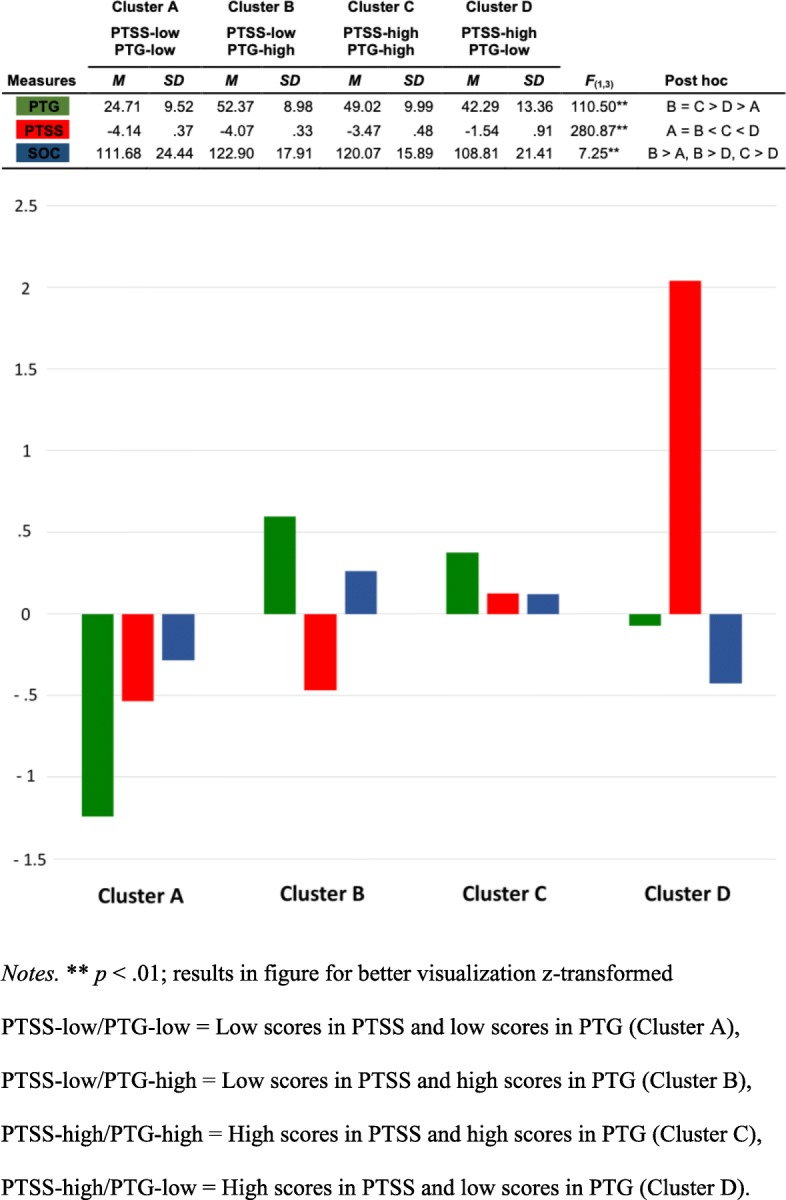
BACKGROUND: Ambulance personnel, as well as other emergency services like fire-fighters or the police force, are regularly confronted with experiences of extreme psychological distress and potentially traumatizing events in the line of their daily duties. As a consequence, this occupational group is exposed to an elevated risk of developing symptoms of Post-Traumatic Stress (PTSS). Subsequently, symptoms of Post-Traumatic Stress have been observed as potentially co-occurring with Post-Traumatic Growth (PTG) in ambulance personnel as well. Therefore, in this study we hypothesized that Sense of Coherence (SOC) might play an important role as an underlying feature in enabling growth after stressful experiences in Austrian ambulance personnel. METHODS: In this study, voluntary and full-time ambulance personnel (n = 266) of the Austrian Red Cross ambulance service completed an online survey including the Sense of Coherence Scale (SOC-29), the Post-Traumatic Growth Inventory (PTGI) and the Impact of Event Scale Revised (IES-R) for the assessment of PTSS. In line with theoretical considerations, a two-step cluster analysis limited to four clusters and further ANOVAs were conducted. RESULTS: Four clusters were confirmed and labelled PTSS-low/PTG-low, PTSS-low/PTG-high, PTSS-high/PTG-high and PTSS-high/PTG-low. Further ANOVAs revealed substantial cluster differences in SOC, with higher SOC-levels in PTSS-high/PTG-high than in PTSS-high/PTG-low (p < .01), in PTSS-low/PTG-high than in PTSS-low/PTG-low (p < .01) and in PTSS-low/PTG-high than in PTSS-high/PTG-low (p < .01). CONCLUSIONS: Our findings point to a significant association between SOC and the development of PTG in ambulance personnel. Furthermore, the results suggest that growth and stress after critical incidents are independent from each other and can co-exist. Therefore, promoting SOC (e.g., meaningfulness) in ambulance personnel - e.g., through psychological interventions - might preserve and enhance psychological health after critical incidents.
Overview
The claims and statistics of this paper haven’t been checked yet.
Free: it reads the open-access text and checks the first 5 claims that cite a source we can check. Create a free account to check every claim.
Integrity signals
Registry
Cites
Statistics
Figures
Verification
Claims the paper makes
The claims and statistics of this paper haven’t been checked yet.
Free: it reads the open-access text and checks the first 5 claims that cite a source we can check. Create a free account to check every claim.
Claims other papers make about this one
Each is checked against this paper’s own text: does it say what the citing paper says it does?
The cited source doesn’t support the claim as written.
In the citing paper
“As Ragger et al. (2019, p. 2) explained, both Tedeschi and Calhoun (2004) view PTSD and SOC as independent systems that can coexist.”
From Post-traumatic stress, sense of coherence, and growth after the February earthquake: Evidence from teacher training institute students in Syria (2025) · cites this paper as Ragger et al. (2019)
Checked by a reasoning model — may be wrong.
Experimental — accuracy not yet measuredThe cited source says what the claim attributes to it.
In the citing paper
“So, the research results are consistent with what was confirmed by the study (Ragger et al., 2019; Streb et al., 2014).”
From Post-traumatic stress, sense of coherence, and growth after the February earthquake: Evidence from teacher training institute students in Syria (2025) · cites this paper as Ragger et al., 2019
Self-check
Percentages, sums and reported differences re-computed from the paper’s own numbers.
The self-check needs the paper’s full text.
Citations
Cites
Diagnostic and Statistical Manual of Mental Disorders
American Psychiatric Association (2013) · doi:10.1176/appi.books.9780890425596 · Cited by 116,369
Diagnostic and Statistical Manual of Mental Disorders
Williams, J. B. W., & First, M. (2013) · Encyclopedia of Social Work · doi:10.1093/acrefore/9780199975839.013.104 · Cited by 109,519
Everitt, B. J., Landau, S., & Leese, M. (1974) · Cited by 9,373
TARGET ARTICLE: "Posttraumatic Growth: Conceptual Foundations and Empirical Evidence"
Tedeschi, R. G., & Calhoun, L. G. (2004) · Psychological Inquiry · doi:10.1207/s15327965pli1501_01 · Cited by 7,154
The posttraumatic growth inventory: measuring the positive legacy of trauma
Tedeschi, R. G., & Calhoun, L. G. (1996) · Journal of Traumatic Stress · doi:10.1002/jts.2490090305 · Cited by 7,061
Unraveling the Mystery of Health: How People Manage Stress and Stay Well
Antonovsky, A. (2002) · The Health Psychology Reader · doi:10.4135/9781446221129.n9 · Cited by 5,543
The structure and properties of the sense of coherence scale
Antonovsky, A. (1993) · Social Science & Medicine · doi:10.1016/0277-9536(93)90033-z · Cited by 3,515
The Impact of Event Scale: Revised
Weiss, D. S. (2007) · International and Cultural Psychology Series · doi:10.1007/978-0-387-70990-1_10 · Cited by 2,996
Validity of Antonovsky’s sense of coherence scale: a systematic review
Eriksson, M., & Lindström, B. (2005) · Journal of Epidemiology and Community Health · doi:10.1136/jech.2003.018085 · Cited by 1,541
PTSD symptoms, response to intrusive memories and coping in ambulance service workers
Clohessy, S., & Ehlers, A. (1999) · British Journal of Clinical Psychology · doi:10.1348/014466599162836 · Cited by 597
Research works printed but not linked: 5
- Everly GS Innovations in disaster and trauma psychology: Applications in emergency services and disaster response 1995 Ellicott City Chevron
- Hausmann C Notfallpsychologie und Traumabewältigung: Ein Handbuch Wien: Facultas 2010
- Wagner D Heinrichs M Kerber U Wingenfeld K Hellhammer DH Ehlert U Maercker A Ehlert U Wirkfaktoren der Prävention sekundär posttraumatischer Belastungsstörungen bei Hochrisikopopulationen Psychotraumatologie 2001 Göttingen Hogrefe 201 225
- Singer S Brähler E Die “Sense of Coherence Scale” - Testhandbuch zur deutschen Version 2007 Göttingen Vandenhoeck & Ruprech
- Arya B Davidson C Sense of coherence as a predictor of post traumatic growth Indian J Heal Wellbeing 2015 6 634 636
Cited by
Gómez-Salgado, J. C., Domínguez‐Salas, S., Romero‐Martín, M., Ortega‐Moreno, M., García‐Iglesias, J. J., & Ruíz-Frutos, C. (2020) · Sustainability · doi:10.3390/su12176855 · Cited by 102
“SOC has also been related with the prevention of post-traumatic stress experienced by healthcare professionals [47].”
BackgroundWhat's Love Got to do with it: Role of oxytocin in trauma, attachment and resilience
Sharma, S. R., Gonda, X., Dome, P., & Tarazi, F. I. (2020) · Pharmacology & Therapeutics · doi:10.1016/j.pharmthera.2020.107602 · Cited by 61
Peer support facilitates post-traumatic growth in first responders: A literature review
Donovan, N. (2022) · Trauma · doi:10.1177/14604086221079441 · Cited by 57
“It is not considered to be a direct outcome of a traumatic experience but rather an integration of the traumatic experience ‘into a previous view of the world’.(3) PTG is a process that involves the experiencing of a traumatic event, enduring a psychological struggle and then experiencing growth because of the challen…”
BackgroundBehnke, A., Rojas, R., Karrasch, S., Hitzler, M., & Kolassa, I.-T. (2019) · Frontiers in Psychology · doi:10.3389/fpsyg.2019.02305 · Cited by 40
Yeung, N. C. Y., Wong, E. L., Cheung, A. W.-L., Leung, C. S. Y., Yeoh, E., & Wong, S. Y. S. (2022) · European Journal of Psychotraumatology · doi:10.1080/20008198.2021.2005346 · Cited by 49
Metadata
- Authors
- Ragger, K., Hiebler-Ragger, M., Herzog, G., Kapfhammer, H.-P., & Unterrainer, H. F.
- Affiliations
- Medical University of Graz (AT)
- University of Vienna (AT)
- Corresponding author
- Unterrainer, Human Friedrich
- Venue
- BMC Psychiatry
- Published
- 2019-03-11
- Volume
- 19
- Issue
- 1
- Pages
- 89-89
- ISSN
- 1471-244X (ISSN-L)
- PMC
- PMC6417083
- OpenAlex
- W2940447051
- Semantic Scholar
- 1444f661fa86bcf275ba6c33191917beb733ecea
- Cited by
- 43
- References
- 46
- Citations by year
- 2026: 3 · 2025: 3 · 2024: 6 · 2023: 5 · 2022: 12 · 2021: 4 · 2020: 9 · 2019: 1
- FWCI
- 7.59
- Type
- journal article
- Language
- en
- Open access
- gold
- doi.org
- Licence
- cc-by
- creativecommons.org/licenses/by/4.0/ (tdm)
- Locations
- BMC Psychiatry (publishedVersion, cc-by)
- Europe PMC (PubMed Central) (publishedVersion, cc-by)
- PubMed Central (publishedVersion, cc-by)
- PubMed (publishedVersion)
- Phaidra (Universität Wien) (submittedVersion, cc-by-nc-nd)
- DOAJ (DOAJ: Directory of Open Access Journals) (submittedVersion)
- Funders
- Karl-Franzens-Universität Graz
- Medizinische Universität Graz
- Topics
- Social Sciences › Psychology › Clinical Psychology › Posttraumatic Stress Disorder Research
- Health Sciences › Health Professions › General Health Professions › Health, psychology, and well-being
- Social Sciences › Psychology › Clinical Psychology › Resilience and Mental Health
- Keywords
- sense of coherence, posttraumatic growth, post-traumatic stress disorder, ambulance personnel, emergency workers, critical incidents, occupational stress, psychological resilience, Austrian Red Cross
- MeSH terms
- Adaptation, Psychological, Adolescent, Adult, Aged, Ambulances, Austria, Female, Humans, Male, Middle Aged, Surveys and Questionnaires, Stress Disorders, Post-Traumatic, Wounds and Injuries, Young Adult, Sense of Coherence, Emergency Responders
About these checks
Registry, retraction, Cites and statistics results are computed, not judged, with one exception: a printed reference that no index lists is read once by a model before it counts as a citation error. Claims are extracted by a model and kept only when their quote appears verbatim in the text; each cited source is then checked, with a model’s help, for whether it says what the claim relies on. Those verdicts can be wrong — read the claim’s quote and the cited source before relying on one.
Statistics and arithmetic are recomputed, not judged.
Confidence bands are shown only for fields calibrated on our annotated test set. None is calibrated yet, so no band is shown.
What counts as a claim ›How we measure confidence ›How we check this ›
Are you an author, or do you see a problem with this page? Request a review
Data sources
Bibliographic data: Semantic Scholar, OpenAlex, Crossref.
Contains information from the Semantic Scholar Academic Graph Datasets, made available under the ODC Attribution License (ODC-BY 1.0).
Semantic Scholar’s data is described in: Kinney, R., et al. (2023). The Semantic Scholar Open Data Platform. arXiv:2301.10140.
