

The DOI matches its Crossref record; 28 of the 30 references it cites were found in a registry or an index.
Further development of the 12-item EDE-QS: identifying a cut-off for screening purposes
Open accessPublished version of a preprint
Abstract
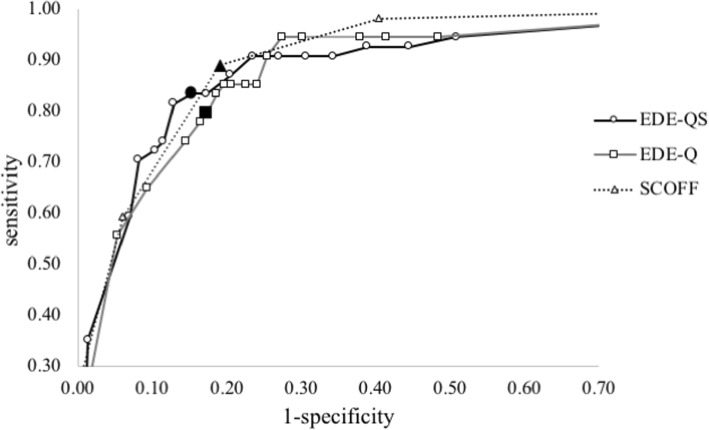
BACKGROUND: The Eating Disorder Examination - Questionnaire Short (EDE-QS) was developed as a 12-item version of the Eating Disorder Examination Questionnaire (EDE-Q) with a 4-point response scale that assesses eating disorder (ED) symptoms over the preceding 7 days. It has demonstrated good psychometric properties at initial testing. The purpose of this brief report is to determine a threshold score that could be used in screening for probable ED cases in community settings. METHODS: Data collected from Gideon et al. (2016) were re-analyzed. In their study, 559 participants (80.86% female; 9.66% self-reported ED diagnosis) completed the EDE-Q, EDE-QS, SCOFF, and Clinical Impairment Assessment (CIA). Discriminatory power was compared between ED instruments using receiver operating characteristic (ROC) curve analyses. RESULTS: A score of 15 emerged as the threshold that ensured the best trade-off between sensitivity (.83) and specificity (.85), and good positive predictive value (.37) for the EDE-QS, with discriminatory power comparable to other ED instruments. CONCLUSION: The EDE-QS appears to be an instrument with good discriminatory power that could be used for ED screening purposes.
Overview
The claims and statistics of this paper haven’t been checked yet.
Run the check — free, no account needed. It reads the open-access text and checks the sources it cites.
Integrity signals
Registry
Cites
Statistics
Figures
Verification
Claims the paper makes
The claims and statistics of this paper haven’t been checked yet.
Run the check — free, no account needed. It reads the open-access text and checks the sources it cites.
Claims other papers make about this one
Each is checked against this paper’s own text: does it say what the citing paper says it does?
The cited source says what the claim attributes to it.
In the citing paper
“This measure was employed in weekly questionnaires and has good reliability (α = 0.91) (42) and validity (43).”
From The acceptability, feasibility, and preliminary efficacy of a supported online self-help treatment program for binge-eating disorder (2023) · cites this paper as [43]
Self-check
Percentages, sums and reported differences re-computed from the paper’s own numbers.
The self-check needs the paper’s full text.
Citations
Cites
Measuring the Accuracy of Diagnostic Systems
Swets, J. A. (1988) · Science · doi:10.1126/science.3287615 · Cited by 10,058
Jacobson, N. S., & Truax, P. (1991) · Journal of Consulting and Clinical Psychology · doi:10.1037/0022-006x.59.1.12 · Cited by 7,770
Lippa, N. C., & Sanderson, S. C. (2013) · Human Heredity · doi:10.1159/000353712 · Cited by 6,095
The SCOFF questionnaire: Assessment of a new screening tool for eating disorders
Morgan, J. F., Reid, F., & Lacey, J. H. (1999) · BMJ · doi:10.1136/bmj.319.7223.1467 · Cited by 1,416
Mond, J., Hay, P., Rodgers, B., Owen, C., & Beumont, P. J. (2003) · Behaviour Research and Therapy · doi:10.1016/s0005-7967(03)00161-x · Cited by 1,124
Berg, K. C., Peterson, C. B., Frazier, P., & Crow, S. J. (2012) · International Journal of Eating Disorders · doi:10.1002/eat.20931 · Cited by 1,042
Fairburn, C. G., Cooper, Z., Doll, H. A., O’Connor, M. E., Bohn, K., Hawker, D. M., Wales, J. A., & Palmer, R. L. (2009) · American Journal of Psychiatry · doi:10.1176/appi.ajp.2008.08040608 · Cited by 829
Eating Disorder Examination-Questionnaire
Hilbert, A., Tuschen‐Caffier, B., Karwautz, A. F. K., Niederhofer, H., & Munsch, S. (2007) · Diagnostica · doi:10.1026/0012-1924.53.3.144 · Cited by 716
Missing Data in Likert Ratings: A Comparison of Replacement Methods
Downey, R. G., & King, C. V. (1998) · The Journal of General Psychology · doi:10.1080/00221309809595542 · Cited by 657
The measurement of impairment due to eating disorder psychopathology
Bohn, K., Doll, H. A., Cooper, Z., O'Connor, M., Palmer, R. L., & Fairburn, C. G. (2008) · Behaviour Research and Therapy · doi:10.1016/j.brat.2008.06.012 · Cited by 527
Research works printed but not linked: 1
- Fairburn CG, Cooper Z, O'Connor M. The eating disorder examination. Int J Eat Disord. 1993;6:1–8.
Cited by
Sorted by citations
Dahlgren, C. L., Sundgot‐Borgen, J., Kvalem, I. L., Wennersberg, A. L., & Wisting, L. (2024) · Journal of Eating Disorders · doi:10.1186/s40337-024-00992-3 · Cited by 89
Mental health among elite athletes in Norway during a selected period of the COVID-19 pandemic
Pensgaard, A. M., Oevreboe, T. H., & Ivarsson, A. (2021) · BMJ Open Sport & Exercise Medicine · doi:10.1136/bmjsem-2020-001025 · Cited by 59
Eating Disorder Examination Questionnaire (EDE-Q-13): expanding on the short form
Lev-Ari, L., Bachner-Melman, R., & Zohar, A. H. (2021) · Journal of Eating Disorders · doi:10.1186/s40337-021-00403-x · Cited by 53
Simons, M. L., Taft, T., Doerfler, B., Ruddy, J., Bollipo, S. J., Nightingale, S. L., Siau, K., & van Tilburg, M. A. L. (2021) · Neurogastroenterology & Motility · doi:10.1111/nmo.14188 · Cited by 54
Steinberg, D., Perry, T. R., Freestone, D. M., Bohon, C., Baker, J. H., & Parks, E. (2022) · Eating Disorders · doi:10.1080/10640266.2022.2076334 · Cited by 47
Metadata
- Authors
- Prnjak, K., Mitchison, D., Griffiths, S., Mond, J., Gideon, N., Serpell, L., & Hay, P.
- Affiliations
- Western Sydney University (AU)
- The University of Melbourne (AU)
- University of Tasmania (AU)
- Norfolk and Suffolk NHS Foundation Trust (GB)
- North East London NHS Foundation Trust (GB)
- Camden and Campbelltown Hospitals (AU)
- Corresponding author
- Prnjak, Katarina
- Venue
- BMC Psychiatry
- Published
- 2020-04-03
- Volume
- 20
- Issue
- 1
- Pages
- 146-146
- ISSN
- 1471-244X (ISSN-L)
- PMC
- PMC7118929
- OpenAlex
- W3014826794
- Cited by
- 134
- References
- 30
- Citations by year
- 2026: 19 · 2025: 28 · 2024: 29 · 2023: 25 · 2022: 15 · 2021: 13 · 2020: 5
- FWCI
- 5.79
- Type
- journal article
- Language
- en
- Open access
- gold
- doi.org
- Locations
- BMC Psychiatry (publishedVersion, cc-by)
- Research Square (acceptedVersion, cc-by)
- PubMed Central (publishedVersion, cc-by)
- PubMed (publishedVersion)
- UTAS Research Repository (acceptedVersion)
- DOAJ (DOAJ: Directory of Open Access Journals) (submittedVersion, cc-by-sa)
- UCL Discovery (University College London) (submittedVersion)
- Figshare (submittedVersion, cc-by)
- Minerva Access (University of Melbourne) (submittedVersion, cc-by)
- Funders
- Western Sydney University
- Medical Research Council
- National Health and Medical Research Council (1121538)
- Topics
- Social Sciences › Psychology › Clinical Psychology › Eating Disorders and Behaviors
- Health Sciences › Nursing › Nutrition and Dietetics › Nutrition, Health and Food Behavior
- Social Sciences › Psychology › Experimental and Cognitive Psychology › Anxiety, Depression, Psychometrics, Treatment, Cognitive Processes
- Keywords
- Eating Disorder Examination Questionnaire, eating disorders, screening, cut-off values, threshold scores, discriminant validity, sensitivity and specificity, SCOFF questionnaire, community settings
- MeSH terms
- Adolescent, Adult, Feeding and Eating Disorders, Female, Humans, Male, Mass Screening, Predictive Value of Tests, Psychometrics, Surveys and Questionnaires, Sensitivity and Specificity, Reproducibility of Results
About these checks
Registry, retraction, Cites and statistics results are computed, not judged, with one exception: a printed reference that no index lists is read once by a model before it counts as a citation error. Claims are extracted by a model and kept only when their quote appears verbatim in the text; each cited source is then checked, with a model’s help, for whether it says what the claim relies on. Those verdicts can be wrong — read the claim’s quote and the cited source before relying on one.
Statistics and arithmetic are recomputed, not judged.
Confidence bands are shown only for fields calibrated on our annotated test set. None is calibrated yet, so no band is shown.
What counts as a claim ›How we measure confidence ›How we check this ›
Are you an author, or do you see a problem with this page? Request a review
