

Stress and work-related mental illness among working adults with ADHD: a qualitative study
Open accessThe DOI matches its Crossref record; 47 of the 47 references it cites were found in a registry or an index.
Abstract
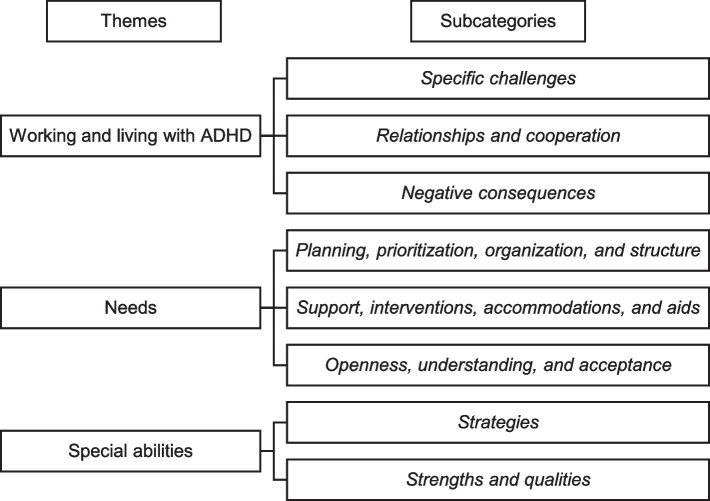
BACKGROUND: Though many adults with ADHD underperform professionally, are more stressed, and have more days of sickness absence compared to adults without ADHD, few studies have explored the experience of working as an adult with ADHD. This study explores the general experience of working with ADHD, including stress and work-related mental illness. METHODS: Semi-structured telephone interviews were conducted with 20 working adults with ADHD. Interview topics included how the ADHD diagnosis and/or symptoms of ADHD may have affected participants on the job, how work may have affected participants' well-being, and the need for support and accommodation. Qualitative content analysis was used to explore verbatim transcripts from the interviews. RESULTS: The analysis yielded three themes that describe some of the challenges of working with ADHD: Working and living with ADHD, Needs, and Special abilities, with a total of eight subcategories. Subcategories were Specific challenges; Relationships and cooperation; Negative consequences; Planning, prioritization, organization, and structure; Support, interventions, accommodations, and aids; Openness, understanding, and acceptance; Strategies; Strengths and qualities. CONCLUSION: Further knowledge about the challenges of working with ADHD is needed in workplaces; where organizational support is lacking, much in terms of accommodations and aids is up to the employee, and the disclosure of diagnoses may be associated with great dilemma.
Overview
The claims and statistics of this paper haven’t been checked yet.
Free: it reads the open-access text and checks the first 5 claims that cite a source we can check. Create a free account to check every claim.
Integrity signals
Registry
Cites
Statistics
Figures
Verification
Claims the paper makes
The claims and statistics of this paper haven’t been checked yet.
Free: it reads the open-access text and checks the first 5 claims that cite a source we can check. Create a free account to check every claim.
Claims other papers make about this one
Each is checked against this paper’s own text: does it say what the citing paper says it does?
The source backs part of the claim, not all of it — or backs it for a different population, condition or comparison.
In the citing paper
“Qualitative studies highlight the use of compensatory strategies such as external structuring systems (e.g., digital calendars, multiple alarms, and task-specific reminders) and behavioral techniques like stimulus control or task segmentation [199].”
From ADHD in Adulthood: Clinical Presentation, Comorbidities, and Treatment Perspectives (2025) · cites this paper as [199]
Experimental — accuracy not yet measuredThe cited source says what the claim attributes to it.
In the citing paper
“Hence, providing support for individuals with symptoms of ADHD might be an effective way not only to prevent some of the difficulties often experienced in occupational settings, but also risk factors that might contribute to or exacerbate mental distress (Ek and Isaksson, 2013; Oscarsson et al., 2022).”
From A study protocol of a randomized controlled study of internet-based cognitive behavioral therapy for adult attention deficit hyperactivity disorder (2023) · cites this paper as Oscarsson et al., 2022
Self-check
Percentages, sums and reported differences re-computed from the paper’s own numbers.
The self-check needs the paper’s full text.
Citations
Cites
Three Approaches to Qualitative Content Analysis
Hsieh, H.-F., & Shannon, S. E. (2005) · Qualitative Health Research · doi:10.1177/1049732305276687 · Cited by 44,601 · cited 1×
“Analysis A conventional approach to qualitative content analysis was used to explore the content of the interviews [35].”
MethodThe qualitative content analysis process
Elo, S., & Kyngäs, H. (2008) · Journal of Advanced Nursing · doi:10.1111/j.1365-2648.2007.04569.x · Cited by 22,617 · cited 1×
“For trustworthiness, the analysis process has been described in detail [51], facilitating the readers’ evaluation of its transferability [52].”
MethodGraneheim, U. H., & Lundman, B. (2004) · Nurse Education Today · doi:10.1016/j.nedt.2003.10.001 · Cited by 20,772 · cited 1×
“For credibility and dependability, all parts of the analysis were continuously discussed between the authors, and representative quotes from the transcripts are presented to illustrate how categories and themes cover data [52, 53].”
BackgroundHow to plan and perform a qualitative study using content analysis
Bengtsson, M. (2016) · NursingPlus Open · doi:10.1016/j.npls.2016.01.001 · Cited by 4,616 · cited 2×
“Categories from all interviews were gradually clustered, with close attention paid to maintaining internal homogeneity and external heterogeneity between the final themes [36].”
BackgroundKessler, R. C., Adler, L., Barkley, R., Biederman, J., Conners, C. K., Demler, O., Faraone, S. V., Greenhill, L. L., Howes, M. J., Secnik, K., et al. (2006) · American Journal of Psychiatry · doi:10.1176/ajp.2006.163.4.716 · Cited by 3,886
Prevalence and correlates of adult attention-deficit hyperactivity disorder: meta-analysis
Simon, V., Czobor, P., Bálint, S., Mészáros, Á., & Bitter, I. (2009) · British Journal of Psychiatry · doi:10.1192/bjp.bp.107.048827 · Cited by 1,601
Kooij, S. J., Bejerot, S., Blackwell, A., Caci, H., Casas-Brugué, M., Carpentier, P. J., Edvinsson, D., Fayyad, J., Foeken, K., Fitzgerald, M., et al. (2010) · BMC Psychiatry · doi:10.1186/1471-244x-10-67 · Cited by 928 · cited 1×
“the most common psychiatric disorders among children and adolescents, and for most patients, symptoms persist throughout adulthood, with associated negative outcomes on both individual and societal levels [6].”
BackgroundSelf-citationUpdated European Consensus Statement on diagnosis and treatment of adult ADHD
Kooij, J. J. S., Bijlenga, D., Salerno, L., Jaeschke, R., Bitter, I., Balázs, J., Thome, J., Dom, G., Kasper, S., Nunes Filipe, C., et al. (2019) · European Psychiatry · doi:10.1016/j.eurpsy.2018.11.001 · Cited by 686
Self-citation(2012) · doi:10.1787/9789264124523-en · Cited by 490
Barkley, R. A., & Fischer, M. (2010) · Journal of the American Academy of Child & Adolescent Psychiatry · doi:10.1016/j.jaac.2010.01.019 · Cited by 479 · cited 3×
“Barkley and Fischer also demonstrate associations between emotional impulsiveness and several measures of occupational outcome, beyond the associations of traditional ADHD symptoms.”
BackgroundInfluential
Cited by
Executive function deficits mediate the relationship between employees’ ADHD and job burnout
Turjeman-Levi, Y., Itzchakov, G., & Engel-Yeger, B. (2024) · AIMS Public Health · doi:10.3934/publichealth.2024015 · Cited by 28
“Therefore, it is not surprising that adults with ADHD suffer from work-related health issues such as stress and sickness [14].”
BackgroundHedlund, Å., & Jordal, M. (2024) · International Journal of Nursing Studies · doi:10.1016/j.ijnurstu.2024.104857 · Cited by 33
Hotte‐Meunier, A., Sarraf, L., Bougeard, A., Bernier, F., Voyer, C., Deng, J., Asmar, S. E., Σταμάτη, Α., Corbière, M., Villotti, P., et al. (2024) · Neurodiversity · doi:10.1177/27546330241287655 · Cited by 46
“…on providing private and quiet workspaces, fl exible workday hours, frequent breaks in long meetings, and dele-gating tedious tasks among colleagues (Button, 2018; Ek & Isaksson, 2013; Harris, 2020; Kent, 2017; Liebel et al., 2023; Means et al., 1997; Oscarsson et al., 2022; Schreuer & Dorot, 2017).”
InfluentialADHD in Adulthood: Clinical Presentation, Comorbidities, and Treatment Perspectives
Bogdańska-Chomczyk, E., Majewski, M. K., & Kozłowska, A. (2025) · International Journal of Molecular Sciences · doi:10.3390/ijms262211020 · Cited by 15
“Qualitative studies highlight the use of compensatory strategies such as external structuring systems (e.g., digital calendars, multiple alarms, and task-specific reminders) and behavioral techniques like stimulus control or task segmentation [199].”
Distractibility and Impulsivity in ADHD as an Evolutionary Mismatch of High Trait Curiosity
Cunff, A. L. (2024) · Evolutionary Psychological Science · doi:10.1007/s40806-024-00400-8 · Cited by 24
“Beyond school, the modern work environment with its rigid structure, administrative tasks, and settings that discourage movement have also been found to pose a challenge for individuals with ADHD traits (Adamou et al., 2013; Fuermaier et al., 2021; Oscarsson et al., 2022).”
Curiosity and zetetic style in ADHD
Steglich‐Petersen, A., & Varga, S. (2023) · Philosophical Psychology · doi:10.1080/09515089.2023.2227217 · Cited by 14
“As “Participant F” notes in a study by Oscarsson et al. (2022), “All the little things like deciding for yourself in what order things should be done, how they should be done, what exactly we are in need of . . .”
Newman, K., Snay, S., Endres, M., Parikh, M., & Begel, A. (2025) · International ACM SIGACCESS Conference on Computers and Accessibility (ASSETS) · doi:10.1145/3663547.3746334 · Cited by 12
Seery, C., Cochrane, R. H., Mulcahy, M., Kilbride, K., Wrigley, M., & Bramham, J. (2025) · Internet Interventions · doi:10.1016/j.invent.2025.100807 · Cited by 7
Hedlund, Å., & Jordal, M. (2024) · Work · doi:10.1177/10519815241289852 · Cited by 15
“25,31,32 The nursing profession is particularly challenging, in that it places signi fi cant demands on communication.”
Conceptualizing adult ADHD with the DSM alternative model of personality disorder
Jacobsson, P., Hopwood, C. J., Krueger, R. F., Söderpalm, B., & Nilsson, T. (2024) · Personality and Mental Health · doi:10.1002/pmh.1632 · Cited by 8
Forsström, D., Oscarsson, M., Buhrman, M., & Rozental, A. (2023) · Internet Interventions · doi:10.1016/j.invent.2023.100652 · Cited by 6
“One way of overcoming this problem of outreach is to provide online interventions, which has proven to be an effective mean of disseminating aid for many psychiatric disorders (Andersson et al., 2019), but is less explored for ADHD-symptoms (P ˘ as ˘ arelu et al., 2020).”
Self-citationRosenthal, E. A., Mitchell, J. T., Weisner, T. S., Silverstein, N. A., Yi, C., Arnold, L. E., Hechtman, L. T., Hinshaw, S. P., & Jensen, P. S. (2025) · Journal of Attention Disorders · doi:10.1177/10870547251352589 · Cited by 6
“…to interpersonal challenges (conflict, inconsistent communication, etc.; Ginapp et al., 2023; Matheson et al., 2013; Oscarsson et al., 2022), stress (e.g., Oscarsson et al., 2022), sleep problems (Matheson et al., 2013), and emotion dysregulation (Matheson et al., 2013; Oscarsson et al., 2022).”
InfluentialADHD and career sustainability: a sustainable career ecosystem perspective
Grabarski, M. K., Jameson, T. P., & Mouratidou, M. (2025) · Career Development International · doi:10.1108/cdi-03-2025-0150 · Cited by 7
Oscarsson, M., Hammarbäck, S., Wiberg, K. B., Rozental, A., Ginsberg, Y., Carlbring, P., Andersson, G., & Jönsson, F. U. (2025) · JMIR Formative Research · doi:10.2196/66388 · Cited by 5
“As part of a previous qualitative study [35], 20 working adults with ADHD were asked about their interest in and attitudes toward a hypothetical web-based psychological intervention developed specifically for working adults with ADHD.”
Self-citationErdal, K., Adami, G., Gelléri, P., & Dettmers, J. (2025) · International Journal of Educational Research Open · doi:10.1016/j.ijedro.2025.100497 · Cited by 4
Interpersonal Skills with a Focus on Creativity in Attention Deficit Hyperactivity Disorder
Kalogeratos, G., Anastasopoulou, E. E., Tsagri, A., Tseremegklis, C., & Asimakopoulou, S. (2023) · Technium Social Sciences Journal · doi:10.47577/tssj.v52i1.10251 · Cited by 6
“…may excel in creative occupations or high-level athletics, underscoring the significance of creating inclusive work environments that can cater to diverse requirements while also recognizing the need for inventive and all-encompassing approaches (Antonopoulou et al., 2021b; Oscarsson et al., 2022).”
BackgroundSvedell, L. A., Lindvall, M. A., Lidström-Holmqvist, K., Cao, Y., & Msghina, M. (2025) · Frontiers in Psychiatry · doi:10.3389/fpsyt.2025.1690216 · Cited by 6
López-Pinar, C., Selaskowski, B., Schulze, M., Oscarsson, M., Fenollar-Cortés, J., Sibley, M. H., Philipsen, A., & Hirvikoski, T. (2026) · Behaviour Research and Therapy · doi:10.1016/j.brat.2026.105026 · Cited by 4
Self-citationADHD and the Early Career Teaching Librarian: An Autoethnography
Swick-Jemison, J. (2023) · Canadian Journal of Academic Librarianship · doi:10.33137/cjal-rcbu.v9.40953 · Cited by 3
Ward, J. H., Becker, K., Smith, J. R., Price, A., & Newlove‐Delgado, T. (2024) · BMC Health Services Research · doi:10.1186/s12913-024-11188-5 · Cited by 4
“There are also other important factors at play, for example the impact of chronic stress related to ADHD on long-term physical and mental health, both directly (e.g. neuroendocrine hypotheses) and indirectly (e.g. financial impacts of sickness) [28, 32–34].”
BackgroundWon, H. Y., Park, M., Kim, G. E., & Kim, E. (2024) · Journal of korean Academy of Child and Adolescent Psychiatry · doi:10.5765/jkacap.240027 · Cited by 2
“In a study by Oscarsson et al. [48], which interviewed 20 participants with adult ADHD, a significant number of participants reported difficulties in maintaining structure and organization at work.”
BackgroundVoyer, C., Corbière, M., Villotti, P., Stamate, A. N., & Sauvé, G. (2025) · Contemporary Clinical Trials · doi:10.1016/j.cct.2025.107997 · Cited by 1
Arya, V. (2026) · Journal of Organizational Effectiveness People and Performance · doi:10.1108/joepp-10-2025-0938 · Cited by 2
Maeda, C., Knouse, L. E., Takeda, K., Masudomi, C., Takahashi, E., Katsuragawa, T., & Kumano, H. (2026) · Frontiers in Psychology · doi:10.3389/fpsyg.2026.1807337 · Cited by 2
“Even when individuals disclose their diagnosis to seek support, their supervisors or managers may lack knowledge about ADHD or fail to understand the specific difficulties faced by adults with the condition (Oscarsson et al., 2022).”
Costa, Í. M., Melo, C. D. F., Gontijo, D. F., Dourado, S., Tavares, L. L. P., & Bezerra, C. M. (2026) · Journal of Attention Disorders · doi:10.1177/10870547261469218 · Cited by 2
Real-Life Symptoms, Difficulties, and Interventions for Adult ADHD: A Literature Review
Chen, J. (2024) · Journal of Education Humanities and Social Sciences · doi:10.54097/w3chre28 · Cited by 1
“Adults with ADHD may struggle to find a balance between work, play, and family obligations, and they are at a higher risk of developing mental illnesses [8].”
BackgroundImpact professionnel du Trouble Déficit de l’Attention avec ou sans Hyperactivité (TDAH)
Jullian, B., Pariente, J., Yrondi, A., & Hérin, F. (2025) · Annales Médico-psychologiques revue psychiatrique · doi:10.1016/j.amp.2024.11.004 · Cited by 3
Leveraging the Metaverse for Inclusive Workplaces: Opening the Research Agenda
Mukherjee, U., Raj, B., & Arora, D. (2025) · Emerald Group Publishing Limited eBooks · doi:10.1108/978-1-83662-110-220251003 · Cited by 1
Porto, G. C., Fistarol, J. M., Mantovani, I., Menegheti, R. F., da Rocha, J. K., Kaskelis, A. G., & Santiago, A. N. (2025) · Arquivos do Mudi · doi:10.4025/arqmudi.v29i3.76043
Biographic Genesis of Vocational Success or Failure of Neurodivergent People
Griesbacher, E.-M. (2025) · Neurodiversity · doi:10.1177/27546330251379268 · Cited by 1
“…2022; Diener et al., 2020; Doyle, 2020; Goldfarb et al., 2019; Harvery et al., 2021; Hayward et al., 2019, 2020; Hendricks, 2010; Hotte-Meunier et al., 2024; Khalifa et al., 2020; Lorenz et al., 2016; Maras et al., 2021; Oscarsson et al., 2022; Sharpe et al., 2022; Waisman-Nitzan et al., 2020).”
Heltne, A., Kenter, R. M. F., Gulseth, R., & Nordgreen, T. (2026) · Internet Interventions · doi:10.1016/j.invent.2026.100922
“This is particularly concerning given the increasing number of people seeking treatment for ADHD (Martin et al., 2025; University of Utah Health, 2024), and given the potential burden these patients may experience in their daily lives (Oscarsson et al., 2022).”
Neurodiverse Work Teams: Linking Individual Variation to Team-Level Processes and Effectiveness
Quigley, N. R., Meloche, A., & Roberson, Q. M. (2026) · Organizational Psychology Review · doi:10.1177/20413866261426472 · Cited by 4
“Then, as the team develops the campaign ’ s message and strategy, selects marketing channels, and produces content, the creativity of the team member with ADHD (e.g., Oscarsson et al., 2022) could help the team feel excited about its work and lead to higher levels of collective ef fi cacy.”
InfluentialInterventi per supportare le persone ADHD nei contesti lavorativi: scoping review
Emanueli, A., Iacomini, S., & Cavallini, F. (2026) · PSICOLOGIA DELLA SALUTE · doi:10.3280/pds2026-001004
Fukuura, Y., Shigematsu, Y., & Mizuochi, Y. (2026) · Nursing Reports · doi:10.3390/nursrep16030101 · Cited by 1
“These include misunderstandings in relationships with supervisors and colleagues, isolation in workplaces with limited knowledge about mental health, and stigma within organizational cultures that treat mental health issues as taboo [12–14].”
Teodorini, R. D., Smith-Spark, J. H., Rycroft, N., & Sattler, S. (2026) · Journal of Public Health · doi:10.1007/s10389-026-02730-2 · Cited by 2
Park, J., Huh, M. B., Miri, M., Hoelting, M., Flores, S., Karagaiah, Y., & Afkhami, M. (2026) · Architecture · doi:10.3390/architecture6020051 · Cited by 1
Workplace and Social Support as Predictors of Job Satisfaction, Motivation, and Income in ADHD
Chan, E. S. M., Swarbrick, M. A., Frontale, S. R., Baker, S., Green, C. D., & Langberg, J. M. (2026) · Journal of Vocational Rehabilitation · doi:10.1177/10522263261449115 · Cited by 1
“However, other jobs offer individuals with ADHD more opportunities to socialize, be active, and engage in novel tasks; all of which has qualitatively been associated with higher occupational well-being in ADHD (Hotte-Meunier et al., 2024; Oscarsson et al., 2022; Schrevel et al., 2016).”
Park, J., Murray, R., Duffy, R. D., & Zhou, Z. E. (2026) · Child Psychiatry & Human Development · doi:10.1007/s10578-026-02036-0 · Cited by 1
Desired Workplace Support: Perspectives of Adults with ADHD and/or Autism
Högstedt, E., Igelström, K. M., Korhonen, L., Ekman, T., Käcker, P., & Björk, M. (2026) · Neurodiversity · doi:10.1177/27546330261456176
Seery, C., Leonard-Curtin, A., Fennessy, J., Rudden, H., McLaughlin, D., Dio, F. U., Cassidy, S., Kilbride, K., Wrigley, M., & Bramham, J. (2026) · Research in Neurodiversity · doi:10.1016/j.rin.2026.100042
Fahad, A. H. M., Chowdhury, N. M. R. A., & Urme, S. A. (2026) · BMJ Open · doi:10.1136/bmjopen-2026-119568
“8 Participants described common difficulties, such as inattention, forgetfulness and impulsivity, as well as less frequently recognised challenges, particularly problems related to emotional regulation.”
Designing inclusive jobs for (and with) neurodivergent talent
Kulkarni, M., Beatty, J. E., Dachner, A. M., & Lyons, B. J. (2026) · Organizational Dynamics · doi:10.1016/j.orgdyn.2026.101255
Task Novelty and Job Satisfaction in Adults with ADHD
Sciutto, M. J., Hall, A. D., & Henry, A. N. (2026) · Occupational Health Science · doi:10.1007/s41542-026-00274-1
“In addition to the impact on work outcomes, the stress and challenges of ADHD at work often spill over into personal life and mental health (Oscarsson et al., 2022 ).”
Perspectives from Adolescents and Young Adults with ADHD: A Mixed Methods Study
Barnard-Brak, L. M., & Snider, L. A. (2026) · Journal of Applied School Psychology · doi:10.1080/15377903.2026.2734986
Metadata
- Authors
- Oscarsson, M., Nelson, M., Rozental, A., Ginsberg, Y., Carlbring, P., & Jönsson, F.
- Affiliations
- Stockholm University (SE)
- Uppsala University (SE)
- Karolinska Institutet (SE)
- Corresponding author
- Oscarsson, Martin
- Venue
- BMC Psychiatry
- Published
- 2022-11-30
- Volume
- 22
- Issue
- 1
- Pages
- 751-751
- ISSN
- 1471-244X (ISSN-L)
- PMC
- PMC9714234
- OpenAlex
- W4310668130
- Semantic Scholar
- ba2ef3f002542d6d7d08527656c19456be190155
- Cited by
- 45
- References
- 46
- Citations by year
- 2026: 19 · 2025: 13 · 2024: 9 · 2023: 4
- FWCI
- 4.23
- Type
- journal article
- Language
- en
- Open access
- gold
- doi.org
- Licence
- cc-by
- creativecommons.org/licenses/by/4.0 (tdm)
- creativecommons.org/licenses/by/4.0 (vor)
- Locations
- BMC Psychiatry (publishedVersion, cc-by)
- PubMed Central (publishedVersion, cc-by)
- PubMed (publishedVersion)
- KTH Publication Database DiVA (KTH Royal Institute of Technology) (submittedVersion, other-oa)
- DOAJ (DOAJ: Directory of Open Access Journals) (submittedVersion, cc-by-sa)
- Funders
- Region Stockholm (FoUI-941466)
- Stockholm University
- Topics
- Health Sciences › Medicine › Psychiatry and Mental health › Attention Deficit Hyperactivity Disorder
- Health Sciences › Medicine › Public Health, Environmental and Occupational Health › Workplace Health and Well-being
- Social Sciences › Education › Disability Education and Employment
- Keywords
- adult ADHD, occupational stress, workplace accommodations, organizational support, diagnosis disclosure, employee well-being, workplace relationships, sick leave
- MeSH terms
- Adult, Attention Deficit Disorder with Hyperactivity, Humans, Workplace, Disclosure, Qualitative Research
About these checks
Registry, retraction, Cites and statistics results are computed, not judged, with one exception: a printed reference that no index lists is read once by a model before it counts as a citation error. Claims are extracted by a model and kept only when their quote appears verbatim in the text; each cited source is then checked, with a model’s help, for whether it says what the claim relies on. Those verdicts can be wrong — read the claim’s quote and the cited source before relying on one.
Statistics and arithmetic are recomputed, not judged.
Confidence bands are shown only for fields calibrated on our annotated test set. None is calibrated yet, so no band is shown.
What counts as a claim ›How we measure confidence ›How we check this ›
Are you an author, or do you see a problem with this page? Request a review
Data sources
Bibliographic data: Semantic Scholar, OpenAlex, Crossref.
Contains information from the Semantic Scholar Academic Graph Datasets, made available under the ODC Attribution License (ODC-BY 1.0).
Semantic Scholar’s data is described in: Kinney, R., et al. (2023). The Semantic Scholar Open Data Platform. arXiv:2301.10140.
