

A systematic review of randomized controlled trials of mHealth interventions against non-communicable diseases in developing countries
Open accessThe DOI matches its Crossref record; 36 of the 36 references it cites were found in a registry or an index; 13 of the 56 sources its claims cite were checked for support.
Abstract
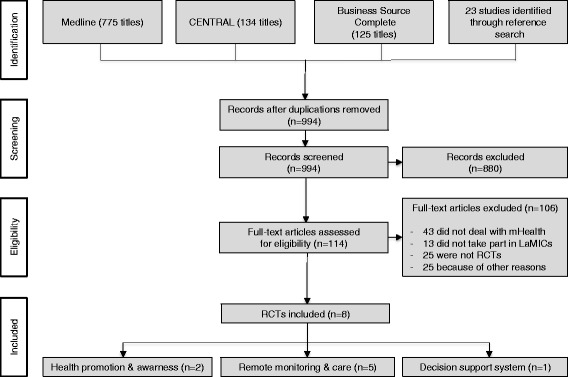
BACKGROUND: The reasons of deaths in developing countries are shifting from communicable diseases towards non-communicable diseases (NCDs). At the same time the number of health care interventions using mobile phones (mHealth interventions) is growing rapidly. We review studies assessing the health-related impacts of mHealth on NCDs in low- and middle-income countries (LAMICs). METHODS: A systematic literature search of three major databases was performed in order to identify randomized controlled trials (RCTs) of mHealth interventions. Identified studies were reviewed concerning key characteristics of the trial and the intervention; and the relationship between intervention characteristics and outcomes was qualitatively assessed. RESULTS: The search algorithms retrieved 994 titles. 8 RCTs were included in the review, including a total of 4375 participants. Trials took place mostly in urban areas, tested different interventions (ranging from health promotion over appointment reminders and medication adjustments to clinical decision support systems), and included patients with different diseases (diabetes, asthma, hypertension). Except for one study all showed rather positive effects of mHealth interventions on reported outcome measures. Furthermore, our results suggest that particular types of mHealth interventions that were found to have positive effects on patients with communicable diseases and for improving maternal care are likely to be effective also for NCDs. CONCLUSIONS: Despite rather positive results of included RCTs, a firm conclusion about the effectiveness of mHealth interventions against NCDs is not yet possible because of the limited number of studies, the heterogeneity of evaluated mHealth interventions and the wide variety of reported outcome measures. More research is needed to better understand the specific effects of different types of mHealth interventions on different types of patients with NCDs in LaMICs.
Overview
CoChat Summary
TL;DR
This systematic review identified only 8 RCTs of mHealth interventions for non-communicable diseases in low- and middle-income countries, covering 4,375 participants. Except for one study, the included trials reported generally positive effects, but heterogeneity and the small evidence base prevented firm conclusions about effectiveness.
Key findings
- The search retrieved 994 titles; 8 RCTs met inclusion criteria, with a total of 4,375 participants (2,095 mHealth intervention, 314 landline-telephone intervention, 1,966 control). Trial size ranged from 16 to 2,086 participants.
- Five studies were in lower middle income countries and three in upper middle income countries; no studies were conducted in low income countries. Conditions included diabetes (3 studies), asthma (2), cardiovascular diseases (2), and different NCDs including hypertension, asthma, and diabetes (1).
- Except for one study, all included RCTs showed rather positive effects on reported outcome measures. Examples: Shetty et al. found significant clinical improvements but not significant compliance improvements; Liu et al. found significant quality-of-life improvements; Liew et al. found appointment reminders significantly lowered non-attendance; Tian et al. found significantly increased medication compliance and lower blood pressure.
- Piette et al. found lower systolic blood pressure, but significance was limited to a subgroup of 117 of 181 participants with low literacy or high hypertension information needs. Only one trial assessed costs, estimating additional monetary costs of €0.67 per patient per week for text messages to physicians and 2 minutes per patient per week at a cost of 1 Euro.
Methods
- Systematic review of RCTs of mHealth interventions for patients with NCDs in low- and middle-income countries, published in English or German before August 2015.
- Searched MEDLINE (PubMed), CENTRAL, and Business Source Complete between December 2013 and February 2014, with an update in August 2015; reference lists of included studies and existing reviews were also screened.
- Two reviewers independently screened studies; data were collected on trial, population, intervention, comparator, and outcomes. Studies were categorized into four mHealth intervention types, and the relationship between intervention characteristics and outcomes was assessed qualitatively. Meta-analysis was not performed because of heterogeneity in interventions, participants, and outcome measures; risk of bias was assessed using the Cochrane Collaboration’s tool.
Limitations
- The paper states that it excluded all non-RCTs, restricted inclusion to English and German, and could not compare results across studies or perform pooled analyses because of the limited number of studies and heterogeneity of interventions, diseases, and outcome measures.
- The paper states that all included studies were from middle income countries, so evidence from low income countries is very limited, and information on cost-effectiveness is largely unavailable.
- Evident from the text: one included trial had only 16 participants, most trials took place in urban areas, and the wide variety of reported outcome measures limits generalizability.
Model-written summary. Check it against the paper before relying on it.
Integrity signals
Registry
Cites
Statistics
Figures
Verification
Claims the paper makes
9 Valid · 1 Not valid · 26 Not checked · 43 Own results and interpretations
Every source the paper cites for this claim was checked and supports it.
In the paper
“Bloomfield et al. [16] performed a review of mHealth interventions against NCDs focusing only on Sub-Saharan African countries.”
§ A systematic review of randomized controlled trials of mHealth interventions against non-communicable diseases in developing countries > Background
What the sources say
- Supportedcites [16] Bloomfield GS Vedanthan R Vasudevan L Kithei A Were M Velazquez EJ Mobile health for non-communicable diseases in Sub-Saharan Africa: a systematic review of the literature and strategic framework for research Glob Health 2014 10 1 49 10.1186/1744-8603-10-49 PMC4064106 24927745 source
The Discussion explicitly describes the work as a systematic review focused on mHealth applied to NCDs in sub-Saharan Africa. The Abstract Results also state that the included studies used mobile phones for NCD care in that region. (LLM, conf=0.94)
plain- Asserted: passes — The authors put it forward as true.
- Checkable: passes — It can be checked against evidence.
- Load-bearing: passes — The paper’s conclusions depend on it.
- Based: passes — The paper gives a reason why it holds.
- Supported
The cited sources support only part of this claim — read each source’s verdict below.
In the paper
“drug intake reminders have been found to improve treatment adherence of people with AIDS and Malaria [37–39]”
§ A systematic review of randomized controlled trials of mHealth interventions against non-communicable diseases in developing countries > Discussion
What the sources say
- Partly supportedcites [37] Thirumurthy H Lester RT M-health for health behaviour change in resource-limited settings: applications to HIV care and beyond Bull World Health Organ 2012 90 5 390 2 10.2471/BLT.11.099317 22589574 PMC3341690 sourceExperimental — accuracy not yet measured
The “Improving medication adherence” section reports that text-message reminders improved adherence to antiretroviral therapy among people with HIV. The malaria study described in “Targeting the supply side of health care” instead concerns health workers’ adherence to treatment guidelines, not patients’ adherence to their medication. Page numbers are not provided in our copy. (LLM, conf=0.88)
- Partly supportedcites [38] Pop-Eleches C Thirumurthy H Habyarimana JP Zivin JG Goldstein MP De Walque D Mackeen L Haberer J Kimaiyo S Sidle J Mobile phone technologies improve adherence to antiretroviral treatment in a resource-limited setting: a randomized controlled trial of text message reminders AIDS (London, England) 2011 25 6 825 10.1097/QAD.0b013e32834380c1 PMC3718389 21252632 sourceExperimental — accuracy not yet measured
The Results (Intervention effects on at least 90% adherence; page unavailable) report better antiretroviral adherence with weekly text reminders than with no reminders, but no significant improvement with daily reminders. The paper studies people receiving HIV treatment and does not provide evidence about malaria treatment adherence. (LLM, conf=0.90)
- Partly supportedcites [39] Zurovac D Larson BA Sudoi RK Snow RW Costs and cost-effectiveness of a mobile phone text-message reminder programmes to improve health workers’ adherence to malaria guidelines in Kenya PLoS One 2012 7 12 e52045 10.1371/journal.pone.0052045 23272206 PMC3525566 sourceExperimental — accuracy not yet measured
The Introduction reports that text-message reminders sent to Kenyan health workers improved their management of children under malaria guidelines. The Methods describe reminders about dosing, dispensing and counseling, not reminders sent to patients to take drugs. The paper does not report improved medication-taking adherence among people with malaria or AIDS. (LLM, conf=0.86)
plainstates a cause- Asserted: passes — The authors put it forward as true.
- Checkable: passes — It can be checked against evidence.
- Load-bearing: passes — The paper’s conclusions depend on it.
- Based: passes — The paper gives a reason why it holds.
- Partly supported
Every source the paper cites for this claim was checked and supports it.
In the paper
“The most basic intervention in the category of remote monitoring & care support was an appointment-reminder system, where text messages were sent 24–48 h before the patients’ scheduled appointments [30].”
§ A systematic review of randomized controlled trials of mHealth interventions against non-communicable diseases in developing countries > Results > Characteristics of included studies
What the sources say
- Supportedcites [30] Liew S-M Tong SF Lee VKM Ng CJ Leong KC Teng CL Text messaging reminders to reduce non-attendance in chronic disease follow-up: a clinical trial Br J Gen Pract 2009 59 569 916 20 10.3399/bjgp09X472250 19712544 PMC2784529 source
The Method and Randomisation and intervention sections state that reminders were sent 24–48 hours before scheduled appointments. The intervention description identifies a text-messaging reminder group; calling it the “most basic” intervention is the citing authors’ framing, not a finding attributed to this paper. (LLM, conf=0.94)
plain- Asserted: passes — The authors put it forward as true.
- Checkable: passes — It can be checked against evidence.
- Load-bearing: unclear — It is unclear whether the paper’s conclusions depend on it.
- Based: passes — The paper gives a reason why it holds.
- Supported
The sources with a verdict support this claim; the rest weren’t checked yet, have no full text we could read, or their verdicts aren’t rated yet.
In the paper
“Four interventions required the patients to record key parameters of their disease, e.g., the Peak Expiratory Flow Rate (PEFR) for patients with Asthma [28, 29], the blood glucose level for patients with Diabetes [27] or the blood pressure for patients with hypertension [23].”
§ A systematic review of randomized controlled trials of mHealth interventions against non-communicable diseases in developing countries > Results > Characteristics of included studies
What the sources say
- Not checked yetcites [28] Liu W-T Huang C-D Wang C-H Lee K-Y Lin S-M Kuo H-P A mobile telephone-based interactive self-care system improves asthma control Eur Respir J 2011 37 2 310 7 10.1183/09031936.00000810 20562122 source
- Not checked yetcites [29] Ostojic V Cvoriscec B Ostojic SB Reznikoff D Stipic-Markovic A Tudjman Z Improving asthma control through telemedicine: a study of short-message service Telemed J E Health 2005 11 1 28 35 10.1089/tmj.2005.11.28 15785218 source
- Not checked yetcites [27] Shahid M Mahar SA Shaikh S Shaikh Z Mobile phone intervention to improve diabetes care in rural areas of pakistan: a randomized controlled trial J College of Physicians Surg Pak 2015 25 3 166 71 25772954
- Supportedcites [23] Piette JD Datwani H Gaudioso S Foster SM Westphal J Perry W Hypertension management using mobile technology and home blood pressure monitoring: results of a randomized trial in two low/middle-income countries Telemed E Health 2012 18 8 613 20 10.1089/tmj.2011.0271 PMC4361160 23061642 source
The INTERVENTION section of Piette et al. (2012) states that intervention patients with hypertension were given an electronic home BP monitor and 'instructed to measure their BP at least several times per week and keep a written record of the results', and that the automated calls gathered information on the patient's BP and BP self-monitoring. This makes the paper a valid example for the cited part of the sentence (patients recording blood pressure in a hypertension intervention). The 'four interventions' tally and the asthma/diabetes examples belong to the other citations and are not attributed to this source. (LLM, conf=0.90)
plainn = 4- Asserted: passes — The authors put it forward as true.
- Checkable: passes — It can be checked against evidence.
- Load-bearing: unclear — It is unclear whether the paper’s conclusions depend on it.
- Based: passes — The paper gives a reason why it holds.
A result the paper reports from its own data — it cites no other source for it, so there is none to check. The quote shows it is in the paper.
In the paper
“8 RCTs were included in the review”
- Also stated in: § Literature search results · plain
“The final analysis included 8 studies, which met all inclusion criteria.”
§ A systematic review of randomized controlled trials of mHealth interventions against non-communicable diseases in developing countries > Abstract > Results
plain- Asserted: passes — The authors put it forward as true.
- Checkable: passes — It can be checked against evidence.
- Load-bearing: passes — The paper’s conclusions depend on it.
- Based: passes — The paper gives a reason why it holds.
- Also stated in: § Literature search results · plain
32 more claims
Create a free account to see all 79 claims and to verify the 43 references still open.
- Probably not a substantial claim. 25
- It may state two separate claims as one. 24
Claims other papers make about this one
Each is checked against this paper’s own text: does it say what the citing paper says it does?
The cited source says what the claim attributes to it.
In the citing paper
“Three recent systematic reviews, two specifically focusing on the use of mHealth interventions for the care and management of NCDs in SSA [6] and in developing countries [9], and the other looking more broadly at the use of mHealth interventions against chronic diseases in developing countries [10], found that the included studies generally reported positive outcomes.”
From A realist review of mobile phone-based health interventions for non-communicable disease management in sub-Saharan Africa (2017) · cites this paper as [9]
In the citing paper
“However, the authors also noted that there was insufficient evidence to support the scale-up of mHealth interventions because there were only five studies from SSA countries [6] and only nine studies from developing countries [9, 10].”
From A realist review of mobile phone-based health interventions for non-communicable disease management in sub-Saharan Africa (2017) · cites this paper as [9]
Citations
Cites
Global status report on noncommunicable diseases 2010.
Alwan, A. (2011) · Cited by 8,494
An estimation of the global volume of surgery: a modelling strategy based on available data
Weiser, T. G., Regenbogen, S. E., Thompson, K. D., Haynes, A. B., Lipsitz, S. R., Berry, W. R., & Gawande, A. A. (2008) · The Lancet · doi:10.1016/s0140-6736(08)60878-8 · Cited by 2,511 · cited 1×
“As a result of increasing life-expectancy and growing welfare in low and middle income countries (LaMICs), there is a steady shift away from communicable to noncommunicable diseases (NCDs) [1–3].”
Background(2012) · RePEc: Research Papers in Economics · Cited by 1,951
Pop-Eleches, C., Thirumurthy, H., Habyarimana, J. P., Zivin, J. G., Goldstein, M. P., de Walque, D., MacKeen, L., Haberer, J., Kimaiyo, S., Sidle, J., et al. (2011) · AIDS · doi:10.1097/qad.0b013e32834380c1 · Cited by 982
The double burden of communicable and non-communicable diseases in developing countries
Boutayeb, A. (2006) · Transactions of the Royal Society of Tropical Medicine and Hygiene · doi:10.1016/j.trstmh.2005.07.021 · Cited by 672 · cited 1×
“It is predicted that this number will increase to 70 % of all deaths in 2020 [5].”
Background(2006) · Globalization and Health · doi:10.1186/1744-8603-2-9 · Cited by 467
‘Mobile’ Health Needs And Opportunities In Developing Countries
Kahn, J. G., Yang, J. S., & Kahn, J. S. (2010) · Health Affairs · doi:10.1377/hlthaff.2009.0965 · Cited by 408 · cited 1×
“for both communicable and non-communicable diseases [12].”
Beratarrechea, A., Lee, A. G., Willner, J. M., Jahangir, E., Ciapponi, A., & Rubinstein, A. (2014) · Telemedicine and e-Health · doi:10.1089/tmj.2012.0328 · Cited by 403 · cited 3×
“[15] evaluated text and automated voice interventions for chronic diseases in the developing world and Bloomfield et al.”
BackgroundWhich clinical studies provide the best evidence?
Barton, S. (2000) · BMJ · doi:10.1136/bmj.321.7256.255 · Cited by 384 · cited 1×
“We focused on RCTs since they remain the gold standard for evidence of effectiveness of health interventions [17].”
BackgroundHall, C. S., Fottrell, E., Wilkinson, S., & Byass, P. (2014) · Global Health Action · doi:10.3402/gha.v7.25606 · Cited by 384
Technologies for global health
Howitt, P., Darzi, A., Yang, G.-Z., Ashrafian, H., Atun, R., Barlow, J., Blakemore, A., Bull, A. M., Car, J., Conteh, L., et al. (2012) · The Lancet · doi:10.1016/s0140-6736(12)61127-1 · Cited by 373
Gurman, T. A., Rubin, S. E., & Roess, A. A. (2012) · Journal of Health Communication · doi:10.1080/10810730.2011.649160 · Cited by 331 · cited 1×
“This finding is in line with findings from a much broader literature on communicable disease and maternal care, where many different kinds of mHealth interventions have been found to improve clinical outcomes and compliance of patients – although results have been shown to vary depending on the specific type of interv…”
ResultIncluding Non‐Randomized Studies
Reeves, B. C., Deeks, J. J., Higgins, J. P., & Wells, G. A. (2008) · Cochrane Handbook for Systematic Reviews of Interventions · doi:10.1002/9780470712184.ch13 · Cited by 288 · cited 2×
“Nevertheless, we opted for excluding these studies as nonrandomized trial designs carry a greater risk of being flawed as a result of multiple biases [22].”
BackgroundMethodSMS for disease control in developing countries: a systematic review of mobile health applications
Déglise, C., Suggs, L. S., & Odermatt, P. (2012) · Journal of Telemedicine and Telecare · doi:10.1258/jtt.2012.110810 · Cited by 240 · cited 1×
“This finding is in line with findings from a much broader literature on communicable disease and maternal care, where many different kinds of mHealth interventions have been found to improve clinical outcomes and compliance of patients – although results have been shown to vary depending on the specific type of interv…”
ResultLund, S., Hemed, M., Nielsen, B., Said, A., Said, K., Makungu, M., & Rasch, V (2012) · BJOG: An International Journal of Obstetrics & Gynaecology · doi:10.1111/j.1471-0528.2012.03413.x · Cited by 228 · cited 1×
“rates of pregnant women [34–36], and two studies included in our review show that they are also effective at”
Mbuagbaw, L., Mursleen, S., Lytvyn, L., Smieja, M., Dolovich, L., & Thabane, L. (2015) · BMC Health Services Research · doi:10.1186/s12913-014-0654-6 · Cited by 187 · cited 1×
“HIV and Malaria) or on maternal care [13].”
BackgroundImproving Asthma Control Through Telemedicine: A Study of Short-Message Service
Ostojic, V., Cvoriscec, B., Ostojic, S. B., Reznikoff, D., Stipic-Markovic, A., & Tudjman, Z. (2005) · Telemedicine and e-Health · doi:10.1089/tmj.2005.11.28 · Cited by 183 · cited 12×
“Two studies evaluated interactive mHealth interventions for patients with asthma [28, 29], where patients transmitted information about their pulmonary function (as assessed by the peak expiratory flow rate, PEFR) to a physician and received personalized therapeutic advice (e.”
BackgroundMethodInfluentialIntroduction to Randomized Controlled Clinical Trials
Matthews, J. N. S. (2006) · Chapman & Hall/CRC eBooks · doi:10.1201/9781420011302 · Cited by 176
Piette, J. D., Datwani, H., Gaudioso, S., Foster, S. M., Westphal, J., Perry, W., Rodríguez-Saldaña, J., Mendoza-Avelares, M. O., & Marinec, N. (2012) · Telemedicine and e-Health · doi:10.1089/tmj.2011.0271 · Cited by 172 · cited 6×
“[23] Honduras (rural), Mexico (urban) UMIC, LMIC Hypertension Four private and two public clinics in Cortes, Honduras and one primary care center in Real de Monte SBP > = 130 mm Hg if diabetic and SBP > = 140 mm Hg if non-diabetic; between 18 and 80 years; access to a cellphone and able to use it 89 (intervention) 92…”
BackgroundMethodInfluentialTian, M., Ajay, V. S., Dunzhu, D., Hameed, S. S., Li, X., Liu, Z., Li, C., Chen, H., Cho, K., Li, R., et al. (2015) · Circulation · doi:10.1161/circulationaha.115.015373 · Cited by 171
A mobile telephone-based interactive self-care system improves asthma control
Liu, W.-T., Huang, C.-D., Wang, C.-H., Lee, K.-Y., Lin, S.-M., & Kuo, H.-P. (2011) · European Respiratory Journal · doi:10.1183/09031936.00000810 · Cited by 171 · cited 4×
“, the Peak Expiratory Flow Rate (PEFR) for patients with Asthma [28, 29], the blood glucose level for patients with Diabetes [27] or the blood pressure for patients with hypertension [23].”
BackgroundMethodInfluentialBloomfield, G. S., Vedanthan, R., Vasudevan, L., Kithei, A., Were, M., & Velazquez, E. J. (2014) · Globalization and Health · doi:10.1186/1744-8603-10-49 · Cited by 154 · cited 4×
“However, we can only repeat the conclusions of previous reviews [15, 16] that more research is needed to fill the many gaps in knowledge about mHealth interventions for NCDs in LaMICs.”
BackgroundInfluentialText messaging reminders to reduce non-attendance in chronic disease follow-up: a clinical trial
Liew, S.-M., Tong, S. F., Mun Lee, V. K., Ng, C. J., Leong, K. C., & Teng, C. L. (2009) · British Journal of General Practice · doi:10.3399/bjgp09x472250 · Cited by 134 · cited 5×
“The most basic intervention in the category of remote monitoring & care support was an appointmentreminder system, where text messages were sent 24–48 h before the patients’ scheduled appointments [30].”
BackgroundInfluentialShetty, A. S., Snehalatha, C., Nanditha, A., Raj, R. K. C., & Ramachandran, A. (2011) · PubMed · Cited by 131
Tran, K., Ayad, M., Weinberg, J., Cherng, A., Chowdhury, M., Monir, S., El Hariri, M., & Kovarik, C. (2011) · Journal of the American Academy of Dermatology · doi:10.1016/j.jaad.2010.01.010 · Cited by 111 · cited 1×
“In our review, several studies evaluating clinical decision support systems were identified during full-text screening [40–43] but they had to be excluded because they were no RCTs.”
BackgroundThirumurthy, H., & Lester, R. (2012) · Bulletin of the World Health Organization · doi:10.2471/blt.11.099317 · Cited by 109 · cited 1×
“Malaria [37–39], and one study in our review showed that drug intake reminders (combined with other information on medical nutrition and physical activity) improve clinical outcomes of patients with Diabetes [26].”
BackgroundScope and effectiveness of mobile phone messaging for HIV/AIDS care: A systematic review
Velthoven, M. H. M. M. T. V., Brusamento, S., Majeed, A., & Car, J. (2013) · Psychology, Health & Medicine · doi:10.1080/13548506.2012.701310 · Cited by 96 · cited 1×
“This finding is in line with findings from a much broader literature on communicable disease and maternal care, where many different kinds of mHealth interventions have been found to improve clinical outcomes and compliance of patients – although results have been shown to vary depending on the specific type of interv…”
ResultUse of mobile telemedicine for cervical cancer screening
Quinley, K. E., Gormley, R. H., Ratcliffe, S. J., Shih, T., Szep, Z., Steiner, A., Ramogola-Masire, D., & Kovarik, C. L. (2011) · Journal of Telemedicine and Telecare · doi:10.1258/jtt.2011.101008 · Cited by 92 · cited 1×
“In our review, several studies evaluating clinical decision support systems were identified during full-text screening [40–43] but they had to be excluded because they were no RCTs.”
BackgroundLau, Y. K., Cassidy, T., Hacking, D., Brittain, K., Haricharan, H. J., & Heap, M. (2014) · BMC Pregnancy and Childbirth · doi:10.1186/1471-2393-14-284 · Cited by 79 · cited 1×
“rates of pregnant women [34–36], and two studies included in our review show that they are also effective at”
Zurovac, D., Larson, B. A., Sudoi, R. K., & Snow, R. W. (2012) · PLoS ONE · doi:10.1371/journal.pone.0052045 · Cited by 76 · cited 1×
“Malaria [37–39], and one study in our review showed that drug intake reminders (combined with other information on medical nutrition and physical activity) improve clinical outcomes of patients with Diabetes [26].”
BackgroundImpact of Mobile Telephone on Maternal Health Service Care: A Case of Njoro Division
Fedha, T. (2014) · Open Journal of Preventive Medicine · doi:10.4236/ojpm.2014.45044 · Cited by 61 · cited 1×
“rates of pregnant women [34–36], and two studies included in our review show that they are also effective at”
Shahid, M., Mahar, S. A., Shaikh, S., & Shaikh, Z.-U.-D. (2015) · PubMed · Cited by 57
Frühauf, J., Hofman-Wellenhof, R., Kovarik, C., Mulyowa, G., Alitwala, C., Soyer, H., & Kaddu, S. (2013) · Acta Dermato-Venereologica · doi:10.2340/00015555-1404 · Cited by 37 · cited 1×
“In our review, several studies evaluating clinical decision support systems were identified during full-text screening [40–43] but they had to be excluded because they were no RCTs.”
BackgroundExperience with telepathology at a tertiary cancer centre and a rural cancer hospital.
Desai, S. B., Patil, R., Chinoy, R. F., Kothari, A., Ghosh, T. K., Chavan, M., Mohan, A., Nene, B. M., & Dinshaw, K. A. (2004) · PubMed · Cited by 24
The Impact of ICT on Health Promotion: A Randomized Experiment with Diabetic Patients
Balsa, A. I., & Gandelman, N. (2011) · doi:10.2139/ssrn.1818754 · Cited by 5
Stephani, V., Quentin, W., & Opoku, D. (2015) · DepositOnce · doi:10.14279/depositonce-4373 · Cited by 3
Self-citation
Cited by
Omboni, S., McManus, R. J., Bosworth, H. B., Chappell, L. C., Green, B. B., Kario, K., Logan, A. G., Magid, D. J., Mckinstry, B., Margolis, K. L., et al. (2020) · Hypertension · doi:10.1161/hypertensionaha.120.15873 · Cited by 307
“However, the current evidence of the effectiveness of telemedicine on noncommunicable diseases in low- and middle-income countries is poor and mainly based on m-Health interventions.(43,44) These studies show potential benefit from promoting physical activity and healthy diets, whereas results for other outcomes are c…”
BackgroundMobile Health (mHealth) in Low- and Middle-Income Countries
McCool, J., Dobson, R., Whittaker, R., & Paton, C. (2022) · Annual Review of Public Health · doi:10.1146/annurev-publhealth-052620-093850 · Cited by 269
Teleneurology and mobile technologies: the future of neurological care
Dorsey, E. R., Glidden, A. M., Holloway, M. R., Birbeck, G. L., & Schwamm, L. H. (2018) · Nature Reviews Neurology · doi:10.1038/nrneurol.2018.31 · Cited by 258
Müller, A. M., Alley, S., Schoeppe, S., & Vandelanotte, C. (2016) · International Journal of Behavioral Nutrition and Physical Activity · doi:10.1186/s12966-016-0434-2 · Cited by 213
“patients with an NCD from developing countries identified only two studies that measured physical activity and none examined dietary behaviours [32].”
BackgroundSelf-management of diabetes in Sub-Saharan Africa: a systematic review
Stephani, V., Opoku, D., & Beran, D. (2018) · BMC Public Health · doi:10.1186/s12889-018-6050-0 · Cited by 172
“shown to be effective against non-communicable diseases [63], could be used to guide health professionals through the education process and to follow up with patients.”
BackgroundSelf-citation
Metadata
- Authors
- Stephani, V., Opoku, D., & Quentin, W.
- Affiliations
- Technische Universität Berlin (DE)
- Corresponding author
- Stephani, Victor
- Venue
- BMC Public Health
- Published
- 2016-07-15
- Volume
- 16
- Issue
- 1
- Pages
- 572-572
- ISSN
- 1471-2458 (ISSN-L)
- PMC
- PMC4946127
- OpenAlex
- W2462052607
- Cited by
- 118
- References
- 36
- Citations by year
- 2026: 9 · 2025: 8 · 2024: 11 · 2023: 6 · 2022: 9 · 2021: 14 · 2020: 14 · 2019: 21 · 2018: 17 · 2017: 8 · 2016: 1
- FWCI
- 2.99
- Type
- journal article
- Language
- en
- Open access
- gold
- doi.org
- Licence
- Locations
- BMC Public Health (publishedVersion, cc-by)
- PubMed Central (publishedVersion, cc-by)
- PubMed (publishedVersion)
- DOAJ (DOAJ: Directory of Open Access Journals) (submittedVersion, cc-by-sa)
- Topics
- Health Sciences › Health Professions › General Health Professions › Mobile Health and mHealth Applications
- Physical Sciences › Computer Science › Information Systems › Mobile Learning in Education
- Social Sciences › Psychology › Applied Psychology › Digital Mental Health Interventions
- Keywords
- mobile health intervention, non-communicable diseases, mobile health, low- and middle-income countries, diabetes mellitus, asthma, hypertension, health promotion, appointment reminders, medication adherence, clinical decision support systems, intervention effectiveness
- MeSH terms
- Asthma, Chronic Disease, Developing Countries, Diabetes Mellitus, Health Promotion, Humans, Hypertension, Residence Characteristics, Randomized Controlled Trials as Topic, Telemedicine
About these checks
Registry, retraction, Cites and statistics results are computed, not judged, with one exception: a printed reference that no index lists is read once by a model before it counts as a citation error. Claims are extracted by a model and kept only when their quote appears verbatim in the text; each cited source is then checked, with a model’s help, for whether it says what the claim relies on. Those verdicts can be wrong — read the claim’s quote and the cited source before relying on one.
The claim verdicts this report counts are experimental: their accuracy is not yet measured.
A language model drew the claims from the paper on 2026-10-07, under version 3 of the claim definition (model deepseek-v4.1-flash, prompt extract-v3).
A second model labelled each claim on 2026-10-07 (model jev-1.13-20260917, definition revision gold-guideline-v0.2).
Cited sources are checked with a language model’s help (gpt-6-sol and qwen3.8-omni-flash).
Statistics and arithmetic are recomputed, not judged.
Confidence bands are shown only for fields calibrated on our annotated test set. None is calibrated yet, so no band is shown.
What counts as a claim ›How we measure confidence ›How we check this ›
Are you an author, or do you see a problem with this page? Request a review
Data sources
Bibliographic data: Semantic Scholar, OpenAlex, Crossref.
Contains information from the Semantic Scholar Academic Graph Datasets, made available under the ODC Attribution License (ODC-BY 1.0).
Semantic Scholar’s data is described in: Kinney, R., et al. (2023). The Semantic Scholar Open Data Platform. arXiv:2301.10140.
