

Extreme weather events in developing countries and related injuries and mental health disorders - a systematic review
Open accessThe DOI matches its Crossref record; 45 of the 48 references it cites were found in a registry or an index.
Abstract
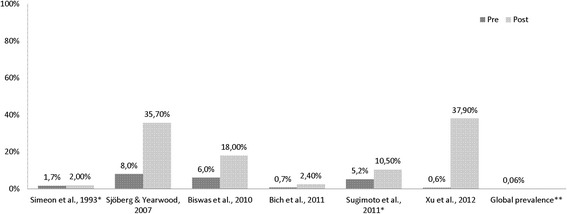
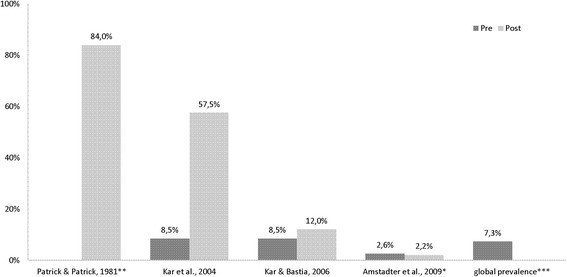
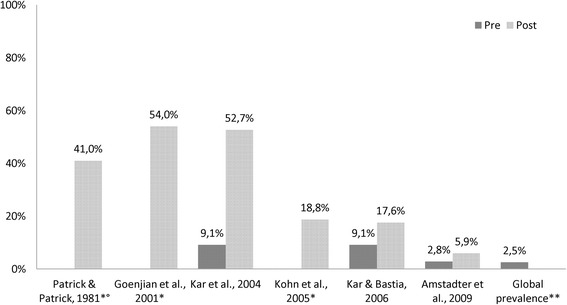
BACKGROUND: Due to climate change, extreme weather events have an incremental impact on human health. Injuries and mental health disorders are a particular burden of disease, which is broadly investigated in high income countries. Most distressed populations are, however, those in developing countries. Therefore, this study investigates mental and physical health impacts arising from extreme weather events in these populations. METHOD: Post-traumatic Stress Disorder (PTSD), injury [primary outcomes], anxiety and depressive disorders [secondary outcomes], caused by weather extremes were systematically analyzed in people of developing countries. A systematic review of observational studies was conducted searching six databases, complemented by hand search, and utilizing two search engines. Review processing was done independently by two reviewers. Prevalence rates were analyzed in a pre/post design; an additional semi-structured search was conducted, to provide reference data for studies not incorporating reference values. RESULTS: All 17 identified studies (70,842 individuals) indicate a disease increase, compared to the reference data. Increase ranges from 0.7-52.6 % for PTSD, and from 0.3-37.3 % for injury. No studies on droughts and heatwaves were identified. All studies were conducted in South America and Asia. CONCLUSION: There is an increased burden of psychological diseases and injury. This finding needs to be incorporated into activities of prevention, preparedness and general health care of those developing countries increasingly experiencing extreme weather events. There is also a gap in research in Africa (in quantity and quality) of studies in this field and a predominant heterogeneity of health assessment tools. PROSPERO registration no.: CRD42014009109.
Overview
The claims and statistics of this paper haven’t been checked yet.
Free: it reads the open-access text and checks the first 5 claims that cite a source we can check. Create a free account to check every claim.
Integrity signals
Registry
Cites
Statistics
Figures
Verification
Claims the paper makes
The claims and statistics of this paper haven’t been checked yet.
Free: it reads the open-access text and checks the first 5 claims that cite a source we can check. Create a free account to check every claim.
Claims other papers make about this one
Each is checked against this paper’s own text: does it say what the citing paper says it does?
The cited source says what the claim attributes to it.
In the citing paper
“Several systematic and scoping reviews have identified LMIC-specific evidence supporting the various negative mental health outcomes associated with climate change and climate-related disasters [6,14,15,16].”
From A Scoping Review of Climate Change, Climate-Related Disasters, and Mental Disorders among Children in Low- and Middle-Income Countries (2022) · cites this paper as [14]
The cited source says what the claim attributes to it.
In the citing paper
“For example, Rataj et al. [14] identified increased burdens of PTSD, anxiety, and depression associated with climate-related disasters in developing countries.”
From A Scoping Review of Climate Change, Climate-Related Disasters, and Mental Disorders among Children in Low- and Middle-Income Countries (2022) · cites this paper as [14]
The check wasn’t confident either way, so it gives no verdict — never disputed.
In the citing paper
“Second, our work was novel given that no previous reviews have explored this specific topic.”
From A Scoping Review of Climate Change, Climate-Related Disasters, and Mental Disorders among Children in Low- and Middle-Income Countries (2022) · cites this paper as [14]
Experimental — accuracy not yet measured
Self-check
Percentages, sums and reported differences re-computed from the paper’s own numbers.
The self-check needs the paper’s full text.
Citations
Cites
Diagnostic and Statistical Manual of Mental Disorders
Williams, J. B. W., & First, M. (2013) · Encyclopedia of Social Work · doi:10.1093/acrefore/9780199975839.013.104 · Cited by 109,519
The Measurement of Observer Agreement for Categorical Data
Landis, J. R., & Koch, G. G. (1977) · Biometrics · doi:10.2307/2529310 · Cited by 81,148 · cited 2×
“86; percentage agreement: 91 %) [23].”
(2014) · Medical Entomology and Zoology · Cited by 17,633
Diagnostic and Statistical Manual of Mental Disorders(DSM)
(2008) · Encyclopedia of Counseling · doi:10.4135/9781412963978.n182 · Cited by 10,830
60,000 Disaster Victims Speak: Part I. An Empirical Review of the Empirical Literature, 1981–2001
Norris, F. H., Friedman, M. J., Watson, P. J., Byrne, C. M., Diaz, E., & Kaniasty, K. (2002) · Psychiatry: Interpersonal and Biological Processes · doi:10.1521/psyc.65.3.207.20173 · Cited by 3,128
Managing the health effects of climate change
Costello, A., Abbas, M., Allen, A., Ball, S., Bell, S., Bellamy, R., Friel, S., Groce, N., Johnson, A., Kett, M., et al. (2009) · The Lancet · doi:10.1016/s0140-6736(09)60935-1 · Cited by 3,102
Herzog, R., Álvarez-Pasquin, M. J., Díaz, C., Del Barrio, J. L., Estrada, J. M., & Gil, Á. (2013) · BMC Public Health · doi:10.1186/1471-2458-13-154 · Cited by 1,652 · cited 1×
“[18].”
Mental Health: New Understanding, New Hope
(2001) · JAMA · doi:10.1001/jama.286.19.2391 · Cited by 1,598
Global prevalence of anxiety disorders: a systematic review and meta-regression
Baxter, A. J., Scott, K. M., Vos, T., & Whiteford, H. A. (2013) · Psychological Medicine · doi:10.1017/s003329171200147x · Cited by 1,537
Norris, F. H., Friedman, M. J., & Watson, P. J. (2002) · Psychiatry: Interpersonal and Biological Processes · doi:10.1521/psyc.65.3.240.20169 · Cited by 1,137 · cited 1×
“The methodological insufficiencies of the current disaster literature from these countries include that sample selection is often not conducted in a representative manner and that there are no comparison groups [40].”
Background
Research works printed but not linked: 5
- IPCC The regional impact of climate change, extreme weather events: IPCC special reports on climate change 2001 Geneva Intergovernmental Panel on Climate Change
- Zacher W Klimawandel und Gesundheit: Fakten, Folgen, Forderungen - für Industrie- und Entwicklungsländer 2011 Bonn Germanwatch
- Mathers CD Stein C Fat DM Rao C Global burden of disease 2000: version 2: methods and results 2002 Geneva World Health Organization
- WHO Caring for children and adolescents with mental disorders: setting WHO directions 2003 Geneva World Health Organization
- WHO Violence, injuries, and disability: biennial 2006–2007 report 2008 Geneva World Health Organization
Cited by
Items 101–139 of 139
Multi-country projections of temperature-related suicide mortality
Ro, H., Kim, Y., Hashizume, M., Madaniyazi, L., Bell, M. L., Honda, Y., Gasparrini, A., Masselot, P., Sera, F., Guo, Y., et al. (2026) · Nature Mental Health · doi:10.1038/s44220-026-00674-w · Cited by 2
“Epidemiological studies consistently highlight the negative effects of climate change on mental health, showing associations with post-traumatic stress disorder 8,9 , anxiety 8–10 , depression 10 , sleep disorders 11 and suicide 3–6 .”
Policy, governance and institutions for reducing and managing losses and damages
OECD (2021) · OECD eBooks · doi:10.1787/9f70f54e-en · Cited by 2
Climate change impacts and their cascading effects: implications for losses and damages
OECD (2021) · OECD eBooks · doi:10.1787/f50ec22e-en · Cited by 1
Economic impact assessment of the climate change on the health sector: case of Montenegro
Ćetković, J., Žarković, M., Knežević, M., Vujadinović, R., & Stanković, J. (2023) · E3S Web of Conferences · doi:10.1051/e3sconf/202346203036 · Cited by 1
“…psychotropic medication use, alcoholism...), as a consequence of extreme weather events (Benevolenza and DeRigne, 2019; Veenema et al., 2017; Rataj et al., 2016), floods (Leyva et al., 2017; Fernandez et al., 2015), droughts (Stanke et al., 2013; Vins et al., 2015), etc Furthermore, a…”
BackgroundVélez, G. F. P., Wiegel, H., Sapiains, R., & Azócar, G. (2025) · Springer eBooks · doi:10.1007/978-3-031-84433-1_24 · Cited by 2
Benefit Coordination: Development and Carbon Reduction Synergy
Wei, Y. (2025) · Springer eBooks · doi:10.1007/978-981-95-0371-1_6 · Cited by 1
The public health environment and brain function
Doyle, S. J., Rostamihosseinkhani, M., & Sabayan, B. (2024) · Elsevier eBooks · doi:10.1016/b978-0-12-820480-1.00163-7 · Cited by 1
Rataj, E., & Garthus‐Niegel, S. (2020) · Public Health Forum · doi:10.1515/pubhef-2019-0108
Self-citationMenschliche Gesundheit in der Klimakrise: Betroffenheit, Verantwortung und Chancen
Herrmann, A. (2021) · Vandenhoeck & Ruprecht eBooks · doi:10.13109/9783666407710.49
OECD (2021) · OECD eBooks · doi:10.1787/eac256d3-en
OECD (2021) · OECD eBooks · doi:10.1787/8fa34b8c-en
OECD (2021) · OECD eBooks · doi:10.1787/f9803e68-en
Finance and financial risks in the face of growing losses and damages
OECD (2021) · OECD eBooks · doi:10.1787/ecc51c5a-en
Losses and damages from climate change: A critical moment for action
OECD (2021) · OECD eBooks · doi:10.1787/6fbf536c-en
Types of uncertainties and understanding of risks of losses and damages
OECD (2021) · OECD eBooks · doi:10.1787/5e77f65f-en · Cited by 1
OECD (2022) · OECD eBooks · doi:10.1787/ac91b9d7-fr
Enhancing equity and long-term impact assessments in radiotherapy environmental studies
Yang, G., & Dou, J. (2024) · The Lancet Oncology · doi:10.1016/s1470-2045(24)00375-9
INTELIGÊNCIA ARTIFICIAL NA EDUCAÇÃO? DESAFIOS NA SOCIEDADE DE RISCO
C.A., G., Eyng, A. M., & G.E., P. (2024) · EDITORA CRV eBooks · doi:10.24824/978652517085.5.37-56
Examining the heritability of functional brain networks in adolescencePreprint
Coffman, C., Koirala, S., Hermosillo, R. J. M., Lundquist, J. T., Grimsurd, G., Miranda-Domínguez, Ó., Weldon, K. B., Anderson, M. R., Madison, T. J., Nelson, S., et al. (2025) · Research Square · doi:10.1101/2025.08.08.669358 · Cited by 1
“Simultaneously, environmental factors, including socioeconomic status (Xu et al., 2024), lead exposure (McFarland et al., 2025; Xu et al., 2024), neglect (Rutter et al., 2010), and even weather events ( Rataj et al., 2016; Smoller, 2020), have also been shown to impact mental health outcomes.”
Role of Modern Techniques to Measure the Impact of Air Pollution on Climate Change: A Short Review
Kumar, S., Patel, A., Kumar, B. N., Baranwal, A., Patel, N., Chaudhary, V. K., & Srivastav, A. L. (2025) · Studies in systems, decision and control · doi:10.1007/978-3-032-06791-3_17
Ettinger, J. (2023) · Oxford University Research Archive (ORA) (University of Oxford) · doi:10.5287/ora-qqqqjrymz
Suhr, F., & Steinert, J. (2022) · Figshare · doi:10.6084/m9.figshare.19159413
Suhr, F., & Steinert, J. (2022) · Figshare · doi:10.6084/m9.figshare.19159410
Jiang, G., ji, Y., Chen, C., Wang, X., Ye, T., Ling, Y., & Wang, H. (2022) · Figshare · doi:10.6084/m9.figshare.21077387
The Impact of Extreme Weather Events on Mental Health in Africa: A Mixed-Methods Systematic Review
Deglon, M. (2022) · Open University of Cape Town (University of Cape Town)
Cross-Chapter Box HEALTH : Co-benefits of Climate Actions for Human Health, Wellbeing and Equity
Tirado, M. C., Biesbroek, G. R., Pelling, M., Hess, J., Creutzig, F., Kerr, R. B., Eriksen, S., Campbell-Lendrum, D. H., Gilmore, E., Figueroa, M., et al. (2022) · Wageningen University & Research Publications · Cited by 1
Þorsteinsdóttir, A. H. (2023) · Skemman
Oladeji, O., & Noy, I. (2025) · Econstor (Econstor)
Kizilhan, J. I., Al-Ghurbani, S., Uricher, J., Ag, Z., Musa, I. K., & Isa, B. S. (2026) · Frontiers in Public Health · doi:10.3389/fpubh.2025.1719584
La mélioïdose : actualité et impact du réchauffement climatique sur la maladie
Savy, V. (2025) · HAL
Thomas‐Walters, L., Goldberg, M. H., Scheuch, E. G., Lee, S., Thaker, J. J., Lyde, A., Rosenthal, S. A., & Leiserowitz, A. (2026) · Global Environmental Psychology · doi:10.5964/gep.15931
How Much Do We Know About the Mental Health Economic Costs of Disasters?
Noy, I., & Uher, T. (2026) · Economics of Disasters and Climate Change · doi:10.1007/s41885-026-00199-7
“…al. 2024; Vins et al. 2015 ), impacts on specific population groups (Naushad et al. 2019; Kulig and Dabravolskaj 2020; Rother et al. 2022 ) or impacts in specific regions or development con - texts (Cruz et al. 2020; Deglon et al. 2023; Majumder et al. 2024; Rataj et al. 2016; Rother et al. 2022).”
Perceived impacts of extreme heat on health and livelihoods in Nigeria
Mustapha, A., Egbogah, I., Osuolale, K. A., Esiaba, C. N. S., Mason, L. R., & Ekenga, C. C. (2026) · Environmental Research Health · doi:10.1088/2752-5309/ae73a7
“Despite the mounting evidence of climate change impacting health and economies globally, there remains a significant gap of region-specific research focusing explicitly on the compounded effects of extreme heat in West Africa [15, 16].”
Extreme Weather Events and Mental Health Services Use Among Working-Age Adults
Castillo, N. D., Cuffe, H. E., & Noy, I. (2026) · CESifo · doi:10.65864/69kpw3ucij
Vahedi, L., Zaïdi, S., Pradhan, S., Smolik, J., Tikhonov, J., Gaffey, M. F., & Bhutta, Z. A. (2026) · PLOS Climate · doi:10.1371/journal.pclm.0000984 · Cited by 1
Abdulwahab, A. Y., Muhammad, S. B., Aveka, A. I., Surajudeen, A., Khalid, S., Aliyu, M., Attahiru, A., Abubakar, F. S., & Yakasai, B. A. (2026) · Journal of Public Health in Africa · doi:10.4102/jphia.v17i1.1665
“11,28 The predominance of maladaptive coping strategies (67.5 % ) further reinforces this interpretation.”
InfluentialHidayati, N., Hanifah, J., Aiyuda, N., & Yunas, I. M. (2020) · Proceeding ISETH (International Summit on Science Technology and Humanity) · doi:10.23917/iseth.1332
Risk Perception and Helplessness in Mitigation Efforts to Impact Haze in Riau
Kusumawati, I., Ihsani, I. N. M., & Aiyuda, N. (2020) · Proceeding ISETH (International Summit on Science Technology and Humanity) · doi:10.23917/iseth.1335 · Cited by 1
ASMA JAVED, A. S. (2025) · TPM Testing, psychometrics, methodology in applied psychology
Metadata
- Authors
- Rataj, E., Kunzweiler, K., & Garthus-Niegel, S.
- Affiliations
- Zentrum für Evidenzbasierte Gesundheitsversorgung (DE)
- Venue
- BMC Public Health
- Published
- 2016-09-29
- Volume
- 16
- Issue
- 1
- Pages
- 1020-1020
- ISSN
- 1471-2458 (ISSN-L)
- PMC
- PMC5041325
- OpenAlex
- W2526922501
- Cited by
- 119
- References
- 48
- Citations by year
- 2026: 9 · 2025: 18 · 2024: 18 · 2023: 13 · 2022: 16 · 2021: 25 · 2020: 9 · 2019: 5 · 2018: 2 · 2017: 2 · 2016: 2
- FWCI
- 0.41
- Type
- journal article
- Language
- en
- Open access
- gold
- doi.org
- Licence
- Locations
- BMC Public Health (publishedVersion, cc-by)
- Europe PMC (PubMed Central) (publishedVersion, cc-by)
- PubMed Central (publishedVersion, cc-by)
- PubMed (publishedVersion)
- DOAJ (DOAJ: Directory of Open Access Journals) (submittedVersion, cc-by-sa)
- NORA - Norwegian Open Research Archives (submittedVersion, other-oa)
- Topics
- Physical Sciences › Environmental Science › Health, Toxicology and Mutagenesis › Climate Change and Health Impacts
- Health Sciences › Health Professions › Emergency Medical Services › Disaster Response and Management
- Social Sciences › Psychology › Clinical Psychology › Posttraumatic Stress Disorder Research
- Keywords
- extreme weather events, climate change, developing countries, post-traumatic stress disorder, injuries, anxiety disorders, depressive disorders, mental health, physical health, disaster preparedness, health burden
About these checks
Registry, retraction, Cites and statistics results are computed, not judged, with one exception: a printed reference that no index lists is read once by a model before it counts as a citation error. Claims are extracted by a model and kept only when their quote appears verbatim in the text; each cited source is then checked, with a model’s help, for whether it says what the claim relies on. Those verdicts can be wrong — read the claim’s quote and the cited source before relying on one.
Statistics and arithmetic are recomputed, not judged.
Confidence bands are shown only for fields calibrated on our annotated test set. None is calibrated yet, so no band is shown.
What counts as a claim ›How we measure confidence ›How we check this ›
Are you an author, or do you see a problem with this page? Request a review
Data sources
Bibliographic data: Semantic Scholar, OpenAlex, Crossref.
Contains information from the Semantic Scholar Academic Graph Datasets, made available under the ODC Attribution License (ODC-BY 1.0).
Semantic Scholar’s data is described in: Kinney, R., et al. (2023). The Semantic Scholar Open Data Platform. arXiv:2301.10140.
