

The DOI matches its Crossref record; 27 of the 27 references it cites were found in a registry or an index.
The fundamental association between mental health and life satisfaction: results from successive waves of a Canadian national survey
Open accessAbstract
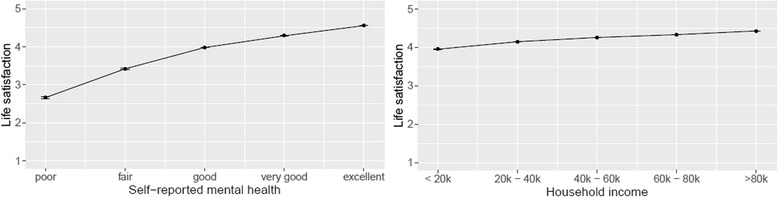
BACKGROUND: A self-reported life satisfaction question is routinely used as an indicator of societal well-being. Several studies support that mental illness is an important determinant for life satisfaction and improvement of mental healthcare access therefore could have beneficial effects on a population's life satisfaction. However, only a few studies report the relationship between subjective mental health and life satisfaction. Subjective mental health is a broader concept than the presence or absence of psychopathology. In this study, we examine the strength of the association between a self-reported mental health question and self-reported life satisfaction, taking into account other relevant factors. METHODS: We conducted this analysis using successive waves of the Canadian Community Health Survey (CCHS) collected between 2003 and 2012. Respondents included more than 400,000 participants aged 12 and over. We extracted information on self-reported mental health, socio-demographic and other factors and examined correlation with self-reported life satisfaction using a proportional ordered logistic regression. RESULTS: Life satisfaction was strongly associated with self-reported mental health, even after simultaneously considering factors such as income, general health, and gender. The poor-self-reported mental health group had a particularly low life satisfaction. In the fair-self-reported mental health category, the odds of having a higher life satisfaction were 2.35 (95% CI 2.21 to 2.50) times higher than the odds in the poor category. In contrast, for the "between 60,000 CAD and 79,999 CAD" household income category, the odds of having a higher life satisfaction were only 1.96 (95% CI 1.90 to 2.01) times higher than the odds in the "less than 19,999 CAD" category. CONCLUSIONS: Subjective mental health contributes highly to life satisfaction, being more strongly associated than other selected previously known factors. Future studies could be useful to deepen our understanding of the interplay between subjective mental health, mental illness and life satisfaction. This may be beneficial for developing public health policies that optimize mental health promotion, illness prevention and treatment of mental disorders to enhance life satisfaction in the general population.
Overview
The claims and statistics of this paper haven’t been checked yet.
Run the check — free, no account needed. It reads the open-access text and checks the sources it cites.
Integrity signals
Registry
Cites
Statistics
Figures
Verification
Claims the paper makes
The claims and statistics of this paper haven’t been checked yet.
Run the check — free, no account needed. It reads the open-access text and checks the sources it cites.
Claims other papers make about this one
Each is checked against this paper’s own text: does it say what the citing paper says it does?
The source backs part of the claim, not all of it — or backs it for a different population, condition or comparison.
In the citing paper
“According to previous studies, life satisfaction and well-being are negatively affected by mental health problems (40, 41).”
From Can Viewing Nature Through Windows Improve Isolated Living? A Pathway Analysis on Chinese Male Prisoners During the COVID-19 Epidemic (2021) · cites this paper as [40]
Experimental — accuracy not yet measured
Self-check
Percentages, sums and reported differences re-computed from the paper’s own numbers.
The self-check needs the paper’s full text.
Citations
Cites
No health without mental health
Prince, M. J., Patel, V., Saxena, S., Maj, M., Maselko, J., Phillips, M. R., & Rahman, A. (2007) · The Lancet · doi:10.1016/s0140-6736(07)61238-0 · Cited by 4,028
Mental illness and/or mental health? Investigating axioms of the complete state model of health
Keyes, C. L. M. (2005) · Journal of Consulting and Clinical Psychology · doi:10.1037/0022-006x.73.3.539 · Cited by 3,357
Dolan, P., Peasgood, T., & White, M. (2008) · Journal of Economic Psychology · doi:10.1016/j.joep.2007.09.001 · Cited by 3,121
Happy People Live Longer: Subjective Well‐Being Contributes to Health and Longevity
Diener, E., & Chan, M. Y. (2011) · Applied Psychology: Health and Well-Being · doi:10.1111/j.1758-0854.2010.01045.x · Cited by 2,260
OECD Guidelines on Measuring Subjective Well-being
OECD (2013) · doi:10.1787/9789264191655-en · Cited by 1,434
Theory and Validity of Life Satisfaction Scales
Diener, E., Inglehart, R., & Tay, L. (2012) · Social Indicators Research · doi:10.1007/s11205-012-0076-y · Cited by 1,386
Mental Illness and Mental Health: The Two Continua Model Across the Lifespan
Westerhof, G. J., & Keyes, C. L. M. (2010) · Journal of Adult Development · doi:10.1007/s10804-009-9082-y · Cited by 1,345
glmulti : An R Package for Easy Automated Model Selection with (Generalized) Linear Models
Calcagno, V., & de Mazancourt, C. (2010) · Journal of Statistical Software · doi:10.18637/jss.v034.i12 · Cited by 1,302
The VGAM Package for Categorical Data Analysis
Yee, T. W. (2010) · Journal of Statistical Software · doi:10.18637/jss.v032.i10 · Cited by 640
Single item measures of self-rated mental health: a scoping review
Ahmad, F., Jhajj, A. K., Stewart, D. E., Burghardt, M., & Bierman, A. S. (2014) · BMC Health Services Research · doi:10.1186/1472-6963-14-398 · Cited by 561
A dual-factor model of mental health: Toward a more comprehensive understanding of youth functioning
Antaramian, S. P., Huebner, E. S., Hills, K. J., & Valois, R. F. (2010) · American Journal of Orthopsychiatry · doi:10.1111/j.1939-0025.2010.01049.x · Cited by 405
The measurement of economic performance and social progress revisitedPreprint
Stiglitz, J. E., Sen, A. K., & Fitoussi, J. (2009) · RePEc: Research Papers in Economics · Cited by 355
Life satisfaction and mental health problems (18 to 35 years)
Fergusson, D. M., McLeod, G. F. H., Horwood, L. J., Swain, N., Chapple, S., & Poulton, R. (2015) · Psychological Medicine · doi:10.1017/s0033291715000422 · Cited by 351
ggplot2:Elegant Graphics for Data Analysis
Valero‐Mora, P. (2010) · Journal of Statistical Software · doi:10.18637/jss.v035.b01 · Cited by 329
Suicide rates, life satisfaction and happiness as markers for population mental health
Bray, I., & Gunnell, D. (2006) · Social Psychiatry and Psychiatric Epidemiology · doi:10.1007/s00127-006-0049-z · Cited by 201
Adolescent health-related quality of life and perceived satisfaction with life
Zullig, K. J., Valois, R. F., Huebner, E. S., & Drane, J. W. (2005) · Quality of Life Research · doi:10.1007/s11136-004-7707-y · Cited by 190
Strine, T. W., Kroenke, K., Dhingra, S. S., Balluz, L. S., Gonzalez, O., Berry, J. T., & Mokdad, A. H. (2009) · The Journal of Nervous and Mental Disease · doi:10.1097/nmd.0b013e3181924ad8 · Cited by 188
Fleishman, J. A., & Zuvekas, S. H. (2007) · Medical Care · doi:10.1097/mlr.0b013e31803bb4b0 · Cited by 159
Validation of self-rated mental health.
Mawani, F. N., & Gilmour, H. (2010) · PubMed · Cited by 158
Long term life dissatisfaction and subsequent major depressive disorder and poor mental health
Rissanen, T., Viinamäki, H. T., Honkalampi, K. M., Lehto, S. M., Hintikka, J. J., Saharinen, T., & Koivumaa-Honkanen, H. T. (2011) · BMC Psychiatry · doi:10.1186/1471-244x-11-140 · Cited by 84
World happiness report 2016 - update
Helliwell, J. F., Layard, R., & Sachs, J. D. (2016) · Cited by 64
Mental Illness and UnhappinessPreprint
Chisholm, D., Layard, R., Patel, V., & Saxena, S. (n.d.) · RePEc: Research Papers in Economics · Cited by 60
An Assessment of Life Satisfaction Responses on Recent Statistics Canada Surveys
Bonikowska, A., Helliwell, J. F., Hou, F., & Schellenberg, G. (2013) · Social Indicators Research · doi:10.1007/s11205-013-0437-1 · Cited by 53
Mental Health Care and Average Happiness: Strong Effect in Developed Nations
Touburg, G., & Veenhoven, R. (2014) · Administration and Policy in Mental Health and Mental Health Services Research · doi:10.1007/s10488-014-0579-8 · Cited by 32
Healthy Days, Health Satisfaction and Satisfaction with the Overall Quality of Life
Zumbo, B. D. (2003) · Social indicators research series · doi:10.1007/978-94-017-0389-5_11 · Cited by 28
Rissanen, T., Viinamäki, H. T., Lehto, S. M., Hintikka, J. J., Honkalampi, K. M., Saharinen, T., & Koivumaa-Honkanen, H. T. (2012) · Nordic Journal of Psychiatry · doi:10.3109/08039488.2012.687766 · Cited by 27
Healthy Days, Health Satisfaction and Satisfaction with the Overall Quality of Life
Michalos, A. C., & Zumbo, B. D. (2002) · Social Indicators Research · doi:10.1023/a:1019601213926 · Cited by 20
Research works printed but not linked: 1
- Sharpe A, Ghanghro A, Johnson E, Kidwai A. Does money matter?: determining the happiness of Canadians. 2010.
Cited by
Sorted by citations
Bulińska–Stangrecka, H., & Bagieńska, A. (2021) · International Journal of Environmental Research and Public Health · doi:10.3390/ijerph18041903 · Cited by 249
Yáñez, J. A., Afshar Jahanshahi, A., Alvarez-Risco, A., Li, J., & Zhang, S. X. (2020) · The American Journal of Tropical Medicine and Hygiene · doi:10.4269/ajtmh.20-0800 · Cited by 200
The Peru Approach against the COVID-19 Infodemic: Insights and Strategies
Álvarez-Risco, A., Mejia, C. R., Delgado-Zegarra, J., Del-Aguila-Arcentales, S., Arce‐Esquivel, A. A., Valladares-Garrido, M. J., del Portal, M. R., Villegas, L., Curioso, W. H., Sekar, M. C., et al. (2020) · American Journal of Tropical Medicine and Hygiene · doi:10.4269/ajtmh.20-0536 · Cited by 170
Linking decent work with physical and mental health: A psychology of working perspective
Duffy, R. D., Kim, H. J., Gensmer, N. P., Raque‐Bogdan, T. L., Douglass, R. P., England, J. W., & Büyükgöze‐Kavas, A. (2019) · Journal of Vocational Behavior · doi:10.1016/j.jvb.2019.05.002 · Cited by 129
He, D., Miao, J., Lü, Y., Song, Y., Chen, L., & Liu, Y. (2022) · Cities · doi:10.1016/j.cities.2022.103607 · Cited by 111
Metadata
- Authors
- Lombardo, P., Jones, W., Wang, L., Shen, X., & Goldner, E. M.
- Affiliations
- Simon Fraser University (CA)
- Shanghai Ocean University (CN)
- Corresponding author
- Lombardo, Patrick
- Venue
- BMC Public Health
- Published
- 2018-03-12
- Volume
- 18
- Issue
- 1
- Pages
- 342-342
- ISSN
- 1471-2458 (ISSN-L)
- PMC
- PMC5848433
- OpenAlex
- W2797655228
- Cited by
- 333
- References
- 27
- Citations by year
- 2026: 31 · 2025: 45 · 2024: 59 · 2023: 73 · 2022: 54 · 2021: 32 · 2020: 28 · 2019: 11
- FWCI
- 24.03
- Type
- journal article
- Language
- en
- Open access
- gold
- doi.org
- Licence
- Locations
- BMC Public Health (publishedVersion, cc-by)
- PubMed Central (publishedVersion, cc-by)
- PubMed (publishedVersion)
- Summit (Simon Fraser University) (submittedVersion, other-oa)
- DOAJ (DOAJ: Directory of Open Access Journals) (submittedVersion, cc-by-sa)
- Summit (Simon Fraser University) (submittedVersion, cc-by)
- Funders
- National Science Foundation
- Schweizerischer Nationalfonds zur Förderung der Wissenschaftlichen Forschung (164907)
- Topics
- Social Sciences › Psychology › Social Psychology › Psychological Well-being and Life Satisfaction
- Social Sciences › Psychology › Clinical Psychology › Health and Well-being Studies
- Health Sciences › Medicine › Psychiatry and Mental health › Mental Health Treatment and Access
- Keywords
- subjective mental health, life satisfaction, self-rated mental health, mental illness, household income, Canadian Community Health Survey, well-being, mental health promotion, public health policy
- MeSH terms
- Adolescent, Adult, Aged, Aged, 80 and over, Mental Disorders, Canada, Child, Female, Health Surveys, Humans, Male, Mental Health, Middle Aged, Personal Satisfaction, Young Adult, Self Report, Diagnostic Self Evaluation
About these checks
Registry, retraction, Cites and statistics results are computed, not judged, with one exception: a printed reference that no index lists is read once by a model before it counts as a citation error. Claims are extracted by a model and kept only when their quote appears verbatim in the text; each cited source is then checked, with a model’s help, for whether it says what the claim relies on. Those verdicts can be wrong — read the claim’s quote and the cited source before relying on one.
Statistics and arithmetic are recomputed, not judged.
Confidence bands are shown only for fields calibrated on our annotated test set. None is calibrated yet, so no band is shown.
What counts as a claim ›How we measure confidence ›How we check this ›
Are you an author, or do you see a problem with this page? Request a review
