

Waist-to-height ratio index for predicting incidences of hypertension: the ARIRANG study
Open accessThe DOI matches its Crossref record; 36 of the 36 references it cites were found in a registry or an index.
Abstract
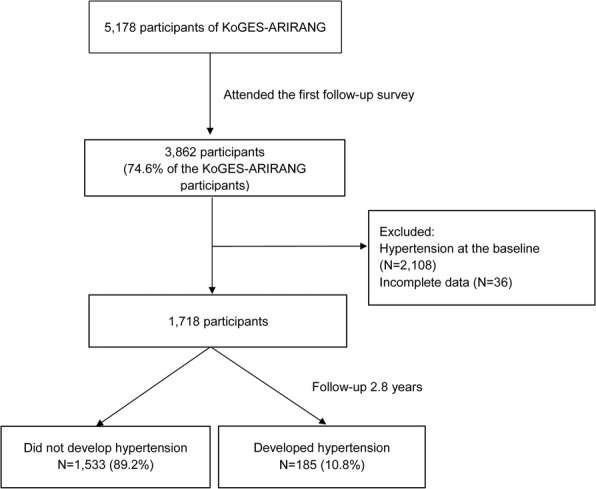
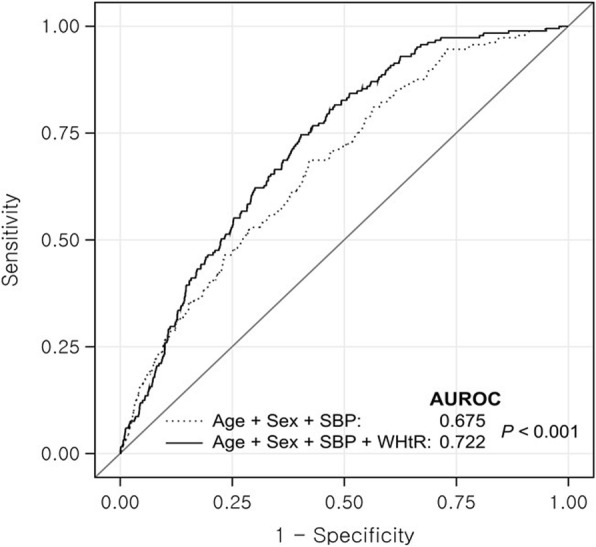
BACKGROUND: Several anthropometric indices such as body mass index (BMI) and waist circumference (WC) have been examined as indicators of cardiovascular diseases, in both adults and children. However, the waist-to-height ratio (WHtR) is considered a better predictor for the detection of cardiovascular risk factors, than BMI. We investigated the association between the WHtR and incident hypertension. METHODS: A total of 1718 participants, aged 39-72 years, were recruited in this longitudinal study. Participants were divided into 2 groups according to the development of hypertension during 2005-2008 (baseline) and 2008-2011 (follow-up). Logistic regression models were used to evaluate the WHtR as a significant predictor of hypertension. RESULTS: During the 2.8 years of follow-up, 185 new cases of hypertension (10.8%) were diagnosed, with an incidence rate of approximately 4% per year. The WHtR was significantly higher in the participants who had developed hypertension than in those who had not (0.54 ± 0.05 vs. 0.51 ± 0.05, p < 0.001). After adjusting for age, sex, smoking status, alcohol intake, regular exercise status, total cholesterol, and systolic blood pressure, at the baseline, the logistic regression analysis indicated that the participants with the highest quartile of the WHtR (WHtR≥0.54) were 4.51 times more likely to have hypertension than those with the lowest quartile (odds ratio 4.51; 95% confidence interval 2.41-8.43; p < .0001). The area under the curve for the WHtR, in identifying hypertension risk, was significantly greater than that for the BMI (p = 0.0233). CONCLUSION: A positive association between WHtR and the incidence of hypertension was observed in Korean adults. The findings of the present community-based prospective study suggest that the WHtR may be a better predictor of incident hypertension.
Overview
The claims and statistics of this paper haven’t been checked yet.
Free: it reads the open-access text and checks the first 5 claims that cite a source we can check. Create a free account to check every claim.
Integrity signals
Registry
Cites
Statistics
Figures
Verification
Claims the paper makes
The claims and statistics of this paper haven’t been checked yet.
Free: it reads the open-access text and checks the first 5 claims that cite a source we can check. Create a free account to check every claim.
Claims other papers make about this one
Each is checked against this paper’s own text: does it say what the citing paper says it does?
The source backs part of the claim, not all of it — or backs it for a different population, condition or comparison.
In the citing paper
“It has been identified as a cardiovascular disease predictor (17, 18).”
From The waist-to-height ratio is a good predictor for insulin resistance in women with polycystic ovary syndrome (2024) · cites this paper as [17]
Experimental — accuracy not yet measured
Self-check
Percentages, sums and reported differences re-computed from the paper’s own numbers.
The self-check needs the paper’s full text.
Citations
Cites
Ashwell, M., Gunn, P., & Gibson, S. (2012) · Obesity Reviews · doi:10.1111/j.1467-789x.2011.00952.x · Cited by 2,130 · cited 2×
“In contrast, WHtR values have been demonstrated to be steady, across age groups, gender, and ethnicities, and are even easier to measure than BMI [12, 27].”
BackgroundPouliot, M.-C., Després, J.-P., Lemieux, S., Moorjani, S., Bouchard, C., Tremblay, A., Nadeau, A., & Lupien, P. J. (1994) · The American Journal of Cardiology · doi:10.1016/0002-9149(94)90676-9 · Cited by 2,085 · cited 1×
“WC is strongly associated with visceral fat depots [24] and is now widely used in the measurement of abdominal obesity [21].”
BackgroundBrowning, L. M., Hsieh, S. D., & Ashwell, M. (2010) · Nutrition Research Reviews · doi:10.1017/s0954422410000144 · Cited by 1,400 · cited 4×
“of the age-, gender-, and ethnicity-specific values [12].”
BackgroundInfluentialAshwell, M., & Hsieh, S. D. (2005) · International Journal of Food Sciences and Nutrition · doi:10.1080/09637480500195066 · Cited by 1,065
The Canadian Heart Health Surveys Research Group, Dobbelsteyn, C., Joffres, M., MacLean, D., & Flowerdew, G. (2001) · International Journal of Obesity · doi:10.1038/sj.ijo.0801582 · Cited by 464
Waist-to-Height Ratio, a Useful Index to Identify High Metabolic Risk in Overweight Children
Maffeis, C., Banzato, C., & Talamini, G. (2008) · The Journal of Pediatrics · doi:10.1016/j.jpeds.2007.09.021 · Cited by 419 · cited 1×
“in children as well as in adults, without age-related distinctions [1, 13, 14].”
BackgroundPrevalence of Overweight and Obesity among Chinese Adults: Role of Adiposity Indicators and Age
Xu, W., Zhang, H., Paillard-Borg, S., Zhu, H., Qi, X., & Rizzuto, D. (2016) · Obesity Facts · doi:10.1159/000443003 · Cited by 417
Jousilahti, P., Tuomilehto, J., Vartiainen, E., Pekkanen, J., & Puska, P. (1996) · Circulation · doi:10.1161/01.cir.93.7.1372 · Cited by 401 · cited 1×
“Various prospective studies revealed the association of BMI, a measure of overall obesity, and hypertension [31, 32], while other follow-up studies investigated the WC, WHtR, and WHR, measurements in the case of abdominal adiposity, and found them to be significantly associated with the risk of hypertension [3].”
BackgroundHsieh, S. D., Yoshinaga, H., & Muto, T. (2003) · International Journal of Obesity · doi:10.1038/sj.ijo.0802259 · Cited by 400 · cited 1×
“In Japan, various cross-sectional studies have demonstrated a stronger association of WHtR with cardiovascular risk factors, compared to BMI and WC [2, 6, 9].”
BackgroundDoll, S., Paccaud, F., Bovet, P., Burnier, M., & Wietlisbach, V (2002) · International Journal of Obesity · doi:10.1038/sj.ijo.0801854 · Cited by 311
Predicting cardiometabolic risk: waist-to-height ratio or BMI. A meta-analysis
Savva, S., Lamnisos, D., & Kafatos, A. (2013) · Diabetes, Metabolic Syndrome and Obesity: Targets and Therapy · doi:10.2147/dmso.s34220 · Cited by 264 · cited 1×
“in Asian populations; in non-Asian populations, this association may be different [18, 19].”
BackgroundKhoury, M., Manlhiot, C., & McCrindle, B. W. (2013) · Journal of the American College of Cardiology · doi:10.1016/j.jacc.2013.01.026 · Cited by 244 · cited 1×
“in children as well as in adults, without age-related distinctions [1, 13, 14].”
BackgroundAssociation between simple anthropometric indices and cardiovascular risk factors
Ho, S., Chen, Y., Woo, J., Leung, S., Lam, T., & Janus, E. (2001) · International Journal of Obesity · doi:10.1038/sj.ijo.0801784 · Cited by 214
HSIEH, S., & MUTO, T. (2005) · Preventive Medicine · doi:10.1016/j.ypmed.2004.05.025 · Cited by 193 · cited 1×
“In Japan, various cross-sectional studies have demonstrated a stronger association of WHtR with cardiovascular risk factors, compared to BMI and WC [2, 6, 9].”
BackgroundTulloch-Reid, M. K., Williams, D. E., Looker, H. C., Hanson, R. L., & Knowler, W. C. (2003) · Diabetes Care · doi:10.2337/diacare.26.9.2556 · Cited by 164
Harris, M. M., Stevens, J., Thomas, N., Schreiner, P., & Folsom, A. R. (2000) · Obesity Research · doi:10.1038/oby.2000.64 · Cited by 153
Heymsfield, S. B., Scherzer, R., Pietrobelli, A., Lewis, C. E., & Grunfeld, C. (2009) · International Journal of Obesity · doi:10.1038/ijo.2009.184 · Cited by 143 · cited 4×
“Diverse anthropometric indices have been developed to identify the risk factors of CVDs, especially hypertension, diabetes, and obesity.”
BackgroundInfluentialSimple anthropometric indexes and cardiovascular risk factors in Chinese
Ko, G., Chan, J., Woo, J., Lau, E. M. C., Yeung, V. T. F., Chow, C., Wai, H. P. S., Li, J. K. Y., So, W.-Y., & Cockram, C. (1997) · International Journal of Obesity · doi:10.1038/sj.ijo.0800508 · Cited by 135
Four anthropometric indices and cardiovascular risk factors in Taiwan
Huang, K.-C., Lin, W.-Y., Lee, L.-T., Chen, C.-Y., Lo, H., Hsia, H.-H., Liu, I.-L., Shau, W., & Lin, R.-S. (2002) · International Journal of Obesity · doi:10.1038/sj.ijo.0802047 · Cited by 118
Indicadores antropométricos como preditores de pressão arterial elevada em adolescentes
Beck, C. C., Lopes, A. D. S., & Pitanga, F. J. G. (2011) · Arquivos Brasileiros de Cardiologia · doi:10.1590/s0066-782x2010005000153 · Cited by 108
Anthropometric Indices and the Incidence of Hypertension: A Comparative Analysis
Fuchs, F. D., Gus, M., Moreira, L. B., Moraes, R. S., Wiehe, M., Pereira, G. M., & Fuchs, S. C. (2005) · Obesity Research · doi:10.1038/oby.2005.184 · Cited by 103 · cited 5×
“Diverse anthropometric indices have been developed to identify the risk factors of CVDs, especially hypertension, diabetes, and obesity.”
BackgroundInfluentialAssociation between obesity indices and blood pressure or hypertension: which index is the best?
Zhou, Z.-Q., Hu, D., & Chen, J. (2008) · Public Health Nutrition · doi:10.1017/s1368980008003601 · Cited by 87 · cited 1×
“Nevertheless, only a few longitudinal studies have compared the appearance of anthropometric parameters in population-based cohorts [2, 4].”
BackgroundChung, I. H., Park, S., Park, M. J., & Yoo, E.-G. (2016) · Yonsei Medical Journal · doi:10.3349/ymj.2016.57.3.658 · Cited by 74 · cited 3×
“in children as well as in adults, without age-related distinctions [1, 13, 14].”
BackgroundMethodOreopoulos, A., Padwal, R., McAlister, F. A., Ezekowitz, J., Sharma, A. M., Kalantar-Zadeh, K., Fonarow, G. C., & Norris, C. M. (2010) · International Journal of Obesity · doi:10.1038/ijo.2010.73 · Cited by 72
Body fat distribution and risk of diabetes among Chinese women
Rosenthal, A. D., Jin, F., Shu, X.-O., Yang, G., Elasy, T. A., Chow, W.-H., Ji, B.-T., Xu, H.-X., Li, Q., Gao, Y.-T., et al. (2004) · International Journal of Obesity · doi:10.1038/sj.ijo.0802597 · Cited by 64
Body Fat Distribution and the Risk of Hypertension and Diabetes among Japanese Men and Women
CHEI, C.-L., ISO, H., YAMAGISHI, K., TANIGAWA, T., CUI, R., IMANO, H., KIYAMA, M., KITAMURA, A., SATO, S., & SHIMAMOTO, T. (2008) · Hypertension Research · doi:10.1291/hypres.31.851 · Cited by 57 · cited 3×
“Nevertheless, only a few longitudinal studies have compared the appearance of anthropometric parameters in population-based cohorts [2, 4].”
BackgroundAnthropometric Indicators as Predictors of High Blood Pressure in Adolescents
Beck, C. C., Lopes, A. D. S., & Pitanga, F. J. G. (2011) · Portuguese National Funding Agency for Science, Research and Technology (RCAAP Project by FCT) · Cited by 54
Indicadores antropométricos como preditores de pressão arterial elevada em adolescentes
Beck, C. C., Lopes, A. D. S., & Pitanga, F. J. G. (2011) · LA Referencia (Red Federada de Repositorios Institucionales de Publicaciones Científicas) · Cited by 54
A novel cutoff for the waist-to-height ratio predicting metabolic syndrome in young American adults
Bohr, A. D., Laurson, K. R., & McQueen, M. B. (2016) · BMC Public Health · doi:10.1186/s12889-016-2964-6 · Cited by 54 · cited 1×
“in Asian populations; in non-Asian populations, this association may be different [18, 19].”
BackgroundAssociation of Waist-Height Ratio with Diabetes Risk: A 4-Year Longitudinal Retrospective Study
Son, Y., Kim, J., Park, H., Park, S. E., Park, C., Lee, W., Oh, K. W., Park, S., & Rhee, E. (2016) · Endocrinology and Metabolism · doi:10.3803/enm.2016.31.1.127 · Cited by 46 · cited 8×
“Diverse anthropometric indices have been developed to identify the risk factors of CVDs, especially hypertension, diabetes, and obesity.”
BackgroundMethodInfluentialAssociation of a New Measure of Obesity with Hypertension and Health-Related Quality of Life
Chung, W., Park, C. G., & Ryu, O. (2016) · PLoS ONE · doi:10.1371/journal.pone.0155399 · Cited by 41 · cited 3×
“WC is strongly associated with visceral fat depots [24] and is now widely used in the measurement of abdominal obesity [21].”
BackgroundChoi, J. R., Ahn, S. V., Kim, J., Koh, S. B., Choi, E. H., Lee, G. Y., & Jang, Y. (2018) · Journal of Human Hypertension · doi:10.1038/s41371-018-0043-4 · Cited by 38 · cited 1×
“To further investigate which of the aforementioned indices is the best predictor of the risk of hypertension [20], we examined the population-specific association between WHtR and the incidence of hypertension, in this Korean prospective cohort study.”
BackgroundSelf-citationSaeed, A. A., & Al-Hamdan, N. A. (2013) · Journal of Epidemiology and Global Health · doi:10.1016/j.jegh.2013.08.004 · Cited by 33 · cited 1×
“Recently, the WHtR was shown to be the most important predictor of BP and hypertension, in Saudi Arabian adult populations [26].”
BackgroundOverweight and Obesity as Determinants of Cardiovascular Risk: The Framingham Experience
Wilson, P. W. F., D'Agostino, R. B., Sullivan, L., Parise, H., & Kannel, W. B. (2002) · Archives of Internal Medicine · doi:10.1001/archinte.162.16.1867 · Cited by 22
Positive association between waist-to-height ratio and hypertension in adolescents
Madruga, J. G., Silva, F. M., & Adami, F. S. (2016) · Revista Portuguesa de Cardiologia (English Edition) · doi:10.1016/j.repce.2016.03.006 · Cited by 15 · cited 2×
“The early detection of hypertension is crucial for its control and prevention, in adults; however, since BP is not routinely tested in most adolescents, it is difficult to monitor the condition in them [11, 25].”
BackgroundMethodAssociação positiva entre razão cintura‐estatura e presença de hipertensão em adolescentes
Madruga, J. G., Silva, F. M., & Adami, F. S. (2016) · Revista Portuguesa de Cardiologia · doi:10.1016/j.repc.2016.03.004 · Cited by 12
Cited by
Waist-to-height ratio and non-alcoholic fatty liver disease in adults
Sheng, G., Xie, Q., Wang, R., Hu, C., Zhong, M., & Zou, Y. (2021) · BMC Gastroenterology · doi:10.1186/s12876-021-01824-3 · Cited by 70
Zhang, Y., Gu, Y., Wang, N., Zhao, Q., Ng, N., Wang, R., Zhou, X., Jiang, Y., Wang, W., & Zhao, G. (2019) · BMC Public Health · doi:10.1186/s12889-019-7366-0 · Cited by 55
Li, Y., Gui, J., Zhang, X., Wang, Y., Mei, Y., Yang, X., Liu, H., Guo, L., Li, J., Lei, Y., et al. (2023) · BMC Cardiovascular Disorders · doi:10.1186/s12872-023-03232-9 · Cited by 44
“not applicable due to the differences of race and human body composition [63].”
BackgroundResultAlshamiri, M. Q., Habbab, F. M. A., AL-Qahtani, S. S., Alghalayini, K., Al-Qattan, O. M., & Elshaer, F. (2020) · Cardiology Research and Practice · doi:10.1155/2020/4250793 · Cited by 44
Zhang, X., Ye, R., Sun, L., Liu, X., Wang, S., Meng, Q., & Chen, X. (2023) · BMC Public Health · doi:10.1186/s12889-023-15208-7 · Cited by 32
“Lee et al. suggested that WHR was correlated with the incidence of hypertension in both sexes of middle-aged Korean people [7].”
BackgroundInfluential
Metadata
- Authors
- Choi, J. R., Koh, S. B., & Choi, E.
- Affiliations
- Yonsei University (KR)
- Corresponding author
- Koh, Sang Baek
- Venue
- BMC Public Health
- Published
- 2018-06-19
- Volume
- 18
- Issue
- 1
- Pages
- 767-767
- ISSN
- 1471-2458 (ISSN-L)
- PMC
- PMC6008942
- OpenAlex
- W2808813716
- Cited by
- 77
- References
- 36
- Citations by year
- 2026: 10 · 2025: 12 · 2024: 11 · 2023: 5 · 2022: 9 · 2021: 11 · 2020: 11 · 2019: 7 · 2018: 1
- FWCI
- 5.67
- Type
- journal article
- Language
- en
- Open access
- gold
- doi.org
- Licence
- cc-by
- creativecommons.org/licenses/by/4.0/ (tdm)
- Locations
- BMC Public Health (publishedVersion, cc-by)
- Europe PMC (PubMed Central) (publishedVersion, other-oa)
- PubMed Central (publishedVersion, cc-by)
- PubMed (publishedVersion)
- DOAJ (DOAJ: Directory of Open Access Journals) (submittedVersion)
- Funders
- the Basic Science Research Program through the National Research Foundation of Korea (Ministry of Education (2017R1D1A3B03034119).)
- the Korea Centers for Disease Control and Prevention (2005-E71013-00, 2006-E71002-00, 2007-E71013-00, 2008-E71004-00, 2009-E71006-00, and 2010-E71003-00)
- Medical Research Center Program (2017R1A5A2015369)
- Topics
- Health Sciences › Medicine › Cardiology and Cardiovascular Medicine › Blood Pressure and Hypertension Studies
- Health Sciences › Medicine › Endocrinology, Diabetes and Metabolism › Diabetes, Cardiovascular Risks, and Lipoproteins
- Health Sciences › Medicine › Cardiology and Cardiovascular Medicine › Cardiovascular Function and Risk Factors
- Keywords
- waist-to-height ratio, hypertension incidence, anthropometric indices, body mass index, cardiovascular risk factors, hypertension risk prediction, Korean adults
- MeSH terms
- Adult, Aged, Female, Humans, Hypertension, Longitudinal Studies, Male, Middle Aged, Predictive Value of Tests, Prospective Studies, Risk Factors, Incidence, Republic of Korea, Waist-Height Ratio
About these checks
Registry, retraction, Cites and statistics results are computed, not judged, with one exception: a printed reference that no index lists is read once by a model before it counts as a citation error. Claims are extracted by a model and kept only when their quote appears verbatim in the text; each cited source is then checked, with a model’s help, for whether it says what the claim relies on. Those verdicts can be wrong — read the claim’s quote and the cited source before relying on one.
Statistics and arithmetic are recomputed, not judged.
Confidence bands are shown only for fields calibrated on our annotated test set. None is calibrated yet, so no band is shown.
What counts as a claim ›How we measure confidence ›How we check this ›
Are you an author, or do you see a problem with this page? Request a review
Data sources
Bibliographic data: Semantic Scholar, OpenAlex, Crossref.
Contains information from the Semantic Scholar Academic Graph Datasets, made available under the ODC Attribution License (ODC-BY 1.0).
Semantic Scholar’s data is described in: Kinney, R., et al. (2023). The Semantic Scholar Open Data Platform. arXiv:2301.10140.
