

The DOI matches its Crossref record; 50 of the 50 references it cites were found in a registry or an index.
Impact of public smoking bans on children’s exposure to tobacco smoke at home: a systematic review and meta-analysis
Open accessAbstract
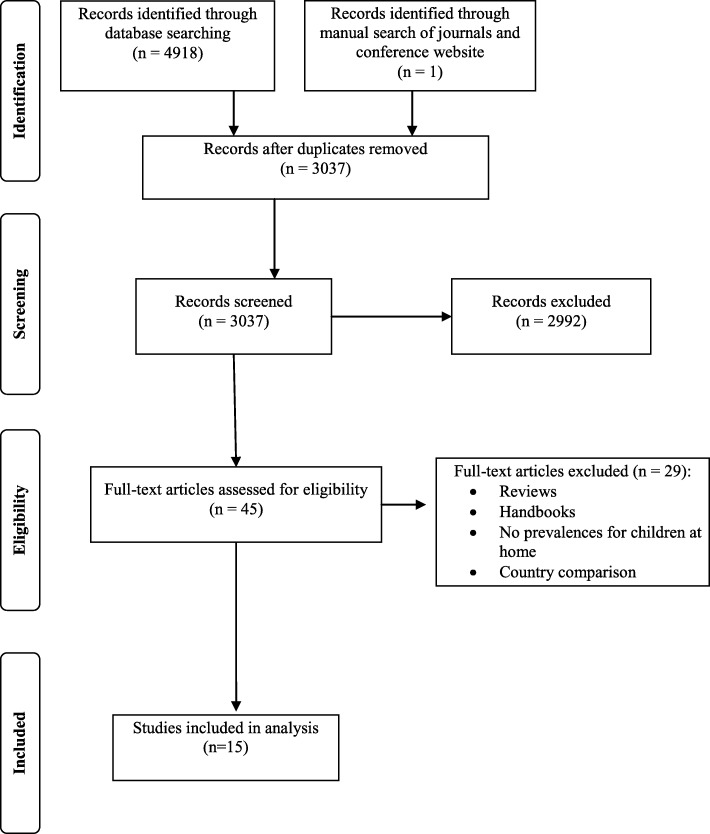
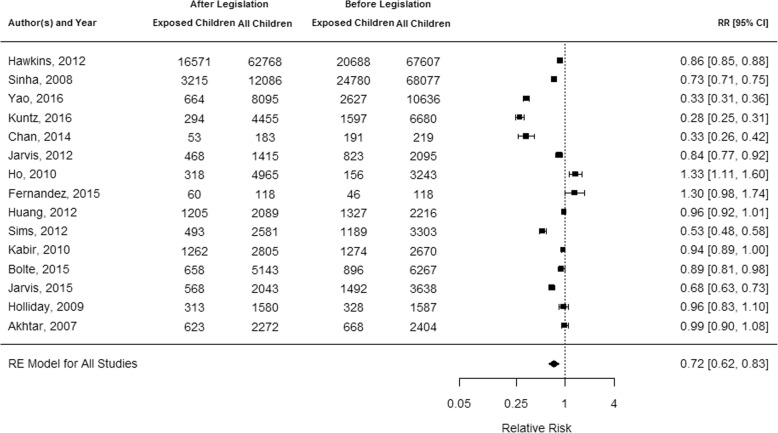
BACKROUND: Meta-analysis of the impact of public smoking bans on children's exposure to secondhand smoke (SHS) exposure at home. METHODS: The electronic databases of PubMed, Web of Science, PsycINFo, ASSIA, CINAHL were searched. German public health journals not captured by these databases and grey literature were considered in addition. Studies were included when they reported children's SHS exposure at home in relation to smoke-free legislation by measuring exposure before and after the introduction of a public smoking ban. Studies had to provide results on exposure prevalences of children aged below 18 years. Language of publications was restricted to German and English. Details of the included studies (n = 15) were extracted by one author and checked for accuracy by a second author. Given the exposure prevalences before and after the introduction of a smoke-free legislation, a random-effects meta-analysis of relative risks (RR) was conducted. Results were presented in a forest plot. RESULTS: Meta-analysis showed that the overall effect was a decreased exposure to SHS in the children's homes after introduction of a public smoking ban (RR = 0.72; 95% CI = 0.62-0.83). Only two of the 15 studies indicated an increased exposure. Sensitivity analyses considering the type of smoke-free legislation, children's age group and study quality did not substantially alter the result. CONCLUSION: The assumption of a displacement of smoking into homes with children due to smoke-free legislation in public places could not be confirmed. Additional research is needed to analyse long-term trends.
Overview
The claims and statistics of this paper haven’t been checked yet.
Run the check — free, no account needed. It reads the open-access text and checks the sources it cites.
Integrity signals
Registry
Cites
Statistics
Figures
Verification
Claims the paper makes
The claims and statistics of this paper haven’t been checked yet.
Run the check — free, no account needed. It reads the open-access text and checks the sources it cites.
Claims other papers make about this one
Each is checked against this paper’s own text: does it say what the citing paper says it does?
In the citing paper
“Despite fears that these would result in displacement of smoking to the home, most studies have found that they either have a neutral effect or, more often, reduce SHS exposure in homes (107).”
From Review of the Impact of Housing Quality on Inequalities in Health and Well-Being (2023) · cites this paper as [107]
Self-check
Percentages, sums and reported differences re-computed from the paper’s own numbers.
The self-check needs the paper’s full text.
Citations
Cites
Preferred Reporting Items for Systematic Reviews and Meta-Analyses: the PRISMA statement
Moher, D., Liberati, A., Tetzlaff, J., Altman, D. G., & for the PRISMA Group (2009) · BMJ · doi:10.1136/bmj.b2535 · Cited by 83,823
Measuring inconsistency in meta-analyses
Higgins, J. P. T., Thompson, S. G., Deeks, J. J., & Altman, D. G. (2003) · BMJ · doi:10.1136/bmj.327.7414.557 · Cited by 63,139
Preferred reporting items for systematic reviews and meta-analyses: the PRISMA Statement.
(2009) · PubMed Central · Cited by 44,859
Meta-analysis in clinical trials
DerSimonian, R., & Laird, N. (1986) · Controlled Clinical Trials · doi:10.1016/0197-2456(86)90046-2 · Cited by 39,552
Conducting Meta-Analyses in R with the metafor Package
Viechtbauer, W. (2010) · Journal of Statistical Software · doi:10.18637/jss.v036.i03 · Cited by 20,464
Preferred Reporting Items for Systematic Reviews and Meta-Analyses: The PRISMA Statement
Moher, D., Liberati, A., Tetzlaff, J., & Altman, D. G. (2009) · Journal of Clinical Epidemiology · doi:10.1016/j.jclinepi.2009.06.005 · Cited by 19,575
Funnel plots for detecting bias in meta-analysis
Sterne, J. A. C., & Egger, M. (2001) · Journal of Clinical Epidemiology · doi:10.1016/s0895-4356(01)00377-8 · Cited by 3,779 · cited 1×
“A funnel plot [23] was used to check whether there could have been publication bias.”
MethodÖberg, M., Jaakkola, M. S., Woodward, A., Peruga, A., & Prüss-Ustün, A. (2011) · The Lancet · doi:10.1016/s0140-6736(10)61388-8 · Cited by 1,939 · cited 2×
“Worldwide, SHS is regarded as the third leading cause of preventable disease, disability and death [2] and approximately 600,000 non-smokers die per year due to SHS exposure [4].”
BackgroundThe Health Consequences of Involuntary Exposure to Tobacco Smoke: A Report of the Surgeon General
(2006) · PsycEXTRA Dataset · doi:10.1037/e601432007-001 · Cited by 1,877
Courtney, R. J. (2015) · Drug and Alcohol Review · doi:10.1111/dar.12309 · Cited by 1,438
Research works printed but not linked: 2
- IARC. Evaluating the effectiveness of smoke-free policies. IARC Handbooks of Cancer Prevention, vol. 13. Lyon: Tobacco Control; 2009.
- Bolte G, Wildner M, Fromme H. Auswirkungen der Nichtraucherschutzgesetzgebung auf die Tabakrauchbelastung von Kindern und auf soziale Ungleichheiten in der Exposition. Prävention. 2015;38:7–10.
Cited by
Sorted by citations
Review of the Impact of Housing Quality on Inequalities in Health and Well-Being
Howden-Chapman, P., Bennett, J., Edwards, R., Jacobs, D., Nathan, K., & Ormandy, D. (2023) · Annual Review of Public Health · doi:10.1146/annurev-publhealth-071521-111836 · Cited by 153
Radó, M. K., Mölenberg, F. J. M., Westenberg, L. E. H., Sheikh, A., Millett, C. J., Alex Burdorf, A., van Lenthe, F. J., & Been, J. V. (2021) · The Lancet Public Health · doi:10.1016/s2468-2667(21)00097-9 · Cited by 40
Faber, T., Mizani, M. A., Sheikh, A., Mackenbach, J. P., Reiss, I. K. M., & Been, J. V. (2019) · The Lancet Public Health · doi:10.1016/s2468-2667(19)30175-6 · Cited by 28
Living with parents who smoke predicts levels of toxicant exposure in children
Park, M.-B. (2020) · Scientific Reports · doi:10.1038/s41598-020-66920-y · Cited by 27
Hone, T., Szklo, A. S., Filippidis, F. T., Laverty, A. A., Sattamini, I. F., Been, J. V., Vianna, C. G. F., de Souza, M. C., de Almeida, L. M., & Millett, C. J. (2019) · Tobacco Control · doi:10.1136/tobaccocontrol-2019-054923 · Cited by 23
Merianos, A. L., Stone, T. M., Jandarov, R., Mahabee‐Gittens, E. M., & Choi, K. (2022) · Nicotine & Tobacco Research · doi:10.1093/ntr/ntac293 · Cited by 14
Partial Smoking Ban and Secondhand Smoke Exposure in Japan
Zeng, S., Noguchi, H., & Shimokawa, S. (2019) · International Journal of Environmental Research and Public Health · doi:10.3390/ijerph16152804 · Cited by 12
“Although a meta-analysis indicated that most studies have confirmed that a public smoking ban reduced exposure to SHS in childrens’ homes [22], our results may still be suggestive because the partial smoking ban in Japan exempted workplace and numerous restaurants.”
ResultHuang, L., Cao, Y., Zhang, Z., Zhang, Y., Kuang, M., Luo, Y., & Zhang, L. (2023) · Tobacco Induced Diseases · doi:10.18332/tid/159802 · Cited by 10
Dai, S., & Chan, K. C. C. (2020) · PLoS ONE · doi:10.1371/journal.pone.0227733 · Cited by 9
“According to a recent meta-analysis of the impact of public smoking bans on children’s household ETS exposure, majority of the included studies reported a decrease in the post-legislation exposure prevalence, while two studies including one Hong Kong study reported an increase.[8] Ho S.”
ResultKang, S. Y., Lim, M. K., & Cho, H. (2021) · Nicotine & Tobacco Research · doi:10.1093/ntr/ntab051 · Cited by 10
Trends of secondhand smoke exposure among children: A scientometric analysis
Lu, H. Z., Qi, S., Chen, W. W., & Gu, D. (2025) · Tobacco Induced Diseases · doi:10.18332/tid/202017 · Cited by 7
“Over the past two decades, the enforcement of smoking bans in public places has indirectly led to a higher prevalence of voluntary smoking bans in homes, which has contributed to a reduction in SHS-related diseases among children and infants 9 .”
Titus, A. R., Mijanovich, T., Terlizzi, K., Ellen, I. G., Anastasiou, E., Shelley, D., Wyka, K., Elbel, B. D., & Thorpe, L. E. (2022) · American Journal of Epidemiology · doi:10.1093/aje/kwac089 · Cited by 7
Effects of Involuntary Smoking and Vaping on the Cardiovascular System
Neuberger, M. (2019) · International Journal of Occupational and Environmental Medicine · doi:10.14302/issn.2690-0904.ijoe-19-2792 · Cited by 6
“A meta-analysis came to the conclusion that public smoking bans (workplaces including the hospitality industry) reduced children’s exposure to SHS at home by 28% [48].”
BackgroundRadó, M. K., van Lenthe, F. J., Sheikh, A., & Been, J. V. (2020) · EClinicalMedicine · doi:10.1016/j.eclinm.2020.100560 · Cited by 7
“Decreased exposure to tobacco smoke exposure in the home via norm spreading is likely to be an important contributor to reducing overall second-hand smoke exposure among infants and pregnant women, hence benefiting neonatal and infant survival [48,49].”
BackgroundRadó, M. K., Mölenberg, F. J. M., Sheikh, A., Millett, C. J., Bramer, W. M., Alex Burdorf, A., van Lenthe, F. J., & Been, J. V. (2020) · BMJ Open · doi:10.1136/bmjopen-2020-038234 · Cited by 7
A breath of fresh air: The effect of public smoking bans on Indigenous youth
Daley, A., Rahman, M., & Watson, B. (2021) · Health Economics · doi:10.1002/hec.4276 · Cited by 9
Hallingberg, B., Angel, L., BROWN, R. M. A., Copeland, L., Gray, L., Godwin, J. V., & Moore, G. F. (2021) · BMC Public Health · doi:10.1186/s12889-021-12004-z · Cited by 5
Gad, M. M., Saad, A. M., Al‐Husseini, M. J., Abdel-Gawad, Y. M., Alsalhani, O. M., Alhaddad, R., Mohamad, B., Saleh, M. A., & Simons-Linares, C. R. (2019) · Clinics and Research in Hepatology and Gastroenterology · doi:10.1016/j.clinre.2019.07.001 · Cited by 6
Oliver, J. F. (2021) · Nicotine & Tobacco Research · doi:10.1093/ntr/ntab158 · Cited by 5
Gupta, A., Bansal, A., Dixit, P., & Kumar, K. (2024) · BMC Public Health · doi:10.1186/s12889-024-18658-9 · Cited by 6
“Studies have shown that the restriction on smoking at the work-place has resulted in a ripple effect at home, resulting in the reduction of SHS exposure [20, 26, 28–32].”
BackgroundAsfaw, S. M., Vijayawada, S. M., Sharifian, Y., Choudhry, F., Khattar, P., Cavalie, P. S. C., & Malasevskaia, I. A. (2024) · Cureus · doi:10.7759/cureus.72548 · Cited by 7
Dai, S., Chan, M. H. M., Kam, R. K. T., Li, A. M., Au, C. T., & Chan, K. C. C. (2022) · Frontiers in Pediatrics · doi:10.3389/fped.2022.798351 · Cited by 4
“However, there are concerns that comprehensive smoke-free legislation without strong support for cessation could displace smoking into homes, increasing children’s passive smoke exposure (12, 13).”
BackgroundNowak, D., Rakete, S., & Suojalehto, H. (2020) · European Respiratory Society eBooks · doi:10.1183/2312508x.10035819 · Cited by 4
Daley, A., Rahman, M., & Watson, B. (2020) · Population Health Management · doi:10.1089/pop.2020.0048 · Cited by 4
Smoking ban in cars protects children, but is vaping ‘The Elephant in the Car’?
Ng, C., & Smyth, A. R. (2020) · Thorax · doi:10.1136/thoraxjnl-2020-214660 · Cited by 3
“[1] However, a systematic review of studies analysing the effects, on children’s ETS exposure, of banning smoking in public places concluded that exposure is considerably reduced.[2] This included data from children in Scotland where ETS exposure was confirmed using salivary cotinine.”
BackgroundModifying urban planning to promote child health: A scoping review of reviews
Wallerich, L., Simos, J., & Cambon, L. (2024) · Health Promotion Perspectives · doi:10.34172/hpp.42995 · Cited by 1
“These results were corroborated to some extent by the meta-analysis conducted by Nanninga et al. 46 In addition, Mlinarić et al 96 clarify the mechanisms that influence the implementation of smoke-free measures at local level, including building trust, reinforcing priorities, and limiting divergent…”
Local tobacco control policy intensity and cigarette smoking behaviours in California
Yu, Y., Toy, P., Yue, D., Macinko, J. A., & Ponce, N. A. (2025) · Tobacco Control · doi:10.1136/tc-2024-059213 · Cited by 1
Sharma, K., Jha, S. K., & Swain, S. (2026) · International Journal of Community Medicine and Public Health · doi:10.18203/2394-6040.ijcmph20261048 · Cited by 1
Fromme, H. (2023) · Springer eBooks · doi:10.1007/978-3-031-40078-0_9 · Cited by 1
Kim, H., Kang, H., & Cho, S. (2023) · Epidemiology and Health · doi:10.4178/epih.e2024009 · Cited by 1
“Household SHS exposure among children decreased after a smoking ban was introduced in public places [33].”
BackgroundLim, K. H., Cheong, Y. L., Kuay, L. K., Riyadzi, M. R., Hamid, H. A. A., Lim, J. H., Kee, C. C., Ghazali, S. M., & Lim, H. L. (2024) · Tobacco Induced Diseases · doi:10.18332/tid/192002 · Cited by 1
“The findings are contradicted by the results of a systematic review and meta-analysis by Nanning et al. 28 on SHS home exposure and Yao et al. 29 among youth in the USA.”
ResultLaila Shahzad, E. H. Q. (2021) · International Journal of Biosciences (IJB) · doi:10.12692/ijb/18.3.30-38 · Cited by 1
The Impact of Tobacco Smoke in the Home
Dai, S., & Chan, K. C. C. (2021) · Springer eBooks · doi:10.1007/978-3-030-67928-6_37-1
The Impact of Tobacco Smoke in the Home
Dai, S., & Chan, K. C. C. (2022) · Springer eBooks · doi:10.1007/978-3-030-92392-1_37
Eisenberg‐Guyot, J., Baker, M., Titus, A. R., Anastasiou, E., Kim, B., Ghassabian, A., & Thorpe, L. E. (2025) · Tobacco Control · doi:10.1136/tc-2025-059422
“53 Nonetheless, given that most NYCHA residents supported the SFH policy pre-implementation, these stakeholder concerns and the ambiguous initial effects of the policy suggest the need for ongoing trust-building and stakeholder engagement to develop effective and sustainable implementation…”
Hallingberg, B., Angel, L., Brown, R., Copeland, L., Gray, L., Godwin, J. V., & Moore, G. (2021) · Figshare · doi:10.6084/m9.figshare.16863732
Chung‐Hall, J., Fong, G. T., Meng, G., Craig, L. V., Indome, E. O., for the ITC Project Collaborators, Kress, A. C., Shi, J., & Ahluwalia, I. B. (2026) · BMJ Open · doi:10.1136/bmjopen-2025-107667
Metadata
- Authors
- Nanninga, S., Lhachimi, S. K., & Bolte, G.
- Affiliations
- University of Bremen (DE)
- Corresponding author
- Nanninga, Sarah
- Venue
- BMC Public Health
- Published
- 2018-06-21
- Volume
- 18
- Issue
- 1
- Pages
- 749-749
- ISSN
- 1471-2458 (ISSN-L)
- PMC
- PMC6011268
- OpenAlex
- W2809374480
- Cited by
- 37
- References
- 50
- Citations by year
- 2026: 2 · 2025: 3 · 2024: 4 · 2023: 3 · 2022: 5 · 2021: 8 · 2020: 7 · 2019: 5
- FWCI
- 0.66
- Type
- journal article
- Language
- en
- Open access
- gold
- doi.org
- Licence
- Locations
- BMC Public Health (publishedVersion, cc-by)
- Europe PMC (PubMed Central) (publishedVersion, other-oa)
- PubMed Central (publishedVersion, cc-by)
- PubMed (publishedVersion)
- Informationszentrum Lebenswissenschaften (ZB MED) (submittedVersion, cc-by)
- DOAJ (DOAJ: Directory of Open Access Journals) (submittedVersion, cc-by-sa)
- Topics
- Health Sciences › Medicine › Public Health, Environmental and Occupational Health › Smoking Behavior and Cessation
- Health Sciences › Medicine › Pediatrics, Perinatology and Child Health › Prenatal Substance Exposure Effects
- Health Sciences › Medicine › Public Health, Environmental and Occupational Health › Global Public Health Policies and Epidemiology
- Keywords
- public smoking bans, passive smoking, children, household smoke exposure, smoking bans, smoke-free public places, tobacco control
- MeSH terms
- Child, Housing, Humans, Tobacco Smoke Pollution, Air Pollution, Indoor, Smoke-Free Policy
About these checks
Registry, retraction, Cites and statistics results are computed, not judged, with one exception: a printed reference that no index lists is read once by a model before it counts as a citation error. Claims are extracted by a model and kept only when their quote appears verbatim in the text; each cited source is then checked, with a model’s help, for whether it says what the claim relies on. Those verdicts can be wrong — read the claim’s quote and the cited source before relying on one.
Statistics and arithmetic are recomputed, not judged.
Confidence bands are shown only for fields calibrated on our annotated test set. None is calibrated yet, so no band is shown.
What counts as a claim ›How we measure confidence ›How we check this ›
Are you an author, or do you see a problem with this page? Request a review
