

Does coffee drinking have beneficial effects on bone health of Taiwanese adults? A longitudinal study
Open accessThe DOI matches its Crossref record; 45 of the 45 references it cites were found in a registry or an index.
Abstract
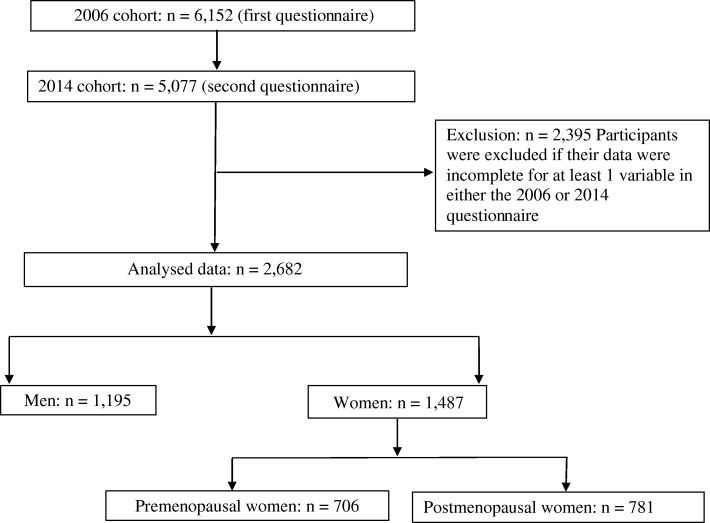
BACKGROUND: Results from studies investigating the association between coffee consumption and osteoporosis or bone mineral density (BMD) have been inconsistent. This longitudinal study was performed to assess the effect of coffee drinking on bone health of Taiwanese adults. METHODS: Data were retrieved from the Li-Shin (Landseed) Hospital in Taoyuan City. In 2006, 6152 participants completed a questionnaire on coffee drinking and other lifestyle factors. In 2014, 5077 of them were followed up. Nonetheless, a total of 2395 participants with incomplete data were excluded. The final analyses included 2682 participants comprising 1195 men and 1487 women (706 premenopausal and 781 postmenopausal). T-scores were derived from the osteo-sono assessment index (OSI) which is a surrogate of BMD. Coffee drinking was categorized as "no, medium, and high" based on the number of cups that were consumed per week in both 2006 and 2014. RESULTS: In general, medium and high coffee drinking were associated with higher T-scores. However, significant results were observed only among high drinkers (β = 0.158; P = 0.0038). Nonetheless, the test for linear trend was significant (P = 0.0046). After stratification by sex, medium and high coffee drinking were associated with higher T-scores. However, significant results were prominent only among high male drinkers (β = 0.237; P = 0.0067) and the test for trend was significant (P = 0.0161). Based on menopausal status, coffee drinking was associated with higher T-scores. Nevertheless, significant results were found only among premenopausal women (β = 0.233; P = 0.0355 and β = 0.234; P = 0.0152 for medium and high coffee drinking, respectively. The test for linear trend was significant (P = 0.0108). CONCLUSION: Coffee drinking was significantly associated with higher T-scores hence, a lower risk of osteoporosis in men and premenopausal women.
Overview
The claims and statistics of this paper haven’t been checked yet.
Free: it reads the open-access text and checks the first 5 claims that cite a source we can check. Create a free account to check every claim.
Integrity signals
Registry
Cites
Statistics
Figures
Verification
Claims the paper makes
The claims and statistics of this paper haven’t been checked yet.
Free: it reads the open-access text and checks the first 5 claims that cite a source we can check. Create a free account to check every claim.
Claims other papers make about this one
Each is checked against this paper’s own text: does it say what the citing paper says it does?
The source backs part of the claim, not all of it — or backs it for a different population, condition or comparison.
In the citing paper
“However, the association between caffeine intake and BMD or osteoporosis remains controversial from molecular studies and epidemiological studies of adult or elderly populations only [37–39].”
From Association between caffeine consumption and bone mineral density in children and adolescent: Observational and Mendelian randomization study (2023) · cites this paper as [37]
Experimental — accuracy not yet measured
Self-check
Percentages, sums and reported differences re-computed from the paper’s own numbers.
The self-check needs the paper’s full text.
Citations
Cites
An estimate of the worldwide prevalence and disability associated with osteoporotic fractures
Johnell, O., & Kanis, J. A. (2006) · Osteoporosis International · doi:10.1007/s00198-006-0172-4 · Cited by 4,704
European guidance for the diagnosis and management of osteoporosis in postmenopausal women
Kanis, J. A., McCloskey, E. V., Johansson, H., Cooper, C., Rizzoli, R., Reginster, J.-Y., & on behalf of the Scientific Advisory Board of the European Society for Clinical and Economic Aspects of Osteoporosis and Osteoarthritis (ESCEO) and the Committee of Scientific Advisors of the International Osteoporosis Foundation (IOF) (2013) · Osteoporosis International · doi:10.1007/s00198-012-2074-y · Cited by 2,948
A systematic review of hip fracture incidence and probability of fracture worldwide
Kanis, J. A., Odén, A., McCloskey, E. V., Johansson, H., Wahl, D. A., Cooper, C., & on behalf of the IOF Working Group on Epidemiology and Quality of Life (2012) · Osteoporosis International · doi:10.1007/s00198-012-1964-3 · Cited by 1,379
Coffee and Health: A Review of Recent Human Research
Higdon, J. V., & Frei, B. (2006) · Critical Reviews in Food Science and Nutrition · doi:10.1080/10408390500400009 · Cited by 1,090
Coffee and its Consumption: Benefits and Risks
Butt, M. S., & Sultan, M. T. (2011) · Critical Reviews in Food Science and Nutrition · doi:10.1080/10408390903586412 · Cited by 612
Quantitative Ultrasound in the Management of Osteoporosis: The 2007 ISCD Official Positions
Krieg, M.-A., Barkmann, R., Gonnelli, S., Stewart, A., Bauer, D. C., Del Rio Barquero, L., Kaufman, J. J., Lorenc, R., Miller, P. D., Olszynski, W. P., et al. (2008) · Journal of Clinical Densitometry · doi:10.1016/j.jocd.2007.12.011 · Cited by 387 · cited 3×
“Therefore, in clinical practice, QUS is not a gold standard for BMD measurement [2, 46].”
BackgroundMarques, E. A., Mota, J., & Carvalho, J. (2012) · AGE · doi:10.1007/s11357-011-9311-8 · Cited by 254
Hallström, H., Wolk, A., Glynn, A., & Michaëlsson, K. (2006) · Osteoporosis International · doi:10.1007/s00198-006-0109-y · Cited by 194
The Relationship between Metabolic Syndrome and Osteoporosis: A Review
Wong, S., Chin, K.-Y., Suhaimi, F., Ahmad, F., & Ima-Nirwana, S. (2016) · Nutrients · doi:10.3390/nu8060347 · Cited by 186
A high body mass index protects against femoral neck osteoporosis in healthy elderly subjects
Barrera, G., Bunout, D. C., Vivien Gattas, Z., de la Maza, M. P., Leiva, L., & Hirsch, S. (2004) · Nutrition · doi:10.1016/j.nut.2004.05.014 · Cited by 167
Chin, K.-Y., & Ima-Nirwana, S. (2013) · International Journal of Medical Sciences · doi:10.7150/ijms.6765 · Cited by 165
Langsetmo, L., Hitchcock, C. L., Kingwell, E., Davison, K. S., Berger, C., Forsmo, S., Zhou, W. Z., Kreiger, N., & Prior, J. C. (2011) · Bone · doi:10.1016/j.bone.2011.11.009 · Cited by 149
Langsetmo, L., Hanley, D. A., Prior, J. C., Barr, S. I., Anastassiades, T., Towheed, T., Goltzman, D., Morin, S. N., Poliquin, S., & Kreiger, N. (2010) · American Journal of Clinical Nutrition · doi:10.3945/ajcn.110.002956 · Cited by 114
Long-term coffee consumption in relation to fracture risk and bone mineral density in women
Hallstrom, H., Byberg, L., Glynn, A., Lemming, E. W., Wolk, A., & Michaelsson, K. (2013) · American Journal of Epidemiology · doi:10.1093/aje/kwt062 · Cited by 105
Fawzy, T., Muttappallymyalil, J., Sreedharan, J., Ahmed, A. M., Alshamsi, S. O. S., Ali, M. S. S. H. B. B. A., & Balsooshi, K. A. A. (2011) · Journal of Osteoporosis · doi:10.4061/2011/876309 · Cited by 93 · cited 13×
“It was also associated with Personal disease history Diabetes 13 (1.84) 63 (8.07) .0001* Hypertension 45 (6.37) 166 (21.25) .0001* Heart disease 15 (2.12) 33 (4.23) 0.0221* Hyperlipidemia 18 (2.55) 62 (7.94) .0001* Stroke 1 (0.14) 1 (0.13) 0.9430 Supplement intake Age group (Reference: 30–49 years) 50–69 − 0.447 .0001…”
BackgroundInfluentialZhu, K., Hunter, M. L., James, A. L., Lim, E. M., & Walsh, J. P. (2015) · Bone · doi:10.1016/j.bone.2015.01.015 · Cited by 88
Chen, I.-J., Chiang, C.-Y. F., Li, Y.-H., Chang, C., Hu, C.-C., Chen, D. W., Chang, Y., Yang, W.-E., Shih, H., Ueng, S. W., et al. (2014) · Osteoporosis International · doi:10.1007/s00198-014-2930-z · Cited by 85
Educational Level and Osteoporosis Risk in Postmenopausal Chinese Women
Ho, S. C. (2005) · American Journal of Epidemiology · doi:10.1093/aje/kwi047 · Cited by 82
Arai, Y., Iinuma, T., Takayama, M., Takayama, M., Abe, Y., Fukuda, R., Ando, J., Ohta, K., Hanabusa, H., Asakura, K., et al. (2010) · BMC Geriatrics · doi:10.1186/1471-2318-10-35 · Cited by 73
Hallström, H., Melhus, H., Glynn, A., Lind, L., Syvänen, A.-C., & Michaëlsson, K. (2010) · Nutrition & Metabolism · doi:10.1186/1743-7075-7-12 · Cited by 66
Choi, E., Choi, K.-H., Park, S. M., Shin, D., Joh, H., & Cho, E. (2016) · PLoS ONE · doi:10.1371/journal.pone.0147762 · Cited by 62
Lu, Y.-C., Lin, Y. C., Lin, Y., Liu, Y., Chang, K., Chieng, P., & Chan, W. P. (2016) · Scientific Reports · doi:10.1038/srep25206 · Cited by 59 · cited 1×
“Low BMI [41, 43, 44], age [3, 6, 39, 43, 44] and education below college level [39, 44, 45] have been associated with lower BMD.”
BackgroundSelf-citationTang, Q. Y., Kukita, T., Ushijima, Y., Kukita, A., Nagata, K., Sandra, F., Watanabe, T., Toh, K., Okuma, Y., Kawasaki, S., et al. (2005) · Histochemistry and Cell Biology · doi:10.1007/s00418-005-0062-4 · Cited by 47
Effects of coffee consumption and smoking habit on bone mineral density
Demirbağ, D., Özdemir, F., & Türe, M. (2005) · Rheumatology International · doi:10.1007/s00296-005-0020-4 · Cited by 40
Coffee Consumption and Bone Mineral Density in Korean Premenopausal Women
Choi, E. J., Kim, K. H., Koh, Y.-J., Lee, J.-S., Lee, D.-R., & Park, S. M. (2014) · Korean Journal of Family Medicine · doi:10.4082/kjfm.2014.35.1.11 · Cited by 36 · cited 3×
“Similar results were observed in a study comprising 1761 premenopausal Korean women with a mean age of 36 years [18].”
BackgroundResultInfluentialApproach of Improving Coffee Industry in Taiwan-Promote Quality of Coffee Bean by Fermentation
Lin, C.-C. (2010) · Cited by 34
Determinants of bone mineral density in older postmenopausal Chinese women
Khoo, C. C., Woo, J., Leung, P. C., Kwok, A. W. L., & Kwok, T. C. Y. (2011) · Climacteric · doi:10.3109/13697137.2010.548566 · Cited by 31
A 12-Year Ecological Study of Hip Fracture Rates among Older Taiwanese Adults
Chan, D., Lee, Y., Wu, Y.-J., Tsou, H., Chen, C.-T., Hwang, J., Tsai, K., & Yang, R. (2013) · Calcified Tissue International · doi:10.1007/s00223-013-9759-x · Cited by 31 · cited 1×
“9 million US dollars) between 1999 and 2010 [9].”
BackgroundSilva, T. R., Franz, R. F., Maturana, M. A., & Spritzer, P. M. (2015) · BMC Endocrine Disorders · doi:10.1186/s12902-015-0072-8 · Cited by 30
Chin, K., Low, N. Y., Dewiputri, W. I., & Ima-Nirwanaa, S. (2017) · International Journal of Environmental Research and Public Health · doi:10.3390/ijerph14070736 · Cited by 27
Yang, P., Zhang, X., Zhang, K., & Tang, Z. (2015) · PubMed Central · Cited by 26
Coffee Consumption and Risk of Fracture in the Cohort of Swedish Men (COSM)
Hallström, H., Wolk, A., Glynn, A. W., Michaëlsson, K., & Byberg, L. (2014) · PLoS ONE · doi:10.1371/journal.pone.0097770 · Cited by 24
No association between bone mass and prolactin levels among patients with schizophrenia
Sugawara, N., Yasui‐Furukori, N., Fujii, A., Saito, M., Sato, Y., Nakagami, T., Tsuchimine, S., & Kaneko, S. (2011) · Human Psychopharmacology Clinical and Experimental · doi:10.1002/hup.1250 · Cited by 23
Yu, Q., Liu, Z., Lei, T., & Tang, Z. (2016) · Journal of Health Population and Nutrition · doi:10.1186/s41043-016-0060-2 · Cited by 18
Akhlaque, U., Ayaz, S. B., Akhtar, N., & Ahmad, N. (2016) · The Egyptian Rheumatologist · doi:10.1016/j.ejr.2016.05.006 · Cited by 16
Tanabe, R., Kawamura, Y., Tsugawa, N., Haraikawa, M., Sogabe, N., Okano, T., Hosoi, T., & Goseki‐Sone, M. (2015) · PubMed · doi:10.6133/apjcn.2015.24.2.01 · Cited by 14 · cited 2×
“T-scores are generated by comparing the OSI with the mean OSI of a reference population [24, 25].”
BackgroundMethodKapetanović, A., & Avdić, D. (2014) · Journal of Health Sciences · doi:10.17532/jhsci.2014.194 · Cited by 10 · cited 2×
“lower BMD among 100 postmenopausal women aged 50–65 years who lived in Sarajevo [32].”
BackgroundMedraś, M., Jankowska, E. A., & Rogucka, E. (2000) · PubMed · Cited by 10
Araujo, E. C. D. S. E. S., Pagotto, V., & Silveira, É. A. (2016) · Current Gerontology and Geriatrics Research · doi:10.1155/2016/4946593 · Cited by 9 · cited 14×
“It was also associated with Personal disease history Diabetes 13 (1.84) 63 (8.07) .0001* Hypertension 45 (6.37) 166 (21.25) .0001* Heart disease 15 (2.12) 33 (4.23) 0.0221* Hyperlipidemia 18 (2.55) 62 (7.94) .0001* Stroke 1 (0.14) 1 (0.13) 0.9430 Supplement intake Age group (Reference: 30–49 years) 50–69 − 0.447 .0001…”
BackgroundInfluentialEffect of body mass index on bone mineral density
Prabha, V., & Stanly, A. M. (2015) · International Journal of Community Medicine and Public Health · doi:10.18203/2394-6040.ijcmph20150942 · Cited by 9
Tsuboi, S., Hayakawa, T., Kanda, H., & Fukushima, T. (2009) · Environmental Health and Preventive Medicine · doi:10.1007/s12199-009-0099-4 · Cited by 8
Osteoporosis : pathophysiology and clinical management
ORWOLL, E. S., & Bliziotes, M. M. (2003) · Humana Press eBooks · Cited by 7
Coffee Consumption Might Reduce the Risk of Osteopenia/Osteoporosis in Premenopausal Taiwanese Women
Chang, H.-C., Hsieh, C.-F., Lin, Y., Tantoh, D. M., Kung, Y.-Y., Lin, M.-C., Liaw, Y., & Liaw, Y. (2017) · Journal of Food and Nutrition Research · doi:10.12691/jfnr-5-10-10 · Cited by 3 · cited 1×
“Furthermore, in a cross-sectional study involving 1336 premenopausal and 1593 postmenopausal Taiwanese aged 30 years and above, coffee consumption was significantly associated with decreased risk of osteoporosis in premenopausal, but not postmenopausal women [29].”
BackgroundSelf-citationNakada, M., & Demura, S. (2010) · Health · doi:10.4236/health.2010.22019 · Cited by 2
Estimation of annual per capita treatment in osteoporosis
Khodadadi, S., & Khodadadi, S. (2016) · Journal of Parathyroid Disease · Cited by 2
Cited by
Pharmacology of caffeine and its effects on the human body
Reddy, V. S., Shiva, S. M., Manikantan, S., & Ramakrishna, S. (2024) · European Journal of Medicinal Chemistry Reports · doi:10.1016/j.ejmcr.2024.100138 · Cited by 243
The effects of caffeine on bone mineral density and fracture risk
Berman, N., Honig, S., Cronstein, B. N., & Pillinger, M. H. (2022) · Osteoporosis International · doi:10.1007/s00198-021-05972-w · Cited by 92
Chau, Y.-P., Au, P. C.-M., Li, G. H., Sing, C., Cheng, V. K.-F., Tan, K. C. B., Kung, A. W. C., & Cheung, C. (2019) · The Journal of Clinical Endocrinology & Metabolism · doi:10.1210/clinem/dgz210 · Cited by 63
António, J., Newmire, D. E., Stout, J. R., Antonio, B. B., Gibbons, M., Lowery, L. M., Harper, J., Willoughby, D. S., Evans, C., Anderson, D., et al. (2024) · Journal of the International Society of Sports Nutrition · doi:10.1080/15502783.2024.2323919 · Cited by 63
“The authors speculated that these bone benefits may be related to the high antioxidant and anti-inflammatory properties of coffee [175].”
BackgroundHemmati, E., Mirghafourvand, M., Mobasseri, M., Shakouri, S. K., Mikaeli, P., & Farshbaf‐Khalili, A. (2021) · Journal of Education and Health Promotion · doi:10.4103/jehp.jehp_945_20 · Cited by 55
“[14] 8%–9% of bone fractures per year are caused by osteoporosis, which results in back pain, impaired quality of life, and interference with daily activities.[15] Bone mass in female in all age groups is significantly lower than male in the same age and race.”
Background
Metadata
- Authors
- Chang, H.-C., Hsieh, C.-F., Lin, Y.-C., Tantoh, D. M., Ko, P.-C., Kung, Y.-Y., Wang, M.-C., Hsu, S.-Y., Liaw, Y.-C., & Liaw, Y.-P.
- Affiliations
- Hsin Sheng College of Medical Care and Management (TW)
- Chung Shan Medical University (TW)
- Landseed Hospital (TW)
- National Yang Ming University (TW)
- Corresponding author
- Liaw, Yi-Ching
- Venue
- BMC Public Health
- Published
- 2018-11-20
- Volume
- 18
- Issue
- 1
- Pages
- 1273-1273
- ISSN
- 1471-2458 (ISSN-L)
- PMC
- PMC6245613
- OpenAlex
- W2900855285
- Cited by
- 39
- References
- 45
- Citations by year
- 2026: 2 · 2025: 3 · 2024: 6 · 2023: 8 · 2022: 7 · 2021: 9 · 2020: 3 · 2019: 1
- FWCI
- 2.10
- Type
- journal article
- Language
- en
- Open access
- gold
- doi.org
- Licence
- cc-by
- creativecommons.org/licenses/by/4.0/ (tdm)
- Locations
- BMC Public Health (publishedVersion, cc-by)
- Europe PMC (PubMed Central) (publishedVersion, cc-by)
- PubMed Central (publishedVersion, cc-by)
- PubMed (publishedVersion)
- DOAJ (DOAJ: Directory of Open Access Journals) (submittedVersion)
- Funders
- Chung Shan Medical University and Landseed Hospital ((CSMU-LSH-103-02, CSMU-LSH-104-01, CSMU-LSH-105-01, and CSMU-LSH-106-01))
- Topics
- Health Sciences › Medicine › Pharmacology (medical) › Coffee research and impacts
- Health Sciences › Medicine › Orthopedics and Sports Medicine › Bone health and osteoporosis research
- Health Sciences › Medicine › Pathology and Forensic Medicine › Alcohol Consumption and Health Effects
- Keywords
- coffee consumption, bone health, bone mineral density, osteoporosis, T-score, menopausal status, premenopausal women, men, Taiwanese adults
- MeSH terms
- Adult, Aged, Coffee, Female, Humans, Longitudinal Studies, Male, Middle Aged, Osteoporosis, Surveys and Questionnaires, Risk, Taiwan, Bone Density
About these checks
Registry, retraction, Cites and statistics results are computed, not judged, with one exception: a printed reference that no index lists is read once by a model before it counts as a citation error. Claims are extracted by a model and kept only when their quote appears verbatim in the text; each cited source is then checked, with a model’s help, for whether it says what the claim relies on. Those verdicts can be wrong — read the claim’s quote and the cited source before relying on one.
Statistics and arithmetic are recomputed, not judged.
Confidence bands are shown only for fields calibrated on our annotated test set. None is calibrated yet, so no band is shown.
What counts as a claim ›How we measure confidence ›How we check this ›
Are you an author, or do you see a problem with this page? Request a review
Data sources
Bibliographic data: Semantic Scholar, OpenAlex, Crossref.
Contains information from the Semantic Scholar Academic Graph Datasets, made available under the ODC Attribution License (ODC-BY 1.0).
Semantic Scholar’s data is described in: Kinney, R., et al. (2023). The Semantic Scholar Open Data Platform. arXiv:2301.10140.
