

Dementia awareness and risk perception in middle-aged and older individuals: baseline results of the MijnBreincoach survey on the association between lifestyle and brain health
Open accessThe DOI matches its Crossref record; 32 of the 32 references it cites were found in a registry or an index.
Abstract
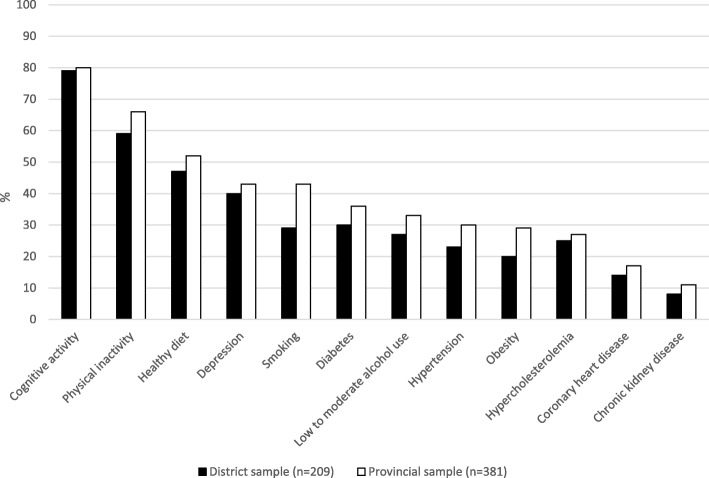
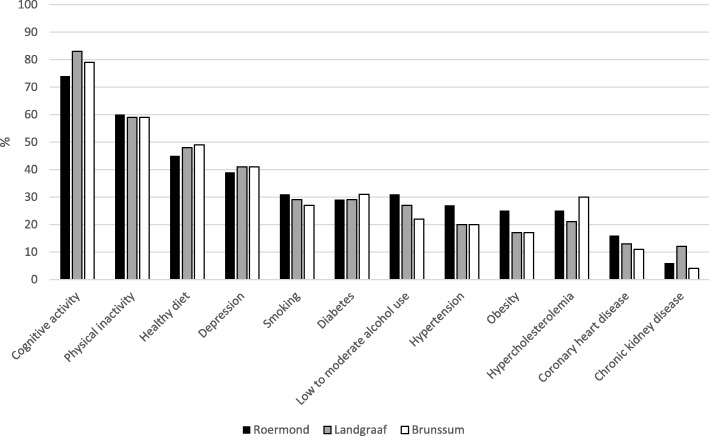
BACKGROUND: The total number of people with dementia is increasing worldwide, due to our aging society. Without a disease-modifying drug available, risk reduction strategies are to date the only promising way to reduce dementia incidence in the future. Substantial evidence exists that lifestyle factors contribute to the risk of dementia, such as physical exercise, mental activity and (non-)smoking. Still, most people seem unaware of a relationship between lifestyle and brain health. This paper investigates dementia literacy and knowledge of modifiable risk and protective factors of dementia in a Dutch population-based sample. METHODS: An online-survey was carried out among 590 community-dwelling people between 40 and 75 years old in the Province of Limburg, the Netherlands. The total group comprises both of a provincial sample (n = 381) and a sample of three specific districts within the province (n = 209). Dementia awareness and knowledge about 12 risk and protective factors was assessed with items derived from the British Social Attitudes (BSA) survey, supplemented with custom items developed by the research team. RESULTS: The majority of participants (56%) were unaware of a relationship between lifestyle and dementia risk. Most individuals identified low cognitive activity, physical inactivity and unhealthy diet as dementia risk factors. Particular gaps in knowledge existed with regard to major cardiovascular risk factors such as hypertension, hypercholesterolemia and coronary heart disease. Although the level of awareness varied by age and level of education, most people (70%) were eager to learn more about the topic of brain health, and indicated to be interested in using eHealth (54%) to measure or improve brain health. CONCLUSIONS: Most people still are unaware of the relation between lifestyle and brain health, indicating the need for public health campaigns. Increasing awareness in the general population about the presence of modifiable dementia risk and protective factors is a crucial first step prior to implementation of preventative measures. Targeting specific subgroups, such as individuals with low socioeconomic status and low health literacy, is essential for the reach and effect of a prevention campaign. Outcome of this study was the rationale for an awareness campaign in The Netherlands, called "MijnBreincoach" ("MyBraincoach").
Overview
The claims and statistics of this paper haven’t been checked yet.
Free: it reads the open-access text and checks the first 5 claims that cite a source we can check. Create a free account to check every claim.
Integrity signals
Registry
Cites
Statistics
Figures
Verification
Claims the paper makes
The claims and statistics of this paper haven’t been checked yet.
Free: it reads the open-access text and checks the first 5 claims that cite a source we can check. Create a free account to check every claim.
Claims other papers make about this one
Each is checked against this paper’s own text: does it say what the citing paper says it does?
The source backs part of the claim, not all of it — or backs it for a different population, condition or comparison.
In the citing paper
“A recent study showed that 56% of the Dutch population aged 40-75 years believed that there is nothing one could do to decrease dementia risk.14”
From Awareness of dementia risk reduction among current and future healthcare professionals: A survey study (2021) · cites this paper as [14]
Experimental — accuracy not yet measuredThe source backs part of the claim, not all of it — or backs it for a different population, condition or comparison.
In the citing paper
“A recent study conducted in The Netherlands showed that 56% of the general population was unaware of a relationship between lifestyle and dementia risk.14”
From Awareness of dementia risk reduction among current and future healthcare professionals: A survey study (2021) · cites this paper as [14]
Experimental — accuracy not yet measuredThe source backs part of the claim, not all of it — or backs it for a different population, condition or comparison.
In the citing paper
“The utilized surveys are comprehensive and allow for cross-country comparisons since they were employed elsewhere (Heger et al., 2019;Marcinkiewicz and Reid, 2015).”
From Increasing knowledge on dementia risk reduction in the general population: Results of a public awareness campaign. (2021) · cites this paper as Heger et al., 2019
Experimental — accuracy not yet measuredThe source backs part of the claim, not all of it — or backs it for a different population, condition or comparison.
In the citing paper
“This pattern mirrors findings from the Netherlands and Denmark, where older adults stated that dementia cannot be prevented more often than younger people [18,26].”
From Sociodemographic differences in dementia prevention knowledge in Germany: Implications for targeted health communication (2026) · cites this paper as [18]
Experimental — accuracy not yet measuredThe source backs part of the claim, not all of it — or backs it for a different population, condition or comparison.
In the citing paper
“In Europe, public awareness of the importance of lifestyle and general health with dementia risk has been the focus of several studies, but findings have been inconsistent, with awareness levels ranging from 34% to 70%.”
From Awareness and knowledge of dementia risk reduction among current and future health professionals: A survey study (2025) · cites this paper as [4]
Experimental — accuracy not yet measured
18 more claims about this paper
Create a free account to see every claim other papers make about this one.
Self-check
Percentages, sums and reported differences re-computed from the paper’s own numbers.
The self-check needs the paper’s full text.
Citations
Cites
Ror2 signaling regulates Golgi structure and transport through IFT20 for tumor invasiveness
Nishita, M., Park, S.-Y., Nishio, T., Kamizaki, K., Wang, Z., Tamada, K., Takumi, T., Hashimoto, R., Otani, H., Pazour, G. J., et al. (2017) · Scientific Reports · doi:10.1038/s41598-016-0028-x · Cited by 15,947
Dementia prevention, intervention, and care
Livingston, G., Sommerlad, A., Orgeta, V., Costafreda, S. G., Huntley, J., Ames, D., Ballard, C., Banerjee, S., Burns, A., Cohen-Mansfield, J., et al. (2017) · The Lancet · doi:10.1016/s0140-6736(17)31363-6 · Cited by 6,072
Potential for primary prevention of Alzheimer's disease: an analysis of population-based data
Norton, S., Matthews, F. E., Barnes, D. E., Yaffe, K., & Brayne, C. (2014) · The Lancet Neurology · doi:10.1016/s1474-4422(14)70136-x · Cited by 2,466
Defeating Alzheimer's disease and other dementias: a priority for European science and society
Winblad, B., Amouyel, P., Andrieu, S., Ballard, C., Brayne, C., Brodaty, H., Cedazo-Minguez, A., Dubois, B., Edvardsson, D., Feldman, H., et al. (2016) · The Lancet Neurology · doi:10.1016/s1474-4422(16)00062-4 · Cited by 1,676
(2016) · London School of Economics and Political Science Research Online (London School of Economics and Political Science) · Cited by 874
Deckers, K., van Boxtel, M. P. J., Schiepers, O. J. G., de Vugt, M., Muñoz Sánchez, J. L., Anstey, K. J., Brayne, C., Dartigues, J.-F., Engedal, K., Kivipelto, M., et al. (2015) · International Journal of Geriatric Psychiatry · doi:10.1002/gps.4245 · Cited by 534
Self-citationGorelick, P. B., Furie, K. L., Iadecola, C., Smith, E. E., Waddy, S. P., Lloyd-Jones, D. M., Bae, H.-J., Bauman, M. A., Dichgans, M., Duncan, P. W., et al. (2017) · Stroke · doi:10.1161/str.0000000000000148 · Cited by 411
Ritchie, K., & Lovestone, S. (2002) · The Lancet · doi:10.1016/s0140-6736(02)11667-9 · Cited by 387
Determinants of the intention to use e-Health by community dwelling older people
de Veer, A. J. E., Peeters, J. M., Brabers, A. E., Schellevis, F. G., Rademakers, J. J. J., & Francke, A. L. (2015) · BMC Health Services Research · doi:10.1186/s12913-015-0765-8 · Cited by 298
Deckers, K., Schievink, S. H. J., Rodriquez, M. M. F., van Oostenbrugge, R. J., van Boxtel, M. P. J., Verhey, F. R. J., & Köhler, S. (2017) · PLOS ONE · doi:10.1371/journal.pone.0184244 · Cited by 271
Self-citation
Research works printed but not linked: 1
- Prince M Comas A Knapp M Guerchet M Karagiannidou M World Alzheimer Report 2016: improving healthcare for people living with dementia 2016 London Alzheimer's Disease International
Cited by
Items 101–140 of 140
Heger, I. (2022) · Research Publications (Maastricht University) · doi:10.26481/dis.20220324ih · Cited by 1
Self-citationGuo, Y. C., Zhang, F. Y., Zhang, W. L., Liang, Y., & Zhou, L. H. (2020) · doi:10.2196/preprints.21797
Evaluation and Analyses of the General Public’s Dementia Knowledge and Its Characteristics
Jeong, H., Im, D., & Ock, M. (2022) · Health Insurance Review & Assessment Service Research · doi:10.52937/hira.22.2.1.75
Grkman, L., Mavrič, N., Lovrenčič, B., & Lovrenčič, M. (2022) · ZRC SAZU, Založba ZRC eBooks · doi:10.3986/9789610506768_14
Dolgotrajni covid-19/postcovidni sindrom in kognitivne motnje
Lovrečić, B., Lovrečić, M., & Grkman, L. (2022) · ZRC SAZU, Založba ZRC eBooks · doi:10.3986/9789610506966_06
(2022) · ZRC SAZU, Založba ZRC eBooks · doi:10.3986/9789610506966_00
Breme neformalnih oskrbovalcev oseb z demenco v času covida-19
Lovrečić, B., Lovrečić, M., & Mavrič, N. (2022) · ZRC SAZU, Založba ZRC eBooks · doi:10.3986/9789610506966_08
Dinamika nevropsihiatričnih simptomov pri osebah z demenco v povezavi s pandemijo in covidom-19
Lovrečić, B., Lovrečić, M., & Grkman, L. (2022) · ZRC SAZU, Založba ZRC eBooks · doi:10.3986/9789610506966_05
Duševno zdravje neformalnih družinskih oskrbovalcev oseb z demenco
Lovrečić, B., Lovrečić, M., & Cizl, M. (2022) · ZRC SAZU, Založba ZRC eBooks · doi:10.3986/9789610506966_07
Javnozdravstveni izzivi demence
Lovrečić, B., Lovrečić, M., Sambt, J., Grkman, L., Simon, M. R., Mavrič, N., Sedlak, S., Jelenc, M., Cizl, M., Kralj, M., et al. (2022) · ZRC SAZU, Založba ZRC eBooks · doi:10.3986/9789610506966 · Cited by 2
Poznavanje demence med splošno javnostjo
Lovrečić, B., Lovrečić, M., & Mavrič, N. (2022) · ZRC SAZU, Založba ZRC eBooks · doi:10.3986/9789610506966_02
Dolgotrajna oskrba ljudi z demenco
Mali, J. (2022) · ZRC SAZU, Založba ZRC eBooks · doi:10.3986/9789610506966_03
Ekonomsko breme demence v Sloveniji glede na rutinske podatkovne zbirke zdravstvenega varstva
Lovrečić, B., Sambt, J., Sedlak, S., & Jelenc, M. (2022) · ZRC SAZU, Založba ZRC eBooks · doi:10.3986/9789610506966_04
Lee, J., Bae, H., & Lee, E. (2024) · Informatics for Health and Social Care · doi:10.1080/17538157.2024.2404941 · Cited by 1
Best Practices for Communicating Nutrition and Brain Health Science
Roberson, L. B., Latulippe, M. E., Ohlhorst, S. D., Faye, D., Aarts, K., Steiber, A. L., Ferland, G., Coetzee, T., Chura, L. R., & Ho, E. H. (2025) · Nutrition Today · doi:10.1097/nt.0000000000000744
Understanding Dementia: Knowledge and Risk Factor Awareness Among University Psychology StudentsPreprint
Sabatini, S., Burley, C. V., Ambagtsheer, R. C., & Stephan, B. C. M. (2025) · Research Square · doi:10.21203/rs.3.rs-6523159/v1 · Cited by 1
SOCIAL PROCESSES. SOCIAL DYNAMICS
Basheva, O. A., Chernikova, E. F., Ogannisyan, M. G., Геннадьевна, Д. Е., & Vedunova, M. V. (2025) · Sociologicheskaja nauka i social naja praktika · doi:10.19181/snsp.2025.13.2.5
Senff, J. R., Shah-Ostrowski, M. J., Tack, R. W. P., Nunley, C., Palys, C. R., Ng, S., Mallick, A., Gutiérrez-Martínez, L., Duskin, J. A., Kimball, T. N., et al. (2025) · BMC Public Health · doi:10.21203/rs.3.rs-5145102/v1
de Rijke, T. J., Visser, L. N. C., Kaijser, K. K. M., Bruinsma, J., Oudbier, S. J., Heger, I., van der Flier, W. M., Smets, E. M. A., & Engelsma, T. (2025) · BMC Public Health · doi:10.1186/s12889-025-23777-y · Cited by 1
“…the Dutch app MijnBrein-coach is an example of a digital tool that provides insight into someone’s personal dementia risk profile, identifies room-for-improvement based on lifestyle, and provides support to make small steps towards improved brain health and dementia risk reduction [15, 16].”
Self-citationTownsend, R. F., Shannon, O. M., Stevenson, E., Ritchie, C. W., Minihane, A. M., Devine, P., Casey, S., Fullerton, N., Leroi, I., LAWLOR, B. A., et al. (2025) · BMC Public Health · doi:10.1186/s12889-025-24175-0 · Cited by 3
“Generally, lower awareness was identified among younger adults and those with lower educational attainment, consistent with previous international research [30].”
Ownby, R. L., Cavanaugh, G., Weatherly, S., Akhtarullah, S., & Caballero, J. (2025) · medRxiv · doi:10.64898/2025.12.02.25341494
Additional file 1 of Public awareness and knowledge of factors associated with dementia in China
Zheng, Y.-B., Shi, L., Gong, Y.-M., Wang, X.-X., Lu, Q.-D., Que, J.-Y., Khan, M. Z., Bao, Y., & Lu, L. (2020) · Figshare · doi:10.6084/m9.figshare.13107640
Bartlett, L., Bindoff, A. D., Doherty, K., Kim, S., Eccleston, C. E. A., Kitsos, A., Roccati, E., Alty, J., King, A. E., & Vickers, J. C. (2024) · Figshare · doi:10.6084/m9.figshare.26620963
Vrijsen, J., Matulessij, T. F., Joxhorst, T., de Rooij, S. E., & Smidt, N. (2021) · Figshare · doi:10.6084/m9.figshare.14532380
Additional file 3 of Public knowledge about dementia risk reduction in Norway
Kjelvik, G., Rokstad, A. M. M., Stuebs, J., Thingstad, P., Deckers, K., Köhler, S., & Selbæk, G. (2022) · Figshare · doi:10.6084/m9.figshare.21523764
Self-citationAdditional file 2 of Public knowledge about dementia risk reduction in Norway
Kjelvik, G., Rokstad, A. M. M., Stuebs, J., Thingstad, P., Deckers, K., Köhler, S., & Selbæk, G. (2022) · Figshare · doi:10.6084/m9.figshare.21523761
Self-citationAdditional file 1 of Public knowledge about dementia risk reduction in Norway
Kjelvik, G., Rokstad, A. M. M., Stuebs, J., Thingstad, P., Deckers, K., Köhler, S., & Selbæk, G. (2022) · Figshare · doi:10.6084/m9.figshare.21523758
Self-citationAttitudes and needs of brain health promotion for older adults in China: a qualitative study
Zhang, X., Zhang, Y., Yuan, P., Zhao, M., Xing, L., Tian, Y., & Dong, S. (2025) · BMC Geriatrics · doi:10.1186/s12877-025-06900-x
“While recognizing links to stroke and dementia, most couldn’t name specific diseases or understand connections to chronic conditions like hypertension [21, 22].”
Applications and implicit assumptions in dementia risk scores: A scoping review of the LIBRA score
Kant, W. M. R., de Swart, W., Smit, J. M., Loog, M., & Krijthe, J. H. (2026) · Journal of Alzheimer s Disease Reports · doi:10.1177/25424823261416457 · Cited by 1
“22,23,27,43,45,50,55,71,73,74 While awareness of the relation between lifestyle factors and dementia is important, the added bene fi t of the LIBRA score is not always clear in these studies.”
Latent profiles and Influencing factors of perceived threat of dementia among older adultsPreprint
Xu, Y., Ren, Q., Jiang, Y., Jiang, Y., Sheng, S., & Zhang, Q. (2026) · Research Square · doi:10.21203/rs.3.rs-8420233/v1
Lefèvre‐Arbogast, S. (2019) · theses.fr (ABES) · doi:10.70675/6915e632z663fz4caaz9c7az455ad25755da
Röhr, S., & Alpass, F. (2026) · BMJ Open · doi:10.1136/bmjopen-2025-112021
“The research team brought a strong commitment to participatory and equity-focused approaches, which shaped the choice of photovoice as the primary method.”
Truin, L. S., Heger, I., Deckers, K., Knops, R., Palsma, T., de Heus, R. A. A., Claassen, J. A. H. R., de Vugt, M. E., & Köhler, S. (2026) · Journal of Alzheimer s Disease · doi:10.1177/13872877261440966
Self-citationTruin, L. S., Heger, I., Wimmers, S. C. P. M., Deckers, K., de Vugt, M. E., & Köhler, S. (2026) · Journal of Alzheimer s Disease · doi:10.1177/13872877261440958
Self-citationPereira, M. G., Guimarães, R., & Lima, S. (2026) · Springer eBooks · doi:10.1007/978-981-95-2121-0_23
KUNDAKÇI, G. A., Arabacı, Z., Atila, D., & Aktaş, B. (2026) · Journal of Prevention · doi:10.1007/s10935-026-00929-3
“In their study, Heger and colleagues emphasised the relationship between lifestyle and brain health, and the importance of raising awareness of dementia risk and protective factors (Heger et al., 2019 ).”
Agdere, S., Albers, E. A. C., Kreuk, E., Horstkötter, D., Paauw, D., Rirash, A. F., Smets, E. M. A., & Visser, L. N. C. (2026) · Research Square · doi:10.21203/rs.3.rs-9940093/v1
Reducing Dementia Risk with the BrainSpan Program:
Cohen, M. L., Buren, K. V., Myers, M. J., Martens, C. R., & Huege, S. (2026) · Delaware Journal of Public Health · doi:10.32481/djph.2026.07.09
“22 increased significantly with a large effect size.”
Svolos, V., Strongylou, D. E., Zoupa, E., Triantafyllou, A., Katsama, M., Michas, K., Kosti, R., Bogiatzidou, O., Siokas, V., Liampas, I., et al. (2026) · Dietetics · doi:10.3390/dietetics5030050
“First, an initial item pool was generated from previously published studies addressing dementia knowledge, risk perception and beliefs about the role of diet [29,35–37], adapted to the Greek context and to the specific focus on offspring.”
Zülke, A. E., Luppa, M., Deckers, K., Köhler, S., & Riedel-Heller, S. G. (2026) · BMJ Open · doi:10.1136/bmjopen-2026-117886
Self-citation
Metadata
- Authors
- Heger, I., Deckers, K., van Boxtel, M., de Vugt, M., Hajema, K., Verhey, F., & Köhler, S.
- Affiliations
- Maastricht University (NL)
- GGD Zuid Limburg (NL)
- Corresponding author
- Heger, Irene
- Köhler, Sebastian
- Venue
- BMC Public Health
- Published
- 2019-06-03
- Volume
- 19
- Issue
- 1
- Pages
- 678-678
- ISSN
- 1471-2458 (ISSN-L)
- PMC
- PMC6545627
- OpenAlex
- W2948267705
- Cited by
- 140
- References
- 32
- Citations by year
- 2026: 17 · 2025: 25 · 2024: 15 · 2023: 16 · 2022: 35 · 2021: 16 · 2020: 11 · 2019: 5
- FWCI
- 13.32
- Type
- journal article
- Language
- en
- Open access
- gold
- doi.org
- Licence
- cc-by
- creativecommons.org/licenses/by/4.0/ (tdm)
- creativecommons.org/licenses/by/4.0/ (vor)
- Locations
- BMC Public Health (publishedVersion, cc-by)
- PubMed Central (publishedVersion, cc-by)
- PubMed (publishedVersion)
- Research Publications (Maastricht University) (publishedVersion, cc-by)
- DOAJ (DOAJ: Directory of Open Access Journals) (submittedVersion)
- Research Publications (Maastricht University) (submittedVersion, other-oa)
- Funders
- Province of Limburg, the Netherlands
- Health Foundation Limburg
- Topics
- Health Sciences › Medicine › Psychiatry and Mental health › Dementia and Cognitive Impairment Research
- Social Sciences › Health › Health, Education, and Aging
- Social Sciences › Psychology › Experimental and Cognitive Psychology › Cognitive Functions and Memory
- Keywords
- dementia awareness, dementia risk factors, modifiable risk factors, protective factors, dementia literacy, physical inactivity, cognitive activity, cardiovascular risk factors, hypertension, hypercholesterolemia, coronary artery disease, e-health, public health campaigns, dementia prevention, health literacy, socioeconomic status
- MeSH terms
- Adult, Aged, Attitude, Awareness, Brain, Dementia, Diet, Female, Health Promotion, Humans, Hypertension, Health Knowledge, Attitudes, Practice, Life Style, Male, Mental Processes, Middle Aged, Netherlands, Surveys and Questionnaires, Risk Factors, Health Behavior, Exercise, Risk Reduction Behavior, Protective Factors
About these checks
Registry, retraction, Cites and statistics results are computed, not judged, with one exception: a printed reference that no index lists is read once by a model before it counts as a citation error. Claims are extracted by a model and kept only when their quote appears verbatim in the text; each cited source is then checked, with a model’s help, for whether it says what the claim relies on. Those verdicts can be wrong — read the claim’s quote and the cited source before relying on one.
Statistics and arithmetic are recomputed, not judged.
Confidence bands are shown only for fields calibrated on our annotated test set. None is calibrated yet, so no band is shown.
What counts as a claim ›How we measure confidence ›How we check this ›
Are you an author, or do you see a problem with this page? Request a review
Data sources
Bibliographic data: Semantic Scholar, OpenAlex, Crossref.
Contains information from the Semantic Scholar Academic Graph Datasets, made available under the ODC Attribution License (ODC-BY 1.0).
Semantic Scholar’s data is described in: Kinney, R., et al. (2023). The Semantic Scholar Open Data Platform. arXiv:2301.10140.
