

The DOI matches its Crossref record; 53 of the 56 references it cites were found in a registry or an index.
The experiences, needs and barriers of people with impairments related to usability and accessibility of digital health solutions, levels of involvement in the design process and strategies for participatory and universal design: a scoping review
Open accessAbstract
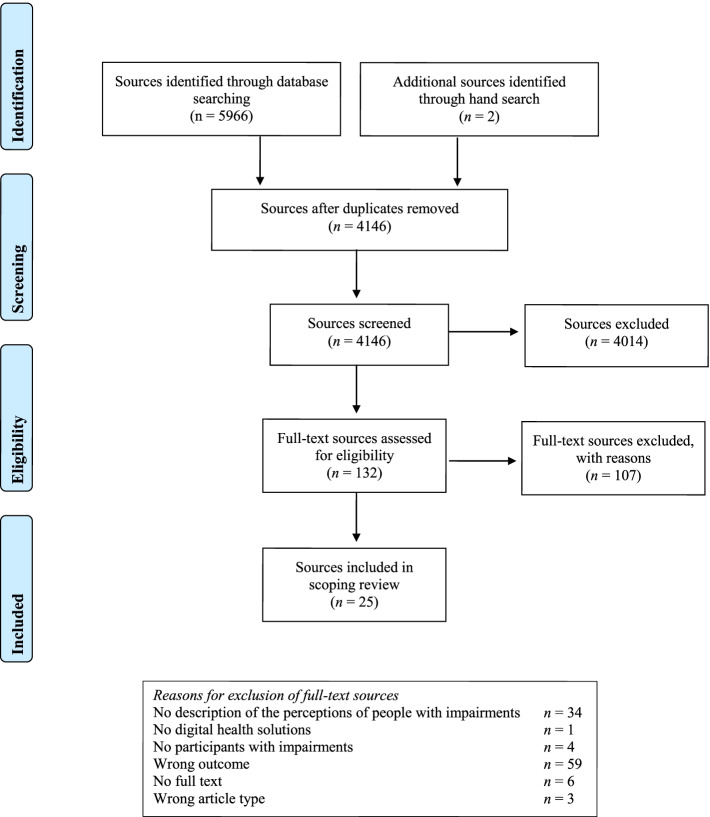
Objective: Globally, the number of digital health solutions is increasing, but they are not always designed with access and utilisation for people with impairments in mind. Development efforts have often not included the voice and requirements of people with impairments, who make up 15% of the world’s population, despite the fact that this can help ensure broad access and utilisation. Little attention to and limited inclusion of people with impairments in the development of digital health solutions results in continued and reinforced inequalities in health services provision for people with impairments. This review investigates the needs and barriers of people with impairments related to use of digital health solutions and strategies to foster user participation, access and utilisation of digital health solutions. Methods: This scoping review, based on the Joanna Briggs Institute Manual, had five phases: 1) identification of aim and research questions, 2) literature search in five databases (April/May 2020), 3) literature screening based on predetermined inclusion and exclusion criteria, 4) data extraction, and (5) reporting results. Results: The literature search resulted in 5968 sources, of which 25 met our inclusion criteria. People with impairments appreciate digital health solutions that are designed to meet their specific impairment-related challenges. The reported needs and barriers related to technological design varied depending on the individuals’ challenges. The literature reported different types of participatory co-design strategies to foster access and utilisation of digital health solutions. Conclusion: This scoping review support needs for increased awareness among developers to design solutions that meet people’s needs, contexts and states of health. By applying universal design as a strategy and including people with different types of impairments, starting in the idea creation phase of digital health solutions and throughout the development, developers can design solutions with better accessibility. Digital health solutions that are accessible and usable have a tremendous opportunity to foster health equity and achieve health promotion, prevention and self-care. This in turn can contribute to closing the gap between different population groups, reduce disparities and get the most from available healthcare services.
Overview
The claims and statistics of this paper haven’t been checked yet.
Run the check — free, no account needed. It reads the open-access text and checks the sources it cites.
Integrity signals
Registry
Cites
Statistics
Figures
Verification
Claims the paper makes
The claims and statistics of this paper haven’t been checked yet.
Run the check — free, no account needed. It reads the open-access text and checks the sources it cites.
Claims other papers make about this one
Each is checked against this paper’s own text: does it say what the citing paper says it does?
In the citing paper
“During the COVID-19 pandemic, telepsychiatry has transformed the mental health care landscape and may continue to help improve the clinical management of depression.17”
From Digital health technologies and major depressive disorder (2023) · cites this paper as [17]
Self-check
Percentages, sums and reported differences re-computed from the paper’s own numbers.
The self-check needs the paper’s full text.
Citations
Cites
Rayyan-a web and mobile app for systematic reviews.
Ouzzani, M., Hammady, H., Fedorowicz, Z., & Elmagarmid, A. (2016) · Systematic Reviews · doi:10.1186/s13643-016-0384-4 · Cited by 26,092
Guidance for conducting systematic scoping reviews
Peters, M. D. J., Godfrey, C. M., Khalil, H., McInerney, P., Parker, D., & Soares, C. B. (2015) · International Journal of Evidence-Based Healthcare · doi:10.1097/xeb.0000000000000050 · Cited by 7,472
JBI Manual for Evidence Synthesis
(2020) · JBI eBooks · doi:10.46658/jbimes-20-01 · Cited by 4,165
Brett, J., Staniszewska, S., Mockford, C., Herron‐Marx, S., Hughes, J., Tysall, C., & Suleman, R. (2014) · Health Expectations · doi:10.1111/j.1369-7625.2012.00795.x · Cited by 1,598
Convention on the Rights of Persons with Disabilities
Nations, U. (2009) · Jahrbuch für Wissenschaft und Ethik · doi:10.1515/9783110208856.203 · Cited by 857
Proceedings of the 2019 CHI Conference on Human Factors in Computing Systems
(2019) · doi:10.1145/3290605 · Cited by 841
Convention on the Rights of Persons with Disabilities (CRPD)
Lord, J. E., & Stein, M. A. (2022) · Edward Elgar Publishing eBooks · doi:10.4337/9781789903621.convention.rights.persons.disabilities · Cited by 777
Good intentions are not enough: how informatics interventions can worsen inequality
Veinot, T. C., Mitchell, H., & Ancker, J. S. (2018) · Journal of the American Medical Informatics Association · doi:10.1093/jamia/ocy052 · Cited by 704
World Trade Organization (2011) · World Trade Report · doi:10.30875/b51b2f2c-en · Cited by 319
Rios, D., Magasi, S. R., Novak, C., & Harniss, M. K. (2016) · American Journal of Public Health · doi:10.2105/ajph.2016.303448 · Cited by 184
Research works printed but not linked: 6
- World Health Organization. From innovation to implementation: eHealth in the who European region: World Health Organization: Regional Office for Europe; 2016.
- World Health Organization. International classification of functioning, disability and health: ICF: world health Organization; 2001.
- De Oliveira GAA, De Bettio RW, Freire AP. Accessibility of the smart home for users with visual disabilities: An evaluation of open source mobile applications for home automation, vol. 2016: Dept. of Computer Science, Federal University of Lavras, Lavras MG, Brazil: Association for Computing Machinery; 2016.
- Malu M, Findlater L. Toward accessible health and fitness tracking for people with mobility impairments. In: 10th EAI international conference on pervasive computing Technologies for Healthcare; 2016. Cancun: ICST Institute for Computer Sciences, Social-Informatics and Telecommunications Engineering; 2016.
- Lazar J, Woglom C, Chung J, Schwartz A, Hsieh YG, Moore R, et al. Co-design process of a smart phone app to help people with Down syndrome manage their nutritional habits. J Usability Stud. 2018;13(2):73–93.
- Fuglerud KS. Inclusive design of ICT: the challenge of diversity: University of Oslo, Faculty of Humanitites; 2014.
Cited by
Sorted by citations
A Survey of the Real-Time Metaverse: Challenges and Opportunities
Hatami, M., Qu, Q., Chen, Y., Kholidy, H. A., Blasch, E., & Ardiles-Cruz, E. (2024) · Future Internet · doi:10.3390/fi16100379 · Cited by 115
Pettersson, L., Johansson, S., Demmelmaier, I., & Gustavsson, C. (2023) · BMC Public Health · doi:10.1186/s12889-023-15094-z · Cited by 89
An umbrella review on how digital health intervention co-design is conducted and described
Kilfoy, A., Hsu, T. C., Stockton-Powdrell, C., Whelan, P., Chu, C. H., & Jibb, L. (2024) · npj Digital Medicine · doi:10.1038/s41746-024-01385-1 · Cited by 123
Familoni, B. T., & Babatunde, S. O. (2024) · Engineering Science & Technology Journal · doi:10.51594/estj.v5i3.975 · Cited by 78
Bakker, J. P., Barge, R., Centra, J., Cobb, B., Cota, C., Guo, C. C., Hartog, B., Horowicz-Mehler, N., Izmailova, E. S., Manyakov, N. V., et al. (2025) · npj Digital Medicine · doi:10.1038/s41746-024-01322-2 · Cited by 40
Metadata
- Authors
- Henni, S. H., Maurud, S., Fuglerud, K. S., & Moen, A.
- Affiliations
- University of Oslo (NO)
- Norwegian Computing Center (NO)
- Corresponding author
- Henni, Silje Havrevold
- Venue
- BMC Public Health
- Published
- 2022-01-06
- Volume
- 22
- Issue
- 1
- Pages
- 35-35
- ISSN
- 1471-2458 (ISSN-L)
- PMC
- PMC8734131
- OpenAlex
- W4205132659
- Cited by
- 141
- References
- 56
- Citations by year
- 2026: 44 · 2025: 41 · 2024: 28 · 2023: 22 · 2022: 6
- FWCI
- 6.64
- Type
- journal article
- Language
- en
- Open access
- gold
- doi.org
- Locations
- BMC Public Health (publishedVersion, cc-by)
- PubMed Central (publishedVersion, cc-by)
- PubMed (publishedVersion)
- DOAJ (DOAJ: Directory of Open Access Journals) (submittedVersion, cc-by-sa)
- NORA - Norwegian Open Research Archives (submittedVersion, cc-by)
- Funders
- Universitetet i Oslo
- Norges Forskningsråd (rcn-foriss-286854)
- Topics
- Social Sciences › Human Factors and Ergonomics › Digital Accessibility for Disabilities
- Health Sciences › Medicine › Geriatrics and Gerontology › Technology Use by Older Adults
- Physical Sciences › Computer Science › Human-Computer Interaction › Usability and User Interface Design
- Keywords
- digital health solutions, people with impairments, accessibility, usability, universal design, participatory design, co-design, user involvement in design, health equity, health disparities, health promotion
- MeSH terms
- Universal Design, Humans
About these checks
Registry, retraction, Cites and statistics results are computed, not judged, with one exception: a printed reference that no index lists is read once by a model before it counts as a citation error. Claims are extracted by a model and kept only when their quote appears verbatim in the text; each cited source is then checked, with a model’s help, for whether it says what the claim relies on. Those verdicts can be wrong — read the claim’s quote and the cited source before relying on one.
Statistics and arithmetic are recomputed, not judged.
Confidence bands are shown only for fields calibrated on our annotated test set. None is calibrated yet, so no band is shown.
What counts as a claim ›How we measure confidence ›How we check this ›
Are you an author, or do you see a problem with this page? Request a review
