

Examining the impact of economic abuse on survivors of intimate partner violence: a scoping review
Open accessThe DOI matches its Crossref record; 82 of the 86 references it cites were found in a registry or an index; 25 of the 89 sources its claims cite were checked for support.
Abstract
Background: Economic abuse is a unique form of intimate partner violence (IPV) and includes behaviors that control a survivor’s ability to acquire, use, and maintain resources. These tactics can result in someone becoming economically dependent on their partner and may limit their ability to leave the relationship and establish independence. The aim of this study was to conduct a scoping review focused on the impact of economic abuse on survivors of IPV. Methods: A total of 14 databases were reviewed, which resulted in 35 peer-reviewed manuscripts for inclusion in the study. Manuscripts were included if they were: written in English, published since the year 2000, focused specifically on the impact of economic abuse perpetrated by an intimate partner, economic abuse was measured as an independent variable, and if economic abuse was looked at separately from other forms of IPV. Both convenience and population-based samples were included in the review. Information was extracted using a data charting form. The data were analyzed using a combination of grouping techniques and constant comparison methods to identify key findings. Results: Studies found significant associations between economic abuse and a range of outcomes, such as mental and physical health, financial impacts, parent-child interactions, and quality of life. The most frequently examined were mental health, followed by financial issues. Conclusions: Limitations of these studies included a lack of longitudinal research and a focus on heterosexual relationships with male-perpetrated violence toward female survivors. Study findings highlight the wide-ranging potential impacts of economic abuse on survivors and the need for additional research to better understand potential outcomes and implement and evaluate interventions to address them.
Overview
CoChat Summary
TL;DR
This scoping review synthesized 35 quantitative peer-reviewed manuscripts on the impact of economic abuse on intimate partner violence (IPV) survivors. It found significant associations with mental and physical health, financial hardship, parenting/child outcomes, and quality of life, while identifying gaps in longitudinal and diverse-sample research.
Key findings
- Across 35 included studies, economic abuse was significantly associated with a range of outcomes: mental and physical health, financial impacts, parent-child interactions, and quality of life; mental health was the most frequently examined outcome, followed by financial issues.
- Financial outcomes were examined in 10 studies; five found economic abuse significantly associated with increased material or economic hardship, and one longitudinal study found within-woman change in economic abuse negatively associated with change in financial resources over time.
- Mental health was commonly examined: depression was the most frequent outcome, with seven cross-sectional studies finding economic abuse significantly positively associated with depression, three with anxiety, and two each with PTSD and suicidal ideation.
- Six studies examined physical health, with age-specific associations such as greater odds of pelvic problems and difficulty keeping weight among women aged 16–49, and psychosomatic symptoms, gastrointestinal symptoms, allergies, and difficulty keeping weight among women aged 50–65; longitudinal Fragile Families analyses linked economic abuse at Y1/Y3 to lower parental involvement, greater child neglect at Y5, and greater child delinquency at Y9 partially mediated by parenting behaviors.
Methods
- Scoping review guided by Arksey and O’Malley’s framework and PRISMA-ScR; searched 14 databases across social work, sociology, psychology, public health, women’s and gender studies, criminal justice, and economics; initial search April 2021, updated March 2022.
- Inclusion criteria: English-language peer-reviewed manuscripts published 2000 or later; focus on the impact of economic abuse perpetrated by an intimate partner; economic abuse measured as an independent variable and examined separately from other IPV; both convenience and population-based samples included.
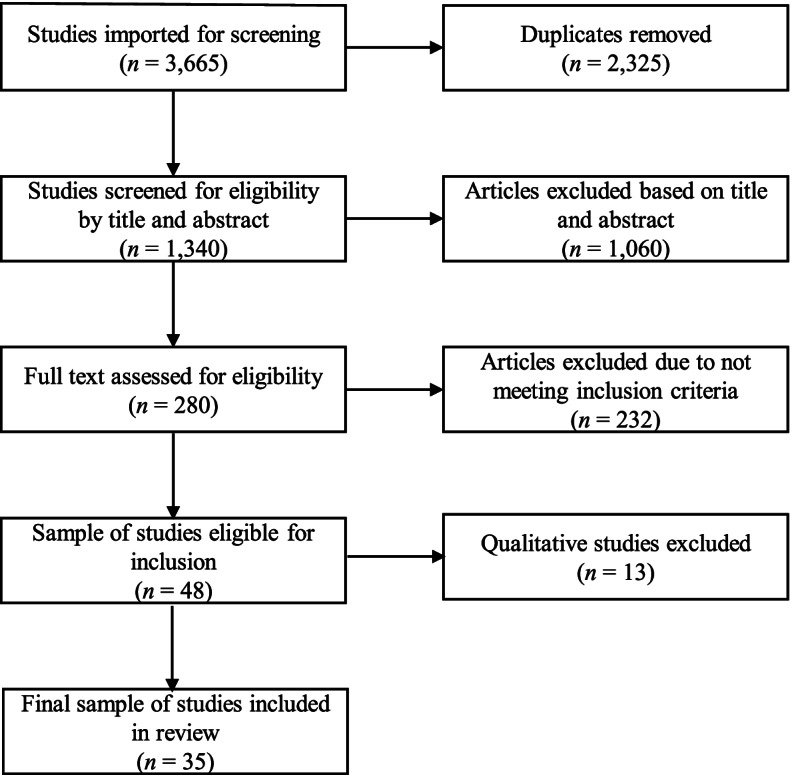
- Screening yielded 3,665 records imported, 2,325 duplicates removed, 1,340 title/abstract screened, 280 full texts assessed, 48 eligible, 13 qualitative studies removed, and 35 quantitative studies included; data were charted and analyzed using grouping and constant comparison, with no critical appraisal and all studies weighted equally.
Limitations
- Stated in the paper: the review included only quantitative studies; most included studies were cross-sectional, so directionality cannot be determined; some analytic strategies precluded confounding factors; measurement variation hinders meta-analysis; only English-language manuscripts were included; samples primarily involved male-perpetrated violence toward female survivors; and about one-third recruited from domestic violence organizations, so findings are not representative of all IPV survivors.
- Stated in the paper: all included studies used self-reported measures; half (17) did not use a validated economic abuse measure; financial outcomes were measured inconsistently, and no studies examined all facets of financial wellbeing collectively.
- Evident from the text and noted by the authors: only three studies specifically measured effects longitudinally using multilevel modeling; research on LGBTQIA+ survivors, male survivors, and cultural variation is limited; and many studies did not control for other forms of IPV when examining economic hardship.
Model-written summary. Check it against the paper before relying on it.
Integrity signals
Registry
Cites
Statistics
Figures
Verification
Claims the paper makes
21 Valid · 2 Not valid · 50 Not checked · 52 Own results and interpretations
The sources with a verdict support this claim; the rest weren’t checked yet, have no full text we could read, or their verdicts aren’t rated yet.
In the paper
“This makes it increasingly difficult to end economic abuse, even post separation when the abusive partner no longer has physical access to the survivor [5, 6].”
§ Examining the impact of economic abuse on survivors of intimate partner violence: a scoping review > Introduction
What the sources say
- Not checked — no full text of the sourcecites [5] Stylianou AM Postmus JL McMahon S Measuring abusive behaviors: is economic abuse a unique form of abuse? J Interpers Violence 2013 28 16 3186 3204 10.1177/0886260513496904 23946140 source
- Supportedcites [6] Stylianou AM Economic abuse within intimate partner violence: a review of the literature Violence Vict 2018 33 3 22 10.1891/0886-6708.33.1.3 29195516 source
In “Economic Abuse as a Unique Form of Abuse” (page not provided), the review says perpetrators can engage in economic abuse without contact or physical proximity. It concludes that victims may have difficulty ending economic abuse and that it may continue after other forms of abuse have ended, supporting the post-separation paraphrase. (LLM, conf=0.93)
plainstates a cause- Asserted: passes — The authors put it forward as true.
- Checkable: passes — It can be checked against evidence.
- Load-bearing: unclear — It is unclear whether the paper’s conclusions depend on it.
- Based: passes — The paper gives a reason why it holds.
The sources with a verdict support this claim; the rest weren’t checked yet, have no full text we could read, or their verdicts aren’t rated yet.
In the paper
“Five studies found that economic abuse was significantly associated with increased material [38, 47] or economic hardship [2, 48, 49].”
§ Examining the impact of economic abuse on survivors of intimate partner violence: a scoping review > Results > F indings on the impact of economic abuse
What the sources say
- Supportedcites [38] Johnson L Exploring factors associated with pregnant women’s experiences of material hardship during COVID-19: a cross-sectional Qualtrics survey in the United States BMC Pregnancy Childbirth 2021 21 1 14 10.1186/s12884-020-03485-8 34749686 PMC8573078 source
The Results report that economic abuse remained significantly associated with material hardship in the adjusted model (B = 1.01, p = .000). The Discussion explicitly describes the association as positive. Our copy provides section labels but no page numbers. (LLM, conf=0.94)
- Not checked — no full text of the sourcecites [47] Voth Schrag RJ Economic abuse and later material hardship: is depression a mediator? Affilia. 2015 30 3 341 351 10.1177/0886109914541118 source
- Not checked — no full text of the sourcecites [2] Adams AE Sullivan CM Bybee D Greeson MR Development of the scale of economic abuse Violence Against Women. 2008 14 5 563 588 10.1177/1077801208315529 18408173 source
- Not checked — no full text of the sourcecites [48] Voth Schrag RJ Robinson SR Ravi K Understanding pathways within intimate partner violence: economic abuse, economic hardship, and mental health J Aggress Maltreat Trauma 2019 28 2 222 242 10.1080/10926771.2018.1546247 source
- Supportedcites [49] Voth Schrag RJ Ravi KE Robinson SR The role of social support in the link between economic abuse and economic hardship J Fam Violence 2020 35 85 93 10.1007/s10896-018-0019-8 32435083 PMC7223436 source
The Results (Bivariate Analyses) report a significant positive correlation between economic abuse and economic hardship (r = .28, p < .001). The Discussion also describes a significant association with increased economic hardship among women attending community college; the Methods define the hardship measure in terms of material hardships. (LLM, conf=0.94)
plainstates an association- Asserted: passes — The authors put it forward as true.
- Checkable: passes — It can be checked against evidence.
- Load-bearing: passes — The paper’s conclusions depend on it.
- Based: passes — The paper gives a reason why it holds.
- Supported
The sources with a verdict support this claim; the rest weren’t checked yet, have no full text we could read, or their verdicts aren’t rated yet.
In the paper
“Seven of the cross-sectional studies found that economic abuse [27, 31, 36, 41, 44, 48, 50] and its associated tactics (i.e., employment sabotage) [24] was significantly and positively associated with depression.”
§ Examining the impact of economic abuse on survivors of intimate partner violence: a scoping review > Results > F indings on the impact of economic abuse
What the sources say
- Supportedcites [27] Gibbs AK Dunkle K Jewkes R Emotional and economic intimate partner violence as key drivers of depression and suicidal ideation: a cross-sectional study among young women in informal settlements in South Africa PLoS One 2018 13 4 e0194885 10.1371/journal.pone.0194885 29659595 PMC5901771 source
The Results and discussion report that all measures of economic intimate partner violence were significantly associated with increased CES-D depression scores. This source supports the economic-abuse association; the employment-sabotage tactic is attached to a different citation in the citing sentence. (LLM, conf=0.92)
- Not checked — no full text of the sourcecites [31] Haj-Yahia MM Implications of wife abuse and battering for self-esteem, depression, and anxiety as revealed by the second Palestinian national survey on violence against women J Fam Issues 2000 21 4 435 463 10.1177/019251300021004002 source
- Could not verifycites [36] Kanougiya S Daruwalla N Gram L Gupta AD Sivakami M Osrin D Economic abuse and its associations with symptoms of common mental disorders among women in a cross-sectional survey in informal settlements in Mumbai India BMC Public Health 2021 21 1 14 10.1186/s12889-020-10013-y PMC8088652 33933060 sourceExperimental — accuracy not yet measured
The Methods > Data analysis and Results > Adoption of the scheme structures and processes passages concern implementation of a community health fund, not economic abuse or depression. Searches for economic abuse, employment sabotage, and depression found no passage in our copy reporting the claimed association or seven cross-sectional studies. (LLM, conf=0.78)
plainstates an association- Asserted: passes — The authors put it forward as true.
- Checkable: passes — It can be checked against evidence.
- Load-bearing: passes — The paper’s conclusions depend on it.
- Based: passes — The paper gives a reason why it holds.
- Supported
Every source the paper cites for this claim was checked and supports it.
In the paper
“Women between the ages of 50–65 had greater odds of experiencing psychosomatic symptoms, gastrointestinal symptoms, allergies, and difficulty keeping weight [43].”
§ Examining the impact of economic abuse on survivors of intimate partner violence: a scoping review > Results > F indings on the impact of economic abuse
What the sources say
- Supportedcites [43] Stöckl H Penhale B Intimate partner violence and its association with physical and mental health symptoms among older women in Germany J Interpers Violence. 2015 30 17 3089 3111 10.1177/0886260514554427 25392386 source
The Associations With Physical and Mental Health Symptoms section states that economic abuse among women aged 50–65 was associated with increased gastrointestinal and psychosomatic symptoms, allergies, and weight problems. This matches the attributed claim; the supplied passage does not provide a page number. (LLM, conf=0.93)
plainstates an association- Asserted: passes — The authors put it forward as true.
- Checkable: passes — It can be checked against evidence.
- Load-bearing: unclear — It is unclear whether the paper’s conclusions depend on it.
- Based: passes — The paper gives a reason why it holds.
- Supported
Every source the paper cites for this claim was checked and supports it.
In the paper
“Women between the ages of 16–49 experiencing economic abuse had greater odds of experiencing pelvic problems and difficulty keeping weight.”
§ Examining the impact of economic abuse on survivors of intimate partner violence: a scoping review > Results > F indings on the impact of economic abuse
What the sources say
- Supportedcites [43] Stöckl H Penhale B Intimate partner violence and its association with physical and mental health symptoms among older women in Germany J Interpers Violence. 2015 30 17 3089 3111 10.1177/0886260514554427 25392386 source
The Associations With Physical and Mental Health Symptoms section states that women under 50 experiencing economic abuse were more likely to report pelvic and weight problems. Table 4 reports elevated odds for both outcomes among women aged 16–49. (LLM, conf=0.94)
plainstates an association- Asserted: passes — The authors put it forward as true.
- Checkable: passes — It can be checked against evidence.
- Load-bearing: unclear — It is unclear whether the paper’s conclusions depend on it.
- Based: passes — The paper gives a reason why it holds.
- Supported
51 more claims · 6 with their cited sources checked
Create a free account to see all 125 claims and to verify the 2 references still open.
- It may state two separate claims as one. 41
- Probably not a substantial claim. 34
- The quote only partly states this claim. 1
Self-check
Percentages, sums and reported differences re-computed from the paper’s own numbers.
Each contradiction between two passages listed here was confirmed by an independent check.
Rated minor: it would not touch a result — a value no result rests on, a p-value that stays on the same side of the significance level, or a conflict that is clerical, resolved elsewhere in the paper, or outside its own findings.
In the paper
§ Examining the impact of economic abuse on survivors of intimate partner violence: a scoping review > Results > F indings on the impact of economic abuse
“While a cross-sectional study conducted by Gul et al. did not find economic abuse to be significantly associated with survivors’ contentment with life score [20]”
§ Examining the impact of economic abuse on survivors of intimate partner violence: a scoping review > Results > Study characteristics
“Three studies looked at data with five time points [3, 20, 25]”
Rated minor: it would not touch a result — a value no result rests on, a p-value that stays on the same side of the significance level, or a conflict that is clerical, resolved elsewhere in the paper, or outside its own findings.
In the paper
“In 30% of the studies (n = 8) no one group had 50% or more of any one ethnicity in their sample [25, 26, 28, 33, 34, 38].”
§ Examining the impact of economic abuse on survivors of intimate partner violence: a scoping review > Results > Sample
Reported 30 · recomputed 22.857143
Citations
Cites
The CES-D Scale: A Self-Report Depression Scale for Research in the General Population
Radloff, L. S. (1977) · Applied Psychological Measurement · doi:10.1177/014662167700100306 · Cited by 53,267
The PHQ-9: Validity of a brief depression severity measure
Kroenke, K., Spitzer, R. L., & Williams, J. B. W. (2001) · Journal of General Internal Medicine · doi:10.1046/j.1525-1497.2001.016009606.x · Cited by 44,910
PRISMA Extension for Scoping Reviews (PRISMA-ScR): Checklist and Explanation
Tricco, A. C., Lillie, E., Zarin, W., O'Brien, K. K., Colquhoun, H., Levac, D., Moher, D., Peters, M. D. J., Horsley, T., Weeks, L., et al. (2018) · Annals of Internal Medicine · doi:10.7326/m18-0850 · Cited by 43,565
Scoping studies: towards a methodological framework
Arksey, H., & O'Malley, L. (2005) · International Journal of Social Research Methodology · doi:10.1080/1364557032000119616 · Cited by 36,742 · cited 5×
“Data extraction and analysis Data extraction and analysis was guided by Rodgers and colleagues’ methodological guidance on the synthesis of study findings [19], in addition to Arksey and O’Malley’s scoping review methodology [15].”
BackgroundMethodInfluentialA Brief Measure for Assessing Generalized Anxiety Disorder: The GAD-7
Spitzer, R. L., Kroenke, K., Williams, J. B. W., & Löwe, B. (2006) · Archives of Internal Medicine · doi:10.1001/archinte.166.10.1092 · Cited by 31,765
The structure of psychological well-being revisited.
Ryff, C. D., & Keyes, C. L. M. (1995) · Journal of Personality and Social Psychology · doi:10.1037//0022-3514.69.4.719 · Cited by 10,285
Straus, M. A., Hamby, S. L., Finkelhor, D., Moore, D. W., & Runyan, D. (1998) · Child Abuse & Neglect · doi:10.1016/s0145-2134(97)00174-9 · Cited by 2,498
International Journal of Social Research Methodology
(2000) · Quine · doi:10.1163/9789004457751_016 · Cited by 1,080
Intimate Partner Violence and Women’s Physical, Mental, and Social Functioning
Bonomi, A. E., Thompson, R. S., Anderson, M., Reid, R. J., Carrell, D., Dimer, J. A., & Rivara, F. P. (2006) · American Journal of Preventive Medicine · doi:10.1016/j.amepre.2006.01.015 · Cited by 686
Rodgers, M., Sowden, A., Petticrew, M., Arai, L., Roberts, H., Britten, N., & Popay, J. (2009) · Evaluation · doi:10.1177/1356389008097871 · Cited by 561
Research works printed but not linked: 7
- Engindeniz A Kuey L Kultur S Validity and reliability of Turkish version of Edinburgh postnatal depression scale Book of annual meeting of psychiatric Association of Turkey 1996 Ankara Turkish Psychiatric Association Press
- Costello CC Comrey depression and anxiety scales. Measures for clinical practice: a sourcebook 1967 2 155 160
- Maumary-Gremaud A Things that you have done. Fast Track project technical report 2000
- Beusenberg M Orley JH A User's guide to the self reporting questionnaire (SRQ) 1994 Geneva World Health Organization
- Walters EE Kessler RC Nelson C Mroczek DK Scoring the World Health Organization’s composite international diagnostic interview short form (CIDI-SF) 2002 Geneva World Health Organization
- Weathers FW Litz BT Herman DS Huska JA Keane TM The PTSD checklist (PCL): reliability, validity, and diagnostic utility 1993 San Antonio Annual convention of the International Society for Traumatic Stress Studies
- Weathers FW Litz BT Keane TM Palmieri PA Marx BP Schnurr PP The PTSD checklist for DSM-5 (PCL-5). National Center for PTSD 2013
Cited by
Paying the Price: When Intimate Partners Use Technology for Financial Harm
Bellini, R. F. (2023) · CHI Conference on Human Factors in Computing Systems · doi:10.1145/3544548.3581101 · Cited by 86
“However, the aftermath of financial abuse can be life-long and continue after a relationship has ended, such as exposing survivors to homelessness, job loss, poverty, and poor health outcomes [41, 67].”
BackgroundMellar, B. M., Fanslow, J., Gulliver, P. J., & McIntosh, T. K. D. (2024) · Journal of Interpersonal Violence · doi:10.1177/08862605241235140 · Cited by 65
In their own words: Perspectives of IPV survivors on obtaining support within the healthcare system
Hargrave, A. S., Dawson-Rose, C. S., Schillinger, D., Ng, F., Valdez, J. J., Rodriguez, A., Cuca, Y. P., Bakken, E. H., & Kimberg, L. S. (2024) · PLoS ONE · doi:10.1371/journal.pone.0310043 · Cited by 30
Disability and intimate partner violence: A cross-sectional study from Mwanza, Tanzania
Meyer, S. R., Mosha, N. R., Shakespeare, T., Kuper, H., Mtolela, G. J., Harvey, S. E., Kapiga, S., Mshana, G. H., & Stöckl, H. (2022) · Disability and health journal · doi:10.1016/j.dhjo.2022.101404 · Cited by 20
News Media Representation of Intimate Partner Violence: A Systematic Review
Taccini, F., & Mannarini, S. (2024) · Sexuality Research and Social Policy · doi:10.1007/s13178-023-00922-z · Cited by 32
“It is important to acknowledge that controlling behaviours and economical abuse fall within this definition (Johnson et al., 2022; WHO & PAHO, 2012).”
Willie, T. C., Linton, S. L., Whittaker, S., Phillips, K., Knight, D., Gray, M. C., Gardner, G., & Overstreet, N. M. (2024) · BMC Public Health · doi:10.1186/s12889-024-17965-5 · Cited by 20
“” ( 26 years old, North Carolina, Apartment Renter) A survivors’ credit history is likely reviewed when applying for certain utilities, housing, and employment [26].”
BackgroundToccalino, D., Asare, G., Fleming, J., Yin, J., Kieftenburg, A., Moore, A., Haag, H. L., Chan, V., Babineau, J., MacGregor, N., et al. (2023) · Trauma Violence & Abuse · doi:10.1177/15248380231196807 · Cited by 17
Exploring the efficacy of ChatGPT in understanding and identifying intimate partner violence
Zhang, Y., Fang, J., Luo, X., Lindsay, D., Madre, N., Paredes, J., Penna, A., Melley, E., & Garcia, T. (2025) · Family Relations · doi:10.1111/fare.13176 · Cited by 18
Men's Economic Abuse Toward Women in Sweden: Findings From a National Survey
Bruno, L., Strid, S., & Ekbrand, H. (2024) · Violence Against Women · doi:10.1177/10778012241257248 · Cited by 20
“Furthermore, economic abuse may have severe and longstanding consequences, such as depression, child maltreatment, economic hardship, and poor physical health (Johnson et al., 2022; Postmus et al., 2012).”
Byrt, A., Cook, K., & Burgin, R. (2023) · Journal of Family Violence · doi:10.1007/s10896-023-00639-y · Cited by 26
“We examine both within-relationship and post-separation EA as the impacts of economic abuse may be felt during and long after leaving an abusive relationship (Cardenas et al., 2021; Hing et al., 2021, 2022; Johnson et al., 2022a, b; Kaittila et al., 2022).”
InfluentialWillie, T. C., Alexander, K. A., Sharpless, L., Zemlak, J. L., Smith, M. V., & Kershaw, T. (2023) · Journal of Interpersonal Violence · doi:10.1177/08862605231178357 · Cited by 15
“Experiencing economic abuse by an intimate partner may lead to reduced finances and job instability, which could increase the risk for psychological distress such as PTSD symptoms (Davila et al., 2021; Johnson et al., 2022; Sanders, 2015; Stylianou, 2018; Voth Schrag et al., 2019).”
BackgroundLi, X., Khan, M. A. S., Xiao, J. J., & Kong, D. (2024) · Journal of Social and Personal Relationships · doi:10.1177/02654075241227125 · Cited by 8
“…forms: economic control (i.e., preventing the victim from having knowledge or access to shared assets), economic exploitation (i.e., taking fi nancial advantage of the victims), and employment sabotage (i.e., preventing the victim from obtaining or maintaining employment) (Johnson et al., 2022).”
BackgroundWilson, B., Zawitkowski, S., Weiss, S., Docherty, L., & Barata, P. (2023) · Violence against Women · doi:10.1177/10778012231185540 · Cited by 7
Ndambo, M. K., Pickersgill, M. D., Bunn, C., Stewart, R. C., Umar, E., Nyasulu, M., McIntosh, A. M., & Manda‐Taylor, L. (2023) · SSM - Mental Health · doi:10.1016/j.ssmmh.2023.100213 · Cited by 9
“The relationship between economic issues and individual experiences in Malawi underscores how legacies of colonialism and contemporary geopolitical processes can contribute to psychological harm (Johnson et al., 2022; Kanougiya et al., 2021; Serpa Pimentel et al., 2021).”
Examining the Psychometric Properties of the Revised Scale of Economic Abuse among Iranian Women
Salimi, H., Hosseinkhani, A., Beeble, M. L., & Samavi, S. A. (2023) · Journal of Interpersonal Violence · doi:10.1177/08862605231190667 · Cited by 8
“The tactics of economic abuse used by assailants are incredibly damaging to their partners’ overall psychological health (Johnson et al., 2022; Stylianou, 2018b; Voth Schrag et al., 2019; Yau et al., 2020) and well-being (Adams & Beeble, 2019).”
MethodLewis, P. C., Cheong, Y. F., Kaslow, N. J., & Yount, K. M. (2024) · BMC Public Health · doi:10.1186/s12889-023-17546-y · Cited by 9
Gender-based violence and its relationship to the mental health of female university students
Laz-Figueroa, K. L., Hernández-Sánchez, B. R., García, J. C. S., Guevara-Viejó, F., & Molina-Molina, V. (2025) · Frontiers in Sociology · doi:10.3389/fsoc.2025.1597261 · Cited by 13
Cook, K., Byrt, A., Edwards, T., & Burgin, R. (2024) · Violence Against Women · doi:10.1177/10778012241280057 · Cited by 11
“…abuse alongside other forms of economic harm, such as employment sabotage and the restriction or control of resources such as housing and transportation, as perpetrators work to control a victim ’ s economic autonomy (Johnson et al., 2022; Postmus et al., 2012, 2016, 2020; Sharp-Jeffs, 2021).”
Gender-based economic violence and the exploitation of women: A deep dive
Saraç, E., & ODABAŞ, D. (2025) · World Journal of Psychiatry · doi:10.5498/wjp.v15.i3.103725 · Cited by 11
Hashemi, L., Fadeeva, A., Khan, N., & McManus, S. (2025) · Women s Health · doi:10.1177/17455057251326419 · Cited by 9
“11,12 The economic and social impact of IPV is substantial, with an estimated cost of £66 billion to the economy of England and Wales in 2017.”
Willie, T. C., Linton, S., Whittaker, S., Phillips, K., Knight, D., Gray, M. C., Gardner, G., & Overstreet, N. M. (2023) · Research Square · doi:10.21203/rs.3.rs-2662616/v1 · Cited by 5
Economic Abuse in Low and Middle-Income Countries: A Scoping Review
Chatterji, S., O’Connor, J., Zane, A., & Steinert, J. (2025) · Trauma Violence & Abuse · doi:10.1177/15248380251325194 · Cited by 5
“In addition, as Johnson et al. (2022) note, studies should use standardized measures for health outcomes to allow researchers to compare findings across contexts.”
InfluentialMapping Gendered Economic Abuse Across the Relationship Lifecourse: A Qualitative Meta-Ethnography
Byrt, A., & Cook, K. (2025) · Journal of Family Violence · doi:10.1007/s10896-025-00872-7 · Cited by 8
Perinatal Economic Abuse: Experiences, Impacts, and Needed Resources
Scott, S. E., Laubacher, C., Chang, J. C., Miller, E. P., Bocinski, S. G., & Ragavan, M. I. (2024) · Journal of Women s Health · doi:10.1089/jwh.2024.0119 · Cited by 6
Johnson, L., & Winter, S. C. (2023) · American Journal of Community Psychology · doi:10.1002/ajcp.12666 · Cited by 8
Self-citationPatrilocality in South Asia as a determinant of maternal mental health: A scoping review
Brown, A., Chandra, P. S., Chakraborty, S., & Satyanarayana, V. A. (2026) · Journal of Public Health Research · doi:10.1177/22799036261459194 · Cited by 5
“, 32– 47– 50, 53 In Social networks, communication channels and system responses shape how women can respond to these risks.”
Cortis, N., & Smyth, C. (2024) · Violence Against Women · doi:10.1177/10778012241263103 · Cited by 4
“In the United States, more than three-quarters of survivors seeking support for intimate partner violence have been found to have experienced economic abuse (Johnson et al., 2022).”
Salimi, H., Abadi, F., Beeble, M. L., & Mohammadi, K. (2024) · Feminist Criminology · doi:10.1177/15570851241274867 · Cited by 3
“Female victims suffer a range of physical, psychological, social and economic consequences, as a result of the violence they endure (e.g., Dekel et al., 2020; D ’ Inverno et al., 2019; Johnson et al., 2022; Wessells & Kostelny, 2022).”
Taverna, E. C., Iverson, K. M., Kumar, S. A., Vogt, D. S., & Mitchell, K. S. (2025) · Stress and Health · doi:10.1002/smi.3526 · Cited by 5
Grigaitė, U., Santos-Dias, M., Pedrosa, B., Aluh, D. O., Silva, M., Cardoso, G., & Caldas‐de‐Almeida, J. M. (2025) · Journal of Mental Health · doi:10.1080/09638237.2025.2478375 · Cited by 4
“…risk of adverse physical and mental health outcomes (Bacchus et al., 2018; Black et al., 2011; Clemente-Teixeira et al., 2022; Dokkedahl et al., 2022; Gibbs et al., 2018; Johnson et al., 2022; Lohmann et al., 2023; Reingle Gonzalez et al., 2018; Spencer et al., 2024; White et al., 2024; WHO, 2021).”
Grigaitė, U., Klidziūtė, G., Aluh, D. O., Pedrosa, B., Santos-Dias, M., Silva, M., Cardoso, G., & Caldas‐de‐Almeida, J. M. (2024) · Women & Health · doi:10.1080/03630242.2024.2382419 · Cited by 3
“…of poor physical and mental health outcomes (Bacchus et al. 2018; Black et al. 2011; Clemente-Teixeira et al. 2022; Dokkedahl et al. 2022; Gibbs et al. 2018; Johnson et al. 2022; Lohmann et al. 2023; Reingle Gonzalez et al. 2018; Spencer, Keilholtz, and Palmer 2022; WHO 2021; White et al. 2023).”
Telemental Health Assessment and Implications for Intimate Partner Violence in Rural Settings
O'Briant, D., & Clements, P. T. (2024) · Journal of Psychosocial Nursing and Mental Health Services · doi:10.3928/02793695-20240509-01 · Cited by 2
Economic Abuse and Depression: Is Financial Strain a Missing Mediator?
Lin, H.-F., & Postmus, J. L. (2025) · Journal of Family Violence · doi:10.1007/s10896-025-00911-3 · Cited by 5
Fedock, G. L., Doria, C. M., Shankar, S., & Malcome, M. (2025) · Violence Against Women · doi:10.1177/10778012251351933 · Cited by 2
“IPV-based economic abuse contributes to economic instability, debt, housing insecurity, employment disruption, and material hardship for survivors of IPV (Adams et al., 2015; Johnson et al., 2022; Postmus et al., 2012).”
InfluentialMapping Intimate Partner Financial Abuse Across Public and Private Systems
Byrt, A., Cook, K., Burgin, R., & Dimopoulos, G. (2025) · Australian Journal of Social Issues · doi:10.1002/ajs4.70044 · Cited by 3
Hamamra, B. T. (2025) · Journal of Family Studies · doi:10.1080/13229400.2025.2568017 · Cited by 3
“Machado et al. (2016) and Johnson et al. (2022) highlight that legal challenges such as disputes over child custody and property division further exacerbate the financial insecurity faced by survivors after separation.”
Health Impact of Suspected Interpersonal Violence Against Adults: Retrospective Cohort Study
Barbosa, R., Lopes, R., Taveira‐Gomes, T., Ponte, C., & Magalhães, T. (2025) · JMIR Public Health and Surveillance · doi:10.2196/65191 · Cited by 4
“Health consequences have their own repercussions that substantially diminish survivors’ quality of life, affecting other spheres of life, such as job loss and career abandonment, or increased health care costs [1,15].”
Banda, L. O. L., Mwaene, E., Banda, C. V., & Banda, J. T. (2025) · BMC Public Health · doi:10.1186/s12889-025-25190-x · Cited by 7
“Economic pressures were assessed with four items adapted from the Scale of Economic Abuse–12 (SEA-12) [47, 51], reflecting financial dependency (e.g., “I lack independent financial resources,” “My partner controls my access to money”), rated 1–5 and summed (range 4–20; α = 0.85).”
InfluentialKhan, M. A., Li, X., Zhao, Z., LeBaron‐Black, A. B., & Zhang, Z. (2025) · Family Relations · doi:10.1111/fare.70072 · Cited by 2
Abuse in individuals with multiple sclerosis: the SocialMS Italian study
Ponzano, M., Signori, A., Schiavetti, I., Landi, D., Bellavia, A., Lavorgna, L., Fantozzi, R., Buttari, F., Sapio, A. D., Malucchi, S., et al. (2026) · Multiple Sclerosis and Related Disorders · doi:10.1016/j.msard.2026.107016 · Cited by 2
Nydegger, L. A., Benton, E. N., Hemingway, B., Fung, S., Yuan, M., Phung, C., & Claborn, K. (2023) · International Journal of Environmental Research and Public Health · doi:10.3390/ijerph20247177 · Cited by 2
“Economic abuse is when a partner controls their partner’s ability to acquire, use, and/or maintain resources, often leading to financial dependence [43].”
BackgroundGrigaitė, U., Lopes, S. A., Žeimė, E., Slotkus, P. Y., Heitmayer, M., Aluh, D. O., Pedrosa, B., Silva, M., Santos-Dias, M., Cardoso, G., et al. (2024) · Journal of Public Health · doi:10.1093/pubmed/fdae015 · Cited by 4
“13,25 Nevertheless, this finding is unexpected and alarming because studies across the world show that women with experiences of IPV, especially psychological IPV and coercive control, including economic IPV, are more likely than those with no experience of IPV to have mental health conditions.”
BackgroundJohnson, L. (2024) · Violence and Victims · doi:10.1891/vv-2024-0070 · Cited by 2
Self-citationBarriers to Empowerment at the Intersection of Motherhood, TANF, and Intimate Partner Violence
Thomas, J. M., Leat, S. R., Maxwell, D., & Williams, J. R. (2024) · Journal of Family Violence · doi:10.1007/s10896-024-00738-4 · Cited by 4
“Abusers may control the victim's finances, restrict their access to money, or prevent them from working, making it difficult for victims to leave due to financial dependence (Johnson et al., 2022).”
What does intimate partner violence mean for women with breast cancer? Experiences of Iranian women
Sheikhnezhad, L., Hassankhani, H., Sawin, E. M., Sanaat, Z., & Sahebihagh, M. H. (2025) · BMC Cancer · doi:10.1186/s12885-024-12815-4 · Cited by 3
Showalter, K., & Chung, Y. (2025) · Violence Against Women · doi:10.1177/10778012251320576 · Cited by 3
“Moreover, limited research has been conducted on the relationship between economic abuse and mental health outcomes (Johnson et al., 2022).”
InfluentialAnalysis of IPV success treatment from an AI approach
Wynhoven, I. M. B., & Córdova, C. (2025) · PLoS ONE · doi:10.1371/journal.pone.0323945 · Cited by 2
Socioeconomic Status/Poverty and Domestic Violence
Rosenberg, O., Benson, B., & Blasdell, R. (2023) · Springer eBooks · doi:10.1007/978-3-030-85493-5_1574-1 · Cited by 2
Domestic violence: prevention past due
Chang, D. I. (2024) · Health Affairs Scholar · doi:10.1093/haschl/qxae034 · Cited by 2
Ravi, K. E., Leat, S. R., Rai, A., Obenauf, C., Masters-Henry, N., & Dunbar, D. (2024) · Families in Society The Journal of Contemporary Social Services · doi:10.1177/10443894241260072 · Cited by 1
“IPV can also affect abused individuals economically (see review by Johnson et al., 2022).”
Childcare Subsidy Policy Variations and Physical Intimate Partner Violence
Park, Y., Maguire‐Jack, K., Showalter, K., Marçal, K. E., Chang, O. D., Machinga-Asaolu, R. O., Thibodeau, E. L., Murphy, C., & Klika, J. B. (2025) · Journal of Family Violence · doi:10.1007/s10896-025-00887-0 · Cited by 2
Chen, H., Kita, S., Baba, K., Iwasaki‐Motegi, R., Kishi, E., Skowroński, D. P., Karystianis, G., & Kamibeppu, K. (2025) · Journal of Interpersonal Violence · doi:10.1177/08862605251353495 · Cited by 2
“…intimate partner including the control of a partner’s ability to acquire, use, and maintain resources by threatening their economic security and potential for self-sufficiency (Adams et al., 2008; Centers for Disease Control and Prevention, 2020; Garcia-Moreno et al., 2006; Johnson et al., 2022).”
Holcomb, L. A., Killen, E. C., Ryan, K. R., McRae‐Clark, A. L., Seipel, S. L., Aidoo, R., & Guille, C. (2025) · Biology of Sex Differences · doi:10.1186/s13293-025-00738-z · Cited by 2
The Role of Banks in Addressing and Preventing Coerced Debt in the Context of Intimate Partner Abuse
Wiper, C., & Glinski, J. (2025) · The British Journal of Criminology · doi:10.1093/bjc/azaf078 · Cited by 7
Schrubbe, L. A., Makokha, C., Kimbo, L., Helová, A., Kwena, Z., Darbes, L. A., Okombo, M., Owengah, E., Calvert, C., Stöckl, H., et al. (2025) · PLOS Global Public Health · doi:10.1371/journal.pgph.0004163 · Cited by 2
“There is less research on other types of perinatal IPV such as psychological and financial, but these also alter mental and physical health outcomes [18–23].”
Economic Abuse and Predatory Financial Service use Among Intimate Partner Violence Survivors
Johnson, L., Sherwood, B., & Winter, S. C. (2025) · Journal of Family Violence · doi:10.1007/s10896-025-00941-x · Cited by 4
Self-citationFedock, G. L., Murray, C. M., Sohn, Y., Baquedano, J., & Kull, M. A. (2025) · Journal of Family Violence · doi:10.1007/s10896-025-00992-0 · Cited by 1
Hery, L., Roy, V., & Courtois, R. (2025) · Journal of Family Violence · doi:10.1007/s10896-025-00993-z · Cited by 1
Hamamra, B. T., & Soleiman, N. (2026) · Journal of Ethnicity in Substance Abuse · doi:10.1080/15332640.2026.2620512 · Cited by 1
Abusbaitan, H. A., Pirsch, A., Graf, M., Mkandawire‐Valhmu, L., Eyadat, A. M., Luebke, J. M., Schadewald, D. M., Yu, D., Kako, P. M., Munala, L., et al. (2026) · Journal of Racial and Ethnic Health Disparities · doi:10.1007/s40615-026-02983-3 · Cited by 1
Economic violence against women committed by intimate partners: a population-based study
PAPILE, M. D. C., Nogueira, S. C. M. R., Pàrada, C. M. G. D. L., Parenti, A. B. H., de Almeida, R. J., & Carvalheira, A. P. P. (2026) · Cogitare Enfermagem · doi:10.1590/ce.v31i0.101716en · Cited by 1
Flört Şiddeti Yaşantıları Ölçeği Geçerlik ve Güvenirlik Çalışması
İLYAS, A., & Sapmaz, F. (2023) · Türk Eğitim Bilimleri Dergisi · doi:10.37217/tebd.1366180 · Cited by 2
Wynhoven, I. B., & Alonso, C. Y. (2024) · Frontiers in Sociology · doi:10.3389/fsoc.2024.1419182 · Cited by 1
“Being ashamed of failure, developing tolerance towards violent behavior and psychological or economic dependence can contribute to this risk (Eze-Ajoku et al., 2022; Johnson et al., 2022; Mañas et al., 2023).”
BackgroundChawiyah, E. G. W., Rono, R. C., & Mulinge, M. M. (2024) · East African Journal of Health and Science · doi:10.37284/eajhs.7.1.2158 · Cited by 2
A kapcsolati erőszakhoz köthető attitűdök középiskolai fiatalok körében
Héra, G. (2025) · Educatio · doi:10.1556/2063.33.2024.4.9 · Cited by 1
Esmaeili, H., & Ibrahim, N. (2025) · Religions · doi:10.3390/rel16091099 · Cited by 6
Employment Sabotage by Male Intimate Partners
McCoy, R. T., Woodruff, J., Joseph, R. M., & Bongar, B. M. (2023) · Springer eBooks · doi:10.1007/978-3-030-85493-5_481-1 · Cited by 2
Hidden Risks of Economic Abuse through Company DirectorshipsPreprint
Chen, V. (2023) · SSRN Electronic Journal · doi:10.2139/ssrn.4515673
Roche, Z. (2024) · Bristol University Press eBooks · doi:10.51952/9781529231175.bm002
van Gelder, N. E., Sow, J., van Haalen, D. L., Schoorlemmer, I., Knol, M., Bouwer, E., & Oertelt‐Prigione, S. (2024) · Violence Against Women · doi:10.1177/10778012241270223
“Intimate partner violence and abuse (IPVA) consists of psychological, physical, sexual, and economic abuse by an intimate (ex-)partner (Ali et al., 2016; Johnson et al., 2022; Van Eijkern et al., 2018; World Health Organization, 2021).”
Domestic Violence, Psychosocial Stress, Socio-Economic Status and CVD Risk in Women
van Gelder, N. E., & Oertelt‐Prigione, S. (2024) · Springer eBooks · doi:10.1007/978-3-031-65952-2_16
Definition, Types, Causes and Consequences of Violence
Çifçi, S., & Yaşar, B. N. (2024) · doi:10.69860/nobel.9786053358817.3
Li, X., Khan, M. A., Kuelz, A., & Zhao, Z. (2025) · Journal of Family and Economic Issues · doi:10.1007/s10834-024-10017-5 · Cited by 3
“Experiencing various forms of IPV, including economic abuse, is associated with negative consequences such as poor mental and physical health, reduced quality of life, and suicide attempts (Clemente-Teixeira et al., 2022; Johnson et al., 2022; Lagdon et al., 2014).”
Liedgren, P., & Kullberg, C. (2025) · Socialvetenskaplig tidskrift · doi:10.3384/svt.2024.31.3-4.5631 · Cited by 1
Elizabeth, L. (2025) · Springer eBooks · doi:10.1007/978-3-031-87608-0_2
Elizabeth, L. (2025) · Springer eBooks · doi:10.1007/978-3-031-87608-0_1
Santos, G., McFarland, W., & Wilson, E. C. (2025) · Frontiers in Global Women s Health · doi:10.3389/fgwh.2025.1524148
Showalter, K., Conner, L. R., Bosetti, R. L., Burrows, W. B., & Machinga-Asaolu, R. O. (2025) · International Journal of Environmental Research and Public Health · doi:10.3390/ijerph22071147 · Cited by 2
“As indicated by a literature review (N = 35) [17], abuser-initiated workplace disruptions also have severe health impacts on survivors.”
Ngina, J., Thomas, H. L., Wood, S. N., Williams, A., Thiongo, M. N., Mwatha, R., Kamau, M., Wamue-Ngare, G., Decker, M. R., & Gichangi, P. (2025) · doi:10.12688/verixiv.1714.1 · Cited by 1
Maphakela, M. P., Chuene, T. A., & Onya, H. E. (2025) · Gender Issues · doi:10.1007/s12147-025-09389-1 · Cited by 5
“These findings align with existing research that associates financial dependence with a higher risk of expe - riencing various forms of abuse (Johnson et al., 2022 ).”
Economic abuse as a female battering form: A cross-sectional study among physicians and nurses
Saraç, E., & ODABAŞ, D. (2025) · World Journal of Psychiatry · doi:10.5498/wjp.v15.i12.111334
Pei, L., Hao, Z., Duan, L., Cao, F., Pang, X., & Dou, H. (2025) · BMC Geriatrics · doi:10.1186/s12877-025-06692-0 · Cited by 2
“This finding contradicts the commonly held view that economic independence serves as a protective factor [59], underscoring the complexity of the interplay between the economic well-being of older adults and the cultural context of their families.”
Employment Consequences of Intimate Partner Violence and Abuse: A Systematic Review
Blom, N., & Lamarre, F. (2025) · Trauma Violence & Abuse · doi:10.1177/15248380251395105 · Cited by 4
The Relationship Between Intimate Partner Violence and Spontaneous Abortion: A Systematic Review
Bavi, L., & Arai, L. (2025) · Women s Reproductive Health · doi:10.1080/23293691.2025.2589210
Chen, Y., Manley-Sayin, L., & Yoon, S. (2026) · Child Abuse & Neglect · doi:10.1016/j.chiabu.2025.107880
Self-citationAyob, N., Rauf, S. H. A., Ah, S. H. B. A. B., & Azam, S. B. M. (2026) · Research Square · doi:10.21203/rs.3.rs-7782843/v1
Baek, S., & Yoon, J. (2026) · Addictive Behaviors · doi:10.1016/j.addbeh.2026.108619
Dote-Pardo, J. (2026) · Tizard Learning Disability Review · doi:10.1108/tldr-12-2025-0078
State Safe Leave Policies to Address Domestic Violence
Adhia, A., Richey, A. E., Neumann, K., & Hill, H. D. (2026) · American Journal of Preventive Medicine · doi:10.1016/j.amepre.2026.108338 · Cited by 1
Unveiling the Shadows: A Comprehensive Analysis of Intimate Partner Violence in India
Chowdhury, I. R., Taneja, B., & Singh, S. (2026) · Emerald Group Publishing Limited eBooks · doi:10.1108/978-1-80686-255-920261001
Kelly, E. L., Pumpa, K., Mara, J. K., & Minehan, M. (2026) · Violence Against Women · doi:10.1177/10778012261429098
Jha, A. (2026) · AIP conference proceedings · doi:10.1063/5.0322659
Aging and intimate partner violence: A qualitative study of older Taiwanese women
Yen, Y.-J., Lin, H.-F., Cheng, S., & Wang, P. (2026) · Qualitative Social Work · doi:10.1177/14733250261441827
“Older women may become more fi - nancially dependent on their abusers due to overlapping age and gender demographics (Johnson et al., 2022; Lin et al., 2016).”
Kaiser, R. (2026) · Trauma Violence & Abuse · doi:10.1177/15248380261439143 · Cited by 2
O’Connor, C. E., & Ka’apu, K. (2026) · Trauma Violence & Abuse · doi:10.1177/15248380261429504
From Fear to Disorder: Epidemiological Insights Into the Burden of Violence Against Women
Murty, K. S., Palipudi, S. S., & Palipudi, M. (2026) · IGI Global eBooks · doi:10.4018/979-8-3373-4903-9.ch001
How Employment Matters for First-Time Filing Mothers in Protection Order Cases
Park, S. Y., Hardesty, J. L., & Ogolsky, B. G. (2026) · Journal of Family Violence · doi:10.1007/s10896-026-01106-0
Kaittila, A., Tihveräinen, S., Hietamäki, J., Tuominen, J., Nipuli, S., Kangas-Kalinen, A., Nyqvist, L., & Husso, M. (2026) · Nordic Social Work Research · doi:10.1080/2156857x.2026.2677880 · Cited by 2
Cui, Y., Aun, N. S. M., Mohamad, M. S., & Rajaratnam, S. (2026) · Behavioral Sciences · doi:10.3390/bs16060884
“Previous studies have highlighted that economic empowerment is closely linked to survivors’ well-being and their ability to sustain separation from abusive partners (Johnson et al., 2022; Stylianou, 2018).”
Metadata
- Authors
- Johnson, L., Chen, Y., Stylianou, A., & Arnold, A.
- Affiliations
- Temple University (US)
- Rutgers, The State University of New Jersey (US)
- Columbia University (US)
- Corresponding author
- Johnson, Laura
- Venue
- BMC Public Health
- Published
- 2022-05-19
- Volume
- 22
- Issue
- 1
- Pages
- 1014-1014
- ISSN
- 1471-2458 (ISSN-L)
- PMC
- PMC9121607
- OpenAlex
- W4280571271
- Semantic Scholar
- e445ac0aaf939213d862a7fe7c962c37ca01068a
- Cited by
- 177
- References
- 78
- Citations by year
- 2026: 66 · 2025: 52 · 2024: 37 · 2023: 21 · 2022: 1
- FWCI
- 17.89
- Type
- journal article
- Language
- en
- Open access
- gold
- doi.org
- Licence
- cc-by
- creativecommons.org/licenses/by/4.0 (tdm)
- creativecommons.org/licenses/by/4.0 (vor)
- Locations
- BMC Public Health (publishedVersion, cc-by)
- Research Square (submittedVersion, cc-by)
- PubMed Central (publishedVersion, cc-by)
- PubMed (publishedVersion)
- TUScholarShare (Temple University) (acceptedVersion, cc-by)
- DOAJ (DOAJ: Directory of Open Access Journals) (submittedVersion, cc-by-sa)
- TUScholarShare (Temple University) (submittedVersion, cc-by)
- Topics
- Social Sciences › Health › Intimate Partner and Family Violence
- Health Sciences › Medicine › Geriatrics and Gerontology › Elder Abuse and Neglect
- Social Sciences › Sociology and Political Science › Stalking, Cyberstalking, and Harassment
- Keywords
- economic violence, intimate partner violence, survivors, financial dependence, mental health, physical health, financial impact, parent-child interaction, quality of life, women survivors
- MeSH terms
- Intimate Partner Violence, Child, Female, Humans, Male, Mental Health, Quality of Life, Sexual Partners, Survivors
About these checks
Registry, retraction, Cites and statistics results are computed, not judged, with one exception: a printed reference that no index lists is read once by a model before it counts as a citation error. Claims are extracted by a model and kept only when their quote appears verbatim in the text; each cited source is then checked, with a model’s help, for whether it says what the claim relies on. Those verdicts can be wrong — read the claim’s quote and the cited source before relying on one.
The claim verdicts this report counts are experimental: their accuracy is not yet measured.
A language model drew the claims from the paper on 2026-09-28, under version 3 of the claim definition (prompt extract-v3).
A second model labelled each claim on 2026-09-28 (model jev-1.13-20260917, definition revision gold-guideline-v0.2).
Cited sources are checked with a language model’s help (gpt-6-sol).
Statistics and arithmetic are recomputed, not judged.
Confidence bands are shown only for fields calibrated on our annotated test set. None is calibrated yet, so no band is shown.
What counts as a claim ›How we measure confidence ›How we check this ›
Are you an author, or do you see a problem with this page? Request a review
Data sources
Bibliographic data: Semantic Scholar, OpenAlex, Crossref.
Contains information from the Semantic Scholar Academic Graph Datasets, made available under the ODC Attribution License (ODC-BY 1.0).
Semantic Scholar’s data is described in: Kinney, R., et al. (2023). The Semantic Scholar Open Data Platform. arXiv:2301.10140.
