

Examining the impact of economic abuse on survivors of intimate partner violence: a scoping review
Open accessThe DOI matches its Crossref record; 86 of the 86 references it cites were found in a registry or an index; 25 of the 89 sources its claims cite were checked for support.
Abstract
Background: Economic abuse is a unique form of intimate partner violence (IPV) and includes behaviors that control a survivor’s ability to acquire, use, and maintain resources. These tactics can result in someone becoming economically dependent on their partner and may limit their ability to leave the relationship and establish independence. The aim of this study was to conduct a scoping review focused on the impact of economic abuse on survivors of IPV. Methods: A total of 14 databases were reviewed, which resulted in 35 peer-reviewed manuscripts for inclusion in the study. Manuscripts were included if they were: written in English, published since the year 2000, focused specifically on the impact of economic abuse perpetrated by an intimate partner, economic abuse was measured as an independent variable, and if economic abuse was looked at separately from other forms of IPV. Both convenience and population-based samples were included in the review. Information was extracted using a data charting form. The data were analyzed using a combination of grouping techniques and constant comparison methods to identify key findings. Results: Studies found significant associations between economic abuse and a range of outcomes, such as mental and physical health, financial impacts, parent-child interactions, and quality of life. The most frequently examined were mental health, followed by financial issues. Conclusions: Limitations of these studies included a lack of longitudinal research and a focus on heterosexual relationships with male-perpetrated violence toward female survivors. Study findings highlight the wide-ranging potential impacts of economic abuse on survivors and the need for additional research to better understand potential outcomes and implement and evaluate interventions to address them.
Overview
CoChat Summary
TL;DR
This scoping review synthesized 35 quantitative peer-reviewed manuscripts on the impact of economic abuse on intimate partner violence (IPV) survivors. It found significant associations with mental and physical health, financial hardship, parenting/child outcomes, and quality of life, while identifying gaps in longitudinal and diverse-sample research.
Key findings
- Across 35 included studies, economic abuse was significantly associated with a range of outcomes: mental and physical health, financial impacts, parent-child interactions, and quality of life; mental health was the most frequently examined outcome, followed by financial issues.
- Financial outcomes were examined in 10 studies; five found economic abuse significantly associated with increased material or economic hardship, and one longitudinal study found within-woman change in economic abuse negatively associated with change in financial resources over time.
- Mental health was commonly examined: depression was the most frequent outcome, with seven cross-sectional studies finding economic abuse significantly positively associated with depression, three with anxiety, and two each with PTSD and suicidal ideation.
- Six studies examined physical health, with age-specific associations such as greater odds of pelvic problems and difficulty keeping weight among women aged 16–49, and psychosomatic symptoms, gastrointestinal symptoms, allergies, and difficulty keeping weight among women aged 50–65; longitudinal Fragile Families analyses linked economic abuse at Y1/Y3 to lower parental involvement, greater child neglect at Y5, and greater child delinquency at Y9 partially mediated by parenting behaviors.
Methods
- Scoping review guided by Arksey and O’Malley’s framework and PRISMA-ScR; searched 14 databases across social work, sociology, psychology, public health, women’s and gender studies, criminal justice, and economics; initial search April 2021, updated March 2022.
- Inclusion criteria: English-language peer-reviewed manuscripts published 2000 or later; focus on the impact of economic abuse perpetrated by an intimate partner; economic abuse measured as an independent variable and examined separately from other IPV; both convenience and population-based samples included.
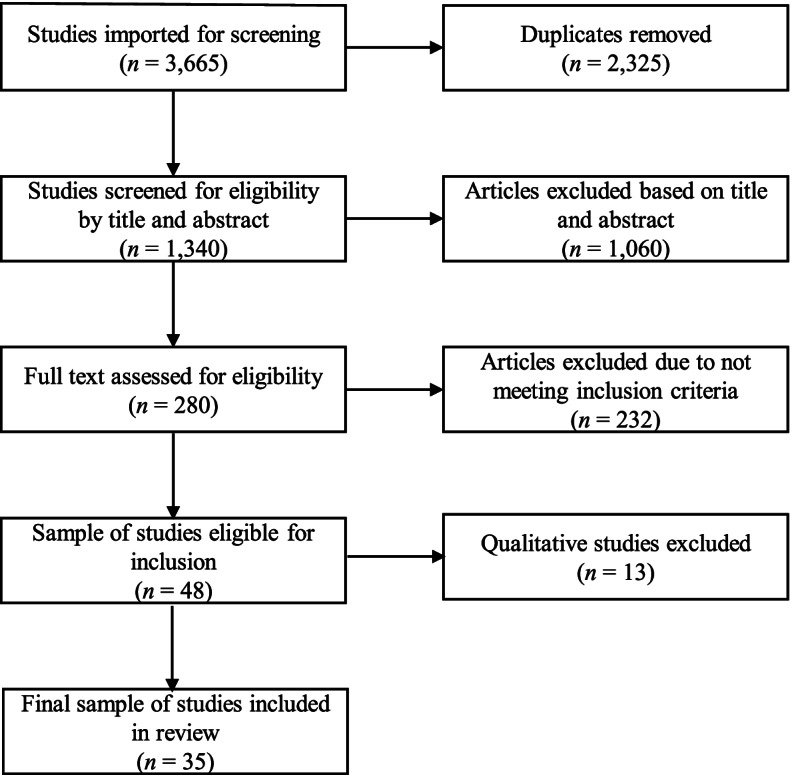
- Screening yielded 3,665 records imported, 2,325 duplicates removed, 1,340 title/abstract screened, 280 full texts assessed, 48 eligible, 13 qualitative studies removed, and 35 quantitative studies included; data were charted and analyzed using grouping and constant comparison, with no critical appraisal and all studies weighted equally.
Limitations
- Stated in the paper: the review included only quantitative studies; most included studies were cross-sectional, so directionality cannot be determined; some analytic strategies precluded confounding factors; measurement variation hinders meta-analysis; only English-language manuscripts were included; samples primarily involved male-perpetrated violence toward female survivors; and about one-third recruited from domestic violence organizations, so findings are not representative of all IPV survivors.
- Stated in the paper: all included studies used self-reported measures; half (17) did not use a validated economic abuse measure; financial outcomes were measured inconsistently, and no studies examined all facets of financial wellbeing collectively.
- Evident from the text and noted by the authors: only three studies specifically measured effects longitudinally using multilevel modeling; research on LGBTQIA+ survivors, male survivors, and cultural variation is limited; and many studies did not control for other forms of IPV when examining economic hardship.
Model-written summary. Check it against the paper before relying on it.
Integrity signals
Registry
Cites
Statistics
Figures
Verification
Claims the paper makes
21 Valid · 2 Not valid · 50 Not checked · 52 Own results and interpretations
The sources with a verdict support this claim; the rest weren’t checked yet, have no full text we could read, or their verdicts aren’t rated yet.
In the paper
“This makes it increasingly difficult to end economic abuse, even post separation when the abusive partner no longer has physical access to the survivor [5, 6].”
§ Examining the impact of economic abuse on survivors of intimate partner violence: a scoping review > Introduction
What the sources say
- Not checked — no full text of the sourcecites [5] Stylianou AM Postmus JL McMahon S Measuring abusive behaviors: is economic abuse a unique form of abuse? J Interpers Violence 2013 28 16 3186 3204 10.1177/0886260513496904 23946140 source
- Supportedcites [6] Stylianou AM Economic abuse within intimate partner violence: a review of the literature Violence Vict 2018 33 3 22 10.1891/0886-6708.33.1.3 29195516 source
In “Economic Abuse as a Unique Form of Abuse” (page not provided), the review says perpetrators can engage in economic abuse without contact or physical proximity. It concludes that victims may have difficulty ending economic abuse and that it may continue after other forms of abuse have ended, supporting the post-separation paraphrase. (LLM, conf=0.93)
plainstates a cause- Asserted: passes — The authors put it forward as true.
- Checkable: passes — It can be checked against evidence.
- Load-bearing: unclear — It is unclear whether the paper’s conclusions depend on it.
- Based: passes — The paper gives a reason why it holds.
The sources with a verdict support this claim; the rest weren’t checked yet, have no full text we could read, or their verdicts aren’t rated yet.
In the paper
“Five studies found that economic abuse was significantly associated with increased material [38, 47] or economic hardship [2, 48, 49].”
§ Examining the impact of economic abuse on survivors of intimate partner violence: a scoping review > Results > F indings on the impact of economic abuse
What the sources say
- Supportedcites [38] Johnson L Exploring factors associated with pregnant women’s experiences of material hardship during COVID-19: a cross-sectional Qualtrics survey in the United States BMC Pregnancy Childbirth 2021 21 1 14 10.1186/s12884-020-03485-8 34749686 PMC8573078 source
The Results report that economic abuse remained significantly associated with material hardship in the adjusted model (B = 1.01, p = .000). The Discussion explicitly describes the association as positive. Our copy provides section labels but no page numbers. (LLM, conf=0.94)
- Not checked — no full text of the sourcecites [47] Voth Schrag RJ Economic abuse and later material hardship: is depression a mediator? Affilia. 2015 30 3 341 351 10.1177/0886109914541118 source
- Not checked — no full text of the sourcecites [2] Adams AE Sullivan CM Bybee D Greeson MR Development of the scale of economic abuse Violence Against Women. 2008 14 5 563 588 10.1177/1077801208315529 18408173 source
- Not checked — no full text of the sourcecites [48] Voth Schrag RJ Robinson SR Ravi K Understanding pathways within intimate partner violence: economic abuse, economic hardship, and mental health J Aggress Maltreat Trauma 2019 28 2 222 242 10.1080/10926771.2018.1546247 source
- Supportedcites [49] Voth Schrag RJ Ravi KE Robinson SR The role of social support in the link between economic abuse and economic hardship J Fam Violence 2020 35 85 93 10.1007/s10896-018-0019-8 32435083 PMC7223436 source
The Results (Bivariate Analyses) report a significant positive correlation between economic abuse and economic hardship (r = .28, p < .001). The Discussion also describes a significant association with increased economic hardship among women attending community college; the Methods define the hardship measure in terms of material hardships. (LLM, conf=0.94)
plainstates an association- Asserted: passes — The authors put it forward as true.
- Checkable: passes — It can be checked against evidence.
- Load-bearing: passes — The paper’s conclusions depend on it.
- Based: passes — The paper gives a reason why it holds.
- Supported
The sources with a verdict support this claim; the rest weren’t checked yet, have no full text we could read, or their verdicts aren’t rated yet.
In the paper
“Seven of the cross-sectional studies found that economic abuse [27, 31, 36, 41, 44, 48, 50] and its associated tactics (i.e., employment sabotage) [24] was significantly and positively associated with depression.”
§ Examining the impact of economic abuse on survivors of intimate partner violence: a scoping review > Results > F indings on the impact of economic abuse
What the sources say
- Supportedcites [27] Gibbs AK Dunkle K Jewkes R Emotional and economic intimate partner violence as key drivers of depression and suicidal ideation: a cross-sectional study among young women in informal settlements in South Africa PLoS One 2018 13 4 e0194885 10.1371/journal.pone.0194885 29659595 PMC5901771 source
The Results and discussion report that all measures of economic intimate partner violence were significantly associated with increased CES-D depression scores. This source supports the economic-abuse association; the employment-sabotage tactic is attached to a different citation in the citing sentence. (LLM, conf=0.92)
- Not checked — no full text of the sourcecites [31] Haj-Yahia MM Implications of wife abuse and battering for self-esteem, depression, and anxiety as revealed by the second Palestinian national survey on violence against women J Fam Issues 2000 21 4 435 463 10.1177/019251300021004002 source
- Could not verifycites [36] Kanougiya S Daruwalla N Gram L Gupta AD Sivakami M Osrin D Economic abuse and its associations with symptoms of common mental disorders among women in a cross-sectional survey in informal settlements in Mumbai India BMC Public Health 2021 21 1 14 10.1186/s12889-020-10013-y PMC8088652 33933060 sourceExperimental — accuracy not yet measured
The Methods > Data analysis and Results > Adoption of the scheme structures and processes passages concern implementation of a community health fund, not economic abuse or depression. Searches for economic abuse, employment sabotage, and depression found no passage in our copy reporting the claimed association or seven cross-sectional studies. (LLM, conf=0.78)
plainstates an association- Asserted: passes — The authors put it forward as true.
- Checkable: passes — It can be checked against evidence.
- Load-bearing: passes — The paper’s conclusions depend on it.
- Based: passes — The paper gives a reason why it holds.
- Supported
Every source the paper cites for this claim was checked and supports it.
In the paper
“Women between the ages of 50–65 had greater odds of experiencing psychosomatic symptoms, gastrointestinal symptoms, allergies, and difficulty keeping weight [43].”
§ Examining the impact of economic abuse on survivors of intimate partner violence: a scoping review > Results > F indings on the impact of economic abuse
What the sources say
- Supportedcites [43] Stöckl H Penhale B Intimate partner violence and its association with physical and mental health symptoms among older women in Germany J Interpers Violence. 2015 30 17 3089 3111 10.1177/0886260514554427 25392386 source
The Associations With Physical and Mental Health Symptoms section states that economic abuse among women aged 50–65 was associated with increased gastrointestinal and psychosomatic symptoms, allergies, and weight problems. This matches the attributed claim; the supplied passage does not provide a page number. (LLM, conf=0.93)
plainstates an association- Asserted: passes — The authors put it forward as true.
- Checkable: passes — It can be checked against evidence.
- Load-bearing: unclear — It is unclear whether the paper’s conclusions depend on it.
- Based: passes — The paper gives a reason why it holds.
- Supported
Every source the paper cites for this claim was checked and supports it.
In the paper
“Women between the ages of 16–49 experiencing economic abuse had greater odds of experiencing pelvic problems and difficulty keeping weight.”
§ Examining the impact of economic abuse on survivors of intimate partner violence: a scoping review > Results > F indings on the impact of economic abuse
What the sources say
- Supportedcites [43] Stöckl H Penhale B Intimate partner violence and its association with physical and mental health symptoms among older women in Germany J Interpers Violence. 2015 30 17 3089 3111 10.1177/0886260514554427 25392386 source
The Associations With Physical and Mental Health Symptoms section states that women under 50 experiencing economic abuse were more likely to report pelvic and weight problems. Table 4 reports elevated odds for both outcomes among women aged 16–49. (LLM, conf=0.94)
plainstates an association- Asserted: passes — The authors put it forward as true.
- Checkable: passes — It can be checked against evidence.
- Load-bearing: unclear — It is unclear whether the paper’s conclusions depend on it.
- Based: passes — The paper gives a reason why it holds.
- Supported
51 more claims · 6 with their cited sources checked
Create a free account to see all 125 claims and to verify the 2 references still open.
- It may state two separate claims as one. 41
- Probably not a substantial claim. 34
- The quote only partly states this claim. 1
Self-check
Percentages, sums and reported differences re-computed from the paper’s own numbers.
Each contradiction between two passages listed here was confirmed by an independent check.
Rated minor: it would not touch a result — a value no result rests on, a p-value that stays on the same side of the significance level, or a conflict that is clerical, resolved elsewhere in the paper, or outside its own findings.
In the paper
§ Examining the impact of economic abuse on survivors of intimate partner violence: a scoping review > Results > F indings on the impact of economic abuse
“While a cross-sectional study conducted by Gul et al. did not find economic abuse to be significantly associated with survivors’ contentment with life score [20]”
§ Examining the impact of economic abuse on survivors of intimate partner violence: a scoping review > Results > Study characteristics
“Three studies looked at data with five time points [3, 20, 25]”
Rated minor: it would not touch a result — a value no result rests on, a p-value that stays on the same side of the significance level, or a conflict that is clerical, resolved elsewhere in the paper, or outside its own findings.
In the paper
“In 30% of the studies (n = 8) no one group had 50% or more of any one ethnicity in their sample [25, 26, 28, 33, 34, 38].”
§ Examining the impact of economic abuse on survivors of intimate partner violence: a scoping review > Results > Sample
Reported 30 · recomputed 22.857143
Citations
Cites
The CES-D Scale: A Self-Report Depression Scale for Research in the General Population
Radloff, L. S. (1977) · Applied Psychological Measurement · doi:10.1177/014662167700100306 · Cited by 53,267
The PHQ-9: Validity of a brief depression severity measure
Kroenke, K., Spitzer, R. L., & Williams, J. B. W. (2001) · Journal of General Internal Medicine · doi:10.1046/j.1525-1497.2001.016009606.x · Cited by 44,910
PRISMA Extension for Scoping Reviews (PRISMA-ScR): Checklist and Explanation
Tricco, A. C., Lillie, E., Zarin, W., O'Brien, K. K., Colquhoun, H., Levac, D., Moher, D., Peters, M. D. J., Horsley, T., Weeks, L., et al. (2018) · Annals of Internal Medicine · doi:10.7326/m18-0850 · Cited by 43,565
Scoping studies: towards a methodological framework
Arksey, H., & O'Malley, L. (2005) · International Journal of Social Research Methodology · doi:10.1080/1364557032000119616 · Cited by 36,742 · cited 5×
“Data extraction and analysis Data extraction and analysis was guided by Rodgers and colleagues’ methodological guidance on the synthesis of study findings [19], in addition to Arksey and O’Malley’s scoping review methodology [15].”
BackgroundMethodInfluentialA Brief Measure for Assessing Generalized Anxiety Disorder: The GAD-7
Spitzer, R. L., Kroenke, K., Williams, J. B. W., & Löwe, B. (2006) · Archives of Internal Medicine · doi:10.1001/archinte.166.10.1092 · Cited by 31,765
The structure of psychological well-being revisited.
Ryff, C. D., & Keyes, C. L. M. (1995) · Journal of Personality and Social Psychology · doi:10.1037//0022-3514.69.4.719 · Cited by 10,285
Straus, M. A., Hamby, S. L., Finkelhor, D., Moore, D. W., & Runyan, D. (1998) · Child Abuse & Neglect · doi:10.1016/s0145-2134(97)00174-9 · Cited by 2,498
International Journal of Social Research Methodology
(2000) · Quine · doi:10.1163/9789004457751_016 · Cited by 1,080
Intimate Partner Violence and Women’s Physical, Mental, and Social Functioning
Bonomi, A. E., Thompson, R. S., Anderson, M., Reid, R. J., Carrell, D., Dimer, J. A., & Rivara, F. P. (2006) · American Journal of Preventive Medicine · doi:10.1016/j.amepre.2006.01.015 · Cited by 686
Rodgers, M., Sowden, A., Petticrew, M., Arai, L., Roberts, H., Britten, N., & Popay, J. (2009) · Evaluation · doi:10.1177/1356389008097871 · Cited by 561
Development of the Scale of Economic Abuse
Adams, A. E., Sullivan, C. M., Bybee, D., & Greeson, M. R. (2008) · Violence Against Women · doi:10.1177/1077801208315529 · Cited by 442 · cited 15×
“Over half of the studies (n = 18) in this scoping review collected data from samples within the United States [2-4, 18-31].”
BackgroundMethodInfluentialKalolo, A., Gautier, L., Radermacher, R., Srivastava, S., Meshack, M., & De Allegri, M. (2021) · BMC Public Health · doi:10.1186/s12889-020-10013-y · Cited by 429
Jewkes, R. K., Levin, J. B., & Penn-Kekana, L. A. (2003) · Social Science & Medicine · doi:10.1016/s0277-9536(02)00012-6 · Cited by 395
Medical and Psychosocial Diagnoses in Women With a History of Intimate Partner Violence
Bonomi, A. E. (2009) · Archives of Internal Medicine · doi:10.1001/archinternmed.2009.292 · Cited by 364
(1993) · PubMed · Cited by 349
Consumer Financial Protection Bureau
(2014) · Choice Reviews Online · doi:10.5860/choice.51-3000 · Cited by 333
Understanding Economic Abuse in the Lives of Survivors
Postmus, J. L., Plummer, S.-B., McMahon, S., Murshid, N. S., & Kim, M. S. (2012) · Journal of Interpersonal Violence · doi:10.1177/0886260511421669 · Cited by 318 · cited 17×
“Over half of the studies (n = 18) in this scoping review collected data from samples within the United States [2-4, 18-31].”
BackgroundMethodInfluentialHealth Outcomes in Women with Physical and Sexual Intimate Partner Violence Exposure
Bonomi, A. E., Anderson, M. L., Rivara, F. P., & Thompson, R. S. (2007) · Journal of Women's Health · doi:10.1089/jwh.2006.0239 · Cited by 298
Industrial and Organizational Psychology
(2009) · Industrial and Organizational Psychology · doi:10.1111/j.1754-9434.2009.01187.x · Cited by 296
Economic Abuse as an Invisible Form of Domestic Violence: A Multicountry Review
Postmus, J. L., Hoge, G. L., Breckenridge, J., Sharp-Jeffs, N., & Chung, D. (2020) · Trauma, Violence, & Abuse · doi:10.1177/1524838018764160 · Cited by 288 · cited 3×
“This is not surprising, given that economic abuse research is still in its infancy [17] and fewer economic measures have been tested with IPV survivors, however, it does speak to the need for continued measurement research in this area.”
BackgroundCharacteristics of Callers to the Domestic Abuse Helpline for Men
Hines, D. A., Brown, J., & Dunning, E. (2007) · Journal of Family Violence · doi:10.1007/s10896-006-9052-0 · Cited by 266 · cited 1×
“who found that 38% of male survivors in their study reported experiencing economic abuse [81].”
BackgroundPredicting Re-Victimization of Battered Women 3 Years After Exiting a Shelter Program
Bybee, D., & Sullivan, C. M. (2005) · American Journal of Community Psychology · doi:10.1007/s10464-005-6234-5 · Cited by 223
Economic Violence To Women and Girls: Is It Receiving the Necessary Attention?
Fawole, O. I. (2008) · Trauma, Violence, & Abuse · doi:10.1177/1524838008319255 · Cited by 194
Levine, S. Z. (2013) · Social Psychiatry and Psychiatric Epidemiology · doi:10.1007/s00127-012-0650-2 · Cited by 169
Elder abuse and neglect in Ireland: results from a national prevalence survey
Naughton, C., Drennan, J., Lyons, I., Lafferty, A., Treacy, M., Phelan, A., O'Loughlin, A., & Delaney, L. (2012) · Age and Ageing · doi:10.1093/ageing/afr107 · Cited by 160 · cited 1×
“Other scales used to measure economic abuse across studies included the Domestic Violence Against Women Screening Form (DVAWS) [53], used in one study [30]; a measure of domestic violence developed by Haj-Yahia [54] for use with Arab survivors [31, 32] or an adaptation [46]; and an adapted version of the Conflict Tact…”
MethodEconomic Abuse in the Lives of Women Abused by an Intimate Partner: A Qualitative Study
Sanders, C. K. (2015) · Violence Against Women · doi:10.1177/1077801214564167 · Cited by 155
Gibbs, A., Dunkle, K., & Jewkes, R. (2018) · PLOS ONE · doi:10.1371/journal.pone.0194885 · Cited by 152 · cited 1×
“…range: 1 (never) to 5 (quite often) (past 12 months) Depression Anxiety PTSD EA did not lead to a signi cant increase in R2 for depression, anxiety, and PTSD United States Gibbs et al. (2018) Women age 18-30 living in informal settlements (n = 680) Crosssectional study using data…”
Measuring Economic Abuse in the Lives of Survivors: Revising the Scale of Economic Abuse
Postmus, J. L., Plummer, S.-B., & Stylianou, A. M. (2016) · Violence Against Women · doi:10.1177/1077801215610012 · Cited by 151
Self-citationKapiga, S., Harvey, S., Muhammad, A. K., Stöckl, H., Mshana, G., Hashim, R., Hansen, C., Lees, S., & Watts, C. (2017) · BMC Public Health · doi:10.1186/s12889-017-4119-9 · Cited by 150 · cited 3×
“Experiencing economic abuse was found to be significantly and negatively associated with self-esteem [31], psychosocial health [45], and positively associated with symptoms of psychological distress [37].”
BackgroundMethodMeasures for clinical practice and research : a sourcebook
Fischer, J., & Corcoran, K. J. (2007) · Oxford University Press eBooks · Cited by 143
Haj‐Yahia, M. M. (2000) · Journal of Family Violence · doi:10.1023/a:1007554229592 · Cited by 135 · cited 5×
“Haj-Yahia, M.M., Implications of wife abuse and battering for self-esteem, depression, and anxiety as revealed by the second Palestinian national survey on violence against women.”
MethodInfluentialSanz-Barbero, B., Barón, N., & Vives-Cases, C. (2019) · PLOS ONE · doi:10.1371/journal.pone.0221049 · Cited by 135 · cited 1×
“The impacts of economic abuse may vary based on survivors’ stage of life, which has been found for physical/sexual IPV and psychological abuse [82].”
BackgroundStöckl, H., & Penhale, B. (2015) · Journal of Interpersonal Violence · doi:10.1177/0886260514554427 · Cited by 122 · cited 9×
“One study by Stockl and Penhale looked at the association between economic abuse and psychological problems by women’s age group [43].”
BackgroundMethodResultInfluentialLavallee, L. F., Hatch, P. M., Michalos, A. C., & McKinley, T. (2006) · Social Indicators Research · doi:10.1007/s11205-006-9054-6 · Cited by 121
Economic Abuse Within Intimate Partner Violence: A Review of the Literature
Stylianou, A. M. (2018) · Violence and Victims · doi:10.1891/0886-6708.33.1.3 · Cited by 117 · cited 4×
“This makes it increasingly difficult to end economic abuse, even post separation when the abusive partner no longer has physical access to the survivor [5, 6].”
BackgroundInfluentialSelf-citationThe impact of physical and economic abuse on maternal mental health and parenting
Postmus, J. L., Huang, C.-C., & Mathisen-Stylianou, A. (2012) · Children and Youth Services Review · doi:10.1016/j.childyouth.2012.06.005 · Cited by 109 · cited 13×
“Postmus et al. (2012a) found that mother’s economic abuse at Y1 and Y3 had greater odds of using spanking to discipline child at Y5, but economic abuse was not signi cantly associated with engagement in parent-child activities in Y5.”
BackgroundMethodInfluentialLee, S., Ma, Y. L., & Tsang, A. (2011) · Journal of Psychosomatic Research · doi:10.1016/j.jpsychores.2011.01.016 · Cited by 106
Measuring Abusive Behaviors: Is Economic Abuse a Unique Form of Abuse?
Stylianou, A. M., Postmus, J. L., & McMahon, S. (2013) · Journal of Interpersonal Violence · doi:10.1177/0886260513496904 · Cited by 104
Self-citationEconomic Abuse Experiences and Depressive Symptoms among Victims of Intimate Partner Violence
Stylianou, A. M. (2018) · Journal of Family Violence · doi:10.1007/s10896-018-9973-4 · Cited by 94 · cited 14×
“[26], Stylianou [44], and Cardenas et al.”
BackgroundMethodInfluentialSelf-citationKutin, J., Russell, R., & Reid, M. (2017) · Australian and New Zealand Journal of Public Health · doi:10.1111/1753-6405.12651 · Cited by 87 · cited 2×
“Kutin included measures of financial resilience (defined as the ability to absorb financial shocks) and financial stress (defined as household cash flow problems) in one study exploring risk factors for economic abuse and found limited financial resilience and moderate to high levels of financial stress were associate…”
BackgroundDevelopment and validation of a pregnancy symptoms inventory
Foxcroft, K. F., Callaway, L. K., Byrne, N. M., & Webster, J. (2013) · BMC Pregnancy and Childbirth · doi:10.1186/1471-2393-13-3 · Cited by 86
Adams, A. E., Greeson, M. R., Littwin, A. K., & Javorka, M. (2020) · Psychology of Violence · doi:10.1037/vio0000244 · Cited by 79 · cited 22×
“The most commonly used measure of economic abuse used across studies was the Scale of Economic Abuse (SEA) or one of its variations [2-4, 18].”
BackgroundMethodInfluentialEconomic Self-Sufficiency: It's Not Just Money
Gowdy, E. A., & Pearlmutter, S. (1993) · Affilia · doi:10.1177/088610999300800402 · Cited by 77
Voth Schrag, R. J., Robinson, S. R., & Ravi, K. (2019) · Journal of Aggression, Maltreatment & Trauma · doi:10.1080/10926771.2018.1546247 · Cited by 74
Domestic violence: The Lebanese experience
Usta, J., Farver, J. A. M., & Pashayan, N. (2007) · Public Health · doi:10.1016/j.puhe.2006.09.014 · Cited by 73 · cited 5×
“Lebanon [41], Malaysia [43], Palestine [45], Philippines [46], and Tanzania [50].”
BackgroundMethodResultInfluentialAdams, A. E., & Beeble, M. L. (2019) · Psychology of Violence · doi:10.1037/vio0000174 · Cited by 73 · cited 1×
“…Year) Sample & Study Location Nature of Study Measurement of Economic Abuse Economic Abuse Prevalence Rate Outcome(s) of Interest Key Finding(s) Adams & Beeble (2019) Women receiving services from DV and SA service agencies (n = 94) Survey data collected as part of a larger, longitudinal…”
BackgroundThe Nature, Patterns and Consequences of Technology-Facilitated Domestic Abuse: A Scoping Review
Afrouz, R. (2023) · Trauma, Violence, & Abuse · doi:10.1177/15248380211046752 · Cited by 73 · cited 1×
“Afrouz highlights ways in which technology has “transcend[ed] communications beyond physical limits,” which has had significant implications for survivors of IPV [12].”
BackgroundWomen’s narratives of economic abuse and financial strategies in Britain and South Asia.
Chowbey, P. (2017) · Psychology of Violence · doi:10.1037/vio0000110 · Cited by 71 · cited 1×
“Weddingrelated traditions, such as marriage gifts, bride price, or dowry can also be used as forms of economic control or exploitation [85].”
BackgroundAntai, D., Oke, A., Braithwaite, P., & Lopez, G. B. (2014) · International Journal of Family Medicine · doi:10.1155/2014/852317 · Cited by 69 · cited 5×
“Three articles came from Turkey [23, 24, 27], two came from South Africa [29, 30] and one article came from Germany [31], Ghana [32], Hong Kong [35], India [36], Jordan [37],”
BackgroundInfluentialChildren’s Exposure to Intimate Partner Violence and Early Delinquency
Huang, C.-C., Vikse, J. H., Lu, S., & Yi, S. (2015) · Journal of Family Violence · doi:10.1007/s10896-015-9727-5 · Cited by 67 · cited 10×
“Although ve studies used the Fragile Families and Child Wellbeing Study dataset [24, 26, 27, 30], these studies used regression analyses to look at associations between experiences of economic Page 16/22 abuse and outcomes of interest.”
BackgroundMethodInfluentialHAJ-YAHIA, M. M. (2000) · Journal of Family Issues · doi:10.1177/019251300021004002 · Cited by 67 · cited 9×
“Experiencing economic abuse was found to be significantly and negatively associated with self-esteem [31], psychosocial health [45], and positively associated with symptoms of psychological distress [37].”
BackgroundMethodInfluentialEconomic Abuse and Later Material Hardship: Is Depression a Mediator?
Voth Schrag, R. J. (2015) · Affilia · doi:10.1177/0886109914541118 · Cited by 65
POSTMUS, J. L., HETLING, A., & L. HOGE, G. (2015) · Journal of Consumer Affairs · doi:10.1111/joca.12057 · Cited by 63 · cited 2×
“Employment sabotage includes behaviors that prevent a survivor from obtaining or maintaining employment [2], such as forbidding or interfering with a survivor’s employment or education, harassing a survivor at their place of work, and interfering with a survivor obtaining other forms of income including disability and…”
BackgroundKanougiya, S., Daruwalla, N., Gram, L., Gupta, A. D., Sivakami, M., & Osrin, D. (2021) · BMC Public Health · doi:10.1186/s12889-021-10904-8 · Cited by 53
Coerced Debt: The Role of Consumer Credit in Domestic Violence
Littwin, A. K. (2012) · bepress Legal Repository · doi:10.15779/z38vr6g · Cited by 53
Core outcome sets and trial registries
Clarke, M., & Williamson, P. (2015) · Trials · doi:10.1186/s13063-015-0738-6 · Cited by 52
Economic Abuse in Lebanon: Experiences and Perceptions
Usta, J., Makarem, N. N., & Habib, R. R. (2013) · Violence Against Women · doi:10.1177/1077801213486313 · Cited by 51
School Sabotage as a Form of Intimate Partner Violence: Provider Perspectives
Schrag, R. V., & Edmond, T. E. (2017) · Affilia · doi:10.1177/0886109916689785 · Cited by 48
Multiple Losses: The Psychological and Economic Well-Being of Survivors of Intimate Partner Violence
Sauber, E. W., & O’Brien, K. M. (2020) · Journal of Interpersonal Violence · doi:10.1177/0886260517706760 · Cited by 48 · cited 11×
“Only one study clearly indicated that the abusers were all male [42] and two studies clearly indicated Fig.”
BackgroundMethodResultInfluentialDavila, A. L., Johnson, L., & Postmus, J. L. (2021) · Journal of Interpersonal Violence · doi:10.1177/0886260517731311 · Cited by 45 · cited 5×
“[26], Stylianou [44], and Cardenas et al.”
BackgroundMethodInfluentialSelf-citationThe Role of Social Support in the Link Between Economic Abuse and Economic Hardship
Voth Schrag, R. J., Ravi, K. E., & Robinson, S. R. (2020) · Journal of Family Violence · doi:10.1007/s10896-018-0019-8 · Cited by 44
Evidence of the Construct Validity of the Scale of Economic Abuse
Adams, A. E., Beeble, M. L., & Gregory, K. A. (2015) · Violence and Victims · doi:10.1891/0886-6708.vv-d-13-00133 · Cited by 41 · cited 15×
“Over half of the studies (n = 18) in this scoping review collected data from samples within the United States [2-4, 18-31].”
BackgroundMethodInfluential(2013) · PsycEXTRA Dataset · doi:10.1037/e308842004-001 · Cited by 38
Marital Abuse and Psychological Well-Being Among Women in the Southern Region of Jordan
Hamdan-Mansour, A. M., Arabiat, D. H., Sato, T., Obaid, B., & Imoto, A. (2011) · Journal of Transcultural Nursing · doi:10.1177/1043659611404424 · Cited by 35 · cited 7×
“Three articles came from Turkey [23, 24, 27], two came from South Africa [29, 30] and one article came from Germany [31], Ghana [32], Hong Kong [35], India [36], Jordan [37],”
BackgroundMethodInfluentialChildren's exposure to intimate partner violence and peer bullying victimization
Vikse Nicholson, J., Chen, Y., & Huang, C.-C. (2018) · Children and Youth Services Review · doi:10.1016/j.childyouth.2018.06.034 · Cited by 34
Self-citationAdams, A. E., Littwin, A. K., & Javorka, M. (2020) · Violence Against Women · doi:10.1177/1077801219841445 · Cited by 34 · cited 3×
“found that coerced debt was significantly associated with greater odds of credit damage and financial dependency (meaning survivors stayed in a relationship longer because of concerns about financially supporting themselves or their children) [22].”
BackgroundEconomic abuse, physical violence, and union formation
Huang, C.-C., Postmus, J. L., Vikse, J. H., & Wang, L.-R. (2013) · Children and Youth Services Review · doi:10.1016/j.childyouth.2013.01.020 · Cited by 32 · cited 10×
“Another longitudinal study using Fragile Families data looked at the effect that economic abuse at Y1 had on union formation at Y5; mothers experiencing economic abuse had lower odds of being married or cohabiting with baby’s father at Y5 [33].”
BackgroundMethodInfluentialDoes Economic Abuse Affect the Health Outcomes of Women in Ghana?
Tenkorang, E. Y., & Owusu, A. Y. (2019) · Health Education & Behavior · doi:10.1177/1090198118806970 · Cited by 27 · cited 9×
“Experiencing economic abuse was found to be significantly and negatively associated with self-esteem [31], psychosocial health [45], and positively associated with symptoms of psychological distress [37].”
BackgroundMethodResultInfluentialPostmus, J. L., Nikolova, K., Lin, H.-F., & Johnson, L. (2022) · Journal of Interpersonal Violence · doi:10.1177/08862605211003168 · Cited by 26 · cited 7×
“Lebanon [41], Malaysia [43], Palestine [45], Philippines [46], and Tanzania [50].”
BackgroundMethodInfluentialSelf-citationThe Influence of Intimate Partner Violence on Pregnancy Symptoms
Gürkan, Ö. C., Ekşi, Z., Deniz, D., & Çırçır, H. (2020) · Journal of Interpersonal Violence · doi:10.1177/0886260518789902 · Cited by 25 · cited 5×
“Economic exploitation and economic deprivation were both significantly associated with cardiovascular disease and economic deprivation was associated with poorer perceptions of overall health; employment sabotage was associated with poorer mental health but not physical health [30].”
BackgroundMethodResultInfluentialYau, J. H.-Y., Wong, J. Y. H., & Fong, D. (2021) · PubMed · doi:10.1891/vv-d-19-00082 · Cited by 25 · cited 1×
“The authors also reviewed the reference lists of three review articles [6, 17, 18] for additional publications for possible inclusion; six were identified.”
BackgroundJohnson, L. (2021) · BMC Pregnancy and Childbirth · doi:10.1186/s12884-021-04234-1 · Cited by 25 · cited 3×
“This revised, 14-item scale was named the SEA2 and was used in two studies [21, 38].”
BackgroundMethodSelf-citationAnalysis of Postdischarge Change in a Dual Diagnosis Population
Mowbray, C. T., Jordan, L. C., Ribisl, K. M., Kewalramani, A., Luke, D. A., Herman, S., & Bybee, D. I. (1999) · Health & Social Work · doi:10.1093/hsw/24.2.91 · Cited by 24
Cardenas, I., Johnson, L., & Postmus, J. L. (2022) · Journal of Interpersonal Violence · doi:10.1177/08862605211013958 · Cited by 23 · cited 8×
“Three studies used longitudinal multilevel modeling to look at the effects of economic abuse over time [3, 20, 25].”
BackgroundMethodInfluentialSelf-citationThe Effect of Multiple Types of Intimate Partner Violence on Maternal Criminal Justice Involvement
Gottlieb, A., & Mahabir, M. (2021) · Journal of Interpersonal Violence · doi:10.1177/0886260518820705 · Cited by 19 · cited 11×
“BMC Public Health (2022) 22:1014 association between experiencing economic abuse in Y1, Y3, and Y5 and mother’s criminal justice involvement, defined as whether mother was charged with a crime or booked by police for anything other than a minor traffic violation in the last 4 years, at Y9; odds of experiencing crimina…”
BackgroundMethodInfluential(2021) · Springer eBooks · doi:10.1007/978-3-030-22009-9_301325 · Cited by 17
Development of the Scale of Economic Abuse
Adams, A., Greeson, M., & Sullivan, C. (2005) · PsycEXTRA Dataset · doi:10.1037/e628622012-130 · Cited by 17
Risk Factors for and Mental Well-Being Outcomes of Economic Abuse in Hong Kong Chinese Population
Yau, J. H.-Y., Fong, D. Y.-T., & Wong, J. Y.-H. (2020) · Violence and Victims · doi:10.1891/vv-d-18-00057 · Cited by 15 · cited 10×
“…hardship Higher levels of EA were associated with higher levels of economic hardship United States Page 12/22 Author (Publication Year) Sample & Study Location Nature of Study Measurement of Economic Abuse Economic Abuse Prevalence Rate Outcome(s) of Interest Key Finding(s) Yau et al.…”
BackgroundMethodResultInfluentialMortality among elder abuse victims in rural Malaysia: A two-year population-based descriptive study
Yunus, R. M., Hairi, N. N., Choo, W. Y., Hairi, F. M., Sooryanarayana, R., Ahmad, S. N., Abdul Razak, I., Peramalah, D., Abdul Aziz, S., Mohammad, Z. L., et al. (2017) · Journal of Elder Abuse & Neglect · doi:10.1080/08946566.2016.1260083 · Cited by 14 · cited 10×
“looked at the associations between IPV and mortality among a sample of older adults and found that proportions of death were highest for survivors of economic abuse, although the number of mortalities in the sample was low overall [51].”
BackgroundMethodResultInfluentialSingh, S. (2020) · Criminalising Coercive Control · doi:10.1007/978-981-15-0653-6_3 · Cited by 14 · cited 2×
“For example, in some cultures women may be restricted from engaging in work activities due to familial obligations, such as caring for children or elderly family members [83].”
BackgroundWhat We Overlook: Background Checks and Their Implications for Discrimination
Kuhn, K. M. (2013) · Industrial and Organizational Psychology · doi:10.1111/iops.12077 · Cited by 13 · cited 1×
“Within the United States credit scores are evaluated when individuals are applying for housing, utilities, employment, and insurance [7, 13, 14].”
BackgroundGul, H. (2020) · Northern Clinics of Istanbul · doi:10.14744/nci.2020.46514 · Cited by 9
Measuring Abusive Behaviors: Is Economic Abuse a Unique Form of Abuse?
Stylianou, A. M. (2014) · Society for Social Work and Research 18th Annual Conference: Research for Social Change: Addressing Local and Global Challenges · Cited by 7
Self-citationThe Relationship Between Postpartum Depression and Intimate Partner Violence
Bulut, S. D. (2017) · The Annals of Clinical and Analytical Medicine · doi:10.4328/jcam.4801 · Cited by 6
Escaping Battered Credit: A Proposal for Repairing Credit Reports Damaged by Domestic Violence
Littwin, A. K. (2013) · Penn Carey Law Legal Scholarship Repository (University of Pennsylvania) · Cited by 4
Usta, J., Makarem, N. N., & Habib, R. R. (2013) · Cited by 1
Research works printed but not linked: 7
- Engindeniz A Kuey L Kultur S Validity and reliability of Turkish version of Edinburgh postnatal depression scale Book of annual meeting of psychiatric Association of Turkey 1996 Ankara Turkish Psychiatric Association Press
- Costello CC Comrey depression and anxiety scales. Measures for clinical practice: a sourcebook 1967 2 155 160
- Maumary-Gremaud A Things that you have done. Fast Track project technical report 2000
- Beusenberg M Orley JH A User's guide to the self reporting questionnaire (SRQ) 1994 Geneva World Health Organization
- Walters EE Kessler RC Nelson C Mroczek DK Scoring the World Health Organization’s composite international diagnostic interview short form (CIDI-SF) 2002 Geneva World Health Organization
- Weathers FW Litz BT Herman DS Huska JA Keane TM The PTSD checklist (PCL): reliability, validity, and diagnostic utility 1993 San Antonio Annual convention of the International Society for Traumatic Stress Studies
- Weathers FW Litz BT Keane TM Palmieri PA Marx BP Schnurr PP The PTSD checklist for DSM-5 (PCL-5). National Center for PTSD 2013
Cited by
Paying the Price: When Intimate Partners Use Technology for Financial Harm
Bellini, R. F. (2023) · CHI Conference on Human Factors in Computing Systems · doi:10.1145/3544548.3581101 · Cited by 86
“However, the aftermath of financial abuse can be life-long and continue after a relationship has ended, such as exposing survivors to homelessness, job loss, poverty, and poor health outcomes [41, 67].”
BackgroundMellar, B. M., Fanslow, J., Gulliver, P. J., & McIntosh, T. K. D. (2024) · Journal of Interpersonal Violence · doi:10.1177/08862605241235140 · Cited by 65
In their own words: Perspectives of IPV survivors on obtaining support within the healthcare system
Hargrave, A. S., Dawson-Rose, C. S., Schillinger, D., Ng, F., Valdez, J. J., Rodriguez, A., Cuca, Y. P., Bakken, E. H., & Kimberg, L. S. (2024) · PLoS ONE · doi:10.1371/journal.pone.0310043 · Cited by 30
Disability and intimate partner violence: A cross-sectional study from Mwanza, Tanzania
Meyer, S. R., Mosha, N. R., Shakespeare, T., Kuper, H., Mtolela, G. J., Harvey, S. E., Kapiga, S., Mshana, G. H., & Stöckl, H. (2022) · Disability and health journal · doi:10.1016/j.dhjo.2022.101404 · Cited by 20
News Media Representation of Intimate Partner Violence: A Systematic Review
Taccini, F., & Mannarini, S. (2024) · Sexuality Research and Social Policy · doi:10.1007/s13178-023-00922-z · Cited by 32
“It is important to acknowledge that controlling behaviours and economical abuse fall within this definition (Johnson et al., 2022; WHO & PAHO, 2012).”
Metadata
- Authors
- Johnson, L., Chen, Y., Stylianou, A., & Arnold, A.
- Affiliations
- Temple University (US)
- Rutgers, The State University of New Jersey (US)
- Columbia University (US)
- Corresponding author
- Johnson, Laura
- Venue
- BMC Public Health
- Published
- 2022-05-19
- Volume
- 22
- Issue
- 1
- Pages
- 1014-1014
- ISSN
- 1471-2458 (ISSN-L)
- PMC
- PMC9121607
- OpenAlex
- W4280571271
- Semantic Scholar
- e445ac0aaf939213d862a7fe7c962c37ca01068a
- Cited by
- 177
- References
- 78
- Citations by year
- 2026: 66 · 2025: 52 · 2024: 37 · 2023: 21 · 2022: 1
- FWCI
- 17.89
- Type
- journal article
- Language
- en
- Open access
- gold
- doi.org
- Licence
- cc-by
- creativecommons.org/licenses/by/4.0 (tdm)
- creativecommons.org/licenses/by/4.0 (vor)
- Locations
- BMC Public Health (publishedVersion, cc-by)
- Research Square (submittedVersion, cc-by)
- PubMed Central (publishedVersion, cc-by)
- PubMed (publishedVersion)
- TUScholarShare (Temple University) (acceptedVersion, cc-by)
- DOAJ (DOAJ: Directory of Open Access Journals) (submittedVersion, cc-by-sa)
- TUScholarShare (Temple University) (submittedVersion, cc-by)
- Topics
- Social Sciences › Health › Intimate Partner and Family Violence
- Health Sciences › Medicine › Geriatrics and Gerontology › Elder Abuse and Neglect
- Social Sciences › Sociology and Political Science › Stalking, Cyberstalking, and Harassment
- Keywords
- economic violence, intimate partner violence, survivors, financial dependence, mental health, physical health, financial impact, parent-child interaction, quality of life, women survivors
- MeSH terms
- Intimate Partner Violence, Child, Female, Humans, Male, Mental Health, Quality of Life, Sexual Partners, Survivors
About these checks
Registry, retraction, Cites and statistics results are computed, not judged, with one exception: a printed reference that no index lists is read once by a model before it counts as a citation error. Claims are extracted by a model and kept only when their quote appears verbatim in the text; each cited source is then checked, with a model’s help, for whether it says what the claim relies on. Those verdicts can be wrong — read the claim’s quote and the cited source before relying on one.
The claim verdicts this report counts are experimental: their accuracy is not yet measured.
A language model drew the claims from the paper on 2026-09-28, under version 3 of the claim definition (prompt extract-v3).
A second model labelled each claim on 2026-09-28 (model jev-1.13-20260917, definition revision gold-guideline-v0.2).
Cited sources are checked with a language model’s help (gpt-6-sol).
Statistics and arithmetic are recomputed, not judged.
Confidence bands are shown only for fields calibrated on our annotated test set. None is calibrated yet, so no band is shown.
What counts as a claim ›How we measure confidence ›How we check this ›
Are you an author, or do you see a problem with this page? Request a review
Data sources
Bibliographic data: Semantic Scholar, OpenAlex, Crossref.
Contains information from the Semantic Scholar Academic Graph Datasets, made available under the ODC Attribution License (ODC-BY 1.0).
Semantic Scholar’s data is described in: Kinney, R., et al. (2023). The Semantic Scholar Open Data Platform. arXiv:2301.10140.
