

The decriminalization of illicit drugs in British Columbia: a national evaluation protocol.
Open accessThe DOI matches its Crossref record; 37 of the 37 references it cites were found in a registry or an index.
Abstract
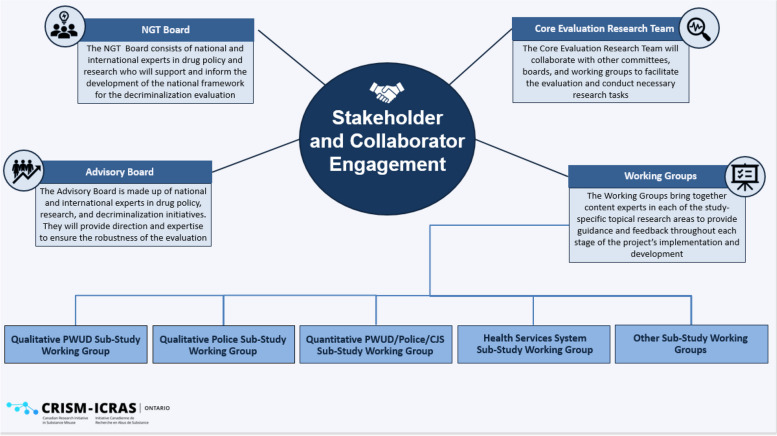
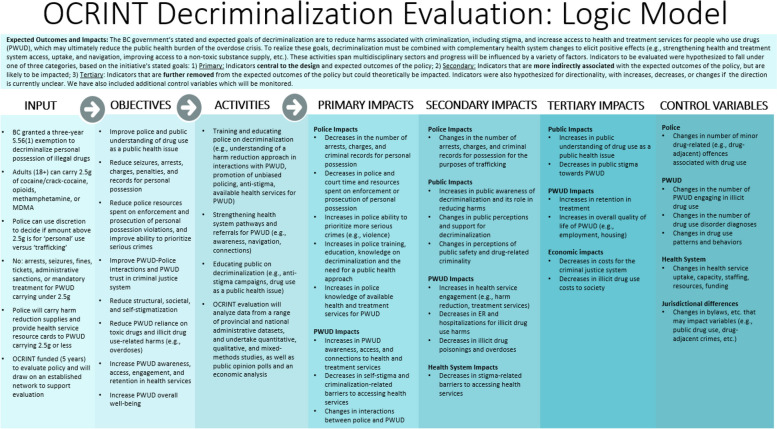
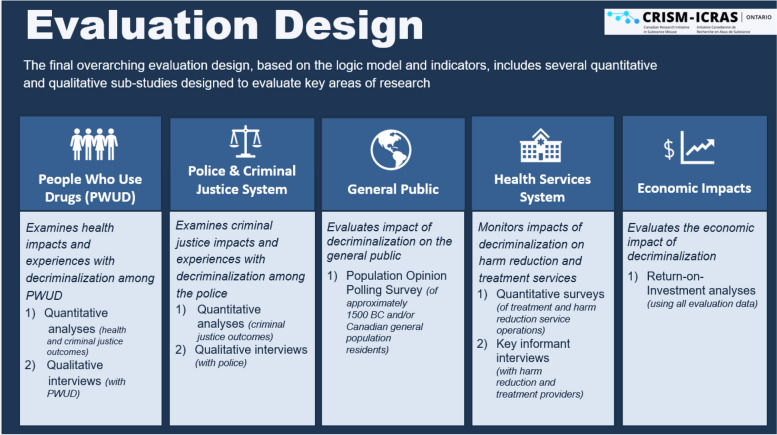
Background: On January 31st, 2023, the province of British Columbia (BC), Canada, was granted a federal exemption allowing adults (aged 18 +) to possess up to 2.5 g of select illicit drugs. The exemption will be in place for three years (2023–2026), marking the first formal decriminalization of illicit drug policy reform in Canada. BC’s decriminalization initiative is premised on several goals. This project seeks to evaluate each of these goals and their individual and combined contributions to determine the overall success of this policy. Methods: The following protocol paper provides a detailed outline of a five-year (2022-2027) national evaluation of BC’s decriminalization initiative, as well as the specific objectives, methodologies, and planned analyses for eight interrelated sub-studies that comprise the evaluation. These sub-studies fall under the following five topical areas of research: 1) people who use drugs (PWUD), 2) the police and the criminal justice system, 3) the general public, 4) the health services system, and 5) an economic analysis. Additional research activities may also be explored. Results: The overall evaluation and specific sub-study designs were informed by intensive stakeholder engagement. The evaluation was developed in collaboration with an international expert committee who came together to undertake a nominal group technique to decide on the final evaluation design and corresponding logic model. The evaluation will also employ an advisory board and individual sub-study working groups comprised of experts and PWUD who will oversee the development and implementation of the overall evaluation as well as each sub-study. Discussion: This evaluation will draw on implementation science research practices to evaluate and understand the full impacts of this novel drug policy experiment. Results will be widely disseminated through manuscripts, reports, presentations, and infographics, which will be adapted and tailored for specific audiences. The protocol identifies several anticipated challenges and limitations. This evaluation’s evidence-based findings will be poised to offer pivotal insights that can shape and refine the discourse on drug policy and will serve as a critical resource for understanding the multifaceted impacts of decriminalization.
Overview
The claims and statistics of this paper haven’t been checked yet.
Free: it reads the open-access text and checks the first 5 claims that cite a source we can check. Create a free account to check every claim.
Integrity signals
Registry
Cites
Statistics
Figures
Verification
Claims the paper makes
The claims and statistics of this paper haven’t been checked yet.
Free: it reads the open-access text and checks the first 5 claims that cite a source we can check. Create a free account to check every claim.
Self-check
Percentages, sums and reported differences re-computed from the paper’s own numbers.
The self-check needs the paper’s full text.
Citations
Cites
The REDCap consortium: building an international community of software platform partners
Harris, P. A., Taylor, R., Minor, B. L., Elliott, V., Fernandez, M., O'Neal, L., McLeod, L., Delacqua, G., Delacqua, F., Kirby, J., et al. (2019) · Journal of Biomedical Informatics · doi:10.1016/j.jbi.2019.103208 · Cited by 24,013
Clarke, V., & Braun, V. (2017) · The Journal of Positive Psychology · doi:10.1080/17439760.2016.1262613 · Cited by 6,543 · cited 1×
“…will be thematic and iterative, primarily following Braun and Clarke’s (2017) contemporary approach to thematic analysis and related meth-ods [52]; however, specific analytical or theoretical lenses, frameworks, and approaches to coding may differ depending on the specific outputs of…”
BackgroundImplementation science: What is it and why should I care?
Bauer, M. S., & Kirchner, J. (2020) · Psychiatry Research · doi:10.1016/j.psychres.2019.04.025 · Cited by 1,167 · cited 1×
“The following protocol provides a detailed outline of the evaluation’s design, as well as the specific objectives, methodologies, and planned analyses for each of the individual sub-studies that comprise the evaluation [38, 39].”
MethodDefining knowledge translation
Straus, S. E., Tetroe, J., & Graham, I. (2009) · Canadian Medical Association Journal · doi:10.1503/cmaj.081229 · Cited by 982 · cited 1×
“For each sub-study, at semi-annual or annual intervals depending on the study specifics, we plan to develop a diverse set of relevant knowledge translation materials [64].”
BackgroundProvisional Drug Overdose Death Counts
(2025) · doi:10.15620/cdc/20250305008 · Cited by 560
What Can We Learn From The Portuguese Decriminalization of Illicit Drugs?
Hughes, C. E., & Stevens, A. (2010) · British Journal of Criminology · doi:10.1093/bjc/azq038 · Cited by 440
Kalolo, A., Gautier, L., Radermacher, R., Srivastava, S., Meshack, M., & De Allegri, M. (2021) · BMC Public Health · doi:10.1186/s12889-020-10013-y · Cited by 429
Meyer, V. M., Benjamens, S., Moumni, M. E., Lange, J. F. M., & Pol, R. A. (2022) · Annals of Surgery · doi:10.1097/sla.0000000000004078 · Cited by 398
Implementation Science and Its Application to Population Health
Lobb, R., & Colditz, G. A. (2013) · Annual Review of Public Health · doi:10.1146/annurev-publhealth-031912-114444 · Cited by 338 · cited 1×
“The following protocol provides a detailed outline of the evaluation’s design, as well as the specific objectives, methodologies, and planned analyses for each of the individual sub-studies that comprise the evaluation [38, 39].”
MethodZhang, F., Wagner, A. K., & Ross-Degnan, D. (2011) · Journal of Clinical Epidemiology · doi:10.1016/j.jclinepi.2011.02.007 · Cited by 291 · cited 1×
“However, experts recommend 50 to 100 observations as a rule of thumb [42–44], as well as two years of monthly data to enable adjustment for seasonality [45].”
BackgroundPetkovic, J., Riddle, A., Akl, E. A., Khabsa, J., Lytvyn, L., Atwere, P., Campbell, P., Chalkidou, K., Chang, S. M., Crowe, S., et al. (2020) · Systematic Reviews · doi:10.1186/s13643-020-1272-5 · Cited by 239 · cited 1×
“To achieve these objectives, the evaluation has been designed with a strong focus on stakeholder engagement and collaboration [40].”
BackgroundUnderstanding and using time series analyses in addiction research
Beard, E., Marsden, J., Brown, J., Tombor, I., Stapleton, J., Michie, S., & West, R. (2019) · Addiction · doi:10.1111/add.14643 · Cited by 189 · cited 1×
“Power calculations performed in other types of statistical analyses using the G*Power Software are not suitable in time series analyses [41].”
MethodDrug Decriminalization in Portugal: Lessons for Creating Fair and Successful Drug Policies
Greenwald, G. (2010) · doi:10.2139/ssrn.1464837 · Cited by 183 · cited 1×
“The Portuguese model gained widespread recognition for its success, initially resulting in higher rates of treatment, lower HIV transmission rates, stable drug prices, continued low overdose rates, and a decrease in incarceration rates [12– 15].”
BackgroundEvaluating the impacts of cannabis legalization: The International Cannabis Policy Study
Hammond, D., Goodman, S., Wadsworth, E., Rynard, V., Boudreau, C., & Hall, W. (2020) · International Journal of Drug Policy · doi:10.1016/j.drugpo.2020.102698 · Cited by 183 · cited 1×
“This move was a marked departure from over a century of prohibition, and considered progressive as Canada is the first economically advanced country to legalize cannabis at the federal level [3, 4].”
BackgroundAli, F., Russell, C., Nafeh, F., Rehm, J., LeBlanc, S., & Elton-Marshall, T. (2021) · International Journal of Drug Policy · doi:10.1016/j.drugpo.2021.103237 · Cited by 162 · cited 3×
“Second, due to the potential impact of COVID-19 restrictions (e.g., lockdowns and masking) on illicit drug use and illicit drug overdose deaths [32, 46], all analyses will include a covariate reflecting the proportion of days in a month spent under masking or lockdown restrictions if relevant.”
BackgroundSelf-citationRussell, C., Ali, F., Nafeh, F., Rehm, J. T., LeBlanc, S., & Elton‐Marshall, T. (2021) · Journal of Substance Abuse Treatment · doi:10.1016/j.jsat.2021.108374 · Cited by 153
Self-citationMinimum Sample Size requirements for Seasonal Forecasting Models
Hyndman, R. J., & Kostenko, A. (2007) · Cited by 135
20 years of Portuguese drug policy - developments, challenges and the quest for human rights
Rêgo, X., Oliveira, M. J., Lameira, C., & Cruz, O. S. (2021) · Substance Abuse Treatment Prevention and Policy · doi:10.1186/s13011-021-00394-7 · Cited by 124 · cited 1×
“Yet, more recently, Portugal has come under scrutiny related to a reversal in some of these trends, including increases in overdose rates, public visibility of drug use, and wait times for treatment, as well as a subsequent decrease in treatment referrals and uptake [21–23].”
BackgroundBonn, M., Palayew, A., Bartlett, S., Brothers, T. D., Touesnard, N., & Tyndall, M. (2020) · Journal of Studies on Alcohol and Drugs · doi:10.15288/jsad.2020.81.556 · Cited by 124 · cited 1×
“…is unclear given the possibility of external factors which may have impacted the drug supply, drug consumption patterns, and the visibility of drug use, such as the novel coronavirus disease pandemic (COVID-19) and associated public health measures and disruptions to the drug supply [32–35].”
BackgroundSelf-citationHughes, C., & Stevens, A. (2012) · Drug and Alcohol Review · doi:10.1111/j.1465-3362.2011.00383.x · Cited by 122 · cited 1×
“Juris-dictions such as Portugal, Oregon (USA), Paraguay, Bolivia, Mexico, Poland, and Germany have introduced diverse decriminalization strategies [11–16].”
BackgroundImtiaz, S., Nafeh, F., Russell, C., Ali, F., Elton-Marshall, T., & Rehm, J. (2021) · Substance Abuse Treatment, Prevention, and Policy · doi:10.1186/s13011-021-00423-5 · Cited by 101 · cited 1×
“Second, due to the potential impact of COVID-19 restrictions (e.g., lockdowns and masking) on illicit drug use and illicit drug overdose deaths [32, 46], all analyses will include a covariate reflecting the proportion of days in a month spent under masking or lockdown restrictions if relevant.”
BackgroundSelf-citationUses and Abuses of Drug Decriminalization in Portugal
Laqueur, H. (2015) · Law & Social Inquiry · doi:10.1111/lsi.12104 · Cited by 79
Béen, F. M., Emke, E., Matias, J., Baz‐Lomba, J. A., Boogaerts, T., Castiglioni, S., Campos‐Mañas, M. C., Celma, A., Covaci, A., de Voogt, P., et al. (2021) · Environment International · doi:10.1016/j.envint.2021.106540 · Cited by 71
Thusini, S., Milenova, M., Nahabedian, N., Grey, B., Soukup, T., Chua, K., & Henderson, C. (2022) · BMC Health Services Research · doi:10.1186/s12913-022-08832-3 · Cited by 69 · cited 1×
“These analyses are increasingly being used to evaluate healthcare policies [57, 58].”
A social cost perspective in the wake of the Portuguese strategy for the fight against drugs
Gonçalves, R., Lourenço, A., & Silva, S. N. D. (2015) · International Journal of Drug Policy · doi:10.1016/j.drugpo.2014.08.017 · Cited by 68 · cited 1×
“These analyses are increasingly being used to evaluate healthcare policies [57, 58].”
Drug decriminalization and the price of illicit drugs
Félix, S., & Portugal, P. (2017) · International Journal of Drug Policy · doi:10.1016/j.drugpo.2016.10.014 · Cited by 58 · cited 1×
“The Portuguese model gained widespread recognition for its success, initially resulting in higher rates of treatment, lower HIV transmission rates, stable drug prices, continued low overdose rates, and a decrease in incarceration rates [12– 15].”
BackgroundGreer, A., Bonn, M., Shane, C., Stevens, A., Tousenard, N., & Ritter, A. (2022) · International Journal of Drug Policy · doi:10.1016/j.drugpo.2022.103605 · Cited by 55 · cited 1×
“However, the implementation, outcomes, and levels of success of decriminalization have varied among these locations [17].”
BackgroundSelf-citationRussell, C., Ali, F., Nafeh, F., LeBlanc, S., Imtiaz, S., Elton‐Marshall, T., & Rehm, J. T. (2021) · BMC Public Health · doi:10.1186/s12889-021-12104-w · Cited by 43 · cited 1×
“COVID-19 has drastically altered the healthcare system and societal behaviours [32, 61].”
BackgroundSelf-citationWhat are the benefits and risks of using return on investment to defend public health programs?
Brousselle, A., Benmarhnia, T., & Benhadj, L. (2016) · Preventive Medicine Reports · doi:10.1016/j.pmedr.2015.11.015 · Cited by 42 · cited 1×
“A return on investment analysis is an economic measure used to understand how much economic benefit is derived from a policy compared to its cost [56].”
BackgroundDecriminalization of Drug Use in Portugal: The Development of a Policy
Van Het Loo, M., Van Beusekom, I., & Kahan, J. P. (2002) · The ANNALS of the American Academy of Political and Social Science · doi:10.1177/000271620258200104 · Cited by 42 · cited 1×
“…of all illegal drugs as part of a wider re-orientation of drug policy towards a public health-focused approach where drug possession began to be treated as an administrative offence instead of a criminal one, resulting in fines or community service in place of arrests or incarceration [18–20].”
BackgroundA century of cannabis control in Canada
Fischer, B., Russell, C., & Boyd, N. (2020) · Routledge eBooks · doi:10.4324/9780429427794-6 · Cited by 40 · cited 1×
“This move was a marked departure from over a century of prohibition, and considered progressive as Canada is the first economically advanced country to legalize cannabis at the federal level [3, 4].”
BackgroundSelf-citationOne-Year Association of Drug Possession Law Change With Fatal Drug Overdose in Oregon and Washington
Joshi, S., Rivera, B. D., Cerdá, M., Guy, G. P., Strahan, A., Wheelock, H., & Davis, C. S. (2023) · JAMA Psychiatry · doi:10.1001/jamapsychiatry.2023.3416 · Cited by 22 · cited 1×
“Just over two years in, in light of mixed evidence regarding whether decriminalization has been associated with changes in fatal drug overdose rates [27, 28], critics have emphasized that public visibility of drug use is at an all-time high [28] and have panned the initiative as a failure [29, 30].”
BackgroundDoes drug decriminalization increase unintentional drug overdose deaths?
Spencer, N. (2023) · Journal of Health Economics · doi:10.1016/j.jhealeco.2023.102798 · Cited by 20 · cited 1×
“Just over two years in, in light of mixed evidence regarding whether decriminalization has been associated with changes in fatal drug overdose rates [27, 28], critics have emphasized that public visibility of drug use is at an all-time high [28] and have panned the initiative as a failure [29, 30].”
BackgroundGoing after the Addiction, Not the Addicted: The Impact of Drug Decriminalization in Portugal
Félix, S., Portugal, P., & Tavares, A. S. (2017) · SSRN Electronic Journal · doi:10.2139/ssrn.3010673 · Cited by 20
Mendes, R. D. O., Pacheco, P. G., Nunes, J. P. C. O. V., Crespo, P. S., & Cruz, M. S. (2019) · Ciência & Saúde Coletiva · doi:10.1590/1413-81232018249.27472017 · Cited by 20 · cited 1×
“Juris-dictions such as Portugal, Oregon (USA), Paraguay, Bolivia, Mexico, Poland, and Germany have introduced diverse decriminalization strategies [11–16].”
BackgroundAli, F., Russell, C., Greer, A., Bonn, M., Werb, D., & Rehm, J. T. (2023) · Substance Abuse Treatment Prevention and Policy · doi:10.1186/s13011-023-00547-w · Cited by 19 · cited 1×
“Additionally, concerns have been raised regarding the possession threshold in particular, which many individuals perceive to be too low or arbitrary in nature [37].”
BackgroundSelf-citationUrgent and long overdue: legal reform and drug decriminalization in Canada
Gruben, V., Hyshka, E., Bonn, M., Cox, C. M., Gagnon, M., Guţă, A., Jackman, M., Mercredi, J., Munga, A., Oscapella, E., et al. (2024) · FACETS · doi:10.1139/facets-2022-0080 · Cited by 17 · cited 1×
“The Controlled Drugs and Substances Act can be amended on a case-by-case basis if it is determined that an exemption is required in the interest of emerging health threats, the public interest, or based on updated medical/scientific evidence [2].”
BackgroundSelf-citation
Research works printed but not linked: 3
- Toronto Public Health (TPH). Toronto's Model for Decriminalizing Drugs for Personal Use. Toronto, Ontario: Toronto Public Health (TPH); 2023.
- Yaffee R. An introduction to forecasting time series with Stata. New York: Taylor & Francis; 2012.
- Effective Practice and Organization of Care (EPOC). Including interrupted time series (ITS) designs in EPOC review. the Cochrane Effective Practice and Organization of Care Group; 1998.
Cited by
Ali, F., Russell, C., Torres-Salbach, S., Lo, M., Bonn, M., Bardwell, G., Budau, J., Hyshka, E., & Rehm, J. T. (2025) · International Journal of Drug Policy · doi:10.1016/j.drugpo.2025.104791 · Cited by 22
Self-citationSafer Opioid Supply, Subsequent Drug Decriminalization, and Opioid Overdoses
Nguyen, H. V., Mital, S., Bugden, S., & McGinty, E. E. (2025) · JAMA Health Forum · doi:10.1001/jamahealthforum.2025.0101 · Cited by 10
Imtiaz, S., Russell, C., Ali, F., Elton‐Marshall, T., Patenaude, S., & Rehm, J. T. (2025) · Substance Abuse Treatment Prevention and Policy · doi:10.1186/s13011-025-00680-8 · Cited by 9
“The survey was developed in consultation with experts from the national decriminalization evaluation [32], and informed by another survey on knowledge and attitudes around decriminalization conducted by Health Canada [25].”
Self-citationImtiaz, S., Abdul, S. A., Jiang, H., Russell, C., Ali, F., Henderson, I., Foll, B. L., Elton‐Marshall, T., Kinniburgh, B. A., & Rehm, J. T. (2025) · Drug and Alcohol Review · doi:10.1111/dar.70036 · Cited by 10
Self-citationWire, S. E., Sivaraman, J. J. C., McDonald, H. S., Silver, I. A., Lambdin, B. H., & Kral, A. H. (2025) · International Journal of Drug Policy · doi:10.1016/j.drugpo.2025.104834 · Cited by 6
Metadata
- Authors
- Russell, C., Ali, F., Imtiaz, S., Butler, A., Greer, A., Rehm, J., the Decriminalization Evaluation Research Group, Bardwell, G., Bonn, M., Boyd, J., Bruneau, J., Costello, J., Crichlow, F., Crépault, J.-F., Degenhardt, L., Elton-Marshall, T., Ferencz, S., Gomes, T., Goulão, J. C.-B., Griffiths, P. N., Hickman, M., Hodgins, D. C., Hodgson, K., Hyshka, E., Le Foll, B., Linklater, R., Lock, K., Patenaude, S., Mackinnon, L. M., McLuckie, T., Mitra, S., Nurse, M., Sedgemore, K.-O., Shahin, R., Smith, W. M., Stewart, S. H., Werb, D., & Xavier, J. C.
- Affiliations
- Centre for Addiction and Mental Health (CA)
- Simon Fraser University (CA)
- Corresponding author
- Russell, Cayley
- ORCID
- Russell, Cayley
- Ali, Farihah
- Imtiaz, Sameer
- Butler, Amanda
- Greer, Alissa
- Rehm, Jürgen
- Bardwell, Geoff
- Bonn, Matthew
- Boyd, Jade
- Bruneau, Julie
- Costello, Jean
- Crépault, Jean-François
- Degenhardt, Louisa
- Gomes, Tara
- Hickman, Matthew
- Hodgins, David C.
- Hyshka, Elaine
- Patenaude, Sean
- Mitra, Sanjana
- Sedgemore, Kali-olt
- Shahin, Rita
- Stewart, Sherry H.
- Werb, Dan
- Xavier, Jessica C.
- Venue
- BMC Public Health
- Published
- 2024-10-18
- Volume
- 24
- Issue
- 1
- Pages
- 2879-2879
- ISSN
- 1471-2458 (ISSN-L)
- PMC
- PMC11490149
- OpenAlex
- W4403537959
- Cited by
- 19
- References
- 37
- Citations by year
- 2026: 7 · 2025: 12
- FWCI
- 5.76
- Type
- journal article
- Language
- en
- Open access
- gold
- doi.org
- Licence
- cc-by
- creativecommons.org/licenses/by/4.0 (tdm)
- creativecommons.org/licenses/by/4.0 (vor)
- Locations
- BMC Public Health (publishedVersion, cc-by)
- PubMed Central (publishedVersion, cc-by)
- PubMed (publishedVersion)
- PUBLISSO (German National Library of Medicine) (submittedVersion, cc-by)
- DOAJ (DOAJ: Directory of Open Access Journals) (submittedVersion, cc-by-sa)
- Funders
- Canadian Institutes of Health Research (184698_1)
- Topics
- Health Sciences › Medicine › Epidemiology › HIV, Drug Use, Sexual Risk
- Social Sciences › Law › Criminal Law and Policy
- Health Sciences › Medicine › Epidemiology › Substance Abuse Treatment and Outcomes
- Keywords
- drug decriminalization, illicit drug policy, British Columbia, drug users, health services, policy evaluation, implementation science, stakeholder engagement, logic model
- MeSH terms
- Adult, British Columbia, Drug and Narcotic Control, Humans, Illicit Drugs, Program Evaluation, Police, Substance-Related Disorders
About these checks
Registry, retraction, Cites and statistics results are computed, not judged, with one exception: a printed reference that no index lists is read once by a model before it counts as a citation error. Claims are extracted by a model and kept only when their quote appears verbatim in the text; each cited source is then checked, with a model’s help, for whether it says what the claim relies on. Those verdicts can be wrong — read the claim’s quote and the cited source before relying on one.
Statistics and arithmetic are recomputed, not judged.
Confidence bands are shown only for fields calibrated on our annotated test set. None is calibrated yet, so no band is shown.
What counts as a claim ›How we measure confidence ›How we check this ›
Are you an author, or do you see a problem with this page? Request a review
Data sources
Bibliographic data: Semantic Scholar, OpenAlex, Crossref.
Contains information from the Semantic Scholar Academic Graph Datasets, made available under the ODC Attribution License (ODC-BY 1.0).
Semantic Scholar’s data is described in: Kinney, R., et al. (2023). The Semantic Scholar Open Data Platform. arXiv:2301.10140.
