

Responsiveness and minimal important change of the QuickDASH and PSFS when used among patients with shoulder pain
Open accessThe DOI matches its Crossref record; 65 of the 65 references it cites were found in a registry or an index.
Abstract
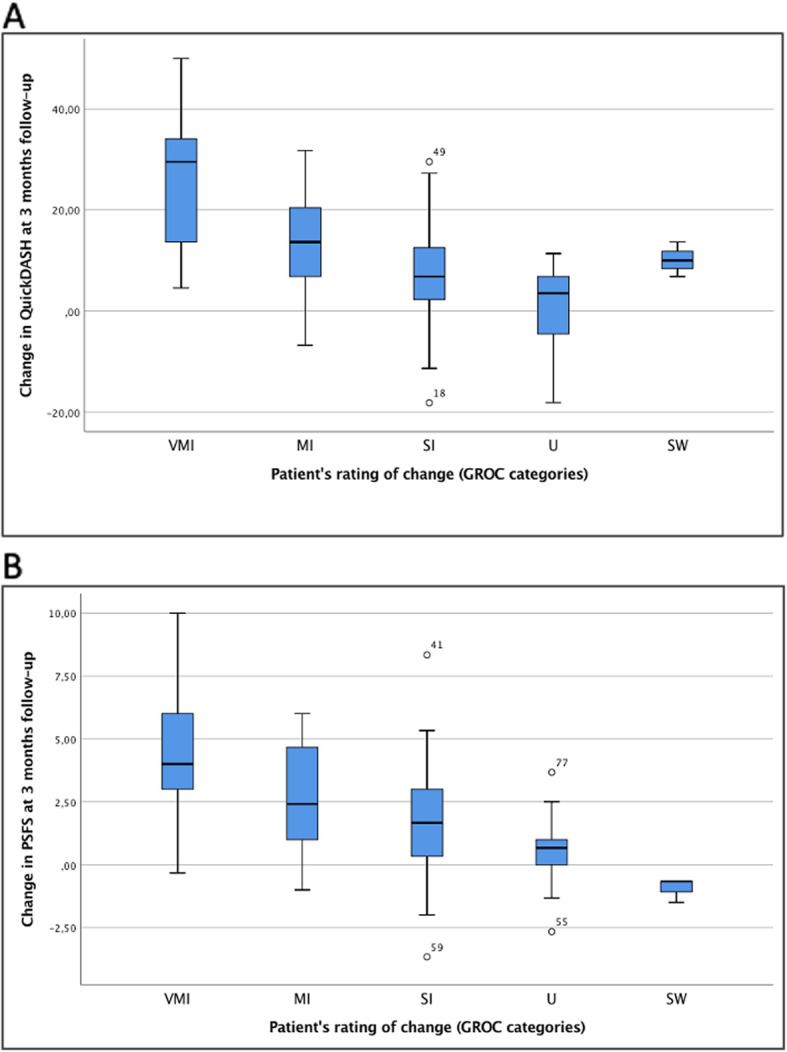
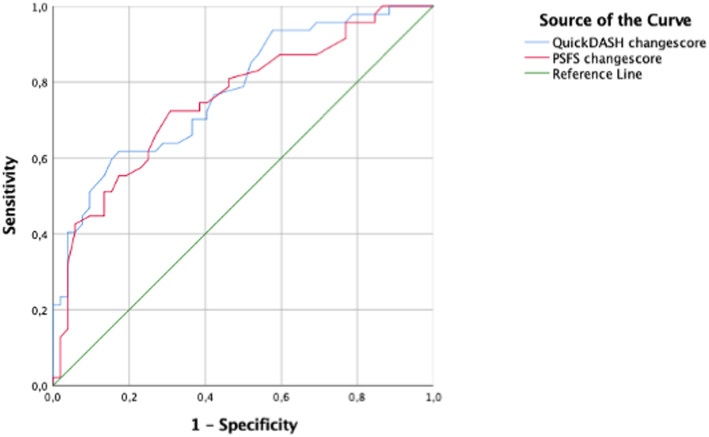
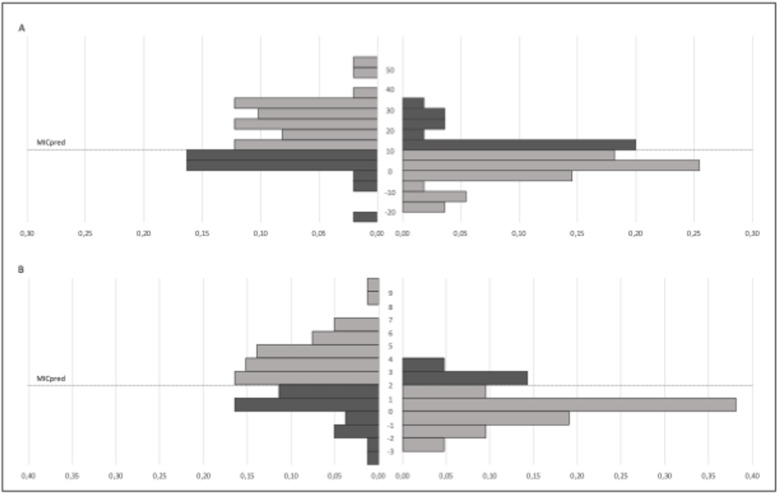
Background: The Quick Disabilities of the Arm, Shoulder and Hand questionnaire (QuickDASH) and the Patient-Specific Functional Scale (PSFS) are commonly used outcome instruments for measuring self-reported disability in patients with shoulder pain. To date, few studies have evaluated the responsiveness and estimated their minimal important change (MIC). Further assessment will expand the current knowledge and improve the interpretability of these instruments in clinical and research practice. The purpose of this prospective cohort study with 3 months follow-up was to evaluate the responsiveness of the QuickDASH and PSFS in patients with shoulder pain, and to estimate their MICs by using two different anchor-based methods. Methods: Patients with shoulder pain recruited at a multidisciplinary hospital outpatient clinic completed the QuickDASH and PSFS at baseline and at 3 months follow-up. The responsiveness was evaluated by using a criterion approach with the area under the receiver operating characteristic curve (AUC) and a construct approach by testing 9 a-priori hypotheses. The MIC was assessed using two anchor-based MIC methods. Results: 134 patients participated at baseline and 117 (87.3%) at 3 months follow-up. The AUC was acceptable for both QuickDASH (0.75) and PSFS (0.75). QuickDASH met 7 (77.8%) and PSFS 8 (88.9%) of the hypotheses. None of the instruments showed signs of floor and ceiling effects. The MIC estimates ranged from 10.8 to 13.6 for QuickDASH and from 1.9 to 2.0 for PSFS, depending on the method used. Conclusion: This study demonstrates that both the QuickDASH and PSFS are responsive measures of disability in patients with shoulder pain. The estimated MIC values were presented.
Overview
The claims and statistics of this paper haven’t been checked yet.
Free: it reads the open-access text and checks the first 5 claims that cite a source we can check. Create a free account to check every claim.
Integrity signals
Registry
Cites
Statistics
Figures
Verification
Claims the paper makes
The claims and statistics of this paper haven’t been checked yet.
Free: it reads the open-access text and checks the first 5 claims that cite a source we can check. Create a free account to check every claim.
Self-check
Percentages, sums and reported differences re-computed from the paper’s own numbers.
The self-check needs the paper’s full text.
Citations
Cites
Health Measurement Scales: A Practical Guide to Their Development and Use
Streiner, D. L., Norman, G. R., & Cairney, J. (1989) · Cited by 9,595
The Hopkins Symptom Checklist (HSCL): A self-report symptom inventory
Derogatis, L. R., Lipman, R. S., Rickels, K., Uhlenhuth, E. H., & Covi, L. (1974) · Behavioral Science · doi:10.1002/bs.3830190102 · Cited by 4,604 · cited 1×
“The total score, average of the 25 items, was calculated [41].”
Mokkink, L. B., Terwee, C. B., Patrick, D. L., Alonso, J., Stratford, P. W., Knol, D. L., Bouter, L. M., & de Vet, H. C. W. (2010) · Journal of Clinical Epidemiology · doi:10.1016/j.jclinepi.2010.02.006 · Cited by 4,465 · cited 2×
“In addition to reliability and validity, responsiveness is an important measurement property which aims to evaluate the PROMs ability to capture change over time [21].”
BackgroundMethodStreiner, D. L., & Norman, G. R. (2008) · doi:10.1093/acprof:oso/9780199231881.001.0001 · Cited by 2,631
COSMIN Risk of Bias checklist for systematic reviews of Patient-Reported Outcome Measures
Mokkink, L. B., de Vet, H. C. W., Prinsen, C. A. C., Patrick, D. L., Alonso, J., Bouter, L. M., & Terwee, C. B. (2018) · Quality of Life Research · doi:10.1007/s11136-017-1765-4 · Cited by 2,479 · cited 2×
“If used as PROMs in clinical or research settings, high-quality studies to thoroughly evaluate their measurement properties are required [18].”
MethodRevicki, D., Hays, R. D., Cella, D., & Sloan, J. (2008) · Journal of Clinical Epidemiology · doi:10.1016/j.jclinepi.2007.03.012 · Cited by 2,362 · cited 10×
“The use of a GROC as an external anchor has been criticised for its reliability and possible object to recall bias [19].”
BackgroundMethodInfluentialMeasurement in Medicine: A Practical Guide
de Vet, H. C. W., Terwee, C. B., Mokkink, L. B., & Knol, D. L. (2011) · doi:10.1017/cbo9780511996214 · Cited by 2,321
DEVELOPMENT OF THE QUICKDASH: COMPARISON OF THREE ITEM-REDUCTION APPROACHES
BEATON, D. E., WRIGHT, J. G., & KATZ, J. N. (2005) · The Journal of Bone and Joint Surgery-American Volume · doi:10.2106/00004623-200505000-00015 · Cited by 1,523 · cited 3×
“The QuickDASH disability questionnaire used in this study does not capture work in a direct way [10].”
BackgroundMethodPrevalence and incidence of shoulder pain in the general population; a systematic review
Luime, J., Koes, B., Hendriksen, I., Burdorf, A., Verhagen, A., Miedema, H., & Verhaar, J. (2004) · Scandinavian Journal of Rheumatology · doi:10.1080/03009740310004667 · Cited by 1,347 · cited 1×
“Background Shoulder pain is a common musculoskeletal condition that can often lead to considerable disability [1], impacting the performance of daily activities and restrict participation in major life areas such as work, education, community, social and civil life [2, 3].”
BackgroundStrand, B. H., Dalgard, O. S., Tambs, K., & Rognerud, M. (2003) · Nordic Journal of Psychiatry · doi:10.1080/08039480310000932 · Cited by 1,304 · cited 1×
“The Norwegian version of HSCL-25 has shown strong correlation with mental health scores [52].”
Background
Research works printed but not linked: 6
- Hefford C, Abbott JH, Arnold R, Baxter GD. The Patient-Specific Functional Scale: Validity, Reliability, and Responsiveness in Patients With Upper Extremity Musculoskeletal Problems. J Orthop Sport Phys Ther. 2012;42:56- 65
- Abbott JH, Schmitt J. Minimum Important Differences for the Patient- Specific Functional Scale, 4 Region-Specific Outcome Measures, and the Numeric Pain Rating Scale. J Orthop Sport Phys Ther. 2014;44:560-4
- Cohen J. Statistical Power Analysis for the Behavioural Science (2nd Edition). Stat. Power Anaylsis. Behav Sci. NJ: Erlbaum; 1988.
- Kowalchuk-Horn K, Jennings S, Richardson G, VanVliet D, Hefford C, Abbott JH. The Patient-Specific Functional Scale: Psychometrics, Clinimetrics, and Application as a Clinical Outcome Measure. J Orthop Sports Phys Ther. 2011; 42:30-40
- Moseng T, Tveter A, Holm I, Dagfinrud H. The patient-specific functional scale -a useful tool for physiotherapists working in primary care. Fysioterapeuten. 2013;2:20-6.
- Thoomes-de Graaf M, Scholten-Peeters W, Duijn E, Karel Y, de Vet HCW, Koes BW, et al. The Responsiveness and Interpretability of the Shoulder Pain and Disability Index. J Orthop Sport Phys Ther. 2017;47:278-86
Cited by
Su, F., Allahabadi, S., Bongbong, D. N., Feeley, B. T., & Lansdown, D. A. (2021) · Current Reviews in Musculoskeletal Medicine · doi:10.1007/s12178-020-09684-2 · Cited by 91
Pak, S. S., Janela, D., Freitas, N., Costa, F. M. T. A., Moulder, R. G., Jr., Molinos, M., Areias, A. C., Bento, V., Cohen, S. P., Yanamadala, V., et al. (2023) · Journal of Medical Internet Research · doi:10.2196/49236 · Cited by 96
“The odds of being a responder for QuickDASH were calculated using logistic regression analysis, considering a 33% minimal clinically important difference (MCID) [47,48].”
Galardini, L., Coppari, A., Pellicciari, L., Ugolini, A., Piscitelli, D., Porta, F. L., Bravini, E., & Vercelli, S. (2024) · Physical Therapy · doi:10.1093/ptj/pzae033 · Cited by 89
“For example, the category “moderate to large” was assigned to both the study by Smith-Forbes et al 46 and the study by Rysstad et al. 45 In the former case, the cutoff was placed between scores + 3 and + 4 on a 15-point scale (from − 7 to + 7), thus considering improved all those who scored + 4 or higher on the GROC s…”
Pathak, A., Wilson, R., Sharma, S., Pryymachenko, Y., Ribeiro, D. C., Chua, J., & Abbott, J. H. (2022) · Journal of Orthopaedic and Sports Physical Therapy · doi:10.2519/jospt.2022.10727 · Cited by 55
Janela, D., Costa, F., Molinos, M., Moulder, R. G., Lains, J., Francisco, G. E., Bento, V., Cohen, S. P., & Correia, F. D. (2022) · Journal of Pain Research · doi:10.2147/jpr.s343308 · Cited by 33
“An improvement of 30% was chosen as the minimal clinically important difference (MCID).(57) Secondary outcome measures included:”
Method
Metadata
- Authors
- Rysstad, T., Grotle, M., Klokk, L. P., & Tveter, A. T.
- Affiliations
- OsloMet – Oslo Metropolitan University (NO)
- Oslo University Hospital (NO)
- Ålesund Hospital (NO)
- Corresponding author
- Rysstad, Tarjei
- Venue
- BMC Musculoskeletal Disorders
- Published
- 2020-05-27
- Volume
- 21
- Issue
- 1
- Pages
- 328-328
- ISSN
- 1471-2474 (ISSN-L)
- PMC
- PMC7254648
- OpenAlex
- W3031709513
- Cited by
- 30
- References
- 65
- Citations by year
- 2026: 7 · 2025: 4 · 2024: 5 · 2023: 4 · 2022: 6 · 2021: 3 · 2020: 1
- FWCI
- 3.20
- Type
- journal article
- Language
- en
- Open access
- gold
- doi.org
- Licence
- cc-by
- creativecommons.org/licenses/by/4.0 (tdm)
- creativecommons.org/licenses/by/4.0 (vor)
- Locations
- BMC Musculoskeletal Disorders (publishedVersion, cc-by)
- PubMed Central (publishedVersion, cc-by)
- PubMed (publishedVersion)
- DOAJ (DOAJ: Directory of Open Access Journals) (submittedVersion, cc-by-sa)
- Funders
- Norwegian Fund for Post-Graduate Training in Physiotherapy
- Topics
- Health Sciences › Medicine › Surgery › Shoulder Injury and Treatment
- Health Sciences › Health Professions › Physical Therapy, Sports Therapy and Rehabilitation › Musculoskeletal pain and rehabilitation
- Social Sciences › Economics, Econometrics and Finance › Economics and Econometrics › Health Systems, Economic Evaluations, Quality of Life
- Keywords
- QuickDASH, Patient-Specific Functional Scale, shoulder pain, responsiveness, minimal important change, patient-reported outcome measures, disability assessment, anchor-based methods, floor and ceiling effects
- MeSH terms
- Adult, Disability Evaluation, Female, Hand, Humans, Male, Middle Aged, Norway, Pain Measurement, Primary Health Care, Prospective Studies, Surveys and Questionnaires, ROC Curve, Shoulder, Practice Guidelines as Topic, Shoulder Pain, Physical Therapy Modalities
About these checks
Registry, retraction, Cites and statistics results are computed, not judged, with one exception: a printed reference that no index lists is read once by a model before it counts as a citation error. Claims are extracted by a model and kept only when their quote appears verbatim in the text; each cited source is then checked, with a model’s help, for whether it says what the claim relies on. Those verdicts can be wrong — read the claim’s quote and the cited source before relying on one.
Statistics and arithmetic are recomputed, not judged.
Confidence bands are shown only for fields calibrated on our annotated test set. None is calibrated yet, so no band is shown.
What counts as a claim ›How we measure confidence ›How we check this ›
Are you an author, or do you see a problem with this page? Request a review
Data sources
Bibliographic data: Semantic Scholar, OpenAlex, Crossref.
Contains information from the Semantic Scholar Academic Graph Datasets, made available under the ODC Attribution License (ODC-BY 1.0).
Semantic Scholar’s data is described in: Kinney, R., et al. (2023). The Semantic Scholar Open Data Platform. arXiv:2301.10140.
