

The DOI matches its Crossref record; 1 of the 1 references it cites were found in a registry or an index.
Poorer patient-reported knee function and quality of life, but not activity level, after revision ACL reconstruction compared with primary ACL reconstruction: a matched-pair analysis with a minimum 5-year follow-up
Open accessAbstract
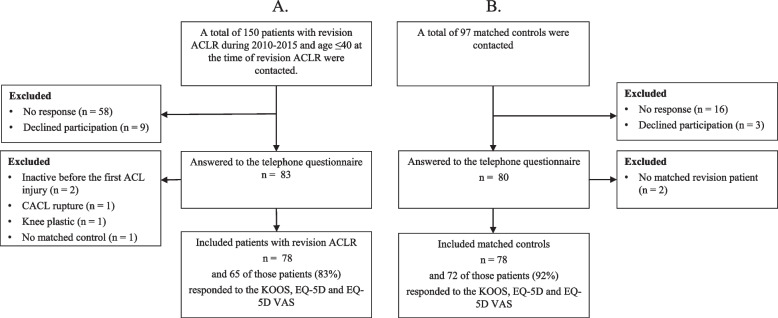
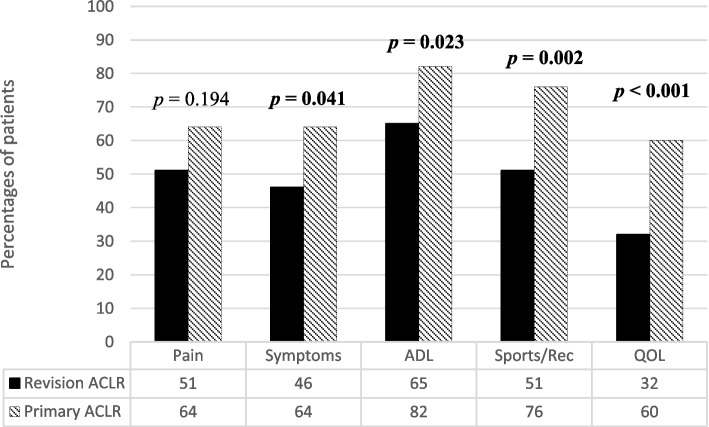
Background: An appropriate method for comparing knee function and activity level between patients with primary and revision anterior cruciate ligament reconstruction (ACLR) is to perform a matched-group analysis. The aim was to assess and compare knee function, knee-related quality of life and activity level between patients with revision ACLR and primary ACLR at a minimum of 5 years of follow-up. Methods: Patients aged ≤ 40 years old who underwent revision ACLR between 2010 and 2015 and a matched control group (primary ACLR) (1:1) with age ± 2 years, year of ACLR, sex, and pre-injury sport and Tegner Activity Scale (TAS) were retrospectively identified in our clinic database. The preoperative Knee injury and Osteoarthritis Outcome Score (KOOS) and surgical data were extracted and analyzed. Patients were mailed KOOS and EQ-5D questionnaires at a minimum of 5-years after revision ACLR. Study-specific questions about knee function, limitation in sport, satisfaction, and activity level according to the TAS (all scales of 1–10, 10 best) were also asked by telephone. Results: Seventy-eight patients with a revision ACLR (mean age ± SD, 29.9 ± 6.0 years) matched with seventy-eight patients with a primary ACLR (30.2 ± 5.8 years) were included. The follow-up for the revision ACLR group was 7.0 ± 1.5 years and for the primary ACLR group 7.7 ± 1.6 years. The revision ACLR group reported poorer KOOS scores in all subscales (p < 0.05) except the Symptoms subscale, poorer EQ-5D VAS (mean 79.2 ± 20.1 vs 86.0 ± 20.1, p = 0.012), and less satisfaction with current knee function (median 7 (6–8) vs 8 (7–9), p < 0.001). Patients with revision ACLR also experienced greater limitation in sports (median 7 (4–8) vs 8 (6–9), p < 0.001). There were no significant differences in the EQ-5D (mean 0.86 ± 0.17 vs 0.89 ± 0.11, p = 0.427), activity level (median 2 (2–5) vs 4 (2–7), p = 0.229), or satisfaction with activity level (median 8 (5–9) vs 8 (6–10), p = 0.281) between the groups. Conclusions: At a minimum 5-year follow-up, the revision ACLR group reported poorer knee function and quality of life, less satisfaction with knee function and a greater limitation in sports but no differences in activity level and satisfaction with activity level compared with the primary ACLR group.
Overview
The claims and statistics of this paper haven’t been checked yet.
Run the check — free, no account needed. It reads the open-access text and checks the sources it cites.
Integrity signals
Registry
Cites
Statistics
Figures
Verification
Claims the paper makes
The claims and statistics of this paper haven’t been checked yet.
Run the check — free, no account needed. It reads the open-access text and checks the sources it cites.
Claims other papers make about this one
Each is checked against this paper’s own text: does it say what the citing paper says it does?
The source backs part of the claim, not all of it — or backs it for a different population, condition or comparison.
In the citing paper
“Clinicians use objective factors such as age, time from injury, and strength symmetry in clinical decision-making for return to sport after ACLR5–11; however, these alone do not fully explain why some athletes do not return to sport despite achieving adequate physical rehabilitation.12–15”
From Determinants of Psychological Readiness to Return to Sport After Anterior Cruciate Ligament Reconstruction (2026) · cites this paper as [14]
Experimental — accuracy not yet measured
Self-check
Percentages, sums and reported differences re-computed from the paper’s own numbers.
The self-check needs the paper’s full text.
Citations
Cites
Roos, E. M., Boyle, E., Frobell, R. B., Lohmander, L. S., & Ingelsrud, L. H. (2019) · British Journal of Sports Medicine · doi:10.1136/bjsports-2018-100260 · Cited by 80
Research works printed but not linked: 32
- Grevnerts HT, Fältstrom A, Sonesson S, Gauffin H, Carlfjord S, Kvist J. Activity demands and instability are the most important factors for recommending to treat ACL injuries with reconstruction. Knee Surg Sports Traumatol Arthrosc. 2018;26(8):2401–9. · DOI
- Fältström A, Kvist J, Hägglund M. High risk of new knee injuries in female soccer players after primary anterior cruciate ligament reconstruction at 5- to 10-year follow-up. Am J Sports Med. 2021;49(13):3479–87. · DOI
- Lindanger L, Strand T, Mølster AO, Solheim E, Inderhaug E. Return to play and long-term participation in pivoting sports after anterior cruciate ligament reconstruction. Am J Sports Med. 2019;47(14):3339–46. · DOI
- Webster KE, Feller JA. Expectations for return to preinjury sport before and after anterior cruciate ligament reconstruction. Am J Sports Med. 2019;47(3):578–83. · DOI
- Ardern CL, Taylor NF, Feller JA, Webster KE. Fifty-five per cent return to competitive sport following anterior cruciate ligament reconstruction surgery: an updated systematic review and meta-analysis including aspects of physical functioning and contextual factors. Br J Sports Med. 2014;48(21):1543–52. · DOI · Paper page
- Della Villa F, Andriolo L, Ricci M, Filardo G, Gamberini J, Caminati D, et al. Compliance in post-operative rehabilitation is a key factor for return to sport after revision anterior cruciate ligament reconstruction. Knee Surg Sports Traumatol Arthrosc. 2020;28(2):463–9. · DOI
- Anand BS, Feller JA, Richmond AK, Webster KE. Return-to-sport outcomes after revision anterior cruciate ligament reconstruction surgery. Am J Sports Med. 2016;44(3):580–4. · DOI
- Mardani-Kivi M, Leili EK, Shirangi A, Azari Z. Return to sports activity in the revision of anterior cruciate ligament reconstruction: a 2–6 year follow-up study. J Clin Orthop Trauma. 2021;16:80–5. · DOI
- Cristiani R, Engstrom B, Edman G, Forssblad M, Stalman A. Revision anterior cruciate ligament reconstruction restores knee laxity but shows inferior functional knee outcome compared with primary reconstruction. Knee Surg Sports Traumatol Arthrosc. 2019;27(1):137–45. · DOI
- Grassi A, Ardern CL, Marcheggiani Muccioli GM, Neri MP, Marcacci M, Zaffagnini S. Does revision ACL reconstruction measure up to primary surgery? A meta-analysis comparing patient-reported and clinician-reported outcomes, and radiographic results. Br J Sports Med. 2016;50(12):716–24. · DOI
- Horvath A, Senorski EH, Westin O, Karlsson J, Samuelsson K, Svantesson E. Outcome after anterior cruciate ligament revision. Curr Rev Musculoskelet Med. 2019;12(3):397–405. · DOI
- Sylvia SM, Toppo AJ, Perrone GS, Miltenberg B, Power LH, Richmond JC, et al. Revision soft-tissue allograft anterior cruciate ligament reconstruction is associated with lower patient-reported outcomes compared with primary anterior cruciate ligament reconstruction in patients aged 40 and older. Arthroscopy. 2023;39(1):82–7. · DOI
- Lin L, Wang HJ, Wang YJ, Wang J, Chen YR, Yu JK. Comparison of the clinical outcomes of revision and primary ACL reconstruction: a matched-pair analysis with 3–5 years of follow-up. Am J Sports Med. 2023;51(3):634–41. · DOI
- Roos EM, Roos HP, Lohmander LS, Ekdahl C, Beynnon BD. Knee Injury and Osteoarthritis Outcome Score (KOOS)–development of a self-administered outcome measure. J Orthop Sports Phys Ther. 1998;28(2):88–96. · DOI
- Fältström A, Hägglund M, Kvist J. Patient-reported knee function, quality of life, and activity level after bilateral anterior cruciate ligament injuries. Am J Sports Med. 2013;41(12):2805–13. · DOI
- Koca F, Fältström A, Cristiani R, Stålman A. Comparison of knee function and activity level between bilateral and unilateral ACL reconstruction: a matched-group analysis with minimum 5-year follow-up. Orthop J Sports Med. 2022;10(4):23259671221083576. · DOI
- Rabin R, de Charro F. EQ-5D: a measure of health status from the EuroQol Group. Ann Med. 2001;33(5):337–43. · DOI · Paper page
- Tegner Y, Lysholm J. Rating systems in the evaluation of knee ligament injuries. Clin Orthop Relat Res. 1985;198(198):43–9.
- Irrgang JJ, Anderson AF, Boland AL, Harner CD, Kurosaka M, Neyret P, et al. Development and validation of the international knee documentation committee subjective knee form. Am J Sports Med. 2001;29(5):600–13. · DOI · Paper page
- Roos EM, Lohmander LS. The Knee injury and Osteoarthritis Outcome Score (KOOS): from joint injury to osteoarthritis. Health Qual Life Outcomes. 2003;1:64. · DOI
- Lind M, Lund B, Fauno P, Said S, Miller LL, Christiansen SE. Medium to long-term follow-up after ACL revision. Knee Surg Sports Traumatol Arthrosc. 2012;20(1):166–72. · DOI
- Wright RW, Huston LJ, Spindler KP, Dunn WR, Haas AK, Allen CR, et al. Descriptive epidemiology of the Multicenter ACL Revision Study (MARS) cohort. Am J Sports Med. 2010;38(10):1979–86. · DOI
- Collins NJ, Prinsen CA, Christensen R, Bartels EM, Terwee CB, Roos EM. Knee Injury and Osteoarthritis Outcome Score (KOOS): systematic review and meta-analysis of measurement properties. Osteoarthritis Cartilage. 2016;24(8):1317–29. · DOI
- Filbay SR, Skou ST, Bullock GS, Le CY, Räisänen AM, Toomey C, et al. Long-term quality of life, work limitation, physical activity, economic cost and disease burden following ACL and meniscal injury: a systematic review and meta-analysis for the OPTIKNEE consensus. Br J Sports Med. 2022;56(24):1465–74. · DOI
- Ageberg E, Forssblad M, Herbertsson P, Roos EM. Sex differences in patient-reported outcomes after anterior cruciate ligament reconstruction: data from the Swedish knee ligament register. Am J Sports Med. 2010;38(7):1334–42. · DOI
- Cronström A, Tengman E, Hager CK. Return to sports: a risky business? A systematic review with meta-analysis of risk factors for graft rupture following ACL reconstruction. Sports Med. 2023;53(1):91–110. · DOI
- Beischer S, Gustavsson L, Senorski EH, Karlsson J, Thomee C, Samuelsson K, et al. Young athletes who return to sport before 9 months after anterior cruciate ligament reconstruction have a rate of new injury 7 times that of those who delay return. J Orthop Sports Phys Ther. 2020;50(2):83–90. · DOI
- Fältström A, Kvist J, Gauffin H, Hägglund M. Female soccer players with anterior cruciate ligament reconstruction have a higher risk of new knee injuries and quit soccer to a higher degree than knee-healthy controls. Am J Sports Med. 2019;47(1):31–40. · DOI
- Carolan D, King E, Richter C, Franklyn-Miller A, Moran R, Jackson M. Differences in strength, patient-reported outcomes, and return-to-play rates between athletes with primary versus revision ACL reconstruction at 9 months after surgery. Orthop J Sports Med. 2020;8(9):2325967120950037. · DOI
- Ardern CL, Österberg A, Tagesson S, Gauffin H, Webster KE, Kvist J. The impact of psychological readiness to return to sport and recreational activities after anterior cruciate ligament reconstruction. Br J Sports Med. 2014;48(22):1613–9. · DOI · Paper page
- Hasani S, Feller JA, Webster KE. Familial predisposition to anterior cruciate ligament injury: a systematic review with meta-analysis. Sports Med. 2022;52(11):2657–68. · DOI
- Sandon A, Werner S, Forssblad M. Factors associated with returning to football after anterior cruciate ligament reconstruction. Knee Surg Sports Traumatol Arthrosc. 2015;23(9):2514–21. · DOI
Cited by
Sorted by citations
Murphy, T., Lyons, L., Mertz-Bynum, N., Lugin, A., Harkey, M. S., Kuenze, C., Baez, S., Myer, G. D., Diekfuss, J., & Petushek, E. (2026) · Journal of Athletic Training · doi:10.4085/1062-6050-0696.25
Metadata
- Authors
- Koca, F., Stålman, A., Vestberg, C., Cristiani, R., & Fältström, A.
- Affiliations
- Karolinska Institutet (SE)
- Linköping University (SE)
- Corresponding author
- Fältström, Anne
- Venue
- BMC Musculoskeletal Disorders
- Published
- 2023-10-23
- Volume
- 24
- Issue
- 1
- Pages
- 831-831
- ISSN
- 1471-2474 (ISSN-L)
- PMC
- PMC10594802
- OpenAlex
- W4387880833
- Cited by
- 15
- References
- 1
- Citations by year
- 2026: 6 · 2025: 6 · 2024: 3
- FWCI
- 3.37
- Type
- journal article
- Language
- en
- Open access
- gold
- doi.org
- Locations
- BMC Musculoskeletal Disorders (publishedVersion, cc-by)
- PubMed Central (publishedVersion, cc-by)
- PubMed (publishedVersion)
- DiVA (Linkoping University) (submittedVersion, other-oa)
- DOAJ (DOAJ: Directory of Open Access Journals) (submittedVersion, cc-by-sa)
- Funders
- Linköping University
- Topics
- Health Sciences › Medicine › Surgery › Knee injuries and reconstruction techniques
- Health Sciences › Medicine › Orthopedics and Sports Medicine › Foot and Ankle Surgery
- Health Sciences › Medicine › Surgery › Total Knee Arthroplasty Outcomes
- Keywords
- revision anterior cruciate ligament reconstruction, knee function, knee-related quality of life, activity level, Tegner score, KOOS, EQ-5D, patient satisfaction, sports participation, matched-pair analysis, long-term outcomes, knee osteoarthritis risk, knee swelling, knee stiffness, knee laxity
- MeSH terms
- Anterior Cruciate Ligament Injuries, Patient Reported Outcome Measures, Adult, Follow-Up Studies, Humans, Knee Joint, Quality of Life, Retrospective Studies, Matched-Pair Analysis
About these checks
Registry, retraction, Cites and statistics results are computed, not judged, with one exception: a printed reference that no index lists is read once by a model before it counts as a citation error. Claims are extracted by a model and kept only when their quote appears verbatim in the text; each cited source is then checked, with a model’s help, for whether it says what the claim relies on. Those verdicts can be wrong — read the claim’s quote and the cited source before relying on one.
Statistics and arithmetic are recomputed, not judged.
Confidence bands are shown only for fields calibrated on our annotated test set. None is calibrated yet, so no band is shown.
What counts as a claim ›How we measure confidence ›How we check this ›
Are you an author, or do you see a problem with this page? Request a review
