

The DOI matches its Crossref record; 42 of the 42 references it cites were found in a registry or an index; none of the 16 sources its claims cite is checked for support yet.
Effectiveness and safety of dermal matrix used for diabetic foot ulcer: a systematic review and meta-analysis of randomized controlled trials
Open accessAbstract
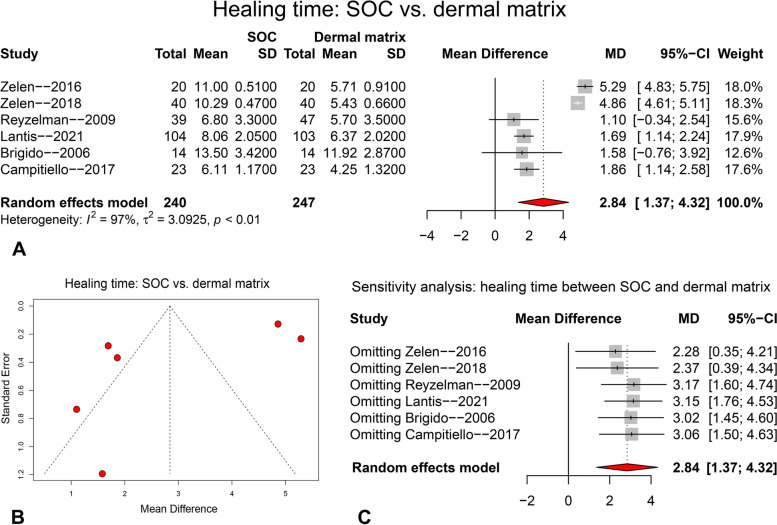
Background: Diabetic foot ulcers (DFUs) have become a global health concern, which can lead to diabetic foot infection (DFI), lower leg amputation, and even mortality. Though the standard of care (SOC) practices have been recognized as the “gold standard” for DFU care, SOC alone may not be adequate to heal all DFUs and prevent their recurrence. The use of dermal matrix has emerged as an adjuvant treatment to enhance DFU healing. The current study aimed to evaluate the effectiveness and safety of dermal matrix application as an adjuvant treatment to the SOC. Methods: The databases of PubMed, Embase and CENTRAL were independently searched by two authors, with the following key terms: “diabetic foot ulcer”, “acellular dermal matrix”, “wound healing”, and so on. Randomized controlled trials (RCTs) evaluated the efficacy and safety of dermal matrix in the treatment of DFUs were eligible for inclusion. The primary outcomes analyzed included time to complete healing and complete healing rate at the final follow-up, while secondary outcomes included wound area, ulcer recurrence rate, amputation risk and complication risk. Meta-analyses were performed using random-effect or fixed-effect models, based on the heterogeneity test. Results: This study included a total of 15 RCTs with a total of 1524 subjects. Of these, 689 patients were treated with SOC alone, while 835 patients received SOC plus dermal matrix. Compared to the SOC group, significantly shorter time (MD = 2.84, 95%CI: 1.37 ~ 4.32, p < 0.001***) was required to achieve complete healing in dermal matrix group. Significantly higher complete healing rate (OR = 0.40, 95%CI: 0.33 ~ 0.49, p < 0.001***) and lower overall (RR = 1.83, 95%CI: 1.15 ~ 2.93, p = 0.011*) and major (RR = 2.64, 95%CI: 1.30 ~ 5.36, p = 0.007**) amputation risks were achieved in dermal matrix group compared to SOC group. No significant difference was found in the wound area, ulcer recurrence rate, and complication risk between the two groups. Conclusions: The application of dermal matrix as an adjuvant therapy in conjunction with SOC effectively improved the healing process of DFUs and reduced the amputation risk when compared to SOC alone. Furthermore, dermal matrix application was well tolerated by the subjects with no added complication risk.
Overview
CoChat Summary
TL;DR
This systematic review and meta-analysis of 15 RCTs found that adding dermal matrix to standard of care (SOC) improved diabetic foot ulcer healing and reduced amputation risk compared with SOC alone. Dermal matrix did not significantly change wound area, ulcer recurrence, or complication risk.
Key findings
- Across 15 RCTs and 1524 subjects (689 SOC alone, 835 SOC plus dermal matrix), dermal matrix was associated with significantly shorter time to complete healing (MD = 2.84, 95% CI 1.37–4.32, p < 0.001) and a significantly higher complete healing rate (OR = 0.40, 95% CI 0.33–0.49, p < 0.001).
- Dermal matrix significantly lowered overall amputation risk (RR = 1.83, 95% CI 1.15–2.93, p = 0.011) and major amputation risk (RR = 2.64, 95% CI 1.30–5.36, p = 0.007), but not minor amputation risk (RR = 1.02, 95% CI 0.49–2.12, p = 0.959).
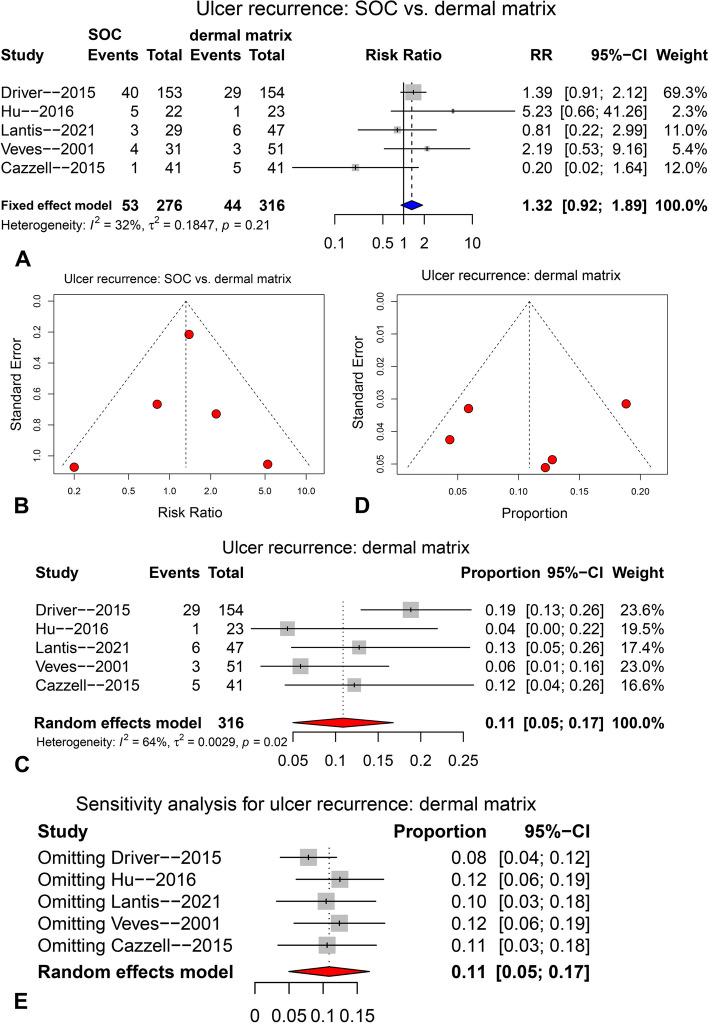
- No significant between-group differences were found for wound area (MD = 0.29, 95% CI −0.32–0.91, p = 0.352), ulcer recurrence rate (RR = 1.32, 95% CI 0.92–1.89, p = 0.138), or complication risk (RR = 1.06, 95% CI 0.93–1.20, p = 0.409).
- Pooled healing rate in the dermal matrix group was 0.70 (95% CI 0.61–0.78), adjusted to 0.56 (95% CI 0.47–0.66) after trim-and-fill for publication bias; pooled ulcer recurrence rate in the dermal matrix group was 0.11 (95% CI 0.05–0.17).
Methods
- Systematic review and meta-analysis conducted per PRISMA, with PubMed, Embase, and CENTRAL searched independently by two authors using terms including “diabetic foot ulcer,” “acellular dermal matrix,” and “wound healing”; English-language publications were included with no country/date restriction.
- Eligible studies were prospectively designed RCTs of patients with DFU comparing SOC with dermal matrix, reporting healing rate, healing time, wound area, ulcer recurrence, amputation risk, or complication risk; 15 RCTs were included qualitatively and 14 quantitatively.
- Meta-analyses used random-effect or fixed-effect models based on heterogeneity (I² ≥ 50% indicated significant heterogeneity); continuous outcomes used mean difference, dichotomous outcomes used odds ratio or risk ratio, and publication bias was assessed with funnel plots, Egger’s and Begg’s tests, and trim-and-fill when indicated.
Limitations
- The paper states that dermal matrix products varied among manufacturers, treatment blinding was difficult because of the different treatment processes, follow-up times differed across studies, and most available RCTs had relatively small sample sizes and short-term follow-up.
- The paper also notes high risk of bias for blinding of participants and personnel, and high risk of bias for blinding of outcome assessment in 4 studies.
- Evident from the text: several pooled analyses had substantial heterogeneity (e.g., I² = 97% for healing time, 86% for healing rate, 98% for wound area, 64% for dermal matrix recurrence rate), and significant publication bias was detected for the pooled dermal matrix healing rate.
Model-written summary. Check it against the paper before relying on it.
Integrity signals
Registry
Cites
Statistics
Figures






Verification
Claims the paper makes
0 Valid · 0 Not valid · 9 Not checked · 57 Own results and interpretations
A result the paper reports from its own data — it cites no other source for it, so there is none to check. The quote shows it is in the paper.
In the paper
“As a result, a total of 15 [22–36] and 14 [22, 23, 25–36] RCTs were included in the qualitative and quantitative synthesis (meta-analysis), respectively.”
§ Effectiveness and safety of dermal matrix used for diabetic foot ulcer: a systematic review and meta-analysis of randomized controlled trials > Results > Study selecting
plain- Asserted: passes — The authors put it forward as true.
- Checkable: passes — It can be checked against evidence.
- Load-bearing: passes — The paper’s conclusions depend on it.
- Based: passes — The paper gives a reason why it holds.
A result the paper reports from its own data — it cites no other source for it, so there is none to check. The quote shows it is in the paper.
In the paper
“No significant difference was found in the wound area, ulcer recurrence rate, and complication risk between the two groups.”
§ Effectiveness and safety of dermal matrix used for diabetic foot ulcer: a systematic review and meta-analysis of randomized controlled trials > Abstract > Results
plainn = 1,524- Asserted: passes — The authors put it forward as true.
- Checkable: passes — It can be checked against evidence.
- Load-bearing: unclear — It is unclear whether the paper’s conclusions depend on it.
- Based: passes — The paper gives a reason why it holds.
A result the paper reports from its own data — it cites no other source for it, so there is none to check. The quote shows it is in the paper.
In the paper
“Significantly higher complete healing rate (OR = 0.40, 95%CI: 0.33 ~ 0.49, p < 0.001***) and lower overall (RR = 1.83, 95%CI: 1.15 ~ 2.93, p = 0.011*) and major (RR = 2.64, 95%CI: 1.30 ~ 5.36, p = 0.007**) amputation risks were achieved in dermal matrix group compared to SOC group.”
§ Effectiveness and safety of dermal matrix used for diabetic foot ulcer: a systematic review and meta-analysis of randomized controlled trials > Abstract > Results
plainstates an associationn = 1,524 ·- Asserted: passes — The authors put it forward as true.
- Checkable: passes — It can be checked against evidence.
- Load-bearing: passes — The paper’s conclusions depend on it.
- Based: passes — The paper gives a reason why it holds.
A result the paper reports from its own data — it cites no other source for it, so there is none to check. The quote shows it is in the paper.
In the paper
“Thirteen studies and 16 arms were pooled with random effects model (I2 = 86%), and the pooled healing rate of dermal matrix group was 0.70 (95CI: 0.61 ~ 0.78) (see the forest plot in Fig. 4A).”
§ Effectiveness and safety of dermal matrix used for diabetic foot ulcer: a systematic review and meta-analysis of randomized controlled trials > Results > Effectiveness of the dermal matrix in DFU
plain- Asserted: passes — The authors put it forward as true.
- Checkable: passes — It can be checked against evidence.
- Load-bearing: passes — The paper’s conclusions depend on it.
- Based: passes — The paper gives a reason why it holds.
- Rests on an assumption not shown here.
A result the paper reports from its own data — it cites no other source for it, so there is none to check. The quote shows it is in the paper.
In the paper
“Of these, 689 patients were treated with SOC alone, while 835 patients received SOC plus dermal matrix.”
- Also stated in: § Summary of the included studies · plain
“The studies randomized a total of 689 patients to receive SOC alone and 835 patients to receive SOC plus dermal matrix.”
§ Effectiveness and safety of dermal matrix used for diabetic foot ulcer: a systematic review and meta-analysis of randomized controlled trials > Abstract > Results
plainn = 1,524- Asserted: passes — The authors put it forward as true.
- Checkable: passes — It can be checked against evidence.
- Load-bearing: unclear — It is unclear whether the paper’s conclusions depend on it.
- Based: passes — The paper gives a reason why it holds.
- Also stated in: § Summary of the included studies · plain
30 more claims
Create a free account to see all 66 claims and to verify the 16 references still open.
- It may state two separate claims as one. 22
- Probably not a substantial claim. 13
Self-check
Percentages, sums and reported differences re-computed from the paper’s own numbers.
Each contradiction between two passages listed here was confirmed by an independent check.
Rated minor: it would not touch a result — a value no result rests on, a p-value that stays on the same side of the significance level, or a conflict that is clerical, resolved elsewhere in the paper, or outside its own findings.
In the paper
“Veves, 2001 [32] | Graftskin | 112 | 8.6 ± 1.5 | 0.65–0.80: 10 (8.9%);0.80–1.00: 50 (35.7%);> 1.00: 59 (52.7%)”
§ Effectiveness and safety of dermal matrix used for diabetic foot ulcer: a systematic review and meta-analysis of randomized controlled trials > Results > Summary of the included studies
Reported 112 · recomputed 119
Rated minor: it would not touch a result — a value no result rests on, a p-value that stays on the same side of the significance level, or a conflict that is clerical, resolved elsewhere in the paper, or outside its own findings.
In the paper
§ Effectiveness and safety of dermal matrix used for diabetic foot ulcer: a systematic review and meta-analysis of randomized controlled trials > Results > Study selecting
“As a result, a total of 15 [22–36] and 14 [22, 23, 25–36] RCTs were included in the qualitative and quantitative synthesis (meta-analysis), respectively.”
§ Effectiveness and safety of dermal matrix used for diabetic foot ulcer: a systematic review and meta-analysis of randomized controlled trials > References
“A prospective, multicenter, single-arm clinical trial for treatment of complex diabetic foot ulcers with deep exposure using acellular dermal matrix”
Rated minor: it would not touch a result — a value no result rests on, a p-value that stays on the same side of the significance level, or a conflict that is clerical, resolved elsewhere in the paper, or outside its own findings.
In the paper
§ Effectiveness and safety of dermal matrix used for diabetic foot ulcer: a systematic review and meta-analysis of randomized controlled trials > Results > Summary of the included studies
“The follow-up periods were 4, 6, 12, 16, 21, 24, 28, and 42 weeks in 1 [22], 1 [36], 5 [25, 29–31, 34], 4 [23, 24, 27, 35], 1 [32], 1 [26], 1 [28] and 1 [33] studies, respectively.”
§ Effectiveness and safety of dermal matrix used for diabetic foot ulcer: a systematic review and meta-analysis of randomized controlled trials > Results > Summary of the included studies
“every other day for 6 months or until 100% wound closure”
Rated minor: it would not touch a result — a value no result rests on, a p-value that stays on the same side of the significance level, or a conflict that is clerical, resolved elsewhere in the paper, or outside its own findings.
In the paper
§ Effectiveness and safety of dermal matrix used for diabetic foot ulcer: a systematic review and meta-analysis of randomized controlled trials > Results > Summary of the included studies
“The follow-up periods were 4, 6, 12, 16, 21, 24, 28, and 42 weeks in 1 [22], 1 [36], 5 [25, 29–31, 34], 4 [23, 24, 27, 35], 1 [32], 1 [26], 1 [28] and 1 [33] studies, respectively.”
§ Effectiveness and safety of dermal matrix used for diabetic foot ulcer: a systematic review and meta-analysis of randomized controlled trials > Results > Summary of the included studies
“efficacy evaluation for 12 weeks + safety evaluation for another 3 months”
Rated minor: it would not touch a result — a value no result rests on, a p-value that stays on the same side of the significance level, or a conflict that is clerical, resolved elsewhere in the paper, or outside its own findings.
In the paper
§ Effectiveness and safety of dermal matrix used for diabetic foot ulcer: a systematic review and meta-analysis of randomized controlled trials > Results > Summary of the included studies
“The follow-up periods were 4, 6, 12, 16, 21, 24, 28, and 42 weeks in 1 [22], 1 [36], 5 [25, 29–31, 34], 4 [23, 24, 27, 35], 1 [32], 1 [26], 1 [28] and 1 [33] studies, respectively.”
§ Effectiveness and safety of dermal matrix used for diabetic foot ulcer: a systematic review and meta-analysis of randomized controlled trials > Results > Summary of the included studies
“for 12 months after grafting surgery”
Citations
Cites
Preferred Reporting Items for Systematic Reviews and Meta-Analyses: the PRISMA statement
Moher, D., Liberati, A., Tetzlaff, J., Altman, D. G., & for the PRISMA Group (2009) · BMJ · doi:10.1136/bmj.b2535 · Cited by 83,823
Preferred reporting items for systematic reviews and meta-analyses: the PRISMA Statement.
(2009) · PubMed Central · Cited by 44,859
The Cochrane Collaboration's tool for assessing risk of bias in randomised trials
Higgins, J. P. T., Altman, D. G., Gotzsche, P. C., Juni, P., Moher, D., Oxman, A. D., Savovic, J., Schulz, K. F., Weeks, L., Sterne, J. A. C., et al. (2011) · BMJ · doi:10.1136/bmj.d5928 · Cited by 33,817
Dermyshi, E., Wang, Y., Yan, C., Hong, W., Qiu, G., Gong, X., & Zhang, T. (2017) · Neonatology · doi:10.1159/000454668 · Cited by 24,451
Diabetic foot ulcers and their recurrence
Armstrong, D. G., Boulton, A. J. M., & Bus, S. A. (2017) · New England Journal of Medicine · doi:10.1056/nejmra1615439 · Cited by 4,376
The global burden of diabetic foot disease
Boulton, A. J. M., Vileikytė, L., Tennvall, G. R., & Apelqvist, J. (2005) · The Lancet · doi:10.1016/s0140-6736(05)67698-2 · Cited by 2,578
Armstrong, D. G., Lavery, L. A., & Harkless, L. B. (1998) · Diabetes Care · doi:10.2337/diacare.21.5.855 · Cited by 1,154
Update on management of diabetic foot ulcers
Everett, E., & Mathioudakis, N. (2018) · Annals of the New York Academy of Sciences · doi:10.1111/nyas.13569 · Cited by 913
Veves, A., Falanga, V., Armstrong, D. G., Sabolinski, M. L., & Study, T. A. D. F. U. (2001) · Diabetes Care · doi:10.2337/diacare.24.2.290 · Cited by 643
The costs of diabetic foot: The economic case for the limb salvage team
Driver, V. R., Fabbi, M., Lavery, L. A., & Gibbons, G. (2010) · Journal of Vascular Surgery · doi:10.1016/j.jvs.2010.06.003 · Cited by 505
Cited by
Monami, M., Scatena, A., Ragghianti, B., Miranda, C., Monge, L., Silverii, G. A., Uccioli, L., Vermigli, C., Syndrome, F. T. P. O. T. I. G. F. T. T. O. D. F., Bernetti, A., et al. (2024) · Acta Diabetologica · doi:10.1007/s00592-024-02426-7 · Cited by 26
Xiong, Y., He, C., Su, D., Zheng, S., Deng, W., & Li, Y. (2026) · Biomaterials · doi:10.1016/j.biomaterials.2026.124428 · Cited by 3
Chen, S.-F., & Chang, C. (2026) · Frontiers in Surgery · doi:10.3389/fsurg.2026.1687275 · Cited by 2
A Novel Prehydrated Porcine‐Derived Acellular Dermal Matrix: A Histological and Clinical Evaluation
van Orten, A., Götz, W., & Bilhan, H. (2024) · International Journal of Biomaterials · doi:10.1155/2024/7322223 · Cited by 2
Adegboye, O., Pillay, K., & Adams, S. (2025) · Journal of Trauma Nursing · doi:10.1097/jtn.0000000000000829 · Cited by 2
LIMB PRESERVATION WITH CELLULAR, ACELLULAR AND MATRIX-LIKE PRODUCTS (CAMPS)
Cole, W., Abdo, R., Chatman, B. C., Couch, A. L., Davis, D., Lullove, E. J., Methodius-Rayford, W., Rogers, L. C., Snyder, R., Wu, S., et al. (2025) · Journal of Wound Care · doi:10.12968/jowc.2025.34.s11d.s1 · Cited by 1
СПОСІБ ВИГОТОВЛЕННЯ БЕЗКЛІТИННОГО ДЕРМАЛЬНОГО МАТРИКСУ ЗІ ШКІРИ СВИНІ
Кулянда, О. І. (2025) · Перспективи та інновації науки · doi:10.52058/2786-4952-2025-11(57)-3226-3235
Корда, М. М., & Кулянда, О. І. (2026) · Здобутки клінічної і експериментальної медицини · doi:10.11603/1811-2471.2025.v.i4.15778
Nam, H. J., Bae, J., Kim, S. Y., & Choi, H. J. (2026) · International Wound Journal · doi:10.1111/iwj.70974
Lao, C., Alcacer‐Pitarch, B., Patterson, S., Tiganescu, A., & Wright, C. S. (2026) · Diabetology · doi:10.3390/diabetology7100193
Qawasmeh, M., Zahdeh, A., Bseiso, O., Mujahed, Z., & Zir, O. A. (2026) · Clinical Case Reports · doi:10.1002/ccr3.73197
Măciuceanu-Zărnescu, B. M., Lungu, I. I., Niculescu, A.-G., Scafa‐Udriște, A., Baciu, C. C., Anghel, D. N., Rădulescu, A. R., Grumezescu, A. M., & Vâlcea, S. (2026) · Journal of Functional Biomaterials · doi:10.3390/jfb17080397
Guerriero, F. P., Clark, R. A., Miller, M., & Delaney, C. L. (2026) · Biomedicines · doi:10.3390/biomedicines14092130
Rahmi, R. N. D., Permana, I., & Ahmad, G. (2026) · Jurnal Penelitian Perawat Profesional · doi:10.37287/jppp.v8i5.2761
Metadata
- Authors
- Sui, L., Xie, Q., Jiang, H.-T., & Li, X.-D.
- Affiliations
- Affiliated Hospital of Chengde Medical College (CN)
- Venue
- BMC Endocrine Disorders
- Published
- 2024-02-20
- Volume
- 24
- Issue
- 1
- Pages
- 23-23
- ISSN
- 1472-6823 (ISSN-L)
- PMC
- PMC10877811
- OpenAlex
- W4391968966
- Cited by
- 14
- References
- 42
- Citations by year
- 2026: 9 · 2025: 3 · 2024: 2
- FWCI
- 0.66
- Type
- journal article
- Language
- en
- Open access
- gold
- doi.org
- Licence
- cc-by
- creativecommons.org/licenses/by/4.0 (tdm)
- creativecommons.org/licenses/by/4.0 (vor)
- Locations
- BMC Endocrine Disorders (publishedVersion, cc-by)
- PubMed Central (publishedVersion, cc-by)
- PubMed (publishedVersion)
- DOAJ (DOAJ: Directory of Open Access Journals) (submittedVersion, cc-by-sa)
- Topics
- Health Sciences › Medicine › Endocrinology, Diabetes and Metabolism › Diabetic Foot Ulcer Assessment and Management
- Health Sciences › Medicine › Surgery › Wound Healing and Treatments
- Health Sciences › Medicine › Surgery › Tissue Engineering and Regenerative Medicine
- Keywords
- diabetic foot ulcer, acellular dermal matrix, wound healing, adjuvant therapy, standard of care, ulcer healing time, amputation risk, ulcer recurrence, wound area, treatment safety, diabetic foot infection, complication risk, wound healing biomarkers, wound healing rate, wound healing time
- MeSH terms
- Amputation, Surgical, Humans, Wound Healing, Randomized Controlled Trials as Topic, Treatment Outcome, Diabetic Foot, Acellular Dermis
About these checks
Registry, retraction, Cites and statistics results are computed, not judged, with one exception: a printed reference that no index lists is read once by a model before it counts as a citation error. Claims are extracted by a model and kept only when their quote appears verbatim in the text; each cited source is then checked, with a model’s help, for whether it says what the claim relies on. Those verdicts can be wrong — read the claim’s quote and the cited source before relying on one.
A language model drew the claims from the paper on 2026-11-13, under version 3 of the claim definition (model deepseek-v4.1-flash, prompt extract-v3).
A second model labelled each claim on 2026-11-13 (model jev-1.13-20260917, definition revision gold-guideline-v0.2).
Statistics and arithmetic are recomputed, not judged.
Confidence bands are shown only for fields calibrated on our annotated test set. None is calibrated yet, so no band is shown.
What counts as a claim ›How we measure confidence ›How we check this ›
Are you an author, or do you see a problem with this page? Request a review
Data sources
Bibliographic data: Semantic Scholar, OpenAlex, Crossref.
Contains information from the Semantic Scholar Academic Graph Datasets, made available under the ODC Attribution License (ODC-BY 1.0).
Semantic Scholar’s data is described in: Kinney, R., et al. (2023). The Semantic Scholar Open Data Platform. arXiv:2301.10140.
