

Do randomised clinical trials on dental caries adopt Open Science practices?
Open accessPublished version of a preprint
The DOI matches its Crossref record; 41 of the 41 references it cites were found in a registry or an index; 10 of the 21 sources its claims cite were checked for support.
Abstract
BACKGROUND: Open Science Practices (OSPs) are essential when assessing research integrity and quality of Randomised Clinical Trials (RCTs). As dental caries represents a significant oral health burden, our objective was to identify and analyse the adoption of OSPs within RCTs focused on addressing this disease. METHODS: We searched PubMed to retrieve RCTs related to dental caries published from January 2000 to March 2022. Two independent researchers assessed a random sample of these articles to evaluate their eligibility until reaching the minimum sample size. Then, the same examiners reviewed the included texts regarding the OSPs adopted in the articles. The collected variables related to OSPs were reporting guidelines, protocol registration, detailed methodology available, open-source software, statistical analysis code sharing, statistical analysis plan, data sharing, open peer review, and open access. Association analyses using logistic regression were conducted considering the publication year, the continent of the first author, impact factor and open-access policy of the journals (explanatory variables), and adoption of at least one OSP or one OSP other than open access (outcomes). The recommendations for adopting OSPs were assessed by reviewing the "Instructions for Authors" section of the most frequently used journals where the included papers were published. RESULTS: 64.8% of the articles (95% Confidence Interval = 59.3-70.1%) adopted at least one OSP. However, no individual OSP was adopted by more than 50% of the articles. The most adopted practices were protocol registration (37.1%), the use of reporting guidelines (33.1%) and publishing open access (37.3%). These are also the OSPs most often recommended by journals in the Instructions for Authors. A few articles adopted other practices. Older articles presented a lower frequency of adopting these practices, and articles published in higher impact factor journals were positively associated with both outcomes. CONCLUSION: The RCTs published on dental caries demonstrate a low frequency of adoption of most OSPs. However, a trend toward increased adoption of these practices has been notable in recent years.
Overview
CoChat Summary
TL;DR
This meta-research study assessed adoption of Open Science Practices (OSPs) in randomised clinical trials on dental caries published from 2000 to 2022. It found that 64.8% adopted at least one OSP, but no individual OSP was adopted by more than 50% of trials, with adoption increasing in more recent and higher-impact-factor journals.
Key findings
- 64.8% of included articles (95% CI = 59.3–70.1%) adopted at least one OSP; however, no individual OSP was adopted by more than 50% of articles.
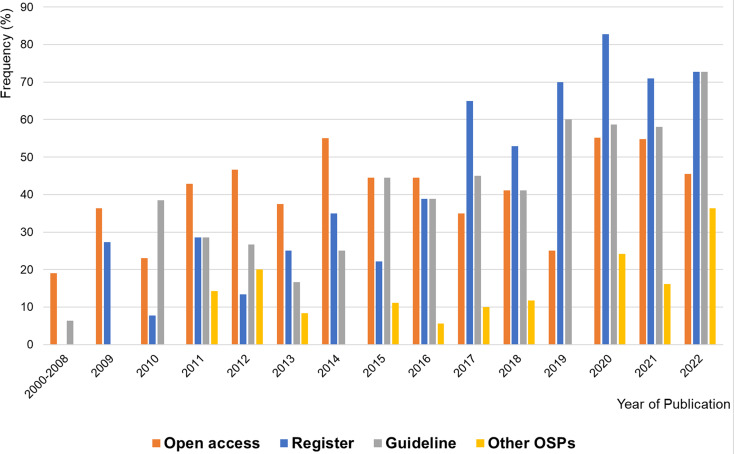
- The most adopted practices were protocol registration (37.1%), reporting guidelines (33.1%), and open access (37.3%); script analysis and statistical analysis plans were absent in 100% of articles, and open-source software was absent or unclear in 96%.
- Data sharing was rare: 13 articles stated data would be shared upon reasonable request, and only 2 reported data availability in public repositories; one of those links could not be accessed.
- Older articles had lower odds of adopting OSPs, while higher journal impact factor was positively associated with both adoption of at least one OSP and adoption of an OSP other than open access; adjusted OR for impact factor was 1.41 (95% CI 1.22–1.64) and 1.68 (95% CI 1.43–1.99), respectively.
Methods
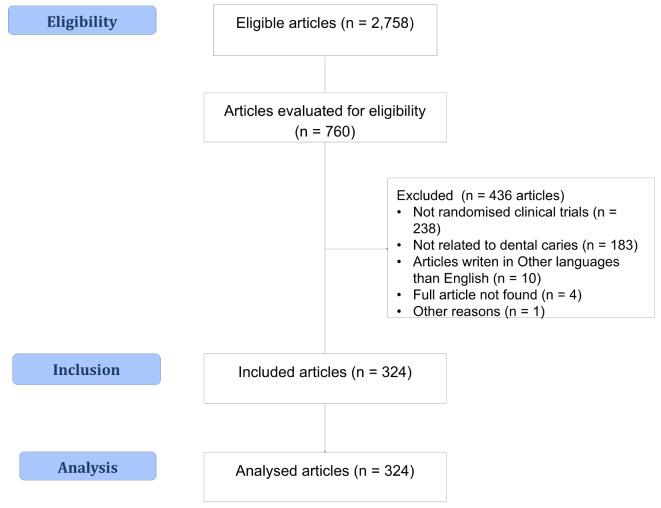
- Cross-sectional meta-research study of RCTs related to dental caries, searched in PubMed on March 27, 2022, with publication limited to after 2000; 2,758 articles were retrieved.
- A random sample was assessed until the minimum sample size of 324 articles was reached; two independent calibrated examiners extracted OSP data after achieving kappa >0.70.
- Logistic regression evaluated associations between publication year, first-author continent, journal impact factor, and journal open-access policy with two outcomes: adoption of at least one OSP and adoption of at least one OSP other than open access; the top 15 journals’ “Instructions for Authors” were also reviewed in 2023.
Limitations
- The authors state that only the most updated versions of the journals’ “Instructions for Authors” were evaluated, with no attempt to assess older versions, and that changes in journal recommendations over time were not evaluated.
- The authors also note difficulty accessing data via the link provided in one of the two articles reporting public repository data sharing.
- Evident from the text: the search was limited to PubMed and to articles fully reported in English, and the cross-sectional design cannot establish causality for the observed associations.
Model-written summary. Check it against the paper before relying on it.
Integrity signals
Registry
Cites
Statistics
Figures
Verification
Claims the paper makes
7 Valid · 1 Not valid · 9 Not checked · 73 Own results and interpretations
Every source the paper cites for this claim was checked and supports it.
In the paper
“A study evaluating more than 10,000 articles on dental research observed a frequency of 7% of the papers with the registered protocol.”
§ Do randomised clinical trials on dental caries adopt Open Science practices? > Discussion
What the sources say
- Supportedcites [20] Raittio E, Sofi-Mahmudi A, Uribe SE. Research transparency in dental research: a programmatic analysis. Eur J Oral Sci. 2023;131(1):e12908. 10.1111/eos.12908. 36482006 PMC10108147 source
The Results report that the study analyzed 10,659 accessible full-text articles from dental journals and that 6.9% (737) had a registered protocol. The 7% figure is an accurate rounding; it applies to the accessible articles analyzed, not all dental articles identified. (LLM, conf=0.95)
plain- Asserted: passes — The authors put it forward as true.
- Checkable: passes — It can be checked against evidence.
- Load-bearing: unclear — It is unclear whether the paper’s conclusions depend on it.
- Based: passes — The paper gives a reason why it holds.
- Supported
Every source the paper cites for this claim was checked and supports it.
In the paper
“Other articles also found a low prevalence of data sharing in articles published in dentistry, around 2% [20, 21].”
§ Do randomised clinical trials on dental caries adopt Open Science practices? > Discussion
What the sources say
- Supportedcites [20] Raittio E, Sofi-Mahmudi A, Uribe SE. Research transparency in dental research: a programmatic analysis. Eur J Oral Sci. 2023;131(1):e12908. 10.1111/eos.12908. 36482006 PMC10108147 source
The Results report that 2.0% of the dental-journal articles analyzed shared their data. The sample was limited to full-text articles accessible through Europe PubMed Central, so the figure should be read as applying to that sample. (LLM, conf=0.94)
- Supportedcites [21] Uribe SE, Sofi-Mahmudi A, Raittio E, Maldupa I, Vilne B. Dental research data availability and quality according to the FAIR principles. J Dent Res. 2022;101(11):1307–13. 10.1177/00220345221101321. 35656591 PMC9516597 source
The Results report that 112 of 7,509 dental articles (1.5%) shared open data. The Discussion likewise describes data sharing in dental journals as remaining at 1.5%, consistent with the citing sentence’s approximate figure of 2%. Page numbers were not supplied. (LLM, conf=0.93)
plain- Asserted: passes — The authors put it forward as true.
- Checkable: passes — It can be checked against evidence.
- Load-bearing: unclear — It is unclear whether the paper’s conclusions depend on it.
- Based: passes — The paper gives a reason why it holds.
- Supported
The cited sources that could be checked couldn’t confirm or dispute this claim.
In the paper
“However, we could not properly access the data in one of these studies [34].”
§ Do randomised clinical trials on dental caries adopt Open Science practices? > Discussion
What the sources say
- Could not verifycites [34] Adham MM, El Kashlan MK, Abdelaziz WE, Rashad AS. The impact of minimally invasive restorative techniques on perception of dental pain among pregnant women: a randomized controlled clinical trial. BMC Oral Health. 2021;21(1):76. 10.1186/s12903-021-01432-3. 33602209 PMC7891028 sourceExperimental — accuracy not yet measured
The Methods (Statistical analysis) and Results describe the trial’s data analysis and findings, but do not address whether the citing authors could access its underlying data. Searches for a data-availability statement and access on request found no passage that could verify their reported difficulty accessing it. (LLM, conf=0.76)
hedged- Asserted: passes — The authors put it forward as true.
- Checkable: passes — It can be checked against evidence.
- Load-bearing: unclear — It is unclear whether the paper’s conclusions depend on it.
- Based: passes — The paper gives a reason why it holds.
- Could not verify
The sources with a verdict support this claim; the rest weren’t checked yet, have no full text we could read, or their verdicts aren’t rated yet.
In the paper
“However, the higher values found in our study are probably due to our focus solely on RCTs, while previous studies considered any study design [29–31].”
§ Do randomised clinical trials on dental caries adopt Open Science practices? > Discussion
What the sources say
- Supportedcites [29] Pathak K, Marwaha JS, Chen HW, Krumholz HM, Matthews JB. Use of open science practices in surgical journals. JAMA Surg. 2024;159(2):228–9. 10.1001/jamasurg.2023.5389. 38117492 PMC10733844 source
The Methods describe a random sample of 240 original research articles, not a sample restricted to RCTs. The Results report practices separately for clinical trials and observational studies, supporting the citing paper’s characterization of this earlier study as considering multiple study designs. The proposed reason for the higher values is the citing authors’ own inference. (LLM, conf=0.90)
- Not checked yetcites [30] Kashif Al-Ghita M, Cobey K, Moher D, Leeflang MMG, Ebrahimzadeh S, Lam E, Rooprai P, Khalil AA, Islam N, Algodi H, et al. Cross-sectional evaluation of open science practices at imaging journals: a meta-research study. Can Assoc Radiol J. 2023. 10.1177/08465371231211290. 37997809 source
Checked before — its earlier verdict is held back until a new check runs.
- Not checked — no full text of the sourcecites [31] Bullock GS, Ward P, Impellizzeri FM, Kluzek S, Hughes T, Hillman C, Waterman BR, Danelson K, Henry K, Barr E, et al. Up front and open? Shrouded in secrecy? Or somewhere in between? A meta-research systematic review of open science practices in sport medicine research. J Orthop Sports Phys Ther. 2023;53(12):1–13. 10.2519/jospt.2023.12016. 37860866 source
hedgedstates a possible cause- Asserted: passes — The authors put it forward as true.
- Checkable: passes — It can be checked against evidence.
- Load-bearing: unclear — It is unclear whether the paper’s conclusions depend on it.
- Based: passes — The paper gives a reason why it holds.
- Supported
A result the paper reports from its own data — it cites no other source for it, so there is none to check. The quote shows it is in the paper.
In the paper
“Of the eight articles in which peer review was open, all were published in gold open-access journals.”
§ Do randomised clinical trials on dental caries adopt Open Science practices? > Discussion
plainstates an association- Asserted: passes — The authors put it forward as true.
- Checkable: passes — It can be checked against evidence.
- Load-bearing: unclear — It is unclear whether the paper’s conclusions depend on it.
- Based: passes — The paper gives a reason why it holds.
53 more claims
Create a free account to see all 90 claims and to verify the 3 references still open.
- Probably not a substantial claim. 24
- It may state two separate claims as one. 8
- The quote only partly states this claim. 1
Citations
Cites
Evidence based medicine: what it is and what it isn't
Sackett, D. L., Rosenberg, W. M. C., Gray, J. A. M., Haynes, R. B., & Richardson, W. S. (1996) · BMJ · doi:10.1136/bmj.312.7023.71 · Cited by 15,769 · cited 1×
“Evidence-based practice is the current paradigm in healthcare, advocating the judicious use of the best available evidence to make healthcare decisions [5, 6].”
Improving the Quality of Reporting of Randomized Controlled Trials: The CONSORT Statement
Begg, C. (1996) · JAMA · doi:10.1001/jama.1996.03540080059030 · Cited by 3,127
The Academic, Economic and Societal Impacts of Open Access: An Evidence-Based Review
Tennant, J. P., Waldner, F., Jacques, D. C., Masuzzo, P., Collister, L. B., & Hartgerink, C. H. J. (2016) · F1000Research · doi:10.12688/f1000research.8460.3 · Cited by 560
(2021) · doi:10.54677/mnmh8546 · Cited by 448
Global Burden and Inequality of Dental Caries, 1990 to 2019
Wen, P. Y. F., Chen, M. X., Zhong, Y. J., Dong, Q. Q., & Wong, H. M. (2022) · Journal of Dental Research · doi:10.1177/00220345211056247 · Cited by 431 · cited 3×
“Untreated dental caries is the most prevalent oral health issue, affecting approximately two billion individuals globally [1] and consistently impacting negatively their quality of life [2].”
Oral Conditions and Health-Related Quality of Life: A Systematic Review
Haag, D. G., Peres, K. G., Balasubramanian, M., & Brennan, D. S. (2017) · Journal of Dental Research · doi:10.1177/0022034517709737 · Cited by 348 · cited 3×
“Untreated dental caries is the most prevalent oral health issue, affecting approximately two billion individuals globally [1] and consistently impacting negatively their quality of life [2].”
Open science saves lives: lessons from the COVID-19 pandemic
Besançon, L., Peiffer-Smadja, N., Segalas, C., Jiang, H., Masuzzo, P., Smout, C., Billy, E., Deforet, M., & Leyrat, C. (2021) · BMC Medical Research Methodology · doi:10.1186/s12874-021-01304-y · Cited by 249 · cited 5×
“It is, therefore, crucial that the growing Open Science movement in the last decades, driven by the pressing demands accentuated by the pandemic, does not lose its momentum [16] and is increasingly incorporated into all fields of dentistry.”
InfluentialPreregistering Qualitative Research: A Delphi Study
Haven, T. L., Errington, T. M., Gleditsch, K. S., van Grootel, L., Jacobs, A. M., Kern, F. G., Piñeiro, R., Rosenblatt, F., & Mokkink, L. B. (2020) · International Journal of Qualitative Methods · doi:10.1177/1609406920976417 · Cited by 211 · cited 1×
“This action may initially restrict some publications, mainly considering some study designs, such as qualitative research [36].”
The academic, economic and societal impacts of Open Access: an evidence-based review
Tennant, J. P., Waldner, F., Jacques, D. C., Masuzzo, P., Collister, L. B., & Hartgerink, C. H. J. (2016) · F1000Research · doi:10.12688/f1000research.8460.1 · Cited by 182 · cited 2×
“Open access has been established since the 1990s, marked by the inception of pioneering platforms such as ArXiv.org, the Open Science Institute (later renamed to Open Science Foun-dations) and the Scientific Electronic Library (SciELO) in Brazil [25].”
Altman, D. G., & Simera, I. (2016) · Journal of the Royal Society of Medicine · doi:10.1177/0141076815625599 · Cited by 173 · cited 1×
“Indeed, guidelines for reporting RCT are pioneers in this sense [32].”
Assessment of transparency indicators across the biomedical literature: How open is open?
Serghiou, S., Contopoulos-Ioannidis, D. G., Boyack, K. W., Riedel, N., Wallach, J. D., & Ioannidis, J. P. A. (2021) · PLOS Biology · doi:10.1371/journal.pbio.3001107 · Cited by 139 · cited 1×
“In other articles, the authors only stated that the data could be made available on reasonable request, which is not counted as “current” data sharing in previous studies [20, 35].”
A Systematic Map of Systematic Reviews in Pediatric Dentistry—What Do We Really Know?
Mejàre, I. A., Klingberg, G., Mowafi, F. K., Stecksén-Blicks, C., Twetman, S. H. A., & Tranæus, S. H. (2015) · PLOS ONE · doi:10.1371/journal.pone.0117537 · Cited by 106 · cited 1×
“Consequently, prevention and management strategies based on the best available evidence for this public health problem are a vast need [3, 4].”
Promoting trust in research and researchers: How open science and research integrity are intertwined
Haven, T. L., Gopalakrishna, G., Tijdink, J. K., van der Schot, D., & Bouter, L. M. (2022) · BMC Research Notes · doi:10.1186/s13104-022-06169-y · Cited by 103 · cited 1×
“…these practices would be more linked to science dissemination, they are, in fact, intertwined with “responsible research practices”, which focus on the rigorous conduct of research, and with “transparency” linked to the complete reporting of research at every stage of the research lifecycle [13].”
Science as collaborative knowledge generation
Ellemers, N. (2020) · British Journal of Social Psychology · doi:10.1111/bjso.12430 · Cited by 77 · cited 1×
“Also, a change in the rewarding academic system focusing more on responsible research practices, including open science [40], is necessary to enhance the adoption of the OSPs.”
Open Science 2.0: Towards a truly collaborative research ecosystem
Thibault, R. T., Amaral, O. B., Argolo, F., Bandrowski, A. E., Davidson, A. R., & Drude, N. I. (2023) · PLOS Biology · doi:10.1371/journal.pbio.3002362 · Cited by 72
Time for NIH to lead on data sharing
Sim, I., Stebbins, M., Bierer, B. E., Butte, A. J., Drazen, J., Dzau, V., Hernandez, A. F., Krumholz, H. M., Lo, B., Munos, B., et al. (2020) · Science · doi:10.1126/science.aba4456 · Cited by 63 · cited 2×
“Moreover, different stakeholders involved in research should value these outputs related to OSPs in the evaluations and funding distribution systems [12, 39].”
Dental Research Waste in Design, Analysis, and Reporting: A Scoping Review
Pandis, N., Fleming, P. S., Katsaros, C., & Ioannidis, J. P. A. (2021) · Journal of Dental Research · doi:10.1177/0022034520962751 · Cited by 58 · cited 1×
“In dentistry, although most journals endorse OSPs, such as the use of reporting guidelines and recommendations for data sharing [18], very few articles have made their crude data available [19–22], and most studies have not registered the research protocol prospectively [19].”
A practical approach to evidence-based dentistry
Brignardello‐Petersen, R., Carrasco‐Labra, A., Glick, M., Guyatt, G. H., & Azarpazhooh, A. (2014) · The Journal of the American Dental Association · doi:10.14219/jada.2014.102 · Cited by 57 · cited 2×
“Given the significant impact of dental caries on the population [1, 2], well-designed RCTs are crucial to investigating effective dental caries treatments [5, 9].”
Open science approaches to COVID-19
Tse, E. G., Klug, D. M., & Todd, M. H. (2020) · F1000Research · doi:10.12688/f1000research.26084.1 · Cited by 48 · cited 2×
“The most remarkable example of the importance of open science could be seen during the COVID-19 pandemic [16, 17].”
Community consensus on core open science practices to monitor in biomedicine
Cobey, K. D., Haustein, S., Brehaut, J., Dirnagl, U., Franzen, D. L., Hemkens, L. G., Presseau, J., Riedel, N., Strech, D., Alperin, J. P., et al. (2023) · PLOS Biology · doi:10.1371/journal.pbio.3001949 · Cited by 46 · cited 2×
“This is the core principle of Open Science [10–12].”
Self-citationCaries management: technical solutions to biological problems or evidence‐based care?
Baelum, V. (2008) · Journal of Oral Rehabilitation · doi:10.1111/j.1365-2842.2007.01784.x · Cited by 43 · cited 1×
“Consequently, prevention and management strategies based on the best available evidence for this public health problem are a vast need [3, 4].”
A practical approach to evidence-based dentistry: III
Brignardello‐Petersen, R., Carrasco‐Labra, A., Glick, M., Guyatt, G. H., & Azarpazhooh, A. (2014) · The Journal of the American Dental Association · doi:10.1016/j.adaj.2014.11.010 · Cited by 32 · cited 1×
“Among the most relevant research designs, randomised clinical trials (RCTs) are the primary studies with the most robust evidence for evaluating health interventions’ efficacy [7].”
Dental Research Data Availability and Quality According to the FAIR Principles
Uribe, S. E., Sofi-Mahmudi, A., Raittio, E., Maldupa, I., & Vilne, B. (2022) · Journal of Dental Research · doi:10.1177/00220345221101321 · Cited by 27 · cited 3×
“Despite the low frequency of OSPs, we could observe that the chance of adopting open science practices is higher in more recent articles, corroborating previous findings [20, 21].”
Public availability of research data in dentistry journals indexed in Journal Citation Reports
Vidal-Infer, A., Tarazona, B., Alonso-Arroyo, A., & Aleixandre-Benavent, R. (2018) · Clinical Oral Investigations · doi:10.1007/s00784-017-2108-0 · Cited by 25 · cited 2×
“Articles published in journals with a higher impact factor also showed a higher frequency of open science practices, which was also observed for journals in dentistry [22] but not in medical radiology [30].”
Opening Brazilian COVID-19 patient data to support world research on pandemics
Mello, L. E., Suman, A., Medeiros, C. B., Prado, C. A., Rizzatti, E. G., Nunes, F. L. S., Barnabé, G. F., Ferreira, J. E., Sá, J., Reis, L. F. L., et al. (2020) · Zenodo (CERN European Organization for Nuclear Research) · doi:10.5281/zenodo.3966426 · Cited by 22
Transparency in clinical trials: Adding value to paediatric dental research
Cenci, M. S., Franco, M. C., Raggio, D. P., Moher, D., & Pereira‐Cenci, T. (2020) · International Journal of Paediatric Dentistry · doi:10.1111/ipd.12769 · Cited by 21 · cited 1×
“Open science practices (OSP) enhance the assessment of research quality and issues related to trans-parency and integrity [14, 15] and also play a pivotal role in the acceleration of research on therapies for emerging and serious diseases, as observed during the COVID-19 pandemic [16, 17].”
Self-citationEquity, transparency, and accountability: open science for the 21st century
Winker, M. A., Bloom, T., Onie, S., & Tumwine, J. (2023) · The Lancet · doi:10.1016/s0140-6736(23)01575-1 · Cited by 20 · cited 1×
“Open science practices (OSP) enhance the assessment of research quality and issues related to trans-parency and integrity [14, 15] and also play a pivotal role in the acceleration of research on therapies for emerging and serious diseases, as observed during the COVID-19 pandemic [16, 17].”
Open-access Plan S to allow publishing in any journal
Van Noorden, R. (2020) · Nature · doi:10.1038/d41586-020-02134-6 · Cited by 19 · cited 1×
“It is important to highlight that several universities have recently made it mandatory for their staff to publish open access [26], which may be reflected in our findings.”
Reward systems for cohort data sharing: An interview study with funding agencies
Devriendt, T., Shabani, M., & Borry, P. (2023) · PLoS ONE · doi:10.1371/journal.pone.0282969 · Cited by 16 · cited 1×
“Some funders have already recommended this [37–39].”
Research transparency in dental research: A programmatic analysis
Raittio, E., Sofi‐Mahmudi, A., & Uribe, S. E. (2023) · European Journal of Oral Sciences · doi:10.1111/eos.12908 · Cited by 15 · cited 4×
“Despite the low frequency of OSPs, we could observe that the chance of adopting open science practices is higher in more recent articles, corroborating previous findings [20, 21].”
InfluentialBullock, G. S., Ward, P., Impellizzeri, F. M., Kluzek, S., Hughes, T., Hillman, C., Waterman, B. R., Danelson, K., Henry, K., Barr, E., et al. (2023) · Journal of Orthopaedic & Sports Physical Therapy · doi:10.2519/jospt.2023.12016 · Cited by 15
Assessing Open Science practices in physical activity behaviour change intervention evaluations
Norris, E., Sulevani, I., Finnerty, A. N., & Castro, O. (2022) · BMJ Open Sport & Exercise Medicine · doi:10.1136/bmjsem-2021-001282 · Cited by 14 · cited 1×
“%) than the one observed in our study was evidenced among interventional studies on physical activity behaviour change [33].”
A practical approach to evidence-based dentistry: X
Carrasco‐Labra, A., Brignardello‐Petersen, R., Azarpazhooh, A., Glick, M., & Guyatt, G. H. (2015) · The Journal of the American Dental Association · doi:10.1016/j.adaj.2015.08.008 · Cited by 13 · cited 1×
“However, to yield optimal evidence, these studies must be appropriately designed, conducted, and reported [8, 9].”
Mendes, F. M., Braga, M. M., Pássaro, A. L., Moro, B. L. P., Freitas, R. D., Gimenez, T., Tedesco, T. K., Raggio, D. P., & Pannuti, C. M. (2020) · International Journal of Paediatric Dentistry · doi:10.1111/ipd.12743 · Cited by 12 · cited 2×
“Given the significant impact of dental caries on the population [1, 2], well-designed RCTs are crucial to investigating effective dental caries treatments [5, 9].”
Self-citationAdham, M. M., El Kashlan, M. K., Abdelaziz, W. E., & Rashad, A. S. (2021) · BMC Oral Health · doi:10.1186/s12903-021-01432-3 · Cited by 12
Cross-Sectional Evaluation of Open Science Practices at Imaging Journals: A Meta-Research Study
Kashif Al-Ghita, M., Cobey, K., Moher, D., Leeflang, M. M. G., Ebrahimzadeh, S., Lam, E., Rooprai, P., Khalil, A. A., Islam, N., Algodi, H., et al. (2024) · Canadian Association of Radiologists Journal · doi:10.1177/08465371231211290 · Cited by 8 · cited 3×
“Articles published in journals with a higher impact factor also showed a higher frequency of open science practices, which was also observed for journals in dentistry [22] but not in medical radiology [30].”
Endorsement of open science practices by dental journals: A meta-research study
Santos, W. V. D. O., Dotto, L., Ferreira, T. D. G. M., & Sarkis-Onofre, R. (2024) · Journal of Dentistry · doi:10.1016/j.jdent.2024.104869 · Cited by 8 · cited 3×
“In dentistry, although most journals endorse OSPs, such as the use of reporting guidelines and recommendations for data sharing [18], very few articles have made their crude data available [19–22], and most studies have not registered the research protocol prospectively [19].”
Use of Open Science Practices in Surgical Journals
Pathak, K., Marwaha, J. S., Chen, H. W., Krumholz, H. M., & Matthews, J. B. (2024) · JAMA Surgery · doi:10.1001/jamasurg.2023.5389 · Cited by 6 · cited 2×
“The frequency of articles with pre-registration was about 16% in articles published in surgical journals [29], about 8% for papers on medical radiology [30] and 12% for articles on sports medicine [31].”
The troubling rise of facial recognition technology
Thompson, B. S., & Noorden, R. V. (2020) · Nature · doi:10.1038/d41586-020-03271-8 · Cited by 3
Murphy, A. M. (1998) · PubMed · Cited by 1
Braga, M. M., Mendes, F. M., Cenci, M. S., Brondani, B., de Picoli Acosta, C., Huysmans, M.-C., & Cenci, J. (2022) · OSF · doi:10.17605/osf.io/dtcw6 · Cited by 1
Self-citation
Cited by
Are open science practices in dentistry associated with higher Altmetric scores and citation rates?
Cenci, J., Mendes, F. M., Bouter, L. M., Pereira‐Cenci, T., Acosta, C. D. P., Brondani, B., Moher, D., Huysmans, M. C. D. N. J. M., & Cenci, M. S. (2024) · Journal of Dentistry · doi:10.1016/j.jdent.2024.105393 · Cited by 9
Self-citationHowe, M.-S., & Richards, D. (2025) · Journal of Dentistry · doi:10.1016/j.jdent.2025.106299 · Cited by 5
Metadata
- Authors
- Acosta, C. D. P., Cenci, J., Brondani, B., Elagami, R. A., Pereira-Cenci, T., Cenci, M. S., Huysmans, M.-C. D. N. J. M., Raggio, D. P., Braga, M. M., & Mendes, F. M.
- Affiliations
- Universidade de São Paulo (BR)
- Universidade Federal de Pelotas (BR)
- Radboud University Medical Center (NL)
- Corresponding author
- Mendes, Fausto Medeiros
- ORCID
- Venue
- BMC Oral Health
- Published
- 2024-11-23
- Volume
- 24
- Issue
- 1
- Pages
- 1431-1431
- ISSN
- 1472-6831 (ISSN-L)
- PMC
- PMC11585932
- OpenAlex
- W4404644158
- Cited by
- 4
- References
- 40
- Citations by year
- 2026: 2 · 2025: 1 · 2024: 1
- FWCI
- 1.49
- Type
- journal article
- Language
- en
- Open access
- gold
- doi.org
- Licence
- cc-by-nc-nd
- creativecommons.org/licenses/by-nc-nd/4.0 (tdm)
- creativecommons.org/licenses/by-nc-nd/4.0 (vor)
- Locations
- BMC Oral Health (publishedVersion, cc-by-nc-nd)
- Research Square (acceptedVersion, cc-by)
- PubMed Central (publishedVersion, cc-by-nc-nd)
- PubMed (publishedVersion)
- Radboud Repository (Radboud University) (submittedVersion, other-oa)
- DOAJ (DOAJ: Directory of Open Access Journals) (submittedVersion)
- Funders
- Coordenação de Aperfeiçoamento de Pessoal de Nível Superior
- Fundação de Amparo à Pesquisa do Estado de São Paulo (2022/16528-3)
- Topics
- Social Sciences › Library and Information Sciences › Academic Publishing and Open Access
- Physical Sciences › Computer Science › Information Systems › Research Data Management Practices
- Social Sciences › Decision Sciences › Statistics, Probability and Uncertainty › Meta-analysis and systematic reviews
- Keywords
- open science practices, dental caries, randomized controlled trials, research integrity, reporting guidelines, protocol registration, open access publishing, data sharing, statistical analysis plan, open peer review, impact factor
- MeSH terms
- Dental Caries, Humans, Research Design, Randomized Controlled Trials as Topic
About these checks
Registry, retraction, Cites and statistics results are computed, not judged, with one exception: a printed reference that no index lists is read once by a model before it counts as a citation error. Claims are extracted by a model and kept only when their quote appears verbatim in the text; each cited source is then checked, with a model’s help, for whether it says what the claim relies on. Those verdicts can be wrong — read the claim’s quote and the cited source before relying on one.
The claim verdicts this report counts are experimental: their accuracy is not yet measured.
A language model drew the claims from the paper on 2026-10-10, under version 3 of the claim definition (model deepseek-v4.1-flash, prompt extract-v3).
A second model labelled each claim on 2026-10-10 (model jev-1.13-20260917, definition revision gold-guideline-v0.2).
Cited sources are checked with a language model’s help (gpt-6-sol).
Statistics and arithmetic are recomputed, not judged.
Confidence bands are shown only for fields calibrated on our annotated test set. None is calibrated yet, so no band is shown.
What counts as a claim ›How we measure confidence ›How we check this ›
Are you an author, or do you see a problem with this page? Request a review
Data sources
Bibliographic data: Semantic Scholar, OpenAlex, Crossref.
Contains information from the Semantic Scholar Academic Graph Datasets, made available under the ODC Attribution License (ODC-BY 1.0).
Semantic Scholar’s data is described in: Kinney, R., et al. (2023). The Semantic Scholar Open Data Platform. arXiv:2301.10140.
