

The DOI matches its Crossref record; 111 of the 111 references it cites were found in a registry or an index.
Compassion: a scoping review of the healthcare literature
Open accessAbstract
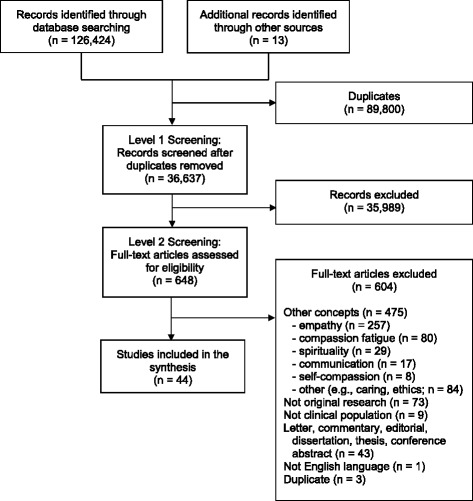
BACKGROUND: Recent concerns about suboptimal patient care and a lack of compassion have prompted policymakers to question the preparedness of clinicians for the challenging environment in which they practice. Compassionate care is expected by patients and is a professional obligation of clinicians; however, little is known about the state of research on clinical compassion. The purpose of this scoping review was to map the literature on compassion in clinical healthcare. METHODS: Searches of eight electronic databases and the grey literature were conducted to identify empirical studies published over the last 25 years. Eligible studies explored perceptions or interventions of compassionate care in clinical populations, healthcare professionals, and healthcare students. Following the title and abstract review, two reviewers independently screened full-texts articles, and extracted study data. A narrative approach to synthesizing and mapping the literature was used. RESULTS AND DISCUSSION: Of 36,637 records, 648 studies were retrieved and 44 studies were included in the review. Less than one third of studies included patients. Six themes emerged from studies that explored perceptions of compassionate care: nature of compassion, development of compassion, interpersonal factors related to compassion, action and practical compassion, barriers and enablers of compassion, and outcomes of compassion. Intervention studies included two compassionate care trials with patients and eight educational programs that aimed to improve compassionate care in clinicians and students. CONCLUSIONS: This review identifies the limited empirical understanding of compassion in healthcare, highlighting the lack of patient and family voices in compassion research. A deeper understanding of the key behaviors and attitudes that lead to improved patient-reported outcomes through compassionate care is necessary.
Overview
The claims and statistics of this paper haven’t been checked yet.
Run the check — free, no account needed. It reads the open-access text and checks the sources it cites.
Integrity signals
Registry
Cites
Statistics
Figures
Verification
Claims the paper makes
The claims and statistics of this paper haven’t been checked yet.
Run the check — free, no account needed. It reads the open-access text and checks the sources it cites.
Claims other papers make about this one
Each is checked against this paper’s own text: does it say what the citing paper says it does?
The source backs part of the claim, not all of it — or backs it for a different population, condition or comparison.
In the citing paper
“Studies have shown that it is an important part of the quality-of-care ratings in EDs [56, 57]”
From Suicide among youth and young adults in Canada: bereaved parents' perspectives on the systems of care (2025) · cites this paper as [56]
Experimental — accuracy not yet measuredThe source backs part of the claim, not all of it — or backs it for a different population, condition or comparison.
In the citing paper
“Thus, although the roots of compassion seem to be innate, current evidence suggests that training, including meditation, can help to sustain compassion and nurture it over time.”
From Mindfulness and compassion-oriented practices at work reduce distress and enhance self-care of palliative care teams: a mixed-method evaluation of an "on the job" program. (2018) · cites this paper as [6]
Experimental — accuracy not yet measuredThe source backs part of the claim, not all of it — or backs it for a different population, condition or comparison.
In the citing paper
“They concluded that patient’s perceived compassion as being rooted in the virtues of their health care provider, generating the first evidence-based definition of compassion—a virtuous response that seeks to address the suffering and needs of a person through relational understanding and action.”
From Mindfulness and compassion-oriented practices at work reduce distress and enhance self-care of palliative care teams: a mixed-method evaluation of an "on the job" program. (2018) · cites this paper as [6]
Experimental — accuracy not yet measuredThe cited source says what the claim attributes to it.
In the citing paper
“Moreover, external factors including the limited healthcare resources, increased clinical demands and negative workplace cultures, can hinder the delivery of compassionate medicine [6].”
The cited source says what the claim attributes to it.
In the citing paper
“The authors note however that, compassion qualities can be cultivated or eroded over time, with practice setting being one of the most powerful modifiers.”
Self-check
Percentages, sums and reported differences re-computed from the paper’s own numbers.
The self-check needs the paper’s full text.
Citations
Cites
Scoping studies: towards a methodological framework
Arksey, H., & O'Malley, L. (2005) · International Journal of Social Research Methodology · doi:10.1080/1364557032000119616 · Cited by 36,742
Scoping studies: advancing the methodology
Levac, D., Colquhoun, H., & O'Brien, K. K. (2010) · Implementation Science · doi:10.1186/1748-5908-5-69 · Cited by 15,268
Self-Compassion: An Alternative Conceptualization of a Healthy Attitude Toward Oneself
NEFF, K. (2003) · Self and Identity · doi:10.1080/15298860309032 · Cited by 5,440
Effective physician-patient communication and health outcomes: a review.
(1995) · Europe PMC (PubMed Central) · Cited by 4,085
The relation of empathy to prosocial and related behaviors
Eisenberg, N., & Miller, P. A. (1987) · Psychological Bulletin · doi:10.1037/0033-2909.101.1.91 · Cited by 2,672
The American Heritage Dictionary of the English Language
Rinehart, E. C., & Morris, W. (1970) · The Journal of Higher Education · doi:10.1080/00221546.1970.11773921 · Cited by 2,471
Compassion: an evolutionary analysis and empirical review
Goetz, J. L., Keltner, D., & Simon-Thomas, E. (2010) · Psychological Bulletin · doi:10.1037/a0018807 · Cited by 2,200
Popay, J., Roberts, H., Sowden, A., Petticrew, M., Arai, L., Rodgers, M., Britten, N., Roen, K., & Duffy, S. (2006) · Lancaster University · doi:10.13140/2.1.1018.4643 · Cited by 2,070
Exploring compassion: A meta-analysis of the association between self-compassion and psychopathology
MacBeth, A., & Gumley, A. (2012) · Clinical Psychology Review · doi:10.1016/j.cpr.2012.06.003 · Cited by 1,838 · cited 1×
“Researchers have reviewed related evidence for compassion-based psychotherapy [38, 39], self-compassion [34, 40, 41], and empathy [42–44].”
BackgroundEmpathy Decline and Its Reasons: A Systematic Review of Studies With Medical Students and Residents
Neumann, M., Edelhäuser, F., Tauschel, D., Fischer, M. R., Wirtz, M. A., Woopen, C., Haramati, A., & Scheffer, C. (2011) · Academic Medicine · doi:10.1097/acm.0b013e318221e615 · Cited by 1,708
Research works printed but not linked: 6
- American Medical Association. Code of medical ethics: Principle 1. 2001. http://www.ama-assn.org/ama/pub/physician-resources/medical-ethics/code-medical-ethics/principles-medical-ethics.page . Accessed on 14 Jan 2016
- Department of Health. Confidence in caring: A framework for best practice. London, England: Department of Health; 2008.
- Francis R. Report of the Mid Staffordshire NHS Foundation Trust public inquiry. The Stationary Office: London, England; 2013.
- Soanes C, Stevenson A. Empathy. In: Stevenson A, editor. Oxford English dictionary of English. 3rd ed. New York, NY: Oxford University Press; 2010.
- Soanes C, Stevenson A. Sympathy. In: Stevenson A, editor. Oxford English dictionary of English. 3rd ed. New York, NY: Oxford University Press; 2010.
- Hoad T, editor. Oxford concise dictionary of English etymology. New York, NY: Oxford University Press; 1996.
Cited by
Sorted by citations
Items 501–507 of 507
Exploring Factors Associated with Caring Self-Perception and Systemic Barriers in Medical Education
Neal, C., Gelatt, T., DiFrancisco‐Donoghue, J., Eng, N., Yao, S. C., & Toma, M. (2026) · International Medical Education · doi:10.3390/ime5040102
Exploring Compassion in Traumatic Brain Injury Screening for Underserved Populations
Chan, V., Hanafy, S., Matheson, F. I., Omar, S., Haag, H. L., & Colantonio, A. (2026) · Journal of Social Service Research · doi:10.1080/01488376.2026.2742899
Kamenšek, T., & Kapun, M. M. (2026) · Pielegniarstwo XXI wieku / Nursing in the 21st Century · doi:10.12923/pielxxiw-2026-0040
Beyond communication: Toward a relational model of silent accompaniment in healthcare
Gouar, N. E. (2026) · Patient Education and Counseling · doi:10.1016/j.pec.2026.110335
Turner, S. (2026) · International Journal of Nursing Studies Advances · doi:10.1016/j.ijnsa.2026.100706
Abdelkader, A. M., Alsalamah, Y., Alslamah, T., Alfalaij, M., Yousif, S., Alotaibi, M., Albuhinyah, R., Alali, H., Saleh, M., Fawaz, M. A., et al. (2026) · Research Square · doi:10.21203/rs.3.rs-11167341/v1
Park, M.-J., Gan, S., Lee, E., Jo, S., & Lee, Y. (2026) · Journal of Nursing Management · doi:10.1155/jonm/3937997
Metadata
- Authors
- Sinclair, S., Norris, J. M., McConnell, S. J., Chochinov, H. M., Hack, T. F., Hagen, N. A., McClement, S., & Bouchal, S. R.
- Affiliations
- University of Calgary (CA)
- CancerCare Manitoba (CA)
- Corresponding author
- Sinclair, Shane
- ORCID
- Venue
- BMC Palliative Care
- Published
- 2016-01-19
- Volume
- 15
- Issue
- 1
- Pages
- 6-6
- ISSN
- 1472-684X (ISSN-L)
- PMC
- PMC4717626
- OpenAlex
- W2252958645
- Cited by
- 507
- References
- 110
- Citations by year
- 2026: 56 · 2025: 65 · 2024: 61 · 2023: 53 · 2022: 50 · 2021: 63 · 2020: 51 · 2019: 48 · 2018: 31 · 2017: 21 · 2016: 8
- FWCI
- 31.99
- Type
- journal article
- Language
- en
- Open access
- gold
- doi.org
- Licence
- cc-by
- Locations
- BMC Palliative Care (publishedVersion, cc-by)
- PubMed Central (publishedVersion, cc-by)
- PubMed (publishedVersion)
- Libraries and Cultural Resources (University of Calgary) (submittedVersion, cc-by)
- Libraries and Cultural Resources (University of Calgary) (submittedVersion)
- Funders
- Canadian Institutes of Health Research
- Topics
- Health Sciences › Medicine › Psychiatry and Mental health › Empathy and Medical Education
- Health Sciences › Health Professions › General Health Professions › Patient-Provider Communication in Healthcare
- Health Sciences › Medicine › Public Health, Environmental and Occupational Health › Palliative Care and End-of-Life Issues
- Keywords
- compassion, compassionate care, healthcare workers, health professions students, compassion education, patient-reported outcomes, patient and family perspectives, clinician attitudes
- MeSH terms
- Compassion Fatigue, Attitude of Health Personnel, Delivery of Health Care, Empathy, Health Personnel, Humans, Learning, Nurse-Patient Relations, Perception
About these checks
Registry, retraction, Cites and statistics results are computed, not judged, with one exception: a printed reference that no index lists is read once by a model before it counts as a citation error. Claims are extracted by a model and kept only when their quote appears verbatim in the text; each cited source is then checked, with a model’s help, for whether it says what the claim relies on. Those verdicts can be wrong — read the claim’s quote and the cited source before relying on one.
Statistics and arithmetic are recomputed, not judged.
Confidence bands are shown only for fields calibrated on our annotated test set. None is calibrated yet, so no band is shown.
What counts as a claim ›How we measure confidence ›How we check this ›
Are you an author, or do you see a problem with this page? Request a review
