

The DOI matches its Crossref record; 26 of the 26 references it cites were found in a registry or an index.
Correlation between patient quality of life in palliative care and burden of their family caregivers: a prospective observational cohort study
Open accessAbstract
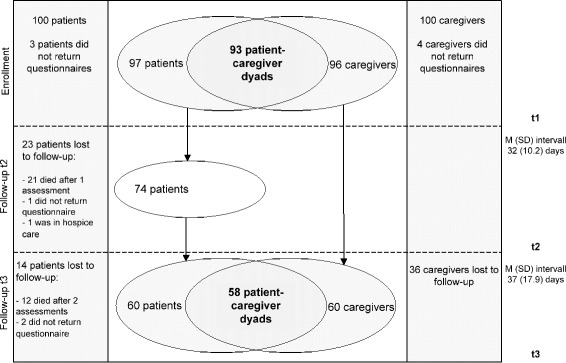
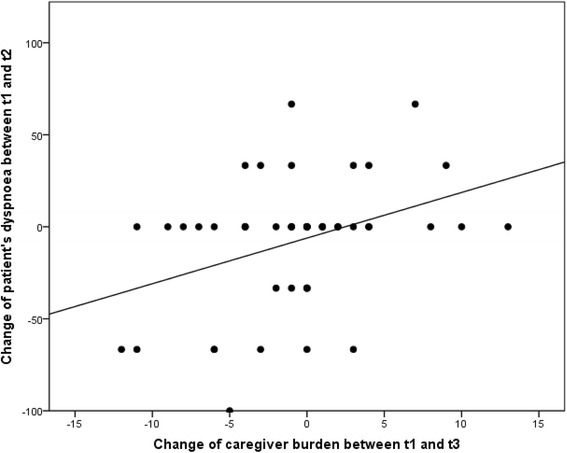
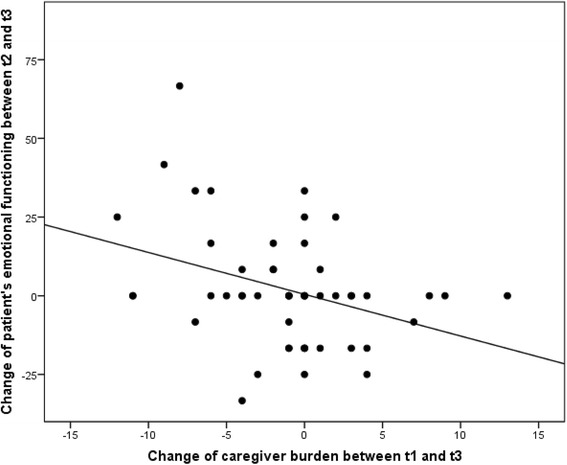
BACKGROUND: Family caregivers play a key role in palliative care at home, and understanding the interdependencies in the constellation of patient, family caregivers and service providers is important. As few longitudinal studies have examined the influence of patient quality of life (QoL) in palliative care on burden of family caregivers, the aim of this study was to identify correlations between changing patient QoL and changing burden of family caregivers that need consideration in patient management. METHODS: Palliative patients with cancer in primary care evaluated their QoL (Quality of Life Questionnaire Core 15 Palliative Care, QLQ-C15-PAL). They were assessed monthly for an interval of 6 months or until death of the patient. Family caregivers reported the burden they perceived while supporting the patient (Short form of the Burden Scale for Family Caregivers, BSFC). Longitudinal data were analysed for all patients with at least 3 available assessments, considering the most recent data for participants with more than 3 assessments. Changes in patient QoL were analysed using the Friedman test. In a stepwise regression analysis, influences of change in patient QoL on changing caregiver burden were investigated. RESULTS: One hundred patients (63 men, 37 women; average age: 68 years) were enrolled in the study. The most common primary diagnoses were colon, lung or breast cancer. In 58 cases, assessments were available from both patients and caregivers. Patients reported overall quality of life increasing towards end of life, although reporting that physical functioning deteriorated. Symptoms of pain and fatigue bothered patients most. Caregiver burden was moderate and on average did not change over time. In a stepwise regression model, the difference in emotional functioning and the difference in dyspnoea showed an influence on the development of caregiver burden (explained variance of 19.3%). CONCLUSIONS: Patients' dyspnoea, feelings of depression and anxiety impacted on the perceived burden of family caregivers, but are manageable symptoms. Our results corroborate the need of regular assessment of patients' needs taking into account caregiver burden. In this way, general practice teams can intervene early and may more likely meet patients' needs in the end of life care process. TRIAL REGISTRATION: Current Controlled Trials ISRCTN78021852, assigned on 04/04/2007.
Overview
The claims and statistics of this paper haven’t been checked yet.
Run the check — free, no account needed. It reads the open-access text and checks the sources it cites.
Integrity signals
Registry
Cites
Statistics
Figures
Verification
Claims the paper makes
The claims and statistics of this paper haven’t been checked yet.
Run the check — free, no account needed. It reads the open-access text and checks the sources it cites.
Claims other papers make about this one
Each is checked against this paper’s own text: does it say what the citing paper says it does?
The check wasn’t confident either way, so it gives no verdict — never disputed.
In the citing paper
“se encuentra que la sobrecarga del cuidado tiene una correlación significativa moderada inversa con la calidad de vida del cuidador, lo cual esta acorde con otros estudios 7,11,28”
From Sobrecarga y calidad de vida de cuidadores de personas con cáncer en cuidados paliativos (2021) · cites this paper as [28]
Experimental — accuracy not yet measuredThe check wasn’t confident either way, so it gives no verdict — never disputed.
In the citing paper
“la sobrecarga del cuidado tiene una correlación significativa moderada inversa con la calidad de vida del cuidador”
From Sobrecarga y calidad de vida de cuidadores de personas con cáncer en cuidados paliativos (2021) · cites this paper as [28]
Experimental — accuracy not yet measuredThe check wasn’t confident either way, so it gives no verdict — never disputed.
In the citing paper
“lo que podría indicar el impacto espiritual y la necesidad de auto trascendencia y encontrar sentido a la experiencia que se ha documentado en otros estudios28”
From Sobrecarga y calidad de vida de cuidadores de personas con cáncer en cuidados paliativos (2021) · cites this paper as [28]
Experimental — accuracy not yet measuredThe check wasn’t confident either way, so it gives no verdict — never disputed.
In the citing paper
“En otros estudios se ha documentado la necesidad de conexión con un ser supremo para mejorar la espiritualidad28”
From Sobrecarga y calidad de vida de cuidadores de personas con cáncer en cuidados paliativos (2021) · cites this paper as [28]
Experimental — accuracy not yet measured
Self-check
Percentages, sums and reported differences re-computed from the paper’s own numbers.
The self-check needs the paper’s full text.
Citations
Cites
Toxicity and response criteria of the Eastern Cooperative Oncology Group
Oken, M. M., Creech, R. H., Tormey, D. C., Horton, J., Davis, T. E., Mcfadden, E. T., & Carbone, P. P. (1982) · American Journal of Clinical Oncology · doi:10.1097/00000421-198212000-00014 · Cited by 11,686
Psychosomatic medicine in Germany: more timely than ever
Zipfel, S., Herzog, W., Kruse, J., & Henningsen, P. (2016) · Psychotherapy and Psychosomatics · doi:10.1159/000447701 · Cited by 2,323
Resolving the 50‐year debate around using and misusing Likert scales
Carifio, J., & Perla, R. J. (2008) · Medical Education · doi:10.1111/j.1365-2923.2008.03172.x · Cited by 1,047
Grunfeld, E. (2004) · Canadian Medical Association Journal · doi:10.1503/cmaj.1031205 · Cited by 963
Mansfield, E. R., & Helms, B. P. (1982) · The American Statistician · doi:10.1080/00031305.1982.10482818 · Cited by 576
Gomes, B., Higginson, I. J., Calanzani, N., Cohen, J., Deliëns, L., Daveson, B. A., Bechinger-English, D., Bausewein, C., Ferreira, P. L., Toscani, F., et al. (2012) · Annals of Oncology · doi:10.1093/annonc/mdr602 · Cited by 560
Bailey, P. H. (2004) · Qualitative Health Research · doi:10.1177/1049732304265973 · Cited by 275
Aoun, S. M., Bentley, B., Funk, L., Toye, C., Grande, G., & Stajduhar, K. J. (2013) · Palliative Medicine · doi:10.1177/0269216312455729 · Cited by 152 · cited 1×
“a study with cancer patients [11] and a review on patients with motor neurone disease [12]), but also between unmet needs of patients and caregiver stress burden [13].”
BackgroundMurray, S. A., Kendall, M., Boyd, K. J., Grant, L., Highet, G., & Sheikh, A. (2010) · BMJ · doi:10.1136/bmj.c2581 · Cited by 149
Götze, H., Brähler, E., Gansera, L., Polze, N., & Köhler, N. (2014) · Supportive Care in Cancer · doi:10.1007/s00520-014-2257-5 · Cited by 143
Research works printed but not linked: 3
- Groenvold M, Petersen MA, on behalf of the EORTC Quality of Life Group. Addendum to the EORTC QLQ-C30 scoring manual: scoring of the EORTC QLQ-C15-PAL. 2006.
- Gräßel E. Häusliche Pflegeskala HPS zur Erfassung der Belastung bei betreuenden oder pflegenden Angehörigen. Ebersberg: VLESS-Verlag; 2001.
- Fayers PM, Aaronson NK, Bjordal K, Groenvold M, Curran D, Bottomley A, et al. EORTC QLQ-C30 scoring manual (3rd edition). Brussels: EORTC; 2001. ISBN: 2-9300 64-22-6.
Cited by
Sorted by citations
Sanders, J. J., Curtis, J. R., & Tulsky, J. A. (2017) · Journal of Palliative Medicine · doi:10.1089/jpm.2017.0459 · Cited by 330
Ullrich, A., Ascherfeld, L., Marx, G., Bokemeyer, C., Bergelt, C., & Oechsle, K. (2017) · BMC Palliative Care · doi:10.1186/s12904-017-0206-z · Cited by 215
Level of Burden and Health-Related Quality of Life in Caregivers of Palliative Care Patients
Perpiñá-Galvañ, J., Orts-Beneito, N., Fernández-Alcántara, M., García-Sanjuán, S., García-Caro, M. P., & Cabañero-Martínez, M. J. (2019) · International Journal of Environmental Research and Public Health · doi:10.3390/ijerph16234806 · Cited by 140
Roest, B., Trappenburg, M. J., & Leget, C. J. W. (2019) · BMC Medical Ethics · doi:10.1186/s12910-019-0361-2 · Cited by 108
Ateş, G., Ebenau, A. F., Busa, C., Csikós, Á., Hasselaar, J. G. J., Jaspers, B., Menten, J. J., Payne, S. A., Beek, K. V., Varey, S., et al. (2018) · BMC Palliative Care · doi:10.1186/s12904-018-0291-7 · Cited by 90
Metadata
- Authors
- Krug, K., Miksch, A., Peters-Klimm, F., Engeser, P., & Szecsenyi, J.
- Affiliations
- University Hospital Heidelberg (DE)
- Corresponding author
- Krug, Katja
- Venue
- BMC Palliative Care
- Published
- 2016-01-15
- Volume
- 15
- Issue
- 1
- Pages
- 4-4
- ISSN
- 1472-684X (ISSN-L)
- PMC
- PMC4714452
- OpenAlex
- W2239477274
- Cited by
- 139
- References
- 26
- Citations by year
- 2026: 9 · 2025: 17 · 2024: 11 · 2023: 15 · 2022: 21 · 2021: 24 · 2020: 14 · 2019: 7 · 2018: 12 · 2017: 7 · 2016: 2
- FWCI
- 9.26
- Type
- journal article
- Language
- en
- Open access
- gold
- doi.org
- Licence
- Locations
- BMC Palliative Care (publishedVersion, cc-by)
- Europe PMC (PubMed Central) (publishedVersion, cc-by)
- PubMed Central (publishedVersion, cc-by)
- PubMed (publishedVersion)
- heiDOK (Heidelberg University) (acceptedVersion, other-oa)
- Funders
- Deutsche Forschungsgemeinschaft
- Universität Heidelberg
- Bundesministerium für Bildung und Forschung (01GK0601)
- Topics
- Health Sciences › Medicine › Public Health, Environmental and Occupational Health › Palliative Care and End-of-Life Issues
- Health Sciences › Medicine › Public Health, Environmental and Occupational Health › Palliative and Oncologic Care
- Health Sciences › Nursing › Research and Theory › Nursing care and research
- Keywords
- patient quality of life, family caregiver burden, home-based palliative care, cancer patients, end-of-life care, dyspnea, emotional functioning, anxiety and depression, pain and fatigue, primary care
- MeSH terms
- Aged, Aged, 80 and over, Fatigue, Female, Home Care Services, Humans, Longitudinal Studies, Male, Middle Aged, Palliative Care, Prospective Studies, Quality of Life, Surveys and Questionnaires, Stress, Psychological, Cohort Studies, Caregivers, Cost of Illness
About these checks
Registry, retraction, Cites and statistics results are computed, not judged, with one exception: a printed reference that no index lists is read once by a model before it counts as a citation error. Claims are extracted by a model and kept only when their quote appears verbatim in the text; each cited source is then checked, with a model’s help, for whether it says what the claim relies on. Those verdicts can be wrong — read the claim’s quote and the cited source before relying on one.
Statistics and arithmetic are recomputed, not judged.
Confidence bands are shown only for fields calibrated on our annotated test set. None is calibrated yet, so no band is shown.
What counts as a claim ›How we measure confidence ›How we check this ›
Are you an author, or do you see a problem with this page? Request a review
