

Paediatric palliative care improves patient outcomes and reduces healthcare costs: evaluation of a home-based program
Open accessThe DOI matches its Crossref record; 39 of the 42 references it cites were found in a registry or an index.
Abstract
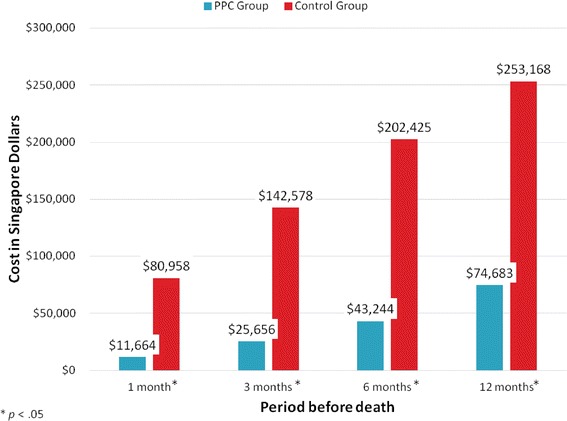
BACKGROUND: Around the world, different models of paediatric palliative care have responded to the unique needs of children with life shortening conditions. However, research confirming their utility and impact is still lacking. This study compared patient-related outcomes and healthcare expenditures between those who received home-based paediatric palliative care and standard care. The quality of life and caregiver burden for patients receiving home-based paediatric palliative care were also tracked over the first year of enrolment to evaluate the service's longitudinal impact. METHOD: A structured impact and cost evaluation of Singapore-based HCA Hospice Care's Star PALS (Paediatric Advance Life Support) programme was conducted over a three-year period, employing both retrospective and prospective designs with two patient groups. RESULTS: Compared to the control group (n = 67), patients receiving home-based paediatric palliative care (n = 71) spent more time at home than in hospital in the last year of life by 52 days (OR = 52.30, 95% CI: 25.44-79.17) with at least two fewer hospital admissions (OR = 2.46, 95% CI: 0.43-4.48); and were five times more likely to have an advance care plan formulated (OR = 5.51, 95% CI: 1.55-19.67). Medical costs incurred by this group were also considerably lower (by up to 87%). Moreover, both patients' quality of life (in terms of pain and emotion), and caregiver burden showed improvement within the first year of enrolment into the programme. DISCUSSION: Our findings suggest that home-based paediatric palliative care brings improved resource utilization and cost-savings for both patients and healthcare providers. More importantly, the lives of patients and their caregivers have improved, with terminally ill children and their caregivers being able to spend more quality time at home at the final stretch of the disease. CONCLUSIONS: The benefits of a community paediatric palliative care programme have been validated. Study findings can become key drivers when engaging service commissioners or even policy makers in appropriate settings.
Overview
The claims and statistics of this paper haven’t been checked yet.
Free: it reads the open-access text and checks the first 5 claims that cite a source we can check. Create a free account to check every claim.
Integrity signals
Registry
Cites
Statistics
Figures
Verification
Claims the paper makes
The claims and statistics of this paper haven’t been checked yet.
Free: it reads the open-access text and checks the first 5 claims that cite a source we can check. Create a free account to check every claim.
Claims other papers make about this one
Each is checked against this paper’s own text: does it say what the citing paper says it does?
The cited source doesn’t support the claim as written.
In the citing paper
“However, some recent studies found that family support interventions did not reduce psychological symptoms in family members. 66,67,75,79”
From European Resuscitation Council Guidelines 2021: Ethics of resuscitation and end of life decisions (2021) · cites this paper as [66]
Checked by a reasoning model — may be wrong.
Experimental — accuracy not yet measured
Self-check
Percentages, sums and reported differences re-computed from the paper’s own numbers.
The self-check needs the paper’s full text.
Citations
Cites
The Health Utilities Index (HUI): concepts, measurement properties and applications.
Horsman, J., Furlong, W. J., Feeny, D. F., & Torrance, G. W. (2003) · Health and Quality of Life Outcomes · doi:10.1186/1477-7525-1-54 · Cited by 1,598
Economic Evaluation in Clinical Trials
Glick, H. A., Doshi, J. A., Sonnad, S. S., & Polsky, D. (2014) · Oxford University Press eBooks · doi:10.1093/med/9780199685028.001.0001 · Cited by 910
Dying in America: improving quality and honoring individual preferences near the end of life
(2015) · Choice Reviews Online · doi:10.5860/choice.191895 · Cited by 881
Himelstein, B. P., Hilden, J. M., Boldt, A. M., & Weissman, D. (2004) · New England Journal of Medicine · doi:10.1056/nejmra030334 · Cited by 571
Pediatric Palliative Care and Hospice Care Commitments, Guidelines, and Recommendations
SECTION ON HOSPICE AND PALLIATIVE MEDICINE AND COMMITTEE ON HOSPITAL CARE, Feudtner, C., Friebert, S., Jewell, J., Friebert, S., Carter, B., Feudtner, C., Hood, M., Imaizumi, S., & Komatz, K. (2013) · Pediatrics · doi:10.1542/peds.2013-2731 · Cited by 472 · cited 1×
“Background Palliative care in children pursues similar goals as in the adult setting; to minimize suffering and to improve quality of life in the face of terminal illness [1, 2].”
BackgroundPediatric Palliative Care Patients: A Prospective Multicenter Cohort Study
Feudtner, C., Kang, T. I., Hexem, K. R., Friedrichsdorf, S. J., Osenga, K., Siden, H., Friebert, S. E., Hays, R. M., Dussel, V., & Wolfe, J. (2011) · Pediatrics · doi:10.1542/peds.2010-3225 · Cited by 427
Economic Evaluation in Clinical Trials
Glick, H. A., Doshi, J. A., Sonnad, S. S., & Polsky, D. E. (2007) · OUP Catalogue · Cited by 366
Pediatric Palliative Care Patients: A Prospective Multicenter Cohort Study
(2011) · PEDIATRICS · doi:10.1542/peds.2010-3225d · Cited by 261
Mack, J. W., & Wolfe, J. (2006) · Current Opinion in Pediatrics · doi:10.1097/01.mop.0000193266.86129.47 · Cited by 226
Pediatric palliative care provision around the world: A systematic review
Knapp, C., Woodworth, L., Wright, M., Downing, J., Drake, R., Fowler‐Kerry, S., Hain, R., & Marston, J. (2011) · Pediatric Blood & Cancer · doi:10.1002/pbc.23100 · Cited by 188 · cited 1×
“[15], two thirds of countries around * Correspondence: pohhengC@hcahospicecare.”
Background
Cited by
Pediatric Palliative Care and Hospice Care Commitments, Guidelines, and Recommendations
SECTION ON HOSPICE AND PALLIATIVE MEDICINE AND COMMITTEE ON HOSPITAL CARE, Feudtner, C., Friebert, S., Jewell, J., Friebert, S., Carter, B., Feudtner, C., Hood, M., Imaizumi, S., & Komatz, K. (2013) · Pediatrics · doi:10.1542/peds.2013-2731 · Cited by 472
European Resuscitation Council Guidelines 2021: Ethics of resuscitation and end of life decisions
Mentzelopoulos, S. D., Couper, K., Voorde, P. V. D., Druwé, P., Blom, M., Perkins, G. D., Lulic, I., Djakow, J., Raffay, V., Lilja, G., et al. (2021) · Resuscitation · doi:10.1016/j.resuscitation.2021.02.017 · Cited by 246
Impact of Specialized Pediatric Palliative Care: A Systematic Review
Marcus, K. L., Santos, G., Ciapponi, A., Comandé, D., Bilodeau, M., Wolfe, J., & Dussel, V. (2019) · Journal of Pain and Symptom Management · doi:10.1016/j.jpainsymman.2019.08.005 · Cited by 123
“(25– 28,33,38,42,43) One study used two designs: a retrospective cohort and an uncontrolled before/after.(38) Half of the studies were survey-based,(24,25,27–29,32,34,38,39,42,43,45) and only one of these used a patient-reported outcome; the other survey studies used outcomes reported by parents or primary caregivers.”
BackgroundResultInstruments to Measure Outcomes in Pediatric Palliative Care: A Systematic Review
Friedel, M., Aujoulat, I., Dubois, A.-C., & Degryse, J. (2019) · PEDIATRICS · doi:10.1542/peds.2018-2379 · Cited by 79
“A study was included if all of the following criteria were fulfilled: (1) the full text was written in English, French, German, Italian, or Dutch; (2) the study sample included a clear description of infants, children, and/or adolescents ranging in age from 0 to 18 years; (3) children’s diseases were included in the d…”
BackgroundResultPalliative Care in Paediatric Oncology: an Update
Salins, N. S., Hughes, S., & Preston, N. J. (2022) · Current Oncology Reports · doi:10.1007/s11912-021-01170-3 · Cited by 62
Metadata
- Authors
- Chong, P. H., De Castro Molina, J. A., Teo, K., & Tan, W. S.
- Affiliations
- National Healthcare Group (SG)
- Corresponding author
- Chong, P. H.
- ORCID
- Chong, P. H.
- Venue
- BMC Palliative Care
- Published
- 2018-01-03
- Volume
- 17
- Issue
- 1
- Pages
- 11-11
- ISSN
- 1472-684X (ISSN-L)
- PMC
- PMC5751774
- OpenAlex
- W2781701630
- Semantic Scholar
- 016159cb18db5dacaf913384b6596baef6b8ec56
- Cited by
- 95
- References
- 42
- Citations by year
- 2026: 9 · 2025: 7 · 2024: 14 · 2023: 15 · 2022: 19 · 2021: 9 · 2020: 7 · 2019: 10 · 2018: 4
- FWCI
- 7.15
- Type
- journal article
- Language
- en
- Open access
- gold
- doi.org
- Licence
- cc-by
- Locations
- BMC Palliative Care (publishedVersion, cc-by)
- Europe PMC (PubMed Central) (publishedVersion, cc-by)
- PubMed Central (publishedVersion, cc-by)
- PubMed (publishedVersion)
- National University of Singapore (submittedVersion, cc-by)
- DOAJ (DOAJ: Directory of Open Access Journals) (submittedVersion, cc-by-sa)
- Funders
- Tote board - Singapore (TB048)
- Ministry of Health -Singapore
- Topics
- Health Sciences › Medicine › Public Health, Environmental and Occupational Health › Palliative Care and End-of-Life Issues
- Health Sciences › Medicine › Public Health, Environmental and Occupational Health › Palliative and Oncologic Care
- Health Sciences › Medicine › Pediatrics, Perinatology and Child Health › Ethics and Legal Issues in Pediatric Healthcare
- Keywords
- pediatric palliative care, home-based palliative care, advance care planning, health care costs, quality of life, caregiver burden, terminally ill children, hospitalization, community-based palliative care
- MeSH terms
- Adolescent, Child, Child, Preschool, Female, Home Care Services, Humans, Infant, Male, Palliative Care, Pediatrics, Prospective Studies, Quality of Life, Retrospective Studies, Singapore, Cohort Studies, Health Care Costs, Patient Outcome Assessment
About these checks
Registry, retraction, Cites and statistics results are computed, not judged, with one exception: a printed reference that no index lists is read once by a model before it counts as a citation error. Claims are extracted by a model and kept only when their quote appears verbatim in the text; each cited source is then checked, with a model’s help, for whether it says what the claim relies on. Those verdicts can be wrong — read the claim’s quote and the cited source before relying on one.
Statistics and arithmetic are recomputed, not judged.
Confidence bands are shown only for fields calibrated on our annotated test set. None is calibrated yet, so no band is shown.
What counts as a claim ›How we measure confidence ›How we check this ›
Are you an author, or do you see a problem with this page? Request a review
Data sources
Bibliographic data: Semantic Scholar, OpenAlex, Crossref.
Contains information from the Semantic Scholar Academic Graph Datasets, made available under the ODC Attribution License (ODC-BY 1.0).
Semantic Scholar’s data is described in: Kinney, R., et al. (2023). The Semantic Scholar Open Data Platform. arXiv:2301.10140.
