

The DOI matches its Crossref record; 4 of the 4 references it cites were found in a registry or an index.
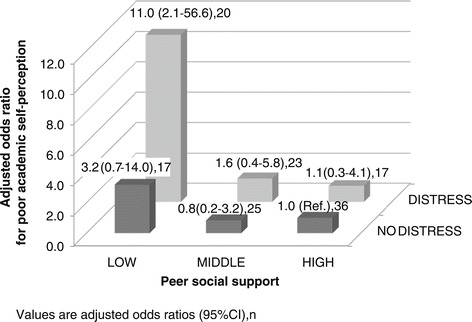
Psychological distress and academic self-perception among international medical students: the role of peer social support
Overview
The claims and statistics of this paper haven’t been checked yet.
Run the check — free, no account needed. It reads the open-access text and checks the sources it cites.
Integrity signals
Registry
Cites
Statistics
Figures
Verification
Claims the paper makes
The claims and statistics of this paper haven’t been checked yet.
Run the check — free, no account needed. It reads the open-access text and checks the sources it cites.
Claims other papers make about this one
Each is checked against this paper’s own text: does it say what the citing paper says it does?
In the citing paper
“These negative experiences were predictive of increased difficulties in cross-cultural and academic adjustment processes, and further put international student clients at higher risk of poor academic self-perception than domestic student clients (Baba & Hosoda, 2014; Yamada et al., 2014).”
From The role of social support in the effectiveness of counseling for international students (2026) · cites this paper as Yamada et al., 2014
Self-check
Percentages, sums and reported differences re-computed from the paper’s own numbers.
The self-check needs the paper’s full text.
Citations
Cites
The Multidimensional Scale of Perceived Social Support
Zimet, G. D., Dahlem, N. W., Zimet, S. G., & Farley, G. K. (1988) · Journal of Personality Assessment · doi:10.1207/s15327752jpa5201_2 · Cited by 13,339
Calculating measures of biological interaction
Andersson, T., Alfredsson, L., Källberg, H., Zdravkovic, S., & Ahlbom, A. (2005) · European Journal of Epidemiology · doi:10.1007/s10654-005-7835-x · Cited by 1,498
An empirical study of decline in empathy in medical school
Hojat, M., Mangione, S., Nasca, T. J., Rattner, S., Erdmann, J. B., Gonnella, J. S., & Magee, M. (2004) · Medical Education · doi:10.1111/j.1365-2929.2004.01911.x · Cited by 864
de Vibe, M., Solhaug, I., Tyssen, R., Friborg, O., Rosenvinge, J. H., Sørlie, T., & Bjørndal, A. (2013) · BMC Medical Education · doi:10.1186/1472-6920-13-107 · Cited by 398 · cited 1×
“Examining possible factors that could alter this negative association could have important implications for medical schools in the development of effective measures to improve student’s well-being and academic performance [20].”
Background
Research works printed but not linked: 42
- Paro HB, Morales NM, Silva CH, Rezende CH, Pinto RM, Morales RR, Mendonca TM, Prado MM: Health-related quality of life of medical students. Med Educ. 2010, 44 (3): 227-235. · DOI
- Baldassin S, Alves TC, de Andrade AG, Nogueira Martins LA: The characteristics of depressive symptoms in medical students during medical education and training: a cross-sectional study. BMC Med Educ. 2008, 8: 60. · DOI
- Dyrbye L, Thomas M, Shanafelt T: Systematic review of depression, anxiety, and other indicators of psychological distress among U.S. and Canadian medical students. Acad Med. 2006, 81: 354-373. · DOI · Paper page
- Stecker T: Well-being in an academic environment. Med Educ. 2004, 38 (5): 465-478. · DOI
- Chandavarkar U, Azzam A, Mathews CA: Anxiety symptoms and perceived performance in medical students. Depress Anxiety. 2007, 24 (2): 103-111. · DOI
- Crandall SJ, Volk RJ, Loemker V: Medical students' attitudes toward providing care for the underserved. Are we training socially responsible physicians?. JAMA. 1993, 269 (19): 2519-2523. · DOI
- Woloschuk W, Harasym PH, Temple W: Attitude change during medical school: a cohort study. Med Educ. 2004, 38 (5): 522-534. · DOI
- Davis BE, Nelson DB, Sahler OJ, McCurdy FA, Goldberg R, Greenberg LW: Do clerkship experiences affect medical students' attitudes toward chronically ill patients?. Acad Med. 2001, 76 (8): 815-820. · DOI
- Eikeland HL, Ornes K, Finset A, Pedersen R: The physician's role and empathy - a qualitative study of third year medical students. BMC Med Educ. 2014, 14: 165. · DOI
- Ahrweiler F, Neumann M, Goldblatt H, Hahn EG, Scheffer C: Determinants of physician empathy during medical education: hypothetical conclusions from an exploratory qualitative survey of practicing physicians. BMC Med Educ. 2014, 14: 122. · DOI
- Adams J: Straining to describe and tackle stress in medical students. Med Educ. 2004, 38 (5): 463-464. · DOI
- Dunn LB, Iglewicz A, Moutier C: A conceptual model of medical student well-being: promoting resilience and preventing burnout. Acad Psychiatry. 2008, 32 (1): 44-53. · DOI
- Yusoff MSB, Esa AR: Stress Management for Medical Students: A Systematic Review, Social Sciences and Cultural Studies - Issues of Language, Public Opinion, Education and Welfare. ᅟ. Edited by: Asunción L-V. 2012, InTech, ᅟ, doi:10.5772/37095. Available from: http://www.intechopen.com/books/social-sciences-and-cultural-studies-issues-of-language-public-opinion-education-and-welfare/stress-management-for-medical-students-a-systematic-review, [ http://www.intechopen.com/books/social-sciences-and-cultural-studies-issues-of-language-public-opinion-education-and-welfare/stress-management-for-medical-students-a-systematic-review ] · DOI
- Sohail N: Stress and academic performance among medical students. J Coll Physicians Surg Pak. 2013, 23 (1): 67-71.
- Spiegel DA, Smolen RC, Jonas CK: An examination of the relationships among interpersonal stress, morale and academic performance in male and female medical students. Soc Sci Med. 1986, 23 (11): 1157-1161. · DOI
- Dyrbye LN, Thomas MR, Shanafelt TD: Medical student distress: causes, consequences, and proposed solutions. Mayo Clin Proc. 2005, 80 (12): 1613-1622. · DOI
- Hojat M, Robeson M, Damjanov I, Veloski JJ, Glaser K, Gonnella JS: Students' psychosocial characteristics as predictors of academic performance in medical school. Acad Med. 1993, 68 (8): 635-637. · DOI
- Stewart S, Lam T, Betson C, Wong C, Wong A: A prospective analysis of stress and academic performance in the first 2 years of medical school. Med Educ. 1999, 33: 243-250. · DOI · Paper page
- Roy R: Social support, health, and illness : a complicated relationship. 2011, University of Toronto, Toronto; Buffalo · DOI
- Cohen S, McKay G: Social support, stress and the buffering hypothesis: a theoretical analysis. Handbook of Psychology and Health. Edited by: Baum A, Taylor SE, Singer JE. 1984, Lawrence Erlbaum, NJ: Hillsdale
- Vaananen A, Vahtera J, Pentti J, Kivimaki M: Sources of social support as determinants of psychiatric morbidity after severe life events: prospective cohort study of female employees. J Psychosom Res. 2005, 58 (5): 459-467. · DOI
- Salgado H, Castaneda SF, Talavera GA, Lindsay SP: The role of social support and acculturative stress in health-related quality of life among day laborers in Northern San Diego. J Immigr Minor Health. 2012, 14 (3): 379-385. · DOI
- Andel R, Crowe M, Hahn EA, Mortimer JA, Pedersen NL, Fratiglioni L, Johansson B, Gatz M: Work-related stress may increase the risk of vascular dementia. J Am Geriatr Soc. 2012, 60 (1): 60-67. · DOI
- Frese M: Social support as a moderator of the relationship between work stressors and psychological dysfunctioning: a longitudinal study with objective measures. J Occup Health Psychol. 1999, 4 (3): 179-192. · DOI
- LaRocco JM, House JS, French JR: Social support, occupational stress, and health. J Health Soc Behav. 1980, 21 (3): 202-218. · DOI · Paper page
- Yamada Y, Loureiro E, Klugar M, Tancred A, Ivanova K, Oborna I: Students' psychological distress in an English program embedded in a medical school in a non English speaking country. Int J Med Educ. 2013, 4: 260-266. · DOI
- Dyrbye LN, Szydlo DW, Downing SM, Sloan JA, Shanafelt TD: Development and preliminary psychometric properties of a well-being index for medical students. BMC Med Educ. 2010, 10: 8. · DOI
- Dyrbye LN, Schwartz A, Downing SM, Szydlo DW, Sloan JA, Shanafelt TD: Efficacy of a Brief Screening Tool to Identify Medical Students in Distress. Acad Med. 2011, 86 (7): 907-914. · DOI
- Ng CG, Amer Siddiq AN, Aida SA, Zainal NZ, Koh OH: Validation of the Malay version of the Multidimensional Scale of Perceived Social Support (MSPSS-M) among a group of medical students in Faculty of Medicine. University Malaya. Asian J Psychiatr. 2010, 3 (1): 3-6. · DOI
- Wongpakaran T, Wongpakaran N, Ruktrakul R: Reliability and Validity of the Multidimensional Scale of Perceived Social Support (MSPSS): Thai Version. Clin Pract Epidemiol Ment Health. 2011, 7: 161-166. · DOI
- Cecil H, Stanley MA, Carrion PG, Swann A: Psychometric properties of the MSPSS and NOS in psychiatric outpatients. J Clin Psychol. 1995, 51 (5): 593-602. · DOI
- Roff S, McAleer S, Harden RM, Al-Qahtani M, Ahmed AU, Deza H, Groenen G, Primparyon P: Development and validation of the Dundee Ready Education Environment Measure (DREEM). Med Teach. 1997, 19 (4): 295-299. · DOI
- Roff S: The Dundee Ready Educational Environment Measure (DREEM)—a generic instrument for measuring students’ perceptions of undergraduate health professions curricula. Med Teach. 2005, 27 (4): 322-325. · DOI
- Miles S, Swift L, Leinster SJ: The Dundee Ready Education Environment Measure (DREEM): a review of its adoption and use. Med Teach. 2012, 34 (9): e620-e634. · DOI
- de Mutsert R, Jager KJ, Zoccali C, Dekker FW: The effect of joint exposures: examining the presence of interaction. Kidney Int. 2009, 75 (7): 677-681. · DOI
- Bolger N, Zuckerman A, Kessler RC: Invisible support and adjustment to stress. J Pers Soc Psychol. 2000, 79 (6): 953-961. · DOI
- Diener E, Seligman ME: Very happy people. Psychol Sci. 2002, 13 (1): 81-84. · DOI · Paper page
- Baumeister RF, Leary MR: The need to belong: desire for interpersonal attachments as a fundamental human motivation. Psychol Bull. 1995, 117 (3): 497-529. · DOI · Paper page
- Rospenda KM, Halpert J, Richman JA: Effects of social support on medical students' performances. Acad Med. 1994, 69 (6): 496-500. · DOI
- Woolf K, Potts HW, Patel S, McManus IC: The hidden medical school: a longitudinal study of how social networks form, and how they relate to academic performance. Med Teach. 2012, 34 (7): 577-586. · DOI
- Roseth CJ, Johnson DW, Johnson RT: Promoting early adolescents' achievement and peer relationships: the effects of cooperative, competitive, and individualistic goal structures. Psychol Bull. 2008, 134 (2): 223-246. · DOI · Paper page
- Hammond SM, O'Rourke M, Kelly M, Bennett D, O'Flynn S: A psychometric appraisal of the DREEM. BMC Med Educ. 2012, 12: 2. · DOI
Cited by
Sorted by citations
The role of social support in the effectiveness of counseling for international students
Tan, H., Castonguay, L. G., Janis, R. A., Hayes, J. A., Magruder, S. A. N., Chun-Kennedy, C. L., & Scofield, B. E. (2026) · Cogent Mental Health · doi:10.1080/28324765.2026.2653852
Metadata
- Authors
- Yamada, Y., Klugar, M., Ivanova, K., & Oborna, I.
- Venue
- BMC Medical Education
- Published
- 2014-11-28
- Volume
- 14
- Issue
- 1
- ISSN
- 1472-6920
- PMC
- PMC4251849
- Cited by
- 66
- References
- 4
- Language
- en
About these checks
Registry, retraction, Cites and statistics results are computed, not judged, with one exception: a printed reference that no index lists is read once by a model before it counts as a citation error. Claims are extracted by a model and kept only when their quote appears verbatim in the text; each cited source is then checked, with a model’s help, for whether it says what the claim relies on. Those verdicts can be wrong — read the claim’s quote and the cited source before relying on one.
Statistics and arithmetic are recomputed, not judged.
Confidence bands are shown only for fields calibrated on our annotated test set. None is calibrated yet, so no band is shown.
What counts as a claim ›How we measure confidence ›How we check this ›
Are you an author, or do you see a problem with this page? Request a review
How to cite
Cite CoChat for the checks on this page, and the paper for its own findings.
- This page
- CoChat. (2026). Citation check: Psychological distress and academic self-perception among international medical students: the role of peer social support. https://app.cochat.ai/papers/10.1186/s12909-014-0256-3
- The paper
- Yamada, Y., Klugar, M., Ivanova, K., & Oborna, I. (2014). Psychological distress and academic self-perception among international medical students: the role of peer social support. BMC Medical Education. https://doi.org/10.1186/s12909-014-0256-3
