

Mindfulness training for medical students in their clinical clerkships: two cross-sectional studies exploring interest and participation
Open accessThe DOI matches its Crossref record; 42 of the 42 references it cites were found in a registry or an index.
Abstract
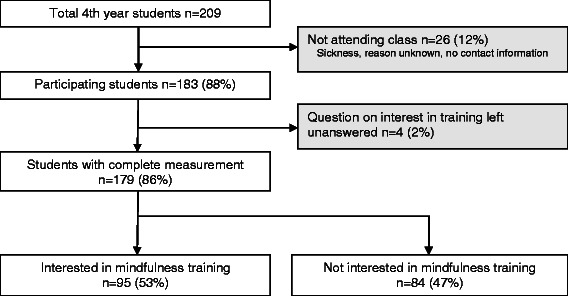
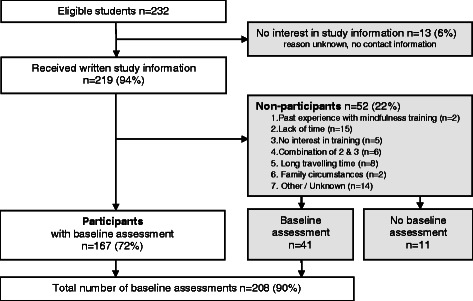
BACKGROUND: So far, studies investigating Mindfulness Based Stress Reduction (MBSR) training in medical students are conducted in self-selected, pre-clinical samples, with modest response rates without collecting data on non-participants. This study first examines interest and participation rates of students starting their clinical clerkships. Second, it compares students interested in a mindfulness training with non-interested students and students participating in a trial on the effect of MBSR with non-participating students on levels of psychological distress, personality traits, cognitive styles and mindfulness skills. METHODS: We examined two student samples from the Radboud University Medical Center, Nijmegen: Study 1 From March to December 2010 we performed a cross-sectional pilot-study among 4th year medical students starting their clinical clerkships, assessing interest in a MBSR training. We compared scores on the Brief Symptom Inventory, the Neo Five Factor Inventory and the Five Facet Mindfulness Questionnaire of interested students with those of non-interested students using t-tests with Bonferroni correction. Study 2 From February 2011 to August 2012 we invited 4th year medical students starting their clinical clerkships to participate in a randomized controlled trial (RCT) on the effectiveness of MBSR. We compared scores on the Brief Symptom Inventory, the Irrational Beliefs Inventory and the Five Facet Mindfulness Questionnaire of participating students with those of non-participants using t-tests with Bonferroni correction. RESULTS: Study 1: Ninety-five out of 179 participating students (53%) were interested in a MBSR training. Interested students scored significantly higher on psychological distress (p = .004) and neuroticism (p < .001), than 84 non-interested students. Study 2: Of 232 eligible students, 167 (72%) participated in our RCT. Participants scored significantly higher on psychological distress (p = .001), worrying (p = .002), problem avoidance (p = .005) and lower on mindfulness skills (p = .002) than 41 non-participants. CONCLUSIONS: Interest in mindfulness training and response rates in a RCT on the effectiveness of MBSR among clinical clerkship students are equal to (study 1) or higher (study 2) than in studies on pre-clinical students. Interested students and participants in a RCT reported more psychological distress and psychopathology related character traits. Participants scored lower on mindfulness skills.
Overview
The claims and statistics of this paper haven’t been checked yet.
Free: it reads the open-access text and checks the first 5 claims that cite a source we can check. Create a free account to check every claim.
Integrity signals
Registry
Cites
Statistics
Figures
Verification
Claims the paper makes
The claims and statistics of this paper haven’t been checked yet.
Free: it reads the open-access text and checks the first 5 claims that cite a source we can check. Create a free account to check every claim.
Claims other papers make about this one
Each is checked against this paper’s own text: does it say what the citing paper says it does?
The cited source says what the claim attributes to it.
In the citing paper
“Medical students notice signs of burnout and psychological distress even before graduation and suffer from more psychological distress than those with a similar age profile [2].”
From Effectiveness of online mindfulness interventions on medical students’ mental health: a systematic review (2021) · cites this paper as [2]
Self-check
Percentages, sums and reported differences re-computed from the paper’s own numbers.
The self-check needs the paper’s full text.
Citations
Cites
The brief symptom inventory: an introductory report.
Derogatis, L. R., & Melisaratos, N. (1983) · Psychological Medicine · doi:10.1017/s0033291700048017 · Cited by 6,650 · cited 2×
“De betrouwbaarheid en validiteit van een handzaam alternatief voor de SCL-90.”
Method(1962) · Medical Entomology and Zoology · Cited by 4,856
Kabat-Zinn, J. (1982) · General Hospital Psychiatry · doi:10.1016/0163-8343(82)90026-3 · Cited by 4,255 · cited 2×
“[17] using an 8-week face-to-face program with formal exercises like a bodyscan, meditation and yoga next to informal practice to cultivate self-awareness.”
BackgroundMethodMindfulness-based stress reduction and health benefits
Grossman, P., Niemann, L., Schmidt, S., & Walach, H. (2004) · Journal of Psychosomatic Research · doi:10.1016/s0022-3999(03)00573-7 · Cited by 3,958
Effects of mindfulness on psychological health: A review of empirical studies
Keng, S.-L., Smoski, M. J., & Robins, C. J. (2011) · Clinical Psychology Review · doi:10.1016/j.cpr.2011.04.006 · Cited by 2,687 · cited 1×
“Meta-analyses of the effectiveness of MBSR in a variety of target groups, show medium effect sizes [18-20].”
BackgroundEllis, P. D. (2010) · doi:10.1017/cbo9780511761676 · Cited by 2,461
Burnout and self-reported patient care in an internal medicine residency program
Shanafelt, T. D., Bradley, K. A., Wipf, J. E., & Back, A. L. (2002) · Annals of Internal Medicine · doi:10.7326/0003-4819-136-5-200203050-00008 · Cited by 2,165 · cited 1×
“Physician distress contributes to a lower quality of patient care [10-12] and patient satisfaction [13-15].”
BackgroundEmpathy Decline and Its Reasons: A Systematic Review of Studies With Medical Students and Residents
Neumann, M., Edelhäuser, F., Tauschel, D., Fischer, M. R., Wirtz, M., Woopen, C., Haramati, A., & Scheffer, C. (2011) · Academic Medicine · doi:10.1097/acm.0b013e318221e615 · Cited by 1,637 · cited 1×
“The scientific literature reports an increase of psychological distress [3,4] and a decrease of self-reported empathy [5,6] and life satisfaction [7] during medical school.”
BackgroundBurnout and Suicidal Ideation among U.S. Medical Students
Dyrbye, L. N., Thomas, M. R., Massie, F. S., Power, D. V., Eacker, A., Harper, W., Durning, S., Moutier, C., Szydlo, D. W., Novotny, P. J., et al. (2008) · Annals of Internal Medicine · doi:10.7326/0003-4819-149-5-200809020-00008 · Cited by 1,532 · cited 1×
“They experience more psychological distress than age matched peers, with up to almost 50% reporting burnout related complaints [1,2].”
BackgroundEffects of mindfulness-based stress reduction on medical and premedical students
Shapiro, S. L., Schwartz, G. E., & Bonner, G. (1998) · Journal of Behavioral Medicine · doi:10.1023/a:1018700829825 · Cited by 1,493 · cited 2×
“Looking more specifically at cohort controlled and randomised controlled studies in medical students, six studies have been conducted so far [26-31].”
BackgroundResult
Research works printed but not linked: 3
- de Beurs E Zitman F De Brief Symptom Inventory (BSI). De betrouwbaarheid en validiteit van een handzaam alternatief voor de SCL-90 2005 Leiden Leids universitair medisch centrum
- Hoekstra HA Ormel J de Fruyt F NEO-PI-R/NEO-FFI Big Five Persoonlijkheidsvragenlijst Handleiding 2003 Amsterdam Hogrefe
- Timmerman I Sanderman R Koopmans P Emmelkamp P Het meten van irrationele cognities met de Irrational Beliefs Inventory (IBI-50), een handleiding 1993 Groningen Noordelijk Centrum voor Gezondheidsvraagstukken
Cited by
McConville, J., McAleer, R., & Hahne, A. (2017) · EXPLORE · doi:10.1016/j.explore.2016.10.002 · Cited by 336
“1 non-interested peers.(58) Although the interventions were successful in decreasing anxiety and mood disturbance in both intervention groups with higher initial levels and those with similar initial levels of stress and anxiety to the controls, results may have been affected overall if students were selfselecting for…”
BackgroundPsychological interventions to foster resilience in healthcare students
Kunzler, A. M., Helmreich, I., König, J., Chmitorz, A., Wessa, M., Binder, H., & Lieb, K. (2020) · Cochrane Database of Systematic Reviews · doi:10.1002/14651858.cd013684 · Cited by 165
Mindfulness in Healthcare Professionals and Medical Education
Chmielewski, J., Łoś, K., & Łuczyński, W. (2021) · International Journal of Occupational Medicine and Environmental Health · doi:10.13075/ijomeh.1896.01542 · Cited by 96
Resilience in Veterinary Students and the Predictive Role of Mindfulness and Self-Compassion
McArthur, M., Mansfield, C., Matthew, S., Zaki, S., Brand, C., Andrews, J., & Hazel, S. (2017) · Journal of Veterinary Medical Education · doi:10.3138/jvme.0116-027r1 · Cited by 90
van Dijk, I., Lucassen, P. L. B. J., Akkermans, R. P., van Engelen, B. G. M., van Weel, C., & Speckens, A. E. M. (2017) · Academic Medicine · doi:10.1097/acm.0000000000001546 · Cited by 87
Self-citationda Silva, C. C. G., Bolognani, C. V., Amorim, F. F., & Imoto, A. M. (2023) · Systematic Reviews · doi:10.1186/s13643-023-02244-y · Cited by 126
Verweij, H., Waumans, R. C., Smeijers, D., Lucassen, P. L., Donders, A. R. T., van der Horst, H. E., & Speckens, A. E. (2016) · British Journal of General Practice · doi:10.3399/bjgp16x683497 · Cited by 78
Self-citationYogeswaran, V., & El Morr, C. (2021) · BMC Public Health · doi:10.1186/s12889-021-12341-z · Cited by 62
“Medical students notice signs of burnout and psychological distress even before graduation and suffer from more psychological distress than those with a similar age profile [2].”
BackgroundSekhar, P., Tee, Q. X., Ashraf, G., Trinh, D., Shachar, J., Jiang, A., Hewitt, J., Green, S., & Turner, T. (2021) · Cochrane Database of Systematic Reviews · doi:10.1002/14651858.cd013740.pub2 · Cited by 59
Enhancing self-care education amongst medical students: a systematic scoping review
Wan, D. W. J., Goh, L. S. H., Teo, M. Y. K., Loh, C. J. L., Yak, G. H. K., Lee, J., Ravindran, N., Rahman, N. D. A., Chiam, M., Ong, E. K., et al. (2024) · BMC Medical Education · doi:10.1186/s12909-023-04965-z · Cited by 61
“Pivotally, reports reveal that rising anxiety, distress and compromises to mental and general wellbeing amongst medical student predispose them to medical errors, and jeopardize patient communication and care [2–8].”
BackgroundNikendei, C., Moczko, T., Bugaj, T. J., & Herzog, W. (2016) · Advances in Medical Education and Practice · doi:10.2147/amep.s94105 · Cited by 49
Los Estudios Universitarios y el Mindfulness. Una Revisión Sistemática
Garófano, V. V., Revelles, A. B. F., Linares, M., Garcés, T. E., Puertas-Molero, P., & Chacón, R. G. (2018) · REICE Revista Iberoamericana sobre Calidad Eficacia y Cambio en Educación · doi:10.15366/reice2018.16.1.008 · Cited by 28
“…centradas en 207 estudiantes de medicina en Australia, señalando el potencial del autocuidado y la atención plena para disminuir la aflicción y la angustia psicológica, de la misma manera que la investigación realizada por Van Dijk, Lucassen y Speckens (2015) en estudiantes de medicina holandeses.”
BackgroundWattanapisit, A., Vijitpongjinda, S., Saengow, U., Amaek, W., Thanamee, S., & Petchuay, P. (2018) · BMC Medical Education · doi:10.1186/s12909-018-1408-7 · Cited by 16
The relationship between neuroticism as a personality trait and mindfulness skills: a scoping review
Angarita‐Osorio, N., Escorihuela, R. M., & Cañete, T. (2024) · Frontiers in Psychology · doi:10.3389/fpsyg.2024.1401969 · Cited by 22
“Finally, Van Dijk et al. (2015) assessed the interest in participating in a MBSR training and found that interested participants reported higher levels of psychological distress and neuroticism.”
Kötter, T., Ritter, J., Katalinic, A., & Voltmer, E. (2016) · PLoS ONE · doi:10.1371/journal.pone.0168104 · Cited by 11
Marconi, A. M., Bàlzola, M. A., Gatto, R., Soresini, A., Mabilia, D., & Poletti, S. (2019) · European Journal of Mental Health · doi:10.5708/ejmh.14.2019.2.4 · Cited by 14
Mindfulness-based intervention for college faculties and students in Brazil
Veloso, C. A., Paiva, S. P. C., Nunes, F. C., Couto, B., Trindade, L., Pereira, L. G., Almeida, T. D. O. S., Bridi, C., & Caldeira, L. S. (2021) · Education for Health · doi:10.4103/efh.efh_340_17 · Cited by 7
Yay-Pence, A., Aslan, S., Çöldür, M., Atalay, Z., Beba, B., Sayın, C. C., Aydin, E., Gumus, Z., Uckan, A. S., Sahinoglu, E. N., et al. (2025) · Psychiatry Research · doi:10.1016/j.psychres.2025.116632 · Cited by 8
Mindfulness en estudiantes de medicina
Oró, P., Esquerda, M., Salas, J. V., Soler-González, J., & Pifarré, J. (2015) · Educación Médica · doi:10.4321/s2014-98322015000600003 · Cited by 18
“La práctica del mindfulness se ha demostrado útil también para los propios profesionales de ciencias de la salud y, más en concreto, los médicos y estudiantes de medicina [29-57].”
BackgroundMental Health for Medical Students, what do we know today?
Yogeswaran, V., & Morr, C. E. (2022) · Procedia Computer Science · doi:10.1016/j.procs.2021.12.245 · Cited by 7
McGrady, A. V., Lynch, D. J., Brennan, J. A., & Whearty, K. (2017) · MedEdPublish · doi:10.15694/mep.2017.000044 · Cited by 5
“Mindfulness, stress management and coping seem to be important components (van Dijk, Lucassen, P.L., & Speckens, A.E., 2015).”
BackgroundNeves, V. V., dos Santos, D. T., Demarzo, M., Antico, L., Meirelles, C. D. A. B., & Barboza, A. R. A. (2025) · BMC Medical Education · doi:10.1186/s12909-025-07726-2 · Cited by 3
“Similarly, other MBI studies on medical students have reported higher baseline levels of mental health distress compared to age-matched samples [90, 91], making this a common occurrence in this field of research.”
Binda, D. D., Weinberg, J., Nguyen, T., & Morone, N. E. (2022) · Global Advances in Health and Medicine · doi:10.1177/2164957x221126484 · Cited by 6
“Additionally, medical students have shown interest in learning and practicing mindfulness during clinical rotations.(49) Rac & Chakravarti(50) have proposed eight recommendations on how to integrate mindfulness practices for education and student benefit into the medical school curriculum.”
BackgroundErickson, A. K., Carson, B. A., Selmic, L. E., Bednarski, L., & McLoughlin, M. A. (2023) · American Journal of Veterinary Research · doi:10.2460/ajvr.23.05.0095 · Cited by 5
Mindfulness-Based Interventions for Psychological Stress in Medical Students: A Systematic Review
Couto, A. L., Pozza, D. H., Teixeira, R. J., & Tavares, I. (2026) · Healthcare · doi:10.3390/healthcare14131961 · Cited by 1
Donohue, K. (2016) · doi:10.6083/m4cz367n · Cited by 1
How does the ‘care of the self’ impact on fitness to practice in dental education?
Hayes, M. J. (2019) · MedEdPublish · doi:10.15694/mep.2019.000139.1
Parikh, C. (2019) · Springer eBooks · doi:10.1007/978-3-030-16558-1_4
Mindfulness in the Medical Learning Environment: An Opportunity for the Struggling Learner?
Vipler, B. S., & Williams, E. (2024) · Medical Science Educator · doi:10.1007/s40670-024-02115-8
Muñoz, C. T. R., Lavín-Maggi, D., Moraga, L., & Illanes, K. P. (2023) · Revista médica de Chile · doi:10.4067/s0034-98872023001101513 · Cited by 1
Meeks, K., Penela, O., Mudireddy, G. K., Brieck, Z. J., Lian, B. E., & Hodge, R. H. (2025) · Research Square · doi:10.21203/rs.3.rs-6595275/v1
Metadata
- Authors
- van Dijk, I., Lucassen, P. L., & Speckens, A. E.
- Affiliations
- Radboud University Medical Center (NL)
- Venue
- BMC Medical Education
- Published
- 2015-02-25
- Volume
- 15
- Issue
- 1
- Pages
- 24-24
- ISSN
- 1472-6920 (ISSN-L)
- PMC
- PMC4348100
- OpenAlex
- W2023713862
- Cited by
- 32
- References
- 42
- Citations by year
- 2026: 1 · 2025: 3 · 2024: 3 · 2023: 3 · 2022: 2 · 2021: 3 · 2020: 2 · 2019: 3 · 2018: 1 · 2017: 4 · 2016: 5 · 2015: 2
- FWCI
- 4.96
- Type
- journal article
- Language
- en
- Open access
- gold
- doi.org
- Locations
- BMC Medical Education (publishedVersion, cc-by)
- Europe PMC (PubMed Central) (publishedVersion, cc-by)
- PubMed Central (publishedVersion, cc-by)
- PubMed (publishedVersion)
- Radboud Repository (Radboud University) (submittedVersion)
- Radboud Repository (Radboud University) (submittedVersion, other-oa)
- Topics
- Social Sciences › Psychology › Clinical Psychology › Mindfulness and Compassion Interventions
- Health Sciences › Health Professions › General Health Professions › Healthcare professionals’ stress and burnout
- Social Sciences › Education › Innovations in Medical Education
- Keywords
- mindfulness training, mindfulness-based stress reduction, medical students, clinical rotations, psychological distress, neuroticism, personality traits, cognitive style, response rate, student participation, worry, problem avoidance, mindfulness skills, irrational beliefs, medical education, student well-being, randomized controlled trials, Brief Symptom Inventory, Five Facet Mindfulness Questionnaire
- MeSH terms
- Adaptation, Psychological, Clinical Clerkship, Cross-Sectional Studies, Female, Humans, Male, Motivation, Personality, Pilot Projects, Surveys and Questionnaires, Stress, Psychological, Students, Medical, Treatment Outcome, Young Adult, Mindfulness
About these checks
Registry, retraction, Cites and statistics results are computed, not judged, with one exception: a printed reference that no index lists is read once by a model before it counts as a citation error. Claims are extracted by a model and kept only when their quote appears verbatim in the text; each cited source is then checked, with a model’s help, for whether it says what the claim relies on. Those verdicts can be wrong — read the claim’s quote and the cited source before relying on one.
Statistics and arithmetic are recomputed, not judged.
Confidence bands are shown only for fields calibrated on our annotated test set. None is calibrated yet, so no band is shown.
What counts as a claim ›How we measure confidence ›How we check this ›
Are you an author, or do you see a problem with this page? Request a review
Data sources
Bibliographic data: Semantic Scholar, OpenAlex, Crossref.
Contains information from the Semantic Scholar Academic Graph Datasets, made available under the ODC Attribution License (ODC-BY 1.0).
Semantic Scholar’s data is described in: Kinney, R., et al. (2023). The Semantic Scholar Open Data Platform. arXiv:2301.10140.
