

Low priority of obesity education leads to lack of medical students’ preparedness to effectively treat patients with obesity: results from the U.S. medical school obesity education curriculum benchmark study
Open accessThe DOI matches its Crossref record; 16 of the 16 references it cites were found in a registry or an index.
Abstract
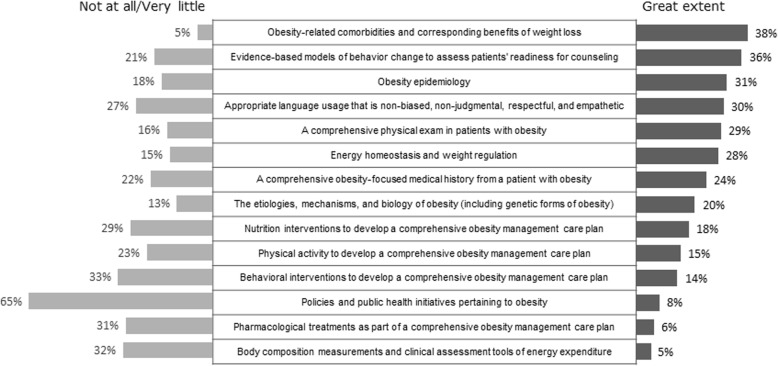
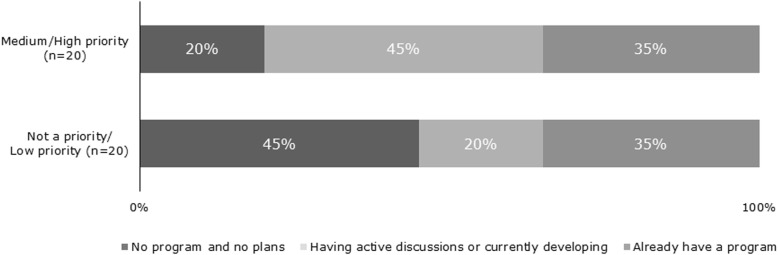
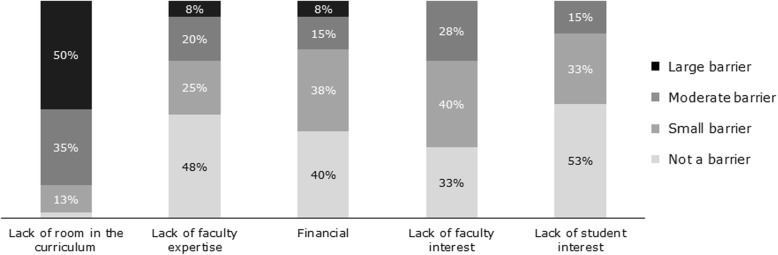
Background: Physicians are currently unprepared to treat patients with obesity, which is of great concern given the obesity epidemic in the United States. This study sought to evaluate the current status of obesity education among U.S. medical schools, benchmarking the degree to which medical school curricula address competencies proposed by the Obesity Medicine Education Collaborative (OMEC). Methods: Invitations to complete an online survey were sent via postal mail to 141 U.S. medical schools compiled from Association of American Medical Colleges. Medical school deans and curriculum staff knowledgeable about their medical school curriculum completed online surveys in the summer of 2018. Descriptive analyses were performed. Results: Forty of 141 medical schools responded (28.4%) and completed the survey. Only 10.0% of respondents believe their students were “very prepared” to manage patients with obesity and one-third reported that their medical school had no obesity education program in place and no plans to develop one. Half of the medical schools surveyed reported that expanding obesity education was a low priority or not a priority. An average of 10 h was reported as dedicated to obesity education, but less than 40% of schools reported that any obesity-related topic was well covered (i.e., to a “great extent”). Medical students received an adequate education (defined as covered to at least “some extent”) on the topics of biology, physiology, epidemiology of obesity, obesity-related comorbidities, and evidence-based behavior change models to assess patient readiness for counseling (range: 79.5 to 94.9%). However, in approximately 30% of the schools surveyed, there was little or no education in nutrition and behavioral obesity interventions, on appropriate communication with patients with obesity, or pharmacotherapy. Lack of room in the curriculum was reported as the greatest barrier to incorporating obesity education. Conclusions: Currently, U.S. medical schools are not adequately preparing their students to manage patients with obesity. Despite the obesity epidemic and high cost burden, medical schools are not prioritizing obesity in their curricula.
Overview
The claims and statistics of this paper haven’t been checked yet.
Free: it reads the open-access text and checks the first 5 claims that cite a source we can check. Create a free account to check every claim.
Integrity signals
Registry
Cites
Statistics
Figures
Verification
Claims the paper makes
The claims and statistics of this paper haven’t been checked yet.
Free: it reads the open-access text and checks the first 5 claims that cite a source we can check. Create a free account to check every claim.
Claims other papers make about this one
Each is checked against this paper’s own text: does it say what the citing paper says it does?
The source backs part of the claim, not all of it — or backs it for a different population, condition or comparison.
In the citing paper
“Academic experts, the U.S. House of Representatives, and clinical societies have called for reform to support and facilitate more robust nutrition education and training in U.S. undergraduate and graduate medical education [[106], [107], [108], [109], [110]].”
From Nutritional priorities to support GLP-1 therapy for obesity: A joint advisory from the American College of Lifestyle Medicine, the American Society for Nutrition, the Obesity Medicine Association, and the Obesity Society (2025) · cites this paper as [106]
Experimental — accuracy not yet measuredIn the citing paper
“Academic experts, the US House of Representatives, and clinical societies have called for reform to support and facilitate more robust nutrition education and training in US undergraduate and graduate medical education [[114], [115], [116], [117], [118]].”
Self-check
Percentages, sums and reported differences re-computed from the paper’s own numbers.
The self-check needs the paper’s full text.
Citations
Cites
Child abuse: Adolescent records vs. adult recall
Femina, D. D., Yeager, C. A., & Lewis, D. O. (1990) · Child Abuse & Neglect · doi:10.1016/0145-2134(90)90033-p · Cited by 8,820
Prevalence of Obesity Among Adults and Youth: United States, 2015-2016.
Hales, C. M., Carroll, M. D., Fryar, C. D., & Ogden, C. L. (2017) · PubMed · Cited by 4,554
Finkelstein, E. A., Trogdon, J. G., Cohen, J. W., & Dietz, W. (2009) · Health Affairs · doi:10.1377/hlthaff.28.5.w822 · Cited by 2,957
Health and economic burden of the projected obesity trends in the USA and the UK
Wang, Y. C., McPherson, K., Marsh, T., Gortmaker, S. L., & Brown, M. (2011) · The Lancet · doi:10.1016/s0140-6736(11)60814-3 · Cited by 2,692
The impact of obesity on health-related quality-of-life in the general adult US population
Jia, H., & Lubetkin, E. I. (2005) · Journal of Public Health · doi:10.1093/pubmed/fdi025 · Cited by 559
Nutrition Education in U.S. Medical Schools: Latest Update of a National Survey
Adams, K. M., Kohlmeier, M., & Zeisel, S. H. (2010) · Academic Medicine · doi:10.1097/acm.0b013e3181eab71b · Cited by 336
The State of Nutrition Education at US Medical Schools
Adams, K. M., Butsch, W. S., & Kohlmeier, M. (2015) · Journal of Biomedical Education · doi:10.1155/2015/357627 · Cited by 200
Self-citationManaging obesity: a survey of attitudes and practices among Israeli primary care physicians
Fogelman, Y., Vinker, S., Lachter, J., Biderman, A., Itzhak, B., & Kitai, E. (2002) · International Journal of Obesity · doi:10.1038/sj.ijo.0802063 · Cited by 173
Mogre, V., Stevens, F. C. J., Aryee, P. A., Amalba, A., & Scherpbier, A. J. J. A. (2018) · BMC Medical Education · doi:10.1186/s12909-018-1130-5 · Cited by 126
Obesity Educational Interventions in U.S. Medical Schools: A Systematic Review and Identified Gaps
Vitolins, M. Z., Crandall, S., Miller, D., Ip, E., Marion, G., & Spangler, J. G. (2012) · Teaching and Learning in Medicine · doi:10.1080/10401334.2012.692286 · Cited by 94
Research works printed but not linked: 2
- Nuttall R AAMC Organizational Characteristics Database (OCD), July 2015, presented in Medical School Revenues and Budgeting Principles 2016
- AMA Adopts New Policies on Second Day of Voting at Annual Meeting [press release]. Chicago, IL., 2013. [file://kjtfsp01/Shared%20Data/Companywide/Jobs/J19XXX/J19025/References/AMA%20Adopts%20Policy%20to%20Help%20Physicians,%20Students%20Prevent,%20Manage%20Obesity%20_%20American%20Medical%20Association_2017.html].
Cited by
Items 101–145 of 145
Ferreira, C. B. D. L., Vitoi, C. R., & Miranda, I. S. D. M. (2024) · Programa de Iniciação Científica - PIC/UniCEUB - Relatórios de Pesquisa · doi:10.5102/pic.n0.2022.9549
Ryan, L., Donoghue, G. O., Heary, C., Birney, S., Crotty, M., Hanlon, M. L. D., Conlan, O., & Walsh, J. C. (2024) · doi:10.31219/osf.io/qnasm
Nelson, B. (2023) · Digital Commons - Michigan Tech (Michigan Technological University) · doi:10.37099/mtu.dc.etdr/1699
Les obstacles à la discussion sur le poids
Christensen, S. M. (2024) · Springer eBooks · doi:10.1007/978-3-031-37335-0_4
Tran, M. T., Dillard, D. B., Abdelwahab, R. M., Abdulwadood, I., Wu, S. Y., Adeleye, O., Shoukry, M. M., Alamy, N. H., Elegbede, A. M., Keddis, M. T., et al. (2024) · Academic Medicine · doi:10.1097/acm.0000000000005736
OBESIDADE UM DESAFIO MULTIDISCIPLINAR
Alves, J. Z., & Borba, É. L. (2024) · Revista Foco · doi:10.54751/revistafoco.v17n7-066 · Cited by 12
Crompvoets, P. I., Nieboer, A. P., van Rossum, E. F. C., & Cramm, J. M. (2024) · Obesity Facts · doi:10.1159/000541499 · Cited by 2
Assessing the Preparedness of Healthcare Graduates for the Challenges of Modern Medicine
Parashar, M., & Sahu, N. (2022) · Health Leadership and Quality of Life · doi:10.56294/hl2022120
Emergence of a New Medical Subspecialty: The Case of Obesity Medicine
Kushner, R. F., & Gudzune, K. A. (2025) · Springer eBooks · doi:10.1007/978-3-031-82888-1_23
Self-citationLadapo, J. A., D’Adamo, C. R., Anton, S. D., Sheer, A. J., VandeWeerd, C. L., Vincent, K. R., Wali, S., Vincent, H. K., & Manini, T. M. (2025) · Journal of the American Medical Directors Association · doi:10.1016/j.jamda.2025.105628
Trends and Disparities in Clinician Diagnosis of Overweight and Obesity
Bajaj, S. S., Zhong, A., Khunte, M., & Stanford, F. C. (2025) · Journal of General Internal Medicine · doi:10.1007/s11606-025-09633-0
Fritzenwallner, S., Flamm, M., Wiesinger, H., & Schaffler‐Schaden, D. (2025) · Wiener klinische Wochenschrift · doi:10.1007/s00508-025-02545-3
Schwartzkoff, E., Pikora, T., Garven, H., Gooey, M., Gilligan, C., Lindley, J., Kerr, N., Smyth, L., Popovic, G., Arena, G., et al. (2025) · Medical Science Educator · doi:10.1007/s40670-025-02527-0 · Cited by 2
“While this issue has been identified by several researchers [9–11], there remains limited research that systematically evaluates obesity related content, particularly content focussed on children and adolescents, in current medical school curricula.”
Katz, N. J., Lovrics, O., & Zevin, B. (2022) · Figshare · doi:10.6084/m9.figshare.20353588
Katz, N. J., Lovrics, O., & Zevin, B. (2022) · Figshare · doi:10.6084/m9.figshare.20353597
Additional file 1 of Preclinical obesity curriculum: audit, implementation, and evaluation
Olson, A., Watowicz, R. P., Seeholzer, E. L., Lyons, K., Butsch, W. S., & Croniger, C. M. (2024) · Figshare · doi:10.6084/m9.figshare.26731015
Self-citationKatz, N. J., Lovrics, O., & Zevin, B. (2022) · Figshare · doi:10.6084/m9.figshare.20353594
Stoutenberg, M., Lewis, L. K., Jones, R. M., Portacio, F., Vidot, D. C., & Kornfeld, J. (2023) · Figshare · doi:10.6084/m9.figshare.22602526
Katz, N. J., Lovrics, O., & Zevin, B. (2022) · Figshare · doi:10.6084/m9.figshare.20353591
Stoutenberg, M., Lewis, L. K., Jones, R. M., Portacio, F., Vidot, D. C., & Kornfeld, J. (2023) · Figshare · doi:10.6084/m9.figshare.22602523
Katz, N. J., Lovrics, O., & Zevin, B. (2022) · Figshare · doi:10.6084/m9.figshare.20353585
Katz, N. J., Lovrics, O., & Zevin, B. (2022) · Figshare · doi:10.6084/m9.figshare.20353582
Orjuela‐Grimm, M., Butsch, W. S., Bhatt-Carreño, S., Smolarz, B. G., & Rao, G. (2021) · Figshare · doi:10.6084/m9.figshare.14843395
Self-citationKoran-Scholl, J. B., Geske, J., Khandalavala, K. R., & Khandalavala, B. N. (2023) · Figshare · doi:10.6084/m9.figshare.22877497
Darmadi, M., Potluri, V., Thomas, R. C., Park, C. J., & Oladunjoye, O. O. (2025) · Cureus · doi:10.7759/cureus.100062
“Despite the marked need for physicians trained in MASLD and its associated metabolic syndromes, residents do not feel prepared to address these conditions in practice due to a lack of focused education and real-world experience during their training [9-12].”
Popescu, S., & Ionescu, A. (2023) · Annals of Pharmacy Education Safety and Public Health Advocacy · doi:10.51847/kbbmhebthm
Obesity competency for nurse practitioners: A call to action
Wenz, L., Browne, N. T., Christensen, S. M., Golden, A. G., Graves, R., & Karp, S. M. (2026) · Journal of the American Association of Nurse Practitioners · doi:10.1097/jxx.0000000000001284
Weight Bias Education in Medical Training: Insights from Stakeholder Perspectives
Oliver, T. L., Diewald, L. K., Felgoise, S. H., Kanyuh, A., Brito-Cherrin, R., Brace, M. M., Furman, G. E., & Shenkman, R. (2026) · Medical Science Educator · doi:10.1007/s40670-026-02731-6
“These findings align with prior research indicating a striking paucity of obesity and weight bias related content in undergraduate medical education, both in terms of content and clinical exposure [ 7, 10, 12, 20].”
InfluentialAre Future Doctors Ready for the Post-Pandemic Obesity Surge? A Mixed-Methods Pilot Study
Sant, D., Cuschieri, A., & Cuschieri, S. (2026) · International Medical Education · doi:10.3390/ime5020044
Lytvyak, E., Mittal, N., Wei, J., Lin, T., Yang, K. Y., Tu, X. M., Lunde, O., Ross, E., Cheng, J., DeConde, J., et al. (2026) · Obesity Research & Clinical Practice · doi:10.1016/j.orcp.2026.05.001
Trends and Sex-Specific Rates of Obesity and Severe Obesity in US Hospitalized Adults, 2012–2021
Lui, J., Fischer, K. M., Gupta, R., Singla, A., Baptista, A. M., Monlezun, D. J., Ayanian, S., Harris, C. M., & Dugani, S. B. (2026) · Journal of General Internal Medicine · doi:10.1007/s11606-026-10567-4 · Cited by 1
Hagiwara, N., Cheng, S., Bú, E. A. D., Denton, A. H., & Krukowski, R. A. (2026) · Patient Education and Counseling · doi:10.1016/j.pec.2026.109749
Ganti, A., Oczypok, E. A., Rothenberger, S. D., & Kohli, A. R. (2026) · Southern Medical Journal · doi:10.14423/smj.0000000000001988
Shenkman, R., Oliver, T. L., Brace, M. M., Furman, G. E., Felgoise, S. H., & Diewald, L. K. (2026) · Teaching and Learning in Medicine · doi:10.1080/10401334.2026.2706833
Integrating obesity education into physiotherapy curricula: A European survey of current practice
Davis, M. E., O’Donoghue, G., Kosińska, E., Verboven, K., Lehtinen‐Jacks, S., Fridén, C., Pystynen, T., Blake, C. M., Tuominen, P. P. A., Wikström‐Grotell, C., et al. (2026) · Physiotherapy · doi:10.1016/j.physio.2026.102369
Marwaha, K., Cain, R., Asmis, K., Harindranathan, P., & Ahmed, S. (2026) · AJP Advances in Physiology Education · doi:10.1152/advan.00291.2025
Exploring Health Education Instructors’ Perspectives and Approaches to Weight-Related Content
Warnock, J., Wolsiefer, K., & Walker, A. E. (2026) · Journal of Nutrition Education and Behavior · doi:10.1016/j.jneb.2026.07.005
Integrating incretin-based therapies into comprehensive obesity care: an EASO position statement
Correia, J. C., Baker, J. L., Boyland, E. J., Busetto, L., Fábryová, Ľ., Helgason, T., Sbraccia, P., Woodward, E., Yumuk, V., & Pataky, Z. (2026) · The Lancet Regional Health - Europe · doi:10.1016/j.lanepe.2026.101840 · Cited by 1
“21 Implementation also requires systems capable of evaluating effectiveness, safety, treatment persistence, and patient-centered outcomes in routine practice.”
Mohan, N., Burks, E. R., Bruskas, M. T., Khan, A. S., Yedatore, R., & Dufour, J. M. (2026) · Research Square · doi:10.21203/rs.3.rs-10913760/v1
Głodek, K. (2026) · International Journal of Innovative Technologies in Social Science · doi:10.31435/ijitss.3(51).2026.6421
García, A. M., González-Santamaría, J., López-García, C. J., Cruz, D. A. R., & Ramírez, J. A. (2026) · Discover Education · doi:10.1007/s44217-026-02131-3
Ko, T. Y. L., Contreras, F., le Roux, C. W., & Al‐Najim, W. (2026) · Obesity Pillars · doi:10.1016/j.obpill.2026.100337
“…education remains limited, with limited specific obesity-teaching on communication, obesity medications, behavioural interventions and weight stigma [14 – 18], while recent competency frameworks advocate broader education encompassing multidisciplinary management and patient-centred care [19 – 22].”
Obesity care in internal medicine: A gap between recognition and treatment competence
Başaran, N. Ç., Yalçinkaya, F., Uyaroğlu, O. A., & Ünal, S. (2026) · European Journal of Internal Medicine · doi:10.1016/j.ejim.2026.107231
Pasarica, M., Kushner, R. F., Leary, A. V., Grunvald, E. L., Velasquez, S. A. T., Uhley, V. E., Johnson, M. S., Ricardo, C., Carpenter, D.-A. L., Velazquez, A., et al. (2026) · International Medical Education · doi:10.3390/ime5040110
Self-citationAddressing the weight of the issue: gaps in obesity education among US osteopathic medical students
Gemma, S. L. L., Rifkin, A. S., Basra, M. H., Rawson, C. D., Nguyen, C., Malhotra, S., Mellacheruvu, S. S., Bhasin, R., Ansari, M. I., Cornwell, H. M., et al. (2026) · Journal of Osteopathic Medicine · doi:10.1515/jom-2025-0073
“Numerous factors may contribute to the integration of obesity curricula into medical education, including limited curricular space, faculty expertise, and persistent weight bias [6].”
Influential
Metadata
- Authors
- Butsch, W. S., Kushner, R. F., Alford, S., & Smolarz, B. G.
- Affiliations
- Cleveland Clinic (US)
- Northwestern University (US)
- Corresponding author
- Smolarz, B. Gabriel
- Venue
- BMC Medical Education
- Published
- 2020-01-28
- Volume
- 20
- Issue
- 1
- Pages
- 23-23
- ISSN
- 1472-6920 (ISSN-L)
- PMC
- PMC6988262
- OpenAlex
- W3007930653
- Cited by
- 145
- References
- 16
- Citations by year
- 2026: 23 · 2025: 27 · 2024: 20 · 2023: 34 · 2022: 25 · 2021: 10 · 2020: 6
- FWCI
- 28.87
- Type
- journal article
- Language
- en
- Open access
- gold
- doi.org
- Licence
- cc-by
- creativecommons.org/licenses/by/4.0/ (tdm)
- creativecommons.org/licenses/by/4.0/ (vor)
- Locations
- BMC Medical Education (publishedVersion, cc-by)
- PubMed Central (publishedVersion, cc-by)
- PubMed (publishedVersion)
- DOAJ (DOAJ: Directory of Open Access Journals) (submittedVersion, cc-by-sa)
- Funders
- Novo Nordisk (NA)
- Topics
- Health Sciences › Medicine › Public Health, Environmental and Occupational Health › Obesity and Health Practices
- Social Sciences › Education › Innovations in Medical Education
- Health Sciences › Health Professions › General Health Professions › Health and Medical Education
- Keywords
- obesity education, medical curriculum, curriculum benchmarking, nutrition education, obesity pharmacotherapy, patient communication, obesity-related comorbidities, behavior change models
- MeSH terms
- Clinical Competence, Counseling, Curriculum, Humans, Obesity, Schools, Medical, Students, Medical, Time Factors, United States, Health Care Surveys, Benchmarking
About these checks
Registry, retraction, Cites and statistics results are computed, not judged, with one exception: a printed reference that no index lists is read once by a model before it counts as a citation error. Claims are extracted by a model and kept only when their quote appears verbatim in the text; each cited source is then checked, with a model’s help, for whether it says what the claim relies on. Those verdicts can be wrong — read the claim’s quote and the cited source before relying on one.
Statistics and arithmetic are recomputed, not judged.
Confidence bands are shown only for fields calibrated on our annotated test set. None is calibrated yet, so no band is shown.
What counts as a claim ›How we measure confidence ›How we check this ›
Are you an author, or do you see a problem with this page? Request a review
Data sources
Bibliographic data: Semantic Scholar, OpenAlex, Crossref.
Contains information from the Semantic Scholar Academic Graph Datasets, made available under the ODC Attribution License (ODC-BY 1.0).
Semantic Scholar’s data is described in: Kinney, R., et al. (2023). The Semantic Scholar Open Data Platform. arXiv:2301.10140.
