

The impact of artificial intelligence on clinical education: perceptions of postgraduate trainee doctors in London (UK) and recommendations for trainers
Open accessThe DOI matches its Crossref record; 31 of the 31 references it cites were found in a registry or an index.
Abstract
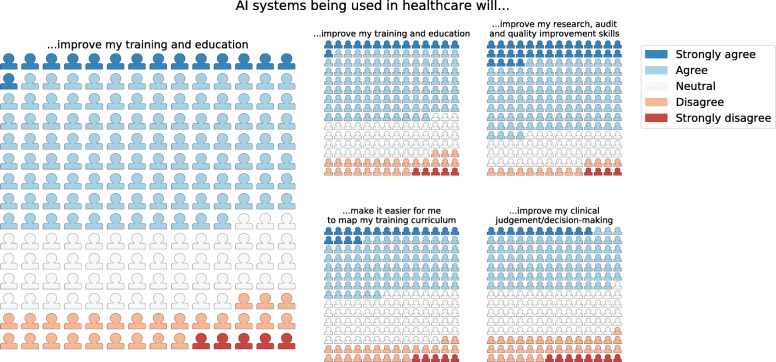
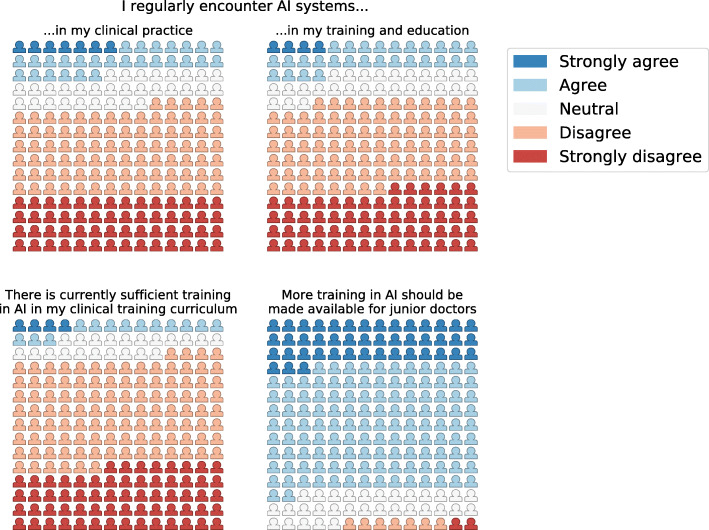
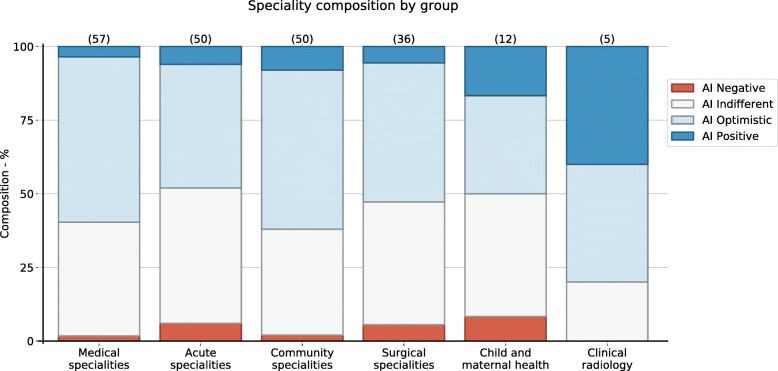
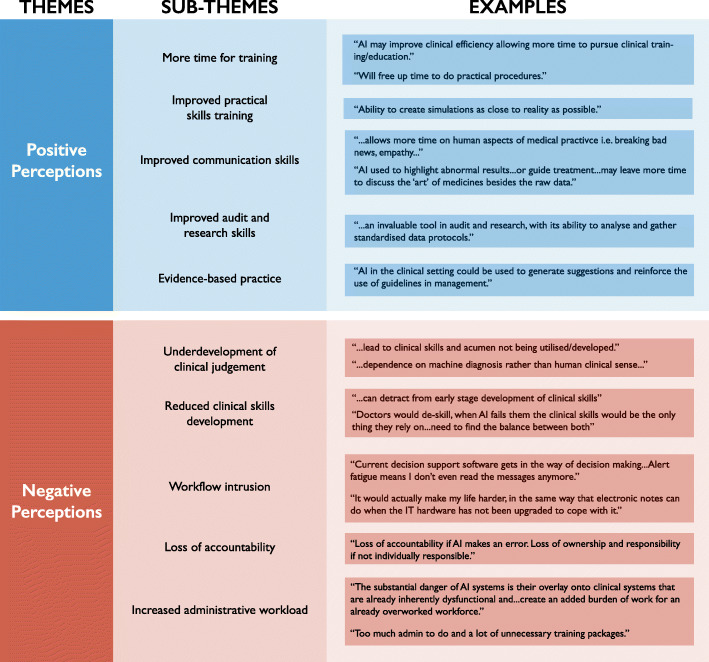
BACKGROUND: Artificial intelligence (AI) technologies are increasingly used in clinical practice. Although there is robust evidence that AI innovations can improve patient care, reduce clinicians' workload and increase efficiency, their impact on medical training and education remains unclear. METHODS: A survey of trainee doctors' perceived impact of AI technologies on clinical training and education was conducted at UK NHS postgraduate centers in London between October and December 2020. Impact assessment mirrored domains in training curricula such as 'clinical judgement', 'practical skills' and 'research and quality improvement skills'. Significance between Likert-type data was analysed using Fisher's exact test. Response variations between clinical specialities were analysed using k-modes clustering. Free-text responses were analysed by thematic analysis. RESULTS: Two hundred ten doctors responded to the survey (response rate 72%). The majority (58%) perceived an overall positive impact of AI technologies on their training and education. Respondents agreed that AI would reduce clinical workload (62%) and improve research and audit training (68%). Trainees were skeptical that it would improve clinical judgement (46% agree, p = 0.12) and practical skills training (32% agree, p < 0.01). The majority reported insufficient AI training in their current curricula (92%), and supported having more formal AI training (81%). CONCLUSIONS: Trainee doctors have an overall positive perception of AI technologies' impact on clinical training. There is optimism that it will improve 'research and quality improvement' skills and facilitate 'curriculum mapping'. There is skepticism that it may reduce educational opportunities to develop 'clinical judgement' and 'practical skills'. Medical educators should be mindful that these domains are protected as AI develops. We recommend that 'Applied AI' topics are formalized in curricula and digital technologies leveraged to deliver clinical education.
Overview
The claims and statistics of this paper haven’t been checked yet.
Free: it reads the open-access text and checks the first 5 claims that cite a source we can check. Create a free account to check every claim.
Integrity signals
Registry
Cites
Statistics
Figures
Verification
Claims the paper makes
The claims and statistics of this paper haven’t been checked yet.
Free: it reads the open-access text and checks the first 5 claims that cite a source we can check. Create a free account to check every claim.
Claims other papers make about this one
Each is checked against this paper’s own text: does it say what the citing paper says it does?
The source backs part of the claim, not all of it — or backs it for a different population, condition or comparison.
In the citing paper
“Surveys indicate strong backing for AI literacy training, with 81% of UK physicians4 and 63% of Canadian medical students recognizing its importance12, while an overwhelming 93.8% of students in Turkey support structured AI education, particularly in the domains of knowledge, applications, and ethics13.”
From Developing a Canadian artificial intelligence medical curriculum using a Delphi study (2024) · cites this paper as [4]
Experimental — accuracy not yet measuredThe source backs part of the claim, not all of it — or backs it for a different population, condition or comparison.
In the citing paper
“Studies show that students support this idea [40, 41].”
From Medical, dental, and nursing students’ attitudes and knowledge towards artificial intelligence: a systematic review and meta-analysis (2024) · cites this paper as [40]
Experimental — accuracy not yet measuredThe cited source says what the claim attributes to it.
In the citing paper
“Few structured programs thoroughly address both the practical and ethical dimensions of AI in medicine3–10.”
From Developing a Canadian artificial intelligence medical curriculum using a Delphi study (2024) · cites this paper as [4]
The cited source says what the claim attributes to it.
In the citing paper
“However, despite these advancements, the adoption of AI curricular elements in medical education has lagged4.”
From Developing a Canadian artificial intelligence medical curriculum using a Delphi study (2024) · cites this paper as [4]
The cited source says what the claim attributes to it.
In the citing paper
“Banerjee et al. and Teng et al., reporting that 81% of physicians and 63·36% of medical students, respectively, support fundamental AI literacy training [7,8].”
From An evidence-based approach to artificial intelligence education for medical students: A systematic review (2023) · cites this paper as [7]
5 more claims about this paper
Create a free account to see every claim other papers make about this one.
Self-check
Percentages, sums and reported differences re-computed from the paper’s own numbers.
The self-check needs the paper’s full text.
Citations
Cites
Using thematic analysis in psychology
Braun, V., & Clarke, V. (2006) · Qualitative Research in Psychology · doi:10.1191/1478088706qp063oa · Cited by 194,414 · cited 1×
“Free-text responses were analysed using thematic analysis [22].”
Dermatologist-level classification of skin cancer with deep neural networks
Esteva, A., Kuprel, B., Novoa, R. A., Ko, J., Swetter, S. M., Blau, H. M., & Thrun, S. (2017) · Nature · doi:10.1038/nature21056 · Cited by 14,362 · cited 1×
“Although there is an abundance of evidence supporting the safety, accuracy, cost and workflow benefits of AI technologies in healthcare [5 – 7], there is limited research investigating the impact of AI on medical education [8, 9], the new skills required, and in particular the perceptions of…”
BackgroundHigh-performance medicine: the convergence of human and artificial intelligence
Topol, E. J. (2019) · Nature Medicine · doi:10.1038/s41591-018-0300-7 · Cited by 10,450 · cited 1×
“The healthcare sector is undergoing a digital revolution [1], with a wide range of artificial intelligence (AI) innovations increasingly encountered in routine clinical practice [2].”
BackgroundA guide to deep learning in healthcare
Esteva, A., Robicquet, A., Ramsundar, B., Kuleshov, V., DePristo, M., Chou, K., Cui, C., Corrado, G., Thrun, S., & Dean, J. (2019) · Nature Medicine · doi:10.1038/s41591-018-0316-z · Cited by 5,312 · cited 1×
“Computer vision algorithms can detect lesions from radiological scans, make measurements, and pick-up incidental findings, saving time and reducing error [13, 14].”
BackgroundExtensions to the k-Means Algorithm for Clustering Large Data Sets with Categorical Values
Huang, Z. (1998) · Data Mining and Knowledge Discovery · doi:10.1023/a:1009769707641 · Cited by 2,505 · cited 1×
“K-modes clustering was used to identify key groups of responses to the Likert-type statements [21].”
MethodArdila, D., Kiraly, A. P., Bharadwaj, S., Choi, B., Reicher, J. J., Peng, L., Tse, D., Etemadi, M., Ye, W., Corrado, G., et al. (2019) · Nature Medicine · doi:10.1038/s41591-019-0447-x · Cited by 2,167 · cited 1×
“Radiology has experienced the most AI advances in clinical practice already [27, 28] so Radiology trainees are most likely to already first-hand experience of AI ’ s impact on their training.”
BackgroundRajpurkar, P., Irvin, J., Ball, R. L., Zhu, K., Yang, B., Mehta, H., Duan, T., Ding, D., Bagul, A., Langlotz, C. P., et al. (2018) · PLOS Medicine · doi:10.1371/journal.pmed.1002686 · Cited by 1,449 · cited 1×
“Radiology has experienced the most AI advances in clinical practice already [27, 28] so Radiology trainees are most likely to already first-hand experience of AI ’ s impact on their training.”
BackgroundEthical and legal challenges of artificial intelligence-driven healthcare
Gerke, S., Minssen, T., & Cohen, G. (2020) · Artificial Intelligence in Healthcare · doi:10.1016/b978-0-12-818438-7.00012-5 · Cited by 1,170
Nagendran, M., Chen, Y., Lovejoy, C. A., Gordon, A. C., Komorowski, M., Harvey, H., Topol, E. J., Ioannidis, J. P. A., Collins, G. S., & Maruthappu, M. (2020) · BMJ · doi:10.1136/bmj.m689 · Cited by 1,152 · cited 1×
“Common pitfalls include over-optimistic conclusions from ‘ human versus clinician ’ studies that are usually retrospective and prone to bias [32], lack of standardized benchmarks and no universally accepted AI evaluation metrics [33].”
BackgroundA clinically applicable approach to continuous prediction of future acute kidney injury
Tomašev, N., Glorot, X., Rae, J. W., Zielinski, M., Askham, H., Saraiva, A., Mottram, A., Meyer, C., Ravuri, S., Protsyuk, I., et al. (2019) · Nature · doi:10.1038/s41586-019-1390-1 · Cited by 1,086 · cited 1×
“For example, decision support systems can triage patients, suggest diagnoses and alert test re-sults by analysing data faster and more accurately than clinicians [6, 10].”
Background
Research works printed but not linked: 2
- (2) [cited 2021 Jan 10] Available from: https://www.ncbi.nlm.nih.gov/pmc/articles/PMC6918207/.
- (6) [cited 2021 May 26] Available from: https://www.ncbi.nlm.nih.gov/pmc/articles/PMC7334754/.
Cited by
Items 101–196 of 196
Beyond the hype: evidence-based approaches to responsible AI integration in workplace learning
Sposato, M. (2025) · Education + Training · doi:10.1108/et-01-2025-0034 · Cited by 3
Panjaitan, S. H., Ma’rifah, I., & Kubro, K. (2025) · Kalijaga Journal of Islamic Religious Education · doi:10.14421/jire.12049 · Cited by 10
“Several studies show that teachers believe AI can help students by providing learning support tailored to individual needs (Banerjee et al., 2021).”
Artificial Intelligence in Social Sciences: Transforming Education and Research
Rosmayanti, V. (2025) · Advances in computational intelligence and robotics book series · doi:10.4018/979-8-3373-2612-2.ch012 · Cited by 3
Kebijakan Penggunaan Teknologi Artificial Intelligence (AI) dalam Pembelajaran di Sekolah Dasar
Setiawan, R., & Sukmana, N. (2025) · Kalam Cendekia Jurnal Ilmiah Kependidikan · doi:10.20961/jkc.v13i2.102104 · Cited by 7
Chu, B., Modi, N. D., Menz, B. D., Cornelisse, E., Bacchi, S., Bulamu, N. B., Ullah, S., McKinnon, R. A., Gradoń, K., Rowland, A., et al. (2026) · Public Health Reports · doi:10.1177/00333549261418596 · Cited by 5
Alshammari, T. (2026) · Journal of the American College of Emergency Physicians Open · doi:10.1016/j.acepjo.2026.100355 · Cited by 3
“24 Such an issue may be manageable in a hospital, but the uncontrolled and time-sensitive EMS setting offers limited ability to depend wholly on AI.”
Generative Artificial Intelligence in Clinical Practice: Undergraduate Experience
Bernal, C. M. A., Fernández-Delgado, J. C. M., & Andía-Alegría, F. S. (2024) · Evolutionary Studies in Imaginative Culture · doi:10.70082/esiculture.vi.1868 · Cited by 4
“Valoración through the personalization of learning and the optimization of study time (Banerjee et al., 2021).”
InfluentialThaker, N. G., Loaiza‐Bonilla, A., Choudhri, A., & Doria, C. (2024) · AI in Precision Oncology · doi:10.1089/aipo.2024.0031 · Cited by 3
A mixed-methods study of the experience of GP educational supervisors
Elliott, D., Shepherd, A., Hanley, K., & Gambhir, N. (2025) · BJGP Open · doi:10.3399/bjgpo.2024.0106 · Cited by 2
Transformational Leadership in Schools: A Bibliometric and Content Analysis (2000-2024)
Le, J., Hamid, A. H. A., & Mansor, A. N. (2025) · International Journal of Educational Leadership and Management · doi:10.4471/ijelm.17382 · Cited by 7
The Role of Artificial Intelligence in Workforce Adaptation and Skill Development
Karmali, Y. (2026) · Biomedical visualization · doi:10.1007/978-3-032-06520-9_10 · Cited by 2
Rahim, N., Nesar, S., Hashmi, U. P., Rasheed, A., Majeed, S., Noor, B., Zehra, A., Naqvi, M., Usmani, M. S., & Jamshed, S. Q. (2026) · BMC Medical Education · doi:10.1186/s12909-026-08632-x · Cited by 2
“[25].”
Enhancing dental clinical education through AI: insights into post-clinical summaries
Luo, F., Li, J., Zhang, T., Huang, B., Jiang, L., Hua, C., & Hu, P. (2026) · BMC Medical Education · doi:10.1186/s12909-026-08774-y · Cited by 2
“Moreover, there is a need to understand both students’ and instructors’ attitudes toward AI, as well as the potential barriers to its widespread adoption in clinical settings [7, 8].”
Zhao, L., Han, Q., Li, P., Dai, H., & Ju, X. (2026) · BMC Medical Education · doi:10.1186/s12909-026-08947-9 · Cited by 4
“These findings underscore the importance of tailoring AI education to the specific contexts and needs of both clinical and academic training pathways [32, 33].”
Uncertain hands: ethical implications of AI dependency in medical education
Lim, E., & Lim, C. E. D. (2026) · AI and Ethics · doi:10.1007/s43681-026-01041-2 · Cited by 3
Aljoudeh, J., Balkhi, A. A., Ranjous, Y., Shbani, A., Takieddin, D., & Izzat, M. B. (2026) · JMIR Medical Education · doi:10.2196/84942 · Cited by 2
“In comparison, a study conducted in London, United Kingdom, found that only 46% agreed that AI would improve clinical judgment [45].”
Perceptions, Attitudes, and Use of AI by Medical Students: Mixed Methods Study
Paris, F., Garrouste, V., & Vuillaume, L. A. (2026) · JMIR Medical Education · doi:10.2196/91345 · Cited by 2
“The themes of “nuanced optimism” and “replacement” align with observations from other studies [18,23,24,26].”
Young People and Social Representations on Artificial Intelligence in Peru and Colombia
León, V. O. V., Poggi-Parodi, C., & Lopera-Moreno, J. (2024) · Smart innovation, systems and technologies · doi:10.1007/978-981-99-7210-4_23 · Cited by 2
Redefining Radiology - Artificial Intelligence Integration in Medical Imaging
Iffath, T., Athkuri, P., Nadeem, M., & Goyal, P. (2024) · doi:10.47275/0032-745x-410 · Cited by 3
Berrami, H., Serhier, Z., Jallal, M., & Othmani, M. B. (2023) · International Conference on Cloud Computing Technologies and Applications (CloudTech) · doi:10.1109/cloudtech58737.2023.10366176 · Cited by 2
Perceptions of Pharmacy Students Toward Artificial Intelligence in Pharmacy
Saeed, A. A., Zamel, A. M. A., Dafallah, A. S., Fagir, A. S. E., Idris, B. A., Youseef, D. A., Saeed, T. B., Idris, W. A., & Hamid, A. (2024) · Matrix Science Pharma · doi:10.4103/mtsp.mtsp_9_24 · Cited by 1
Developing a Collaborative Research Environment in Health Care: Challenges and Opportunities
Sharma, R., Hussain, F. Z., Sneha, G., & Ramya, K. A. (2024) · Indian Journal of Medical and Paediatric Oncology · doi:10.1055/s-0044-1795112 · Cited by 1
Professional Training of Future Doctors Using Cloud Technologies
Єфремова, О. В., Humeniuk, M., Salyzhyn, T., Humeniuk, V. V., & Korniichuk, O. (2024) · Cadernos de Educação Tecnologia e Sociedade · doi:10.14571/brajets.v17.nse5.60-72 · Cited by 1
“Banerjee et al. (2021) note that technological innovations are especially important in training doctors as they enable the development of key competencies, necessary for successful practice in the modern world.”
Exploring Artificial Intelligence Role in Enhancing Medical Education for Future Physicians
Din, M. U., Ali, M. S., Saira, S., Naeem, I., Mahmood, A., & Raza, A. (2025) · Pakistan Journal of Health Sciences · doi:10.54393/pjhs.v6i2.2766 · Cited by 1
Teaching Preventive Care Modalities
Pavlovska, I., Gonzalez-Rivas, J. P., Infante-García, M. M., Nieto-Martínez, R. E., & Mechanick, J. I. (2025) · Springer eBooks · doi:10.1007/978-3-031-82888-1_18 · Cited by 1
Till, H., Elsayed, H., Singer, G., Obermüller, B., Till, T., Gnatzy, R., & Tschauner, S. (2025) · European Journal of Pediatric Surgery · doi:10.1055/a-2650-6603 · Cited by 1
Mihara, H. (2026) · Education and human development · doi:10.5772/intechopen.1012733 · Cited by 1
Adilah, M., Hasanah, U., Wiradinata, R., & Febianti, Y. N. (2025) · Jurnal Pendidikan dan Pengajaran · doi:10.23887/jpp.v58i3.100525 · Cited by 3
AI won’t save us…yet: reimagining AI’s potential to prioritize people
Santhosh, L., & Witt, L. J. (2026) · ATS Scholar · doi:10.1093/atsscholar/aapag009 · Cited by 1
Perception of integrating an AI teaching module into medical education curriculum
Jamjoom, J. M., Alkhwaiter, F., Armosh, G., Alfarra, N., Murshid, S., Tamim, A., Tamim, H., Alhusseini, N. K., & Al-Hazzaa, S. A. F. (2026) · Frontiers in Medicine · doi:10.3389/fmed.2026.1774935 · Cited by 2
Fuzzy best-worst method for analysing the threats of AI in education
Mamites, I. O. (2026) · International Journal of Mathematics in Operational Research · doi:10.1504/ijmor.2026.152325 · Cited by 1
Çetinkaya, Ü. C., & Akyol, C. (2026) · Health Policy and Technology · doi:10.1016/j.hlpt.2026.101219 · Cited by 1
Devi, J., Colbert, C. Y., Dar, S. H., Gros, B., Ardabili, A. R., Ho, A. H. Y., Hebert, A., & Sleiman, J. (2026) · Digestive Diseases and Sciences · doi:10.1007/s10620-026-09987-3 · Cited by 1
Towards patient-centered healthcare: a scoping review of soft skills training in medical schools
Zagalo, D. M., Palmieri, C., Resende, N., Costa, T., de Sousa, R. D., Canhão, H. M., & Bozza, F. A. (2026) · BMC Medical Education · doi:10.1186/s12909-026-09059-0 · Cited by 3
“Equally important is the integration of medical ethics and professionalism within soft skills training [22, 66, 93, 120, 120, 156–158].”
Scholz, F., Sahakian, T. S., GÜVEN, N., Renkema, M., Shulzhenko, E., Cuijpers, C., Schouten, G., Wouters, E., & de Vries, E. (2026) · The International Journal of Human Resource Management · doi:10.1080/09585192.2026.2711067 · Cited by 3
“…and enjoyable tasks, enhancing task significance (Figure 3; Al Harbi et al., 2024; Alkaabi & Elsori, 2025; Amann et al., 2023; Aquino et al., 2023; Banerjee et al., 2021; Buck et al., 2022; Chen et al., 2021; Durukan et al., 2026; Drogt et al., 2024; Fruehwirt & Duckworth, 2021; Goh et al., 2025;…”
Khawaja, S. (2026) · International Journal of Service Science Management Engineering and Technology · doi:10.4018/ijssmet.420182 · Cited by 2
Artificial Intelligence in Clinical Skills Training and Assessment in Anesthesiology
Jiang, H. Z. (2023) · Springer eBooks · doi:10.1007/978-981-99-5925-9_11 · Cited by 1
Awareness of ChatGPT Among Medical Students and Trainee/Residents
Lateef, H., Arshad, R., Ayesha, E., Hanif, S., Zainab, A., Naseer, O., Shahzad, F., & Afzal, S. (2024) · Journal of Society of Prevention Advocacy and Research KEMU · doi:10.21649/jspark.v3i1.375 · Cited by 1
Pears, M., & Konstantinidis, S. T. (2024) · Advances in business information systems and analytics book series · doi:10.4018/979-8-3693-3003-6.ch008 · Cited by 2
Artificial intelligence: Blessing or curse?
Briganti, G. (2024) · Elsevier eBooks · doi:10.1016/b978-0-443-23655-6.00005-8 · Cited by 1
AI-Enhanced Health Counseling: A Futuristic Approach to Holistic Well-Being
Romero, C. B., & Subardjo, R. Y. S. (2024) · Bincang Sains dan Teknologi · doi:10.56741/bst.v3i03.631 · Cited by 1
“While AI innovations have shown benefits in improving patient care and efficiency, their impact on medical training and education remains unclear [25].”
The impact of postgraduate education on career advancement in healthcare
Коцур, Н. (2024) · Scientia et societus · doi:10.69587/ss/2.2024.08 · Cited by 1
Junaidi (2025) · The Journal of Education Insights · doi:10.37155/2972-4856-jei0304-5 · Cited by 1
Promises for the future: The role of artificial intelligence in education and perioperative care
Calvache, J. A. (2023) · Colombian Journal of Anesthesiology · doi:10.5554/22562087.e1090 · Cited by 1
Shinners, L. (2023) · Cross Connect (Southern Cross University) · doi:10.25918/thesis.312 · Cited by 1
The Use of Cloud Technologies in the Professional Training of Future Doctors
Єфремова, О. В., Humeniuk, M., Salyzhyn, T., Humeniuk, V. V., & Korniichuk, O. (2024) · Revista de la Universidad del Zulia · doi:10.46925//rdluz.43.17
Alfuhaid, R. (2024) · Authorea · doi:10.22541/au.171769113.31311492/v1
Juandi, T., Kaniawati, I., Samsudin, A., & Riza, L. S. (2024) · Journal of Advanced Research in Applied Sciences and Engineering Technology · doi:10.37934/araset.60.2.103123 · Cited by 1
“It can provide insights, simplify tasks, and even replace human work [86].”
BackgroundInnovative Pedagogies for a Digital World
Javed, F. (2024) · Advances in logistics, operations, and management science book series · doi:10.4018/979-8-3693-8357-5.ch009 · Cited by 3
Medico-Legal Aspect of Telemedicine in IndiaPreprint
Singh, S., & Devi, L. (2025) · SSRN Electronic Journal · doi:10.2139/ssrn.5168787
Abiad, M. (2025) · Emerald Group Publishing Limited eBooks · doi:10.1108/978-1-83608-904-920251003
Elfituri, Z. Y. K., & Husein, W. A. B. M. (2025) · AlQalam Journal of Medical and Applied Sciences · doi:10.54361/ajmas.258394
Amjad, T., Ikram, O. M., Akif, M., Sajid, H., & Sadiq, R. (2025) · Pakistan Armed Forces Medical Journal · doi:10.51253/pafmj.v75isuppl-6.13519
Integrating a chatbot into simulation-based perfusion training: A pilot randomized controlled trial
Warlick, A., Clifton, C., Trinh, T., Kaur, R., Weinberg, A., & Collins, J. (2025) · Perfusion · doi:10.1177/02676591251394841
“Studies on AI in medical education 1,4,7,8,11 – 14 have indicated that the balance be-tween assistance and distraction is critical for optimizing learning outcomes.”
InfluentialRevisión bibliométrica sobre la adopción de inteligencia artificial en la educación superior
Jiménez, M. U., López-Mallama, Ó. M., & Espinosa, A. A. (2025) · Revista Guillermo de Ockham · doi:10.21500/22563202.7780
Use and perceptions of AI tools among Australian general practice registrars: a national survey
Runciman, D., Turnbull, B., Walker, L., Klein, L., Robinson-Kingi, H., Patsan, I., Fielding, A., Tran, M., Boughen, S., Balasooriya, C. D., et al. (2026) · Journal of Primary Health Care · doi:10.2196/preprints.88142
Barrientos Báez, A., Salas, P. E. R., Goñi Alsúa, E., Huerta González, S., & Núñez, M. M. I. (2025) · Espirales revista multidisciplinaria de investigación · doi:10.31876/9789942531032 · Cited by 1
Dwivedi, A., Yusufi, R., Derashri, A., Sharma, D., Vinchurkar, K., Patel, D., & Suryawanshi, M. V. (2025) · Elsevier eBooks · doi:10.1016/b978-0-443-43823-3.00012-1
Amiri, H., Peiravi, S., Shojaee, S. S. R., Rouhparvarzamin, M., Nateghi, M. N., Etemadi, M. H., ShojaeiBaghini, M., Musaie, F., Anvari, M. H., & Anar, M. A. (2024) · Figshare · doi:10.6084/m9.figshare.26706867
Fitzek, S., & Choi, K.-E. A. (2024) · Figshare · doi:10.6084/m9.figshare.26758306
Daniyal, M., Qureshi, M., Marzo, R. R., Aljuaid, M. M., & Shahid, D. (2024) · Figshare · doi:10.6084/m9.figshare.25792775
Desafios na implementação da inteligência artificial na medicina : uma revisão narrativa
Nogueira, C. A. V. (2024) · Portuguese National Funding Agency for Science, Research and Technology (RCAAP Project by FCT) · Cited by 1
Doutor Chatbot: investigando o uso da inteligência artificial na graduação em medicina
Queirolo, R. P. D. N., Moura, A. L. T. T., de Aguiar, E. E., Tronconi, I. C., Machado, L. A., DIAS, S. G., & Simões, A. L. B. (2025) · Revista JRG de Estudos Acadêmicos · doi:10.55892/jrg.v8i19.2711 · Cited by 1
Zahmatkesh, S., Hooshmand, E., & Meraji, M. (2025) · Research Square · doi:10.21203/rs.3.rs-8394385/v1
Enhancing Junior High School Teaching Performance Through AI-Supported Deep Learning Approaches
Cahyono, B. T., Sukmawati, F., Santosa, E. B., Prihatin, R., Suparmi, & Qodr, T. S. (2025) · JTP - Jurnal Teknologi Pendidikan · doi:10.21009/jtp.v27i3.61743
“Many educational institutions continue to rely on traditional, teacher-centered instructional methodologies, which creates barriers to the adoption of innovative technologies like AI (Banerjee et al., 2021).”
Golestani, A. (2025) · Management Education and Development in Digital Age · doi:10.61838/medda.165
Cordero-Franco, H. F., Carrillo-García, J. M., Romero-García, M. A., & Garza, F. (2026) · Nigerian Postgraduate Medical Journal · doi:10.4103/npmj.npmj_389_25
Sharma, S., Kayat, S., Saboo, N., & Baig, V. N. (2026) · PubMed Central · doi:10.71480/nmj.v66i6.1151
Prakash, M. P., Kannan, J., Nandini, J., & Alkoyak-Yildiz, M. (2025) · Gender and Technology Conference (GTC) · doi:10.1109/gtc64325.2025.11478107
“Despite strong support for AI’s role in healthcare care, particularly in areas such as disease prediction [43], emotion analysis [44], workflow efficiency, and cost reduction [39], there is still a lack of research on the digitalization of soft skills like violence prevention through communication.”
Moving beyond one-size-fits-all education approaches for artificial intelligence in healthcare
Postill, G., Midroni, J., Moturu, A., Rosella, L. C., & Haque, N. (2026) · PLOS Digital Health · doi:10.1371/journal.pdig.0001408
Integrating Technology in Disability Clinical Education
Shukla, A. (2026) · SpringerBriefs in modern perspectives on disability research. · doi:10.1007/978-981-95-7823-8_4
Khan, M. M., Shon, R., Yoon, J., Chien, I., Pouraryan, A., Zahraee, S., Mehranpour, P., Chakravarty, N., Immadisetty, S., Ninan, D., et al. (2026) · doi:10.2196/preprints.100784
Berrami, H., Zaidani, G., Jallal, M., Serhier, Z., & Othmani, M. B. (2026) · OALib · doi:10.4236/oalib.1115419
Teaching artificial intelligence in the emergency department: A practical guide for educators
Heslin, S. M. (2026) · Artificial Intelligence in Emergency Medicine · doi:10.1016/j.aiemed.2026.100026 · Cited by 2
Árvai, N., Katonai, G., & Meskó, B. (2026) · doi:10.2196/preprints.104748
Asfar, A. M. I. T., Asfar, A. M. I. A., Kurnia, A., & Ridha, A. (2026) · Jurnal Pengabdian UNDIKMA · doi:10.33394/jpu.v7i2.21799
Qian, Y., Xu, Z., Škare, M., Lai, K.-H., Qin, Y., & Gou, X. (2026) · Humanities and Social Sciences Communications · doi:10.1057/s41599-026-08263-z
Mondal, C., Namjoshi, K., Bhati, B., Lodam, S., Kale, M., Kaushik, S., & Joardar, N. (2026) · Next Bioengineering · doi:10.1016/j.nxbio.2026.100040 · Cited by 1
Baglivo, F., Gorga, A., Vella, G., Barbati, C., D’Atri, A. L., Pecchioli, M., Angelis, L. D., Siliquini, R., Mazzucco, W., Odone, A., et al. (2026) · Frontiers in Public Health · doi:10.3389/fpubh.2026.1860473
Collaborative Strategies for Pharma Companies Using AI in Phytopharmacology
Zaheer, I., Afzal, T., & Proćków, J. (2026) · Springer eBooks · doi:10.1007/978-981-92-0875-3_10
Ren, Y., Chen, C., Luo, C., Kan, X., Zhou, G., & Zheng, C. (2026) · Advances in Medical Education and Practice · doi:10.2147/amep.s632270
Adoption of AI in Romanian PR and communication education: A TAM-informed survey study
Fitzek, S., Bârgăoanu, A., & Sultănescu, D. (2026) · Heliyon · doi:10.1016/j.heliyon.2026.e45352
Haverkamp, W., Hohendanner, F., Tscholl, V., Alexander, N., Strodthoff, N., Dagres, N., & Hindricks, G. (2026) · Ethik in der Medizin · doi:10.1007/s00481-026-00933-5
Negi, P., Hasan, A., Kaur, T., Thakkar, K., Yeravelli, N., Sadasivan, S., & Almasri, M. (2026) · Cureus · doi:10.7759/cureus.115669
“Younger practitioners and postgraduate trainees are also more likely to encounter AI-assisted software during their training, which may explain their higher familiarity scores [13].”
Adeleye, D. A. (2026) · Scholarship@Western (Western University)
Chenfouh, I., Abusheikha, M., Benhadi, O., Fahd, O. E., Elomri, I., & Aji, N. (2026) · Pan African Medical Journal · doi:10.11604/pamj.2026.55.4.50412
Chenfouh, I., Abusheikha, M., Benhadi, O., Fahd, O. E., Elomri, I., & Aji, N. (2026) · Pan African Medical Journal · doi:10.11604/pamj.2026.55.2.53768
Sukhamsri, C., UNKONG, T., Jansila, V., & Suaklay, N. (2026) · Journal of Multidisciplinary in Humanities and Social Sciences
Ethical Implications of Artificial Intelligence (AI) in Healthcare
Dr. Smitha V Shenoy, D. G. P. T. G., Govindaraj Pandith, T. G., & Tejus, B. (2025) · Journal of Neonatal Surgery
The Integration of Artificial Intelligence in English Education: Opportunities and Challenges
Özdere, M. (2023) · Language Education and Technology Journal · Cited by 42
Rojas, J. P. J., Cañari, W. Y., & Galindez, J. A. O. (2024) · Revista Identidad · doi:10.46276/rifce.v10i2.2308 · Cited by 1
Hesari, M. J., Soleimanpouromran, M., & Abbasi, Z. (2026) · North Khorasan University of Medical Sciences · doi:10.66224/nkums.18.3.1
Adzakpah, G., Quansah, D. K. K., Dakorah, M. P., Emmanuel, Q., Djangmah, L. K., Prah, G., Okyere, D., Baah, D. B., Abakah, J., Koranteng, E. Y., et al. (2026) · Health Science Reports · doi:10.1002/hsr2.73386
Özdemir, Ç., Yeşil, B. M. B., & Özdemir, M. G. (2026) · Gazi Medical Journal · doi:10.12996/gmj.2026.4729
Jauro, S. S., Aminu, A. A., Muhammad, A.-A., Ajuji, M., Dawaki, M., & Mohammed, A. (2026) · FUDMA Journal of Sciences · doi:10.33003/fjs-2026-1022-6293
Walli, N. Z., Gidion, D., Ngowi, E., Salum, H., Mbithe, H., Zehri, A., & Noorani, M. (2026) · Research Square · doi:10.21203/rs.3.rs-10984431/v1
Metadata
- Authors
- Banerjee, M., Chiew, D., Patel, K. T., Johns, I., Chappell, D., Linton, N., Cole, G. D., Francis, D. P., Szram, J., Ross, J., & Zaman, S.
- Affiliations
- University College London (GB)
- Imperial College London (GB)
- Guy's and St Thomas' NHS Foundation Trust (GB)
- Imperial College Healthcare NHS Trust (GB)
- Royal College of Physicians (GB)
- Corresponding author
- Zaman, Sameer
- Venue
- BMC Medical Education
- Published
- 2021-08-14
- Volume
- 21
- Issue
- 1
- Pages
- 429-429
- ISSN
- 1472-6920 (ISSN-L)
- PMC
- PMC8364021
- OpenAlex
- W3193637582
- Cited by
- 168
- References
- 30
- Citations by year
- 2026: 38 · 2025: 49 · 2024: 48 · 2023: 22 · 2022: 10 · 2021: 1
- FWCI
- 5.90
- Type
- journal article
- Language
- en
- Open access
- gold
- doi.org
- Licence
- cc-by
- creativecommons.org/licenses/by/4.0 (tdm)
- creativecommons.org/licenses/by/4.0 (vor)
- Locations
- BMC Medical Education (publishedVersion, cc-by)
- PubMed Central (publishedVersion, cc-by)
- PubMed (publishedVersion)
- DOAJ (DOAJ: Directory of Open Access Journals) (submittedVersion, cc-by-sa)
- Spiral (Imperial College London) (submittedVersion, other-oa)
- Funders
- National Institute for Health and Care Research (ACF-2018-21-001)
- Engineering and Physical Sciences Research Council (2281183, 2281165)
- Topics
- Health Sciences › Medicine › Health Informatics › Artificial Intelligence in Healthcare and Education
- Social Sciences › Education › Innovations in Medical Education
- Health Sciences › Medicine › Surgery › Surgical Simulation and Training
- Keywords
- artificial intelligence, clinical teaching, graduate medical education, clinical judgment, practical skills training, clinical workload, medical curriculum
- MeSH terms
- Artificial Intelligence, United Kingdom, Humans, London, Perception, Physicians, Surveys and Questionnaires
About these checks
Registry, retraction, Cites and statistics results are computed, not judged, with one exception: a printed reference that no index lists is read once by a model before it counts as a citation error. Claims are extracted by a model and kept only when their quote appears verbatim in the text; each cited source is then checked, with a model’s help, for whether it says what the claim relies on. Those verdicts can be wrong — read the claim’s quote and the cited source before relying on one.
Statistics and arithmetic are recomputed, not judged.
Confidence bands are shown only for fields calibrated on our annotated test set. None is calibrated yet, so no band is shown.
What counts as a claim ›How we measure confidence ›How we check this ›
Are you an author, or do you see a problem with this page? Request a review
Data sources
Bibliographic data: Semantic Scholar, OpenAlex, Crossref.
Contains information from the Semantic Scholar Academic Graph Datasets, made available under the ODC Attribution License (ODC-BY 1.0).
Semantic Scholar’s data is described in: Kinney, R., et al. (2023). The Semantic Scholar Open Data Platform. arXiv:2301.10140.
