

Practical strategies to enhance resident engagement in clinical quality improvement
Open accessPublished version of a preprint
The DOI matches its Crossref record; 45 of the 46 references it cites were found in a registry or an index.
Abstract
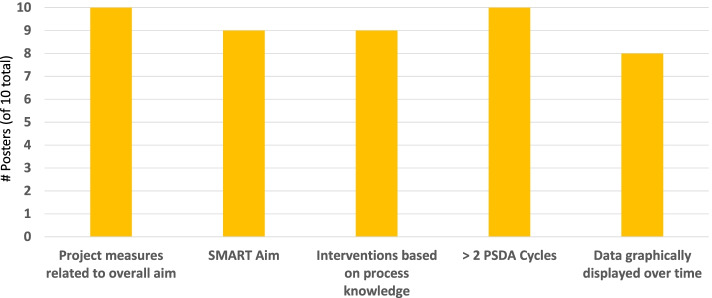
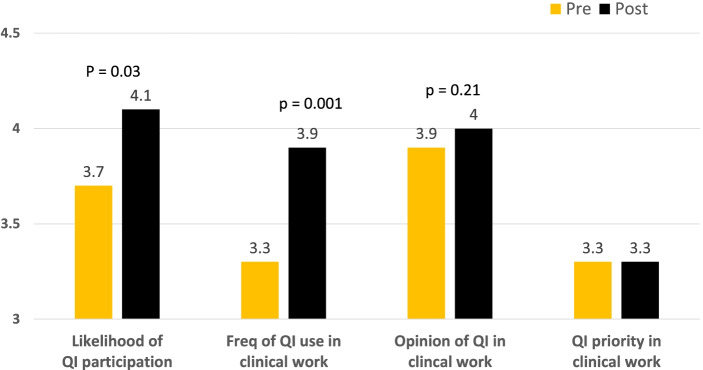
Background: Engaging residents in meaningful quality improvement (QI) is difficult. Challenges include competing demands, didactics which lack connection to meaningful work, suboptimal experiential learning, unclear accountability, absence of timely and relevant data, and lack of faculty coaches and role models. Various strategies to address these challenges for engagement have been described, but not as a unified approach. This paper describes a bundle of practical strategies to address common challenges to resident engagement in QI, illustrated through the experience of one residency education program. Methods: 62 categorical residents in the University of Missouri Internal Medicine residency participated in a longitudinal QI curriculum integrated into residency clinic assignments with dedicated QI work sessions and brief just-in-time didactics with mentorship from faculty coaches. Residents completed at least two PDSA (Plan-Do-Study-Act) cycles for their projects. The experience included clear expectations and tools for accountability. Project criteria included importance to patients, residents, and the institution. Residents had access to data related to their own practice. A pre-post survey asked residents to self-assess their level of interest and engagement in QI on a 5-point Likert scale, with 1 = least desired and 5 = most desired result. Data were analyzed by paired t-test. Results: All 62 residents participated in the program as members of ten QI teams. 40/62 residents completed both pre- and post-surveys. Items related to self-assessment of QI in clinical work all changed in the desired direction: likelihood of participation (3.7 to 4.1, p = 0.03), frequency of QI use (3.3 to 3.9, p = 0.001), and opinion about using QI in clinical work (3.9 to 4.0, p = 0.21). Resident assessment of QI priority in clinical work did not change. Conclusions: We implemented a practical strategies bundle to overcome common challenges to successfully engaging residents in clinical quality improvement. These strategies included QI work integrated into routine clinical assignments, just-in-time didactics, experiential learning with clear expectations and strategic project selection, timely and pertinent data from the residents’ own practice, and real-time faculty coaching.
Overview
The claims and statistics of this paper haven’t been checked yet.
Free: it reads the open-access text and checks the first 5 claims that cite a source we can check. Create a free account to check every claim.
Integrity signals
Registry
Cites
Statistics
Figures
Verification
Claims the paper makes
The claims and statistics of this paper haven’t been checked yet.
Free: it reads the open-access text and checks the first 5 claims that cite a source we can check. Create a free account to check every claim.
Claims other papers make about this one
Each is checked against this paper’s own text: does it say what the citing paper says it does?
The source backs part of the claim, not all of it — or backs it for a different population, condition or comparison.
In the citing paper
“Although coaching is being included in academic medical centres, significant variations exist in how it is being integrated [106,137].”
From Coaching in undergraduate and graduate medical education: a scoping review of success factors, barriers, and outcomes (2026) · cites this paper as [106]
Experimental — accuracy not yet measuredThe cited source says what the claim attributes to it.
In the citing paper
“| Coaching success factors | Program | Coach access to data | [106,129,131] |”
From Coaching in undergraduate and graduate medical education: a scoping review of success factors, barriers, and outcomes (2026) · cites this paper as [106]
Self-check
Percentages, sums and reported differences re-computed from the paper’s own numbers.
The self-check needs the paper’s full text.
Citations
Cites
The Improvement Guide: A Practical Approach to Enhancing Organizational Performance
(1997) · Quality Management Journal · doi:10.1080/10686967.1998.11919154 · Cited by 2,895
The improvement guide : a practical approach to enhancing organizational performance
Langley, G. J. (1996) · Jossey-Bass Publishers eBooks · Cited by 875
Flipping the Quality Improvement Classroom in Residency Education
Bonnes, S. L. R., Ratelle, J. T., Halvorsen, A. J., Carter, K. J., Hafdahl, L. T., Wang, A. T., Mandrekar, J. N., Oxentenko, A. S., Beckman, T. J., & Wittich, C. M. (2016) · Academic Medicine · doi:10.1097/acm.0000000000001412 · Cited by 92
Butler, J. M., Anderson, K. A., Supiano, M. A., & Weir, C. R. (2016) · Academic Medicine · doi:10.1097/acm.0000000000001474 · Cited by 87
Wong, B. M., Goldman, J., Goguen, J., Base, C., Rotteau, L., Melle, E. V., Kuper, A., & Shojania, K. G. (2016) · Academic Medicine · doi:10.1097/acm.0000000000001505 · Cited by 61
Fundamentals of health care improvement: a guide to improving your patients' care
Morse, C. Y., & FINKELSTEIN, J. B. (2009) · BMJ Quality & Safety · doi:10.1136/qshc.2009.033365 · Cited by 60
The 4∶1 Schedule: A Novel Template for Internal Medicine Residencies
Mariotti, J. L., Shalaby, M., & Fitzgibbons, J. P. (2010) · Journal of Graduate Medical Education · doi:10.4300/jgme-d-10-00044.1 · Cited by 60
X + Y Scheduling Models for Internal Medicine Residency Programs—A Look Back and a Look Forward
Shalaby, M., Yaich, S., Donnelly, J., Chippendale, R., DeOliveira, M. C., & Noronha, C. (2014) · Journal of Graduate Medical Education · doi:10.4300/jgme-d-14-00034.1 · Cited by 44
Goldman, J., Kuper, A., Baker, G. R., Bulmer, B., Coffey, M., Jeffs, L. P., Shea, C., Whitehead, C. R., Shojania, K. G., & Wong, B. M. (2020) · Academic Medicine · doi:10.1097/acm.0000000000003203 · Cited by 44
Tess, A. V., Vidyarthi, A. R., Yang, J. J., & Myers, J. S. (2015) · Academic Medicine · doi:10.1097/acm.0000000000000777 · Cited by 42
Research works printed but not linked: 1
- Eraut M. Transfer of knowledge between education and workplace settings. In: H D, H L, J P editors. Knowledge, Values and Education Policy: A Critical Perspective. London: Routledge; 2009.
Cited by
Xiang, J. J., Magier, S., Gruen, J., Welch, M., Bilan, V. P., Rodwin, B. A., Norcott, A. E., & Merchant, N. B. (2023) · MedEdPORTAL · doi:10.15766/mep_2374-8265.11310 · Cited by 9
Humanistic Spirit Training of Medical Students Based on Multisource Medical Data Fusion
Bai, J. (2022) · Computational and Mathematical Methods in Medicine · doi:10.1155/2022/7896367 · Cited by 13
RetractedSarangi, P. K., Narayan, R. K., Purushothama, S., Kumar, A., Asghar, A., Kumar, P., & Panda, B. B. (2024) · Surgical and Radiologic Anatomy · doi:10.1007/s00276-024-03541-4 · Cited by 5
“…limited funding or technology since it makes it hard to use cutting-edge teaching aids like virtual reality, 3D printing, or cadaver dissection workshops [2]. c. Engagement from residents may vary, as some may not prioritize anatomical knowledge once they are immersed in clinical training [12].”
Selecting a Quality Improvement Project: 5 Questions for Trainees and Mentors
Horstman, M. J., Tomolo, A. M., Webb, B. F., & Vaclavik, L. (2023) · Journal of Graduate Medical Education · doi:10.4300/jgme-d-23-00249.1 · Cited by 3
Chang, C., Fleires, A., Alshaikhli, A. M., Carrera, H. M. A., Gavilanes, D., Cabral-Amador, F. J., Cantu, J. R., Bazan, D. Z., Oliveira, K. O., Verduzco, R., et al. (2024) · BMJ Open Quality · doi:10.1136/bmjoq-2023-002480 · Cited by 3
Metadata
- Authors
- Koller, J. P., Cochran, K. A., & Headrick, L. A.
- Affiliations
- University of Missouri (US)
- University of Missouri–Kansas City (US)
- Corresponding author
- Koller, James P.
- Venue
- BMC Medical Education
- Published
- 2022-02-14
- Volume
- 22
- Issue
- 1
- Pages
- 96-96
- ISSN
- 1472-6920 (ISSN-L)
- PMC
- PMC8842865
- OpenAlex
- W4225723764
- Cited by
- 21
- References
- 46
- Citations by year
- 2026: 7 · 2025: 8 · 2024: 3 · 2023: 2 · 2022: 1
- FWCI
- 3.09
- Type
- journal article
- Language
- en
- Open access
- gold
- doi.org
- Licence
- cc-by
- creativecommons.org/licenses/by/4.0 (tdm)
- creativecommons.org/licenses/by/4.0 (vor)
- Locations
- BMC Medical Education (publishedVersion, cc-by)
- Research Square (acceptedVersion, cc-by)
- PubMed Central (publishedVersion, cc-by)
- PubMed (publishedVersion)
- DOAJ (DOAJ: Directory of Open Access Journals) (submittedVersion, cc-by-sa)
- Funders
- University of Missouri
- Topics
- Social Sciences › Education › Innovations in Medical Education
- Health Sciences › Medicine › Public Health, Environmental and Occupational Health › Healthcare Quality and Management
- Health Sciences › Nursing › Leadership and Management › Hospital Admissions and Outcomes
- Keywords
- resident engagement, clinical quality improvement, internal medicine residency, PDSA cycle, faculty coaching, mentoring, experiential learning, accountability, resident self-assessment
- MeSH terms
- Curriculum, Education, Medical, Graduate, Humans, Internship and Residency, Self-Assessment, Quality Improvement
About these checks
Registry, retraction, Cites and statistics results are computed, not judged, with one exception: a printed reference that no index lists is read once by a model before it counts as a citation error. Claims are extracted by a model and kept only when their quote appears verbatim in the text; each cited source is then checked, with a model’s help, for whether it says what the claim relies on. Those verdicts can be wrong — read the claim’s quote and the cited source before relying on one.
Statistics and arithmetic are recomputed, not judged.
Confidence bands are shown only for fields calibrated on our annotated test set. None is calibrated yet, so no band is shown.
What counts as a claim ›How we measure confidence ›How we check this ›
Are you an author, or do you see a problem with this page? Request a review
How to cite
Cite CoChat for the checks on this page, and the paper for its own findings.
- This page
- CoChat. (2026). Citation check: Practical strategies to enhance resident engagement in clinical quality improvement. https://app.cochat.ai/papers/10.1186/s12909-022-03134-y
- The paper
- Koller, J. P., Cochran, K. A., & Headrick, L. A. (2022). Practical strategies to enhance resident engagement in clinical quality improvement. BMC Medical Education. https://doi.org/10.1186/s12909-022-03134-y
Data sources
Bibliographic data: Semantic Scholar, OpenAlex, Crossref.
Contains information from the Semantic Scholar Academic Graph Datasets, made available under the ODC Attribution License (ODC-BY 1.0).
Semantic Scholar’s data is described in: Kinney, R., et al. (2023). The Semantic Scholar Open Data Platform. arXiv:2301.10140.
