

Regulatory emotional self-efficacy and psychological distress among medical students: multiple mediating roles of interpersonal adaptation and self-acceptance
Open accessThe DOI matches its Crossref record; 53 of the 56 references it cites were found in a registry or an index.
Abstract
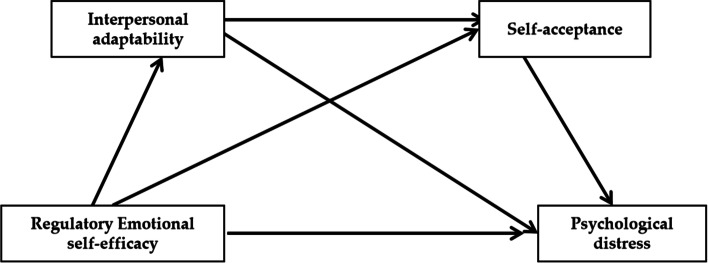
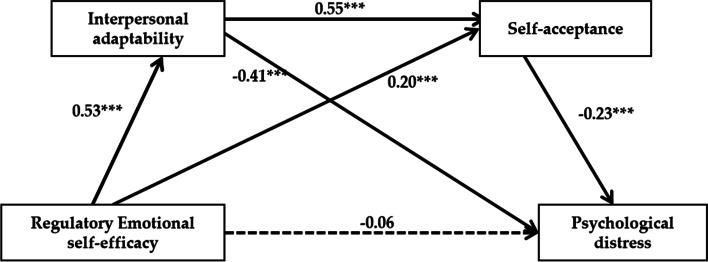
Background: Psychological distress (depression, anxiety and stress) is more common among medical students than in the general population, and is an important cause of insomnia, internet addiction, substance abuse, decreased academic performance and increased suicidality in medical students. Methods: To examine the mechanism by which regulatory emotional self-efficacy affects medical students' psychological distress, a questionnaire of 539 medical students using an interpersonal adaptability scale, regulatory emotional self-efficacy scale, self-acceptance scale and depression-anxiety-stress scale was conducted. Results: ① Regulatory emotional self-efficacy, interpersonal adaptability and self-acceptance are positively correlated, but they are negatively correlated with psychological distress. ② The mediation model shows that interpersonal adaptation and self-acceptance are the mediation variables of the effect of regulatory emotional self-efficacy on psychological distress, and the total mediation effect value is -0.37, accounting for 86.05% of the total effect (-0.43). Specifically, the effect involves three paths: first, regulatory emotional self-efficacy indirectly affects psychological distress through interpersonal adaptation (effect value-0.24); second, regulatory emotional self-efficacy indirectly affects psychological distress through interpersonal adaptation and self-acceptance (effect value-0.08); and third, regulatory emotional self-efficacy indirectly affects psychological distress through self-acceptance (effect value -0.05). Conclusions: Interpersonal adaptation and self-acceptance have a significant mediating effect between regulatory emotional self-efficacy and psychological distress, and the chain mediating effect of interpersonal adaptation and self-acceptance is also significant.
Overview
The claims and statistics of this paper haven’t been checked yet.
Free: it reads the open-access text and checks the first 5 claims that cite a source we can check. Create a free account to check every claim.
Integrity signals
Registry
Cites
Statistics
Figures
Verification
Claims the paper makes
The claims and statistics of this paper haven’t been checked yet.
Free: it reads the open-access text and checks the first 5 claims that cite a source we can check. Create a free account to check every claim.
Self-check
Percentages, sums and reported differences re-computed from the paper’s own numbers.
The self-check needs the paper’s full text.
Citations
Cites
(2013) · Cited by 44,563
Self-efficacy mechanism in human agency
Bandura, A. (1982) · American Psychologist · doi:10.1037/0003-066x.37.2.122 · Cited by 15,975 · cited 1×
“The level of self-efficacy is the core factor that determines an individual’s thinking mode, behaviour mode and emotive response in stressful situations [15].”
BackgroundThe expression of the emotions in man and animals.
Darwin, C. (1872) · J. Murray eBooks · doi:10.1037/10001-000 · Cited by 11,657
User’s guide to correlation coefficients
Akoglu, H. (2018) · Turkish Journal of Emergency Medicine · doi:10.1016/j.tjem.2018.08.001 · Cited by 5,849
Doctor-patient communication: a review.
Ha, J. F., & Longnecker, N. E. (2010) · PubMed · Cited by 2,014
Toward an Interactional Description of Depression
Coyne, J. C. (1976) · Psychiatry · doi:10.1080/00332747.1976.11023874 · Cited by 1,500
Advances in Psychological Science
Bingwu, Q. (2024) · The ECPH Encyclopedia of Psychology · doi:10.1007/978-981-99-6000-2_886-1 · Cited by 662
Hayat, A. A., Shateri, K., Amini, M., & Shokrpour, N. (2020) · BMC Medical Education · doi:10.1186/s12909-020-01995-9 · Cited by 581
Wu, H., Li, S., Zheng, J., & Guo, J. (2020) · Medical Education Online · doi:10.1080/10872981.2020.1742964 · Cited by 468
Prevalence of psychological stress, depression and anxiety among medical students in Egypt
Fawzy, M., & Hamed, S. A. (2017) · Psychiatry Research · doi:10.1016/j.psychres.2017.05.027 · Cited by 455
Research works printed but not linked: 24
- Yang X Yang C Chen P Sun X Wang Y Relationship between Self-regulation Orientation, Depression, Anxiety symptoms and Suicide risk of Medical Students Chin J School Health 2020 41 09 1354 1357
- van Zyl PM Joubert G Bowen E du Plooy F Francis C Jadhunandan S Fredericks F Metz L Depression, anxiety, stress and substance use in medical students in a 5-year curriculum Afr J Health Prof Ed 2017 9 2 67 72
- Tamir M Mauss IB Implications for Well-Being Social Cognitive Factors in Emotion Regulation 2011 31 47
- Bedel A The Relationship between Interpersonal Problem Solving, Positive - Negative Affect and Anxiety Stud Psychol 2015 57 2 121 133
- Hu R Peng S Mao H Zhang b: The Relationship between Smartphone Addiction and Interpersonal Adaptation in Adolescents: the Mediating Role of Emotional Adjustment Efficacy and Cognitive Failure Chin J Health Psychol 2021 29 01 156 160
- Li H The Influence of Perfectionism on Negative Emotion of College Students 2021 Master Sichuan Normal University
- Liao P Li Y Wang F Zhang L The Mediating Effect of Perceived Stress on Maternal Self-acceptance and Postpartum Depression Chinese General Practice 2020 23 03 319 322
- Zhou Y Liang B The Mediating Role of Unconditional Self-acceptance between Perfectionism and Depression of College Students Chin J Clin Psychol 2011 19 03 350 352
- Du F Study on the Intervention of Self-acceptance Group Counseling on Adolescents with Depressive Tendency Contemp Educ Sci 2015 05 61 64
- ZHe al Mediating Effects of Self Acceptance in General Self-Efficacy and Psychological Resilience in College Students with Suicidal Ideation in Shandong Province Med Soc 2019 32 8 89 93
- Lu X Development and Standardization of College Students' adaptability Scale 2003 Master Central China Normal University
- Wang D Liu C Liu S Wang S Sun M Ouyang X Yang X The Influence of Family Function on Psychiatric Experience: Chain Mediating Effect of Interpersonal Adaptation and Loneliness Chinese J Clin Psych 2019 27 06 1135 1138
- Wen S Tang D Yu G Research on the Application of Emotional Self-efficacy Journal of Psychological Science 2009 32 3 666 668
- Zhang P Wang H The Mediating Role of College Students' Emotion-regulated Self-efficacy among Neuroticism, Extroversion and Subjective Well-being Chin Ment Health J 2015 29 02 139 144
- Cong Z Gao W Development of Self-acceptance Questionnaire and Reliability and Validity Test Chinese Behavioral Medicine Science 1999 01 20 22
- luan Y Cao J Zhou Y Yang J Li Y The Relationship between Gender Role and Social Anxiety of College Students and the Mediating Role of Self-acceptance Chinese Men Health J 2015 29 04 311 315
- Gong X Xie X Xu R Luo Y The Test Report of Depression-Anxiety-Stress Scale Simplified Chinese Version (DASS-21) among Chinese College Students Chin J Clin Psychol 2010 18 04 443 446
- Chen H Li Y Li Y Fan C The Influence of Internet Bullying on Non-Suicidal Self-injury: Chain Mediating Effect of Social Exclusion and Negative Emotion Chin J Spec Educ 2020 01 73 78
- Jiang Y Zhang L Mao Z Physical Exercise and Mental Health: the Role of Emotion Regulation Self-efficacy and Emotion Regulation Strategies Studies of Psychology and Behavior 2018 16 04 570 576
- Yan F Study on the Relationship among Medical Students' Interpersonal Relationship, Family Rearing Style and Mental Health J Chifeng Univ(Natural Science Edition) 2016 32 20 65 67
- Qin Z Shen Y Zhang J Xiao J HE S: Human relationship and depressed symptoms and their influencing factors were identified by Logistic regression analysis among the medical students Med J of Communications 2013 27 02 149 151
- Hu C Wang Qiang Zhong Di Sun Minglin Jiang Di Effect of Satir Model group psychological intervention on the improvement of the university students interpersonal relationships China J Health Psych 2020 28 05 767 771
- Zhang Q Zhu C Zhou X Tian Y Study on the Mediating Effect of Self-acceptance between Depression and Depression acta universitatis medicinalis anhui 2016 51 07 1049 1052
- Zhang Y, Xu G. Application of group hypnotic counseling in improving college students' self-acceptance. Psychol Sci. 2006;29(01):236–8+197.
Cited by
Tao, Y., Kaipeng, Z., Liu, T., Li, H., & Feng, X. (2023) · Journal of Psychosomatic Research · doi:10.1016/j.jpsychores.2023.111402 · Cited by 21
Xiang, J. Y., Gao, J., & Gao, Y. (2024) · Frontiers in Psychology · doi:10.3389/fpsyg.2024.1292203 · Cited by 21
“Students who have a habit of physical exercise have significantly better interpersonal relationships than those who do not regularly participate in physical exercise (Ren et al., 2021; Zhang et al., 2022).”
BackgroundMethodRen, S., Ji, S., Liu, X., & Liu, T. (2023) · PsyCh Journal · doi:10.1002/pchj.721 · Cited by 21
“Previous research has found that emotional adaptability is strongly related to other types of adapt-ability, such as academic adaptability (Huang et al., 2018), social adaptability (Feldt et al., 2011), and interpersonal adaptability (Zhang et al., 2022).”
BackgroundXia, Q., Xuan, S., Zhang, T. G., & Zong, B. (2025) · Behavioral Sciences · doi:10.3390/bs15060822 · Cited by 20
“Studies show that autonomy-supportive practices at home and school can help students cultivate self-acceptance (X. Zhang et al., 2022).”
Wang, D., Lin, B., Zhang, S., Xu, W., & Liu, X. (2024) · Journal of Medical Internet Research · doi:10.2196/50664 · Cited by 10
“Psychological distress (depression, anxiety, and stress) is highly prevalent among medical students, raising significant concerns [1-3].”
Sun, Q., Zhao, X., Gao, Y., Zhao, D., & Qi, M. (2023) · Behavioral Sciences · doi:10.3390/bs13090764 · Cited by 14
“Other positive emotions, such as regulatory emotion self-efficacy and interpersonal adaptability, are also negatively correlated with psychological distress among medical students [24].”
BackgroundLin, X., Wang, X., Wang, C., Wu, J., Yang, W., Wang, J., Yang, Y., Zhang, R., Hu, J., Wang, F., et al. (2025) · Journal of Affective Disorders · doi:10.1016/j.jad.2025.01.123 · Cited by 10
Younas, M., El‐Dakhs, D. A. S., & Jiang, Y. (2025) · Scientific Reports · doi:10.1038/s41598-025-28433-4 · Cited by 21
“Psychological resilience relates to college students’ self-concept and negative emotions 104 .”
Liu, F., Yu, P., Wu, J., & Guo, L. (2024) · Frontiers in Public Health · doi:10.3389/fpubh.2024.1447429 · Cited by 7
Xu, H., Zhang, M., Yang, C., Yun, F., Yang, J., Yang, W., Wang, J., Li, X., Yang, J., & Yang, J. (2025) · Journal of Affective Disorders · doi:10.1016/j.jad.2025.01.036 · Cited by 7
Wu, S. L., Mah, P. N., Yap, C. C., Fam, J. Y., & Tan, S. A. (2025) · The Journal of Genetic Psychology · doi:10.1080/00221325.2025.2497457 · Cited by 7
“A past study also revealed that lower self-efficacy diminished university students’ interpersonal adaptability and self-acceptance through heightened self-criticism, self-blame, and reluctance to accept reality while experiencing obstacles (Zhang et al., 2022).”
Jiang, X. X., Tong, J., Zhang, X., & Li, H. (2025) · Frontiers in Psychology · doi:10.3389/fpsyg.2025.1580244 · Cited by 4
Self-citationSu, S., Zhu, X., & Gao, S. (2025) · Current Psychology · doi:10.1007/s12144-025-07764-5 · Cited by 4
“College students with low self-acceptance levels show more negative emotional reac - tions that further increase their depression level (Zhang et al., 2022).”
Chen, M., Huang, L., Qin, Q., Li, J., Zhang, J., Ma, J., & Song, H. (2025) · Frontiers in Psychology · doi:10.3389/fpsyg.2025.1678275 · Cited by 6
Wang, Y., & Zhao, Y. (2026) · PLoS ONE · doi:10.1371/journal.pone.0344809 · Cited by 3
“This interpretation is consistent with prior research suggesting that RESE may reduce psychological distress primarily through indirect or sequential pathways rather than through direct effects [63].”
Factors Affecting Adaptability of International Students in Malaysia during COVID-19 Pandemic
Xie, M., Wider, W., Rajanthran, S. K., Wong, L. S., Chan, C. K., Maidin, S. S., & Mustafa, N. A. (2023) · Journal of Curriculum and Teaching · doi:10.5430/jct.v12n1p100 · Cited by 8
Hamidkholgh, G., Zare, E., Mirzaei, A., Nemati‐Vakilabad, R., & Yousefian, M. (2026) · Scientific Reports · doi:10.1038/s41598-026-40021-8 · Cited by 2
“…broader research indicating that EMSE correlates with well-being through various pathways, such as its association with lower psychological distress via better interpersonal adaptation 38 and its role as a factor linked to lower levels of professional burnout among healthcare professionals 39,40 .”
Zeng, X., Nie, J., & Wei, B. (2022) · Journal of Ethnicity in Substance Abuse · doi:10.1080/15332640.2022.2141411 · Cited by 2
“Studies have also found a significant negative correlation between negative emotions and RESE (Villavicencio & Bernardo, 2013; Zeng et al., 2018; Sui et al., 2021; Zhang et al., 2022), and negative emotions may disrupt perceived RESE (Mesurado et al., 2018).”
Luo, W., Fan, W., Xia, Y., Dou, Y., & Du, J. (2024) · Frontiers in Psychology · doi:10.3389/fpsyg.2024.1411085 · Cited by 3
Oprinca-Muja, L.-A., Cristian, A.-N., Topîrcean, E., Cristian, A., Popa, M. F., Domnariu, H. P., Atasie, D., Oprinca, G.-C., & Morar, S. (2025) · Healthcare · doi:10.3390/healthcare13101169 · Cited by 7
“Their results showed that self-acceptance, along with interpersonal adaptation, mediated the impact of regulatory emotional self-efficacy on psychological distress [63].”
Li, Y., Wang, R., Liu, J., & Zhou, Y. (2025) · BMC Psychology · doi:10.1186/s40359-025-02346-3 · Cited by 3
Khazhuev, I. S. (2025) · Pedagogical Review · doi:10.23951/2307-6127-2025-4-148-162 · Cited by 1
Büyükcebeci, A. (2025) · BMC Psychology · doi:10.1186/s40359-025-03426-0 · Cited by 2
“Regulatory emotional self-efficacy perception is considered to play an important role in maintaining mental well-being [32].”
Zhou, X., Zhao, H., Qi, Y., Zhang, X., Li, J., Longzhu, J., Yang, J., Yulin, M., Zhou, F., Zhang, F., et al. (2025) · Journal of Pain Research · doi:10.2147/jpr.s514865 · Cited by 1
Self-citationWen, L.-Y., Zhang, L., Zhu, L., Wang, A., Feng, Y., Tao, Y.-J., Chen, X.-G., Chen, Z.-Z., Jin, Y., Zhu, Y., et al. (2025) · BMC Psychiatry · doi:10.1186/s12888-025-07587-5 · Cited by 4
“Specifically, it exhibits a positive correlation with subjective well-being [37] and life satisfaction [38], while showing a negative correlation with feelings of loneliness [39], anxiety [40–42], depression [40, 43, 44], and perceived stress [40, 42, 45].”
Ly, T. M. C., Nguyen, K. H., Nguyen, D. P., Trinh, A. K., & Tran, M. D. (2026) · Acta Psychologica · doi:10.1016/j.actpsy.2026.106654 · Cited by 3
Xu, L., Zhou, Y., Xue, Q., Zeng, Q. H., Liang, Q., & Zhang, M. (2026) · BMC Psychology · doi:10.1186/s40359-026-04523-4 · Cited by 2
“Notably, this scale has been employed across diverse contexts, including healthcare professionals [6], medical students [7], university students [8, 9], and secondary education students [10].”
Li, H., & Cheng, C. (2025) · Journal of Community Health Nursing · doi:10.1080/07370016.2025.2477446 · Cited by 2
“Specifically, the study revealed that regulatory ESE indirectly affects psychological distress through three paths: interpersonal adaptation, self-acceptance, and a chain mediating effect of both variables (Zhang et al., 2022).”
Rohmah, A. A. N., Asih, S. W., & Suryaningsih, Y. (2023) · Health & Medical Sciences · doi:10.47134/phms.v1i2.39
“Sejalan dengan prinsip dasar teori Callista Roy, yaitu manusia seicara konstan teirlibat dalam inteiraksi sosial dan biopsikologis deingan lingkungannya (Zhang, 2022).”
BackgroundMa, S. (2024) · Research Square · doi:10.21203/rs.3.rs-3908488/v1
Playing with our ‘self’ in medicine: A discourse analysis of ‘self’ exploration
Khan, R. (2025) · Medical Education · doi:10.1111/medu.15720
Phạm, M., Nguyen, L. T., Huynh, V. K., & Le, U. P. N. (2025) · Acta Psychologica · doi:10.1016/j.actpsy.2025.105544 · Cited by 3
Fabris, M. A., Lin, S., & Longobardi, C. (2025) · Research Square · doi:10.21203/rs.3.rs-7410981/v1
Etaati, F., Nasiri, F., DiPietro, C. P., & Curtiss, J. E. (2025) · Asia Pacific Journal of Counselling and Psychotherapy · doi:10.1080/21507686.2025.2589092 · Cited by 1
“Additionally, individuals with increased RESE tend to exhibit relatively less negative emotional responses to negative emotions (Zhang et al., 2022).”
InfluentialAffective temperaments, self-schemas, and their interplay with emotional distress
Monsonet, M., Fagián-Núñez, K., Kwapil, T. R., & Neus Barrantes-vidal, A. (2026) · Frontiers in Psychiatry · doi:10.3389/fpsyt.2025.1732425 · Cited by 1
Lin, Q., Lan, R., & Gao, W. (2026) · Acta Psychologica · doi:10.1016/j.actpsy.2026.106592
Li, T., Chen, N., Zhang, S., Zhao, S., & Zhao, L. (2026) · Frontiers in Psychiatry · doi:10.3389/fpsyt.2026.1793066
Dongquan, G., Sun, X., Zhou, H., Yan, D., Mazalan, N. S., & Koh, D. (2026) · Frontiers in Sports and Active Living · doi:10.3389/fspor.2026.1858245
Arruda, J. S., Arruda, L. B. S., Mitoso, I. C., Rocha, H. A. L., Kubrusly, M., & Siqueira, F. Q. (2026) · Medical Science Educator · doi:10.1007/s40670-026-02895-1
Yin, T., Peng, Y., Liu, X., Zhu, Y., Wang, J., Pan, T., & Xie, C. (2026) · Frontiers in Psychology · doi:10.3389/fpsyg.2026.1861638
“These findings are broadly consistent with previous evidence suggesting that PE is associated with fewer negative emotional responses in adolescents and that GSE and emotional competence represent important protective psychological resources (Raimondi et al., 2025; Zhang et al., 2022).”
Metadata
- Authors
- Zhang, X., Yue, H., Sun, J., Liu, M., Li, C., & Bao, H.
- Affiliations
- Inner Mongolia Normal University (CN)
- Corresponding author
- Bao, Hugejiletu
- Venue
- BMC Medical Education
- Published
- 2022-04-15
- Volume
- 22
- Issue
- 1
- Pages
- 283-283
- ISSN
- 1472-6920 (ISSN-L)
- PMC
- PMC9011952
- OpenAlex
- W4226027001
- Cited by
- 40
- References
- 56
- Citations by year
- 2026: 10 · 2025: 19 · 2024: 5 · 2023: 5 · 2022: 1
- FWCI
- 8.61
- Type
- journal article
- Language
- en
- Open access
- gold
- doi.org
- Licence
- cc-by
- creativecommons.org/licenses/by/4.0 (tdm)
- creativecommons.org/licenses/by/4.0 (vor)
- Locations
- BMC Medical Education (publishedVersion, cc-by)
- Research Square (acceptedVersion, cc-by)
- PubMed Central (publishedVersion, cc-by)
- PubMed (publishedVersion)
- DOAJ (DOAJ: Directory of Open Access Journals) (submittedVersion, cc-by-sa)
- Funders
- East China Normal University
- Natural Science Foundation of Inner Mongolia (2021MS03099)
- Baotou Medical College
- Topics
- Health Sciences › Health Professions › General Health Professions › Healthcare professionals’ stress and burnout
- Social Sciences › Psychology › Developmental and Educational Psychology › Student Stress and Coping
- Social Sciences › Psychology › Clinical Psychology › Mindfulness and Compassion Interventions
- Keywords
- regulatory emotional self-efficacy, psychological distress, medical students, interpersonal adaptability, self-acceptance, depression, anxiety, stress, mediation, serial mediation
- MeSH terms
- Psychological Distress, Adaptation, Psychological, Anxiety, Emotions, Humans, Stress, Psychological, Students, Medical, Self Efficacy
About these checks
Registry, retraction, Cites and statistics results are computed, not judged, with one exception: a printed reference that no index lists is read once by a model before it counts as a citation error. Claims are extracted by a model and kept only when their quote appears verbatim in the text; each cited source is then checked, with a model’s help, for whether it says what the claim relies on. Those verdicts can be wrong — read the claim’s quote and the cited source before relying on one.
Statistics and arithmetic are recomputed, not judged.
Confidence bands are shown only for fields calibrated on our annotated test set. None is calibrated yet, so no band is shown.
What counts as a claim ›How we measure confidence ›How we check this ›
Are you an author, or do you see a problem with this page? Request a review
Data sources
Bibliographic data: Semantic Scholar, OpenAlex, Crossref.
Contains information from the Semantic Scholar Academic Graph Datasets, made available under the ODC Attribution License (ODC-BY 1.0).
Semantic Scholar’s data is described in: Kinney, R., et al. (2023). The Semantic Scholar Open Data Platform. arXiv:2301.10140.
