

The DOI matches its Crossref record; 80 of the 80 references it cites were found in a registry or an index; 11 of the 28 sources its claims cite were checked for support.
Effectiveness of an Internet-Based Self-Help Acceptance and Commitment Therapy Program on Medical Students’ Mental Well-Being: Follow-Up Randomized Controlled Trial
Open accessAbstract
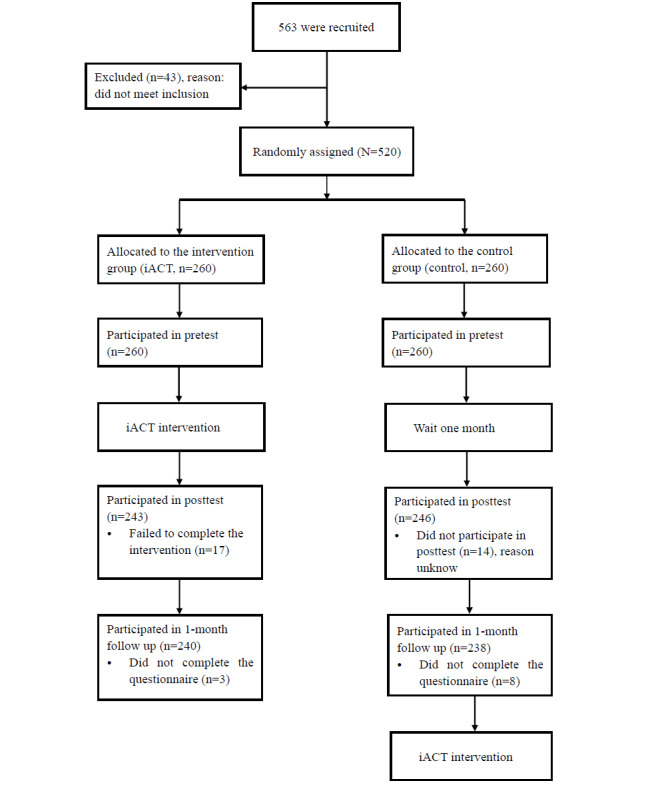
Background: Psychological distress is a growing problem among medical students worldwide. This highlights the need for psychological interventions to focus on mental health and improve well-being in this population. Objective: This study developed an internet-based, self-help, acceptance and commitment therapy program (iACT 2.0), aiming to examine its effectiveness in reducing depression, anxiety, stress, psychological inflexibility (PI), and obsessive-compulsive symptoms (OCSs) among medical students. Methods: A total of 520 Chinese postgraduate medical students were randomly assigned to either an iACT 2.0 intervention group (n=260; six online lessons, once every 5 days) or a control condition (n=260; without intervention). Participants completed questionnaires including the 21-item Depression Anxiety Stress Scale, the revised Obsessive-Compulsive Inventory, and the Multidimensional Psychological Flexibility Inventory at the preintervention (T1), postintervention (T2), and 1-month follow-up time points (T3). No therapist support was provided during the 1-month iACT 2.0 intervention period. Data were collected via an online platform and analyzed using repeated-measures ANOVA. Results: Participants in the intervention group demonstrated a significant decrease in depression, anxiety, stress, PI, and OCSs compared to the control group after the intervention (F=22.9-672.04, all P<.001). Specifically, the intervention group showed significant reductions in all measured outcomes from the preintervention to postintervention time point and at the 1-month follow-up (all P<.001). In contrast, no significant changes were observed in the control group over the same period (all P>.05). The groups did not differ significantly at baseline (all P>.05). Significant differences were noted at both the postintervention and follow-up time points (all P<.001). Conclusions: This study demonstrated that the newly developed iACT 2.0 was effective in reducing depression, anxiety, stress, PI, and OCSs. Notably, the positive effects of the intervention persisted at the 1-month follow-up. This program can offer a useful addition to existing mental illness treatment and lead to improvements in clinical and psychotherapy planning while simultaneously reducing the burden on traditional counseling and services. © 2024 JMIR Publications Inc.. All rights reserved.
Overview
CoChat Summary
## TL;DR
This randomized controlled trial found that a 1-month internet-based self-help ACT program (iACT 2.0) reduced depression, anxiety, stress, psychological inflexibility, and obsessive-compulsive symptoms among Chinese postgraduate medical students. The benefits were maintained at the 1-month follow-up.
## Key findings
- In the intervention group, outcomes improved significantly versus control after the intervention, with reported effects of time, group, and group×time interaction; the paper reports F=22.9–672.04, all P<.001 for the main between-group comparison.
- Compared with controls, the iACT group had significantly lower depression, anxiety, stress, PI, and OCSs at both postintervention (T2) and 1-month follow-up (T3), with all P<.001.
- The intervention group showed significant reductions from preintervention to postintervention and follow-up for all measured outcomes, while the control group showed no significant changes over the same period (all P>.05).
- Baseline values did not differ significantly between groups (all P>.05); the final sample analyzed was 478 participants, with a dropout rate of 8% (42/520).
## Methods
- Design: Single-blinded, 2-arm parallel randomized controlled trial with blocked 1:1 allocation, conducted from April 2023 to June 2023.
- Sample/data: 520 Chinese postgraduate medical students were randomized from an initial 563 interested students; inclusion required at least mild depression, anxiety, and stress on the DASS-21.
- Analysis: Online questionnaires at T1, T2, T3; outcomes analyzed using repeated-measures ANOVA with Bonferroni correction, partial eta squared, and intent-to-treat with last-observation-carried-forward for missing data.
## Limitations
- The paper states that participants were postgraduate medical students who were highly educated and familiar with modern technology, which limits representativeness.
- The paper states that using self-report scales may cause response bias and reduced careful responding.
- The paper states it did not explore intervention-related placebo effects.
- Evident from the text: the study was conducted in one graduate school in China and used a waitlist/no-intervention control, so generalizability beyond this setting and comparison against an active treatment were not tested.
Model-written summary. Check it against the paper before relying on it.
Integrity signals
Registry
Cites
Statistics
Figures


Verification
Claims the paper makes
10 Valid · 0 Not valid · 7 Not checked · 25 Own results and interpretations
The cited sources support only part of this claim — read each source’s verdict below.
In the paper
“Studies have also demonstrated that participants find culturally adapted ACT enjoyable and acceptable [58,61,62].”
§ Effectiveness of an Internet-Based Self-Help Acceptance and Commitment Therapy Program on Medical Students’ Mental Well-Being: Follow-Up Randomized Controlled Trial > Introduction > Objective and Our Study
What the sources say
- Partly supportedcites [58] sourceExperimental — accuracy not yet measured
The Results (Cultural adaptations of PT; page unavailable) describe adaptations intended to enhance acceptability. But the review lists CBT, interpersonal therapy, psychoeducation, problem-solving therapy and dynamically oriented therapy—not ACT—and does not report that ACT participants found treatment enjoyable or acceptable. (LLM, conf=0.82)
- Not checked — no full text of the sourcecites [61] source
- Not checked — no full text of the sourcecites [62] source
boosted- Asserted: passes — The authors put it forward as true.
- Checkable: passes — It can be checked against evidence.
- Load-bearing: passes — The paper’s conclusions depend on it.
- Based: passes — The paper gives a reason why it holds.
- Partly supported
Every source the paper cites for this claim was checked and supports it.
In the paper
“Self-guided internet-based therapies have shown positive results in treating depression [64].”
§ Effectiveness of an Internet-Based Self-Help Acceptance and Commitment Therapy Program on Medical Students’ Mental Well-Being: Follow-Up Randomized Controlled Trial > Introduction > Objective and Our Study
What the sources say
- Supportedcites [64] source
The Results report that self-guided internet-based cognitive behavioral therapy (iCBT) was significantly more effective than controls at reducing depressive symptoms. The Conclusions describe its results as encouraging, supporting the citing sentence's broad claim about positive results. (LLM, conf=0.93)
plainstates a cause- Asserted: passes — The authors put it forward as true.
- Checkable: passes — It can be checked against evidence.
- Load-bearing: passes — The paper’s conclusions depend on it.
- Based: passes — The paper gives a reason why it holds.
- Supported
A result the paper reports from its own data — it cites no other source for it, so there is none to check. The quote shows it is in the paper.
In the paper
“DASS-21 total score, depression score, anxiety score, and stress score were significantly lower in the intervention group at T2 and T3 (all P<.001)”
§ Effectiveness of an Internet-Based Self-Help Acceptance and Commitment Therapy Program on Medical Students’ Mental Well-Being: Follow-Up Randomized Controlled Trial > Results > Effect of the iACT Intervention on Outcome Variables
plain- Asserted: passes — The authors put it forward as true.
- Checkable: passes — It can be checked against evidence.
- Load-bearing: passes — The paper’s conclusions depend on it.
- Based: passes — The paper gives a reason why it holds.
- Rests on 2 assumptions not shown here.
A result the paper reports from its own data — it cites no other source for it, so there is none to check. The quote shows it is in the paper.
In the paper
“Participants in the intervention group demonstrated significantly lower levels of PI at both the postintervention (T2) and 1-month follow-up time points (T3) compared to the control group (all P<.001).”
§ Effectiveness of an Internet-Based Self-Help Acceptance and Commitment Therapy Program on Medical Students’ Mental Well-Being: Follow-Up Randomized Controlled Trial > Results > Effect of the iACT Intervention on Outcome Variables
boosted- Asserted: passes — The authors put it forward as true.
- Checkable: passes — It can be checked against evidence.
- Load-bearing: passes — The paper’s conclusions depend on it.
- Based: passes — The paper gives a reason why it holds.
- Rests on 2 assumptions not shown here.
11 more claims
Create a free account to see all 42 claims and every source verdict.
- Probably not a substantial claim. 16
- It may state two separate claims as one. 16
Citations
Cites
Diagnostic and Statistical Manual of Mental Disorders
American Psychiatric Association (2013) · doi:10.1176/appi.books.9780890425596 · Cited by 116,369
Lovibond, P. F., & Lovibond, S. H. (1995) · Behaviour Research and Therapy · doi:10.1016/0005-7967(94)00075-u · Cited by 14,523 · cited 1×
“The DASS-21 [67] consists of 3 self-report subscales assessing depression, anxiety, and stress.”
Acceptance and commitment therapy: model, processes and outcomes
Hayes, S. C., Luoma, J. B., Bond, F. W., Masuda, A., & Lillis, J. (2006) · Behaviour Research and Therapy · doi:10.1016/j.brat.2005.06.006 · Cited by 6,587 · cited 2×
“Acceptance and commitment therapy (ACT) emphasizes the willingness to experience unwanted thoughts and emotions and contact with the present moment rather than avoid emotional distress [30], and it involves mindfulness and acceptance processes and behavior change processes [31].”
Antony, M. M., Bieling, P. J., Cox, B. J., Enns, M. W., & Swinson, R. P. (1998) · Psychological Assessment · doi:10.1037/1040-3590.10.2.176 · Cited by 4,874 · cited 1×
“…of Medical College of Chinese PLA Hospital; (2) being aged 18 years and older; and (3) having 21-item Depression Anxiety Stress Scale (DASS-21) scores indicating at least mild depression, anxiety, and stress levels (depression subscale ≥ 10, anxiety subscale ≥ 8, and stress subscale ≥ 15) [65,66].”
The Obsessive-Compulsive Inventory: Development and validation of a short version.
Foa, E. B., Huppert, J. D., Leiberg, S., Langner, R., Kichic, R., Hajcak, G., & Salkovskis, P. M. (2002) · Psychological Assessment · doi:10.1037/1040-3590.14.4.485 · Cited by 2,959 · cited 1×
“The 18-item revised Obsessive-Compulsive Inventory [68] was used to assess the frequency and pain of individual OCSs (eg, “I always check the doors, windows, and drawers again and again”).”
Dyrbye, L. N., Thomas, M. R., & Shanafelt, T. D. (2006) · Academic Medicine · doi:10.1097/00001888-200604000-00009 · Cited by 2,909
Rotenstein, L. S., Ramos, M. A., Torre, M., Segal, J. B., Peluso, M. J., Guille, C., Sen, S., & Mata, D. A. (2016) · JAMA · doi:10.1001/jama.2016.17324 · Cited by 2,479
Cultural adaptation of treatments: A resource for considering culture in evidence-based practice
Bernal, G., Jiménez-Chafey, M. I., & Domenech Rodríguez, M. M. (2009) · Professional Psychology: Research and Practice · doi:10.1037/a0016401 · Cited by 1,186 · cited 1×
“Cultural adaptation involves the systematic modification of an evidence-based treatment to align with the client’s language, culture, and context, ensuring compatibility with their cultural values, including factors such as interdependence and spirituality [56,57].”
Rates of medication errors among depressed and burnt out residents: prospective cohort study
Fahrenkopf, A. M., Sectish, T. C., Barger, L. K., Sharek, P. J., Lewin, D., Chiang, V. W., Edwards, S., Wiedermann, B. L., & Landrigan, C. P. (2008) · BMJ · doi:10.1136/bmj.39469.763218.be · Cited by 1,175 · cited 1×
“Poor mental health can lead to unprofessional behavior, including difficulties in decision-making and increased errors [18,19], reduced attention and concentration [19], and loss of empathy [20], ultimately affecting education, employment, and social relationships and causing poorer quality of…”
Medical Student Distress: Causes, Consequences, and Proposed Solutions
Dyrbye, L. N., Thomas, M. R., & Shanafelt, T. D. (2005) · Mayo Clinic Proceedings · doi:10.4065/80.12.1613 · Cited by 1,137 · cited 1×
“…behavior, including difficulties in decision-making and increased errors [18,19], reduced attention and concentration [19], and loss of empathy [20], ultimately affecting education, employment, and social relationships and causing poorer quality of life, lower self-esteem, and a sense of…”
Research works printed but not linked: 1
- El Morr, C, 2017, Stud Health Technol Inform, 234, 104
Cited by
Agyapong-Opoku, N., Agyapong-Opoku, F., Agyapong, B., & Greenshaw, A. J. (2026) · Frontiers in Public Health · doi:10.3389/fpubh.2025.1710333 · Cited by 37
Shin, Y.-M., Jang, S.-H., & Ihm, J. (2025) · Current Psychology · doi:10.1007/s12144-025-07802-2 · Cited by 3
“More-over, recent developments in mobile-based Acceptance and Commitment Therapy have demonstrated notable efficacy in improving mental illness among medical students (Wang et al., 2024 ).”
Wang, J., Fang, S., Zi-hua, L., & Ma, S. (2025) · International Journal of Mental Health Promotion · doi:10.32604/ijmhp.2025.061476 · Cited by 1
“Existing studies have preliminarily demonstrated the effectiveness of iACT and face-to-face ACT in Chinese cultural and educational settings, A study combined iACT with traditional Chinese culture and designed an internet-based self-help ACT for Chinese medical students [46].”
Watanabe, T., Sakai, M., Yoshimura, K., Takakuwa, O., & Akechi, T. (2025) · BMJ Open · doi:10.1136/bmjopen-2025-106542
“22 Although these studies—including those conducted in China— have reported encouraging results, the evidence base for on-demand, scalable ACT interventions in medical students remains limited, and no randomised controlled trials (RCTs) have yet been conducted in Japan.”
Razavi, F. E.-S., Ebrahimi, M. I., & Nazari, A. (2025) · مجله علمی دانشگاه علوم پزشکی رفسنجان · doi:10.66224/jrums.24.8.675
Metadata
- Authors
- Wang, D., Lin, B., Zhang, S., Xu, W., & Liu, X.
- Affiliations
- Beijing Normal University (CN)
- University Medical Center Groningen (NL)
- Hebei University (CN)
- Chinese PLA General Hospital (CN)
- Corresponding author
- Xu, Wei
- Venue
- Journal of Medical Internet Research
- Publisher
- JMIR Publications Inc.
- Published
- 2024-12-04
- Volume
- 26
- Pages
- e50664
- ISSN
- 1438-8871 (ISSN-L)
- PMC
- PMC11656501
- OpenAlex
- W4405017987
- Cited by
- 10
- References
- 71
- Citations by year
- 2026: 6 · 2025: 4
- FWCI
- 3.67
- Type
- journal article
- Language
- en
- Open access
- gold
- doi.org
- Licence
- cc-by
- Locations
- Journal of Medical Internet Research (publishedVersion, cc-by)
- PubMed Central (publishedVersion, cc-by)
- PubMed (publishedVersion)
- DOAJ (DOAJ: Directory of Open Access Journals) (submittedVersion)
- University of Groningen research database (University of Groningen / Centre for Information Technology) (submittedVersion, cc-by)
- Topics
- Social Sciences › Psychology › Clinical Psychology › Mindfulness and Compassion Interventions
- Social Sciences › Psychology › Applied Psychology › Digital Mental Health Interventions
- Health Sciences › Health Professions › General Health Professions › Healthcare professionals’ stress and burnout
- Keywords
- acceptance and commitment therapy, internet-based self-help intervention, medical students, psychological well-being, psychological inflexibility, depression, anxiety, stress, obsessive-compulsive symptoms, psychological distress, follow-up outcomes, Chinese medical students, mindfulness training, cognitive-behavioral training, relaxation training, self-acceptance
- MeSH terms
- Internet-Based Intervention, Adult, Anxiety, Depression, Female, Follow-Up Studies, Humans, Male, Mental Health, Surveys and Questionnaires, Stress, Psychological, Students, Medical, Internet, Young Adult, Acceptance and Commitment Therapy
About these checks
Registry, retraction, Cites and statistics results are computed, not judged, with one exception: a printed reference that no index lists is read once by a model before it counts as a citation error. Claims are extracted by a model and kept only when their quote appears verbatim in the text; each cited source is then checked, with a model’s help, for whether it says what the claim relies on. Those verdicts can be wrong — read the claim’s quote and the cited source before relying on one.
The claim verdicts this report counts are experimental: their accuracy is not yet measured.
A language model drew the claims from the paper on 2026-10-11, under version 3 of the claim definition (model deepseek-v4.1-flash, prompt extract-v3).
A second model labelled each claim on 2026-10-11 (model jev-1.13-20260917, definition revision gold-guideline-v0.2).
Cited sources are checked with a language model’s help (gpt-6-sol).
Statistics and arithmetic are recomputed, not judged.
Confidence bands are shown only for fields calibrated on our annotated test set. None is calibrated yet, so no band is shown.
What counts as a claim ›How we measure confidence ›How we check this ›
Are you an author, or do you see a problem with this page? Request a review
How to cite
Cite CoChat for the checks on this page, and the paper for its own findings.
- This page
- CoChat. (2026). Citation check: Effectiveness of an Internet-Based Self-Help Acceptance and Commitment Therapy Program on Medical Students’ Mental Well-Being: Follow-Up Randomized Controlled Trial. https://app.cochat.ai/papers/10.2196/50664
- The paper
- Wang, D., Lin, B., Zhang, S., Xu, W., & Liu, X. (2024). Effectiveness of an Internet-Based Self-Help Acceptance and Commitment Therapy Program on Medical Students’ Mental Well-Being: Follow-Up Randomized Controlled Trial. Journal of Medical Internet Research. https://doi.org/10.2196/50664
Data sources
Bibliographic data: Semantic Scholar, OpenAlex, Crossref.
Contains information from the Semantic Scholar Academic Graph Datasets, made available under the ODC Attribution License (ODC-BY 1.0).
Semantic Scholar’s data is described in: Kinney, R., et al. (2023). The Semantic Scholar Open Data Platform. arXiv:2301.10140.
