

First-year medical students’ perceptions of a self-regulated learning-informed intervention: an exploratory study
Open accessThe DOI matches its Crossref record; 30 of the 30 references it cites were found in a registry or an index.
Abstract
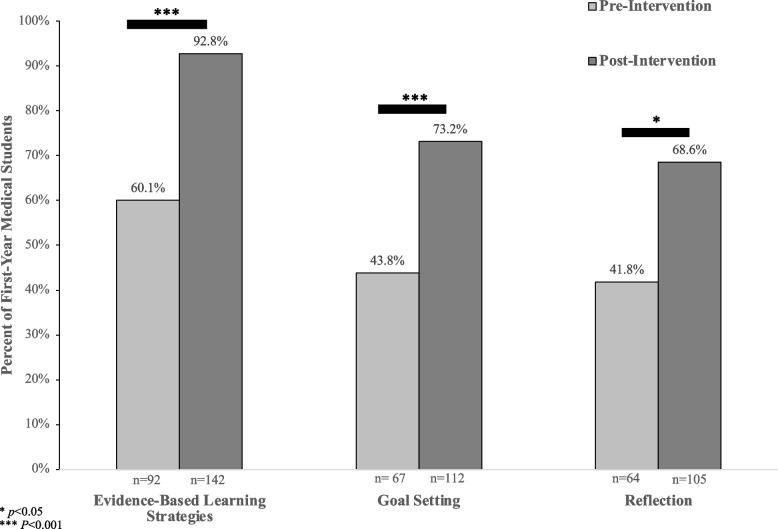
Background: Students with developed self-regulated learning (SRL) skills demonstrate an ability to set individualized educational goals, select optimal learning strategies for reaching these goals, and reflect on overall progress. The primary aims of this study were to investigate first-year medical students’ perceived utility of a self-regulated learning-informed intervention and to assess the impact of its implementation on students’ intended use of SRL throughout medical school. Methods: A two-part educational intervention focused on SRL skill development was carried out at Harvard Medical School during the start of the 2021 academic year. For the first component of the intervention, 169 first-year medical students engaged in an interactive class session structured around SRL concept videos, a brief lecture, small group discussions and individual reflection. Students completed pre- and post-intervention surveys which inquired about learners’ current and anticipated application of SRL skills. During the second component of the intervention, 15 first-year medical students participated in a set of one-on-one academic SRL coaching sessions. All coaching participants completed follow-up semi-structured interviews. Results: A statistically significant increase was observed between students’ use of skills in all domains of self-regulated learning prior to the intervention and their anticipated use of these skills following the intervention. Prior to the intervention, 60.1% (n = 92) of students reported utilizing evidence-based learning strategies, compared to 92.8% (n = 142) of students (p < 0.001) who anticipated applying this SRL skills at the completion of the classroom session. Six core themes emerged from qualitative analysis of the post-intervention survey including learning plan development, accountability and progress tracking, goals for growth, engagement through active learning, routine reflection, and adapting to the curriculum. Conclusions: Both classroom-based learning sessions and one-on-one academic coaching programs are feasible approaches for encouraging the use of self-regulated learning techniques in the preclinical setting.
Overview
The claims and statistics of this paper haven’t been checked yet.
Free: it reads the open-access text and checks the first 5 claims that cite a source we can check. Create a free account to check every claim.
Integrity signals
Registry
Cites
Statistics
Figures
Verification
Claims the paper makes
The claims and statistics of this paper haven’t been checked yet.
Free: it reads the open-access text and checks the first 5 claims that cite a source we can check. Create a free account to check every claim.
Claims other papers make about this one
Each is checked against this paper’s own text: does it say what the citing paper says it does?
The source backs part of the claim, not all of it — or backs it for a different population, condition or comparison.
In the citing paper
“The study by Boyd et al. [12] found first–year medical students at Harvard Medical School that a self–regulated learning (SRL) intervention, which included videos, faculty–led sessions, and coaching, significantly enhanced SRL skills.”
From Exploring the impact of academic coaching interventions on student outcomes in graduate healthcare and medical education: a systematic scoping review. (2025) · cites this paper as [12]
Experimental — accuracy not yet measuredThe cited source says what the claim attributes to it.
In the citing paper
“Interviews revealed themes like strategic learning, improved well–being, and empowerment.”
From Exploring the impact of academic coaching interventions on student outcomes in graduate healthcare and medical education: a systematic scoping review. (2025) · cites this paper as [12]
The cited source says what the claim attributes to it.
In the citing paper
“A statistically significant increase was observed between students’ use of skills in all domains (evidence–based learning strategies, goal setting, and reflection) of self–regulated learning prior to the intervention and their anticipated use of these skills after the intervention.”
From Exploring the impact of academic coaching interventions on student outcomes in graduate healthcare and medical education: a systematic scoping review. (2025) · cites this paper as [12]
Self-check
Percentages, sums and reported differences re-computed from the paper’s own numbers.
The self-check needs the paper’s full text.
Citations
Cites
Gale, N. K., Heath, G., Cameron, E., Rashid, S., & Redwood, S. (2013) · BMC Medical Research Methodology · doi:10.1186/1471-2288-13-117 · Cited by 10,865 · cited 1×
“Students’ short responses from the surveys and transcribed interviews were read through in entirety and an inductive approach was employed using the Framework Method for qualitative analysis [20].”
MethodA social cognitive view of self-regulated academic learning.
Zimmerman, B. J. (1989) · Journal of Educational Psychology · doi:10.1037/0022-0663.81.3.329 · Cited by 3,807 · cited 1×
“This model incorporates three stages of self-regulated learning, including 1) the planning and forethought phase which involves setting goals, 2) the learning and performance phase which encompasses the implementation and experimentation of learning strategies and 3) the evaluation and self-regulation phase, consistin…”
MethodA Review of Self-regulated Learning: Six Models and Four Directions for Research
Panadero, E. (2017) · Frontiers in Psychology · doi:10.3389/fpsyg.2017.00422 · Cited by 2,915 · cited 1×
“In self-regulated learning, students engage in a cycle of setting specific goals, considering and personalizing their learning strategies, and finally reflecting on and adapting behaviors to optimize educational achievement [9, 10].”
BackgroundSelf-Regulated Learning: Beliefs, Techniques, and Illusions
Bjork, R. A., Dunlosky, J., & Kornell, N. (2013) · Annual Review of Psychology · doi:10.1146/annurev-psych-113011-143823 · Cited by 1,468 · cited 1×
“In self-regulated learning, students engage in a cycle of setting specific goals, considering and personalizing their learning strategies, and finally reflecting on and adapting behaviors to optimize educational achievement [9, 10].”
BackgroundMcLean, S. F. (2016) · Journal of Medical Education and Curricular Development · doi:10.4137/jmecd.s20377 · Cited by 759
Trullàs, J. C., Blay, C., Sarri, E., & Pujol, R. (2022) · BMC Medical Education · doi:10.1186/s12909-022-03154-8 · Cited by 473 · cited 1×
“To sufficiently improve course performance, continuous reflection, incorporation of feedback, and adaptation of learning skills are required [4, 24].”
BackgroundWhat do we know about coaching in medical education? A literature review
Lovell, B. (2018) · Medical Education · doi:10.1111/medu.13482 · Cited by 277
Demirören, M., Turan, S., & Öztuna, D. (2016) · Medical Education Online · doi:10.3402/meo.v21.30049 · Cited by 193 · cited 1×
“While engaging in problem solving activities and collaborative learning with peers, students receive constant feedback regarding their level of preparedness for the class session and overall understanding of the material [5, 11, 15, 23].”
BackgroundFacilitating small group learning in the health professions
Burgess, A. W., van Diggele, C., Roberts, C., & Mellis, C. (2020) · BMC Medical Education · doi:10.1186/s12909-020-02282-3 · Cited by 166
White, C. B. (2006) · Advances in Health Sciences Education · doi:10.1007/s10459-006-9000-z · Cited by 163 · cited 1×
“While engaging in problem solving activities and collaborative learning with peers, students receive constant feedback regarding their level of preparedness for the class session and overall understanding of the material [5, 11, 15, 23].”
BackgroundAssessing the Effectiveness of Case-Based Collaborative Learning via Randomized Controlled Trial
Krupat, E., Richards, J. B., Sullivan, A. M., Fleenor, T. J., & Schwartzstein, R. M. (2016) · Academic Medicine · doi:10.1097/acm.0000000000001004 · Cited by 149
Ballouk, R., Mansour, V., Dalziel, B., McDonald, J. L., & Hegazi, I. (2022) · Medical Education Online · doi:10.1080/10872981.2022.2029336 · Cited by 127 · cited 4×
“However there has been little research specifically in the context of CBL and PBL, designed to enhance the development of SRL skills or to motivate the application of these strategies among medical students using coaching and classroom-based interventions [12, 14, 15].”
BackgroundInfluentialAhuja, A. (2013) · JOURNAL OF CLINICAL AND DIAGNOSTIC RESEARCH · doi:10.7860/jcdr/2013/7339.3787 · Cited by 109
Picton, A., Greenfield, S., & Parry, J. M. (2022) · BMC Medical Education · doi:10.1186/s12909-022-03158-4 · Cited by 101 · cited 1×
“Students’ success in the preclinical setting often requires acquisition and application of a considerable amount of complex clinical knowledge and even learners well-accustomed to meeting the demands of rigorous curricular standards may face new educational challenges [2].”
BackgroundParikh, A., McReelis, K., & Hodges, B. (2001) · Medical Education · doi:10.1046/j.1365-2923.2001.00994.x · Cited by 94 · cited 1×
“To sufficiently improve course performance, continuous reflection, incorporation of feedback, and adaptation of learning skills are required [4, 24].”
BackgroundThe Effects of Case-Based Team Learning on Students' Learning, Self Regulation and Self Direction
Rezaee, R., & Mosalanejad, L. (2015) · Global Journal of Health Science · doi:10.5539/gjhs.v7n4p295 · Cited by 64 · cited 2×
“The application of self-regulated learning strategies among medical students may be associated with academic achievement in the preclinical setting [11].”
BackgroundDuke, P., Grosseman, S., Novack, D. H., & Rosenzweig, S. (2014) · Medical Teacher · doi:10.3109/0142159x.2014.956057 · Cited by 63
Self-Regulated Learning Practice of Undergraduate Students in Health Professions Programs
Chitra, E., Hidayah, N., Chandratilake, M. N., & Nadarajah, V. D. (2022) · Frontiers in Medicine · doi:10.3389/fmed.2022.803069 · Cited by 60 · cited 1×
“This simplified model has also been used in prior studies involving self-regulated learning among medical students [17].”
MethodJames, M. L., Baptista, A., Barnabas, D., Sadza, A., Smith, S., Usmani, O. S., & John, C. (2022) · BMC Medical Education · doi:10.1186/s12909-022-03111-5 · Cited by 59 · cited 2×
“are implemented, potential learning challenges may be amplified during the early stages of medical school [3].”
BackgroundMethodProblem-based learning: how do the outcomes compare with traditional teaching?
Clark, C. E. (2006) · Europe PMC (PubMed Central) · Cited by 50
Hauer, K. E., Iverson, N., Quach, A., Yuan, P., Kaner, S., & Boscardin, C. (2018) · Perspectives on Medical Education · doi:10.1007/s40037-018-0449-2 · Cited by 49 · cited 4×
“However there has been little research specifically in the context of CBL and PBL, designed to enhance the development of SRL skills or to motivate the application of these strategies among medical students using coaching and classroom-based interventions [12, 14, 15].”
BackgroundInfluentialPiza, F. M. D. T., Kesselheim, J. C., Perzhinsky, J., Drowos, J. L., Gillis, R., Moscovici, K., Danciu, T., Kosowska, A., & Gooding, H. C. (2019) · Medical Teacher · doi:10.1080/0142159x.2019.1645950 · Cited by 49 · cited 2×
“demonstrated that medical trainees endorsed often utilizing ineffective study habits which do not align with evidence-based principles [18].”
BackgroundMethodWorkplace learning through peer groups in medical school clerkships
Chou, C. L., Teherani, A., Masters, D. E., Vener, M., Wamsley, M. A., & Poncelet, A. N. (2014) · Medical Education Online · doi:10.3402/meo.v19.25809 · Cited by 47
Thomas, L., Bennett, S., & Lockyer, L. (2016) · Medical Teacher · doi:10.3109/0142159x.2015.1132408 · Cited by 46 · cited 5×
“However there has been little research specifically in the context of CBL and PBL, designed to enhance the development of SRL skills or to motivate the application of these strategies among medical students using coaching and classroom-based interventions [12, 14, 15].”
BackgroundInfluentialStudent approaches for learning in medicine: What does it tell us about the informal curriculum?
Zhang, J., Peterson, R. F., & Ozolins, I. (2011) · BMC Medical Education · doi:10.1186/1472-6920-11-87 · Cited by 42 · cited 1×
“While there is increasing evidence of the benefit of self-regulated learning throughout preclinical training, incorporating protected time for students to fully participate in reflection and to assess new approaches to learning may be a challenge [12, 13].”
BackgroundAcademic coaching: Insights from the medical student’s perspective
Wolff, M., Morgan, H., Jackson, J., Skye, E., Hammoud, M., & Ross, P. T. (2020) · Medical Teacher · doi:10.1080/0142159x.2019.1670341 · Cited by 37 · cited 1×
“For these students, academic coaches also served important roles in their wellbeing [30].”
BackgroundUnderstanding the impact of academic difficulties among medical students: A scoping review
Kirtchuk, D., Wells, G., Levett, T. J., Castledine, C. I., & de Visser, R. O. (2021) · Medical Education · doi:10.1111/medu.14624 · Cited by 35 · cited 1×
“Background First-year students may enter medical school with significant variation in academic strengths and areas for growth [1].”
BackgroundAcademic coaching for learners in medical education: Twelve tips for the learning specialist
Reynolds, A. K. (2020) · Medical Teacher · doi:10.1080/0142159x.2019.1607271 · Cited by 31
Coaching to improve self‐directed learning
Wolff, M., Stojan, J., Buckler, S., Cranford, J., Whitman, L., Gruppen, L., & Santen, S. (2020) · The Clinical Teacher · doi:10.1111/tct.13109 · Cited by 29 · cited 2×
“Similar results were found in a study of 171 learners enrolled in a longitudinal educational intervention in which medical students who received coaching, were significantly more likely to implement learning goals and incorporate performance feedback into their learning goals than those who did not [19].”
BackgroundResultMatsuyama, Y., Nakaya, M., Leppink, J., van der Vleuten, C. P. M., Asada, Y., Lebowitz, A., Sasahara, T., Yamamoto, Y., Matsumura, M., Gomi, A., et al. (2021) · BMC Medical Education · doi:10.1186/s12909-020-02460-3 · Cited by 28 · cited 2×
“However there has been little research specifically in the context of CBL and PBL, designed to enhance the development of SRL skills or to motivate the application of these strategies among medical students using coaching and classroom-based interventions [12, 14, 15].”
Background
Cited by
Macedo, A., Aurindo, M. J., & Febra, C. (2024) · BMC Medical Education · doi:10.1186/s12909-024-05041-w · Cited by 22
“In this context, there are many different interventions that are used in medical education, including traditional classroom instruction, hands-on clinical training, simulation-based learning, and the use of digital technology such as virtual reality [21–23].”
MethodBesche, H. C., King, R. W., Shafer, K. M., Fleet, S. E., Charles, J. F., Kaplan, T., Greenzang, K. A., Hoenig, M. P., Schwartzstein, R. M., Cockrill, B. A., et al. (2025) · Journal of Medical Education and Curricular Development · doi:10.1177/23821205251317149 · Cited by 24
Self-citationExploring challenges in learning and study skills among first-year medical students: a case study
Sullivan, S. O., Hageh, C. A., Dimassi, Z., Alsoud, L. O., Presley, D., & Ibrahim, H. (2024) · BMC Medical Education · doi:10.1186/s12909-024-05850-z · Cited by 18
“…students have cyclical control of their learning process, whereby learning starts with motivation and preparation for the task to be performed, followed by adapting their behavior through learning strategies, such as re-reading, summarizing information, and developing concept maps [17].”
BackgroundAdvancing radiology education for medical students: leveraging digital tools and resources
Stirrat, T. P., Martin, R., Umair, M., & Waller, J. (2024) · Polish Journal of Radiology · doi:10.5114/pjr/193518 · Cited by 34
“By comparing our findings with those of earlier reviews, we offer a comprehensive overview of the current state of digital radiology education, identifying both the progress made and the areas where further improvements are needed (Table 1) [45-47].”
ResultLearning Plan Use in Undergraduate Medical Education: A Scoping Review
Romanova, A., Touchie, C., Ruller, S., Kaka, S., Moschella, A., Zucker, M., Cole, V., & Humphrey-Murto, S. M. (2024) · Academic Medicine · doi:10.1097/acm.0000000000005781 · Cited by 13
“30,31,35,42,49,60 Faculty identi fi ed limited human resources, 56 time, 37,39,48 and lack of knowledge of LPs 39 and SRL 58,62 as their main barriers.”
Influential
Metadata
- Authors
- Boyd, T., Besche, H., Goldhammer, R., Alblooshi, A., & Coleman, B. I.
- Affiliations
- Harvard University (US)
- Corresponding author
- Boyd, Taylor
- Venue
- BMC Medical Education
- Published
- 2022-11-29
- Volume
- 22
- Issue
- 1
- Pages
- 821-821
- ISSN
- 1472-6920 (ISSN-L)
- PMC
- PMC9710124
- OpenAlex
- W4310599177
- Cited by
- 16
- References
- 30
- Citations by year
- 2026: 3 · 2025: 5 · 2024: 7 · 2023: 1
- FWCI
- 2.87
- Type
- journal article
- Language
- en
- Open access
- gold
- doi.org
- Licence
- cc-by
- creativecommons.org/licenses/by/4.0 (tdm)
- creativecommons.org/licenses/by/4.0 (vor)
- Locations
- BMC Medical Education (publishedVersion, cc-by)
- PubMed Central (publishedVersion, cc-by)
- PubMed (publishedVersion)
- DOAJ (DOAJ: Directory of Open Access Journals) (submittedVersion, cc-by-sa)
- Topics
- Social Sciences › Education › Innovations in Medical Education
- Social Sciences › Psychology › Developmental and Educational Psychology › Innovative Teaching and Learning Methods
- Social Sciences › Education › Educational Leadership and Innovation
- Keywords
- student self-regulation, first-year medical students, medical education, academic coaching, learning strategies, student perceptions, preclinical education, goal setting, reflection, learning plans
- MeSH terms
- Mentoring, Humans, Learning, Schools, Medical, Students, Medical, Problem-Based Learning
About these checks
Registry, retraction, Cites and statistics results are computed, not judged, with one exception: a printed reference that no index lists is read once by a model before it counts as a citation error. Claims are extracted by a model and kept only when their quote appears verbatim in the text; each cited source is then checked, with a model’s help, for whether it says what the claim relies on. Those verdicts can be wrong — read the claim’s quote and the cited source before relying on one.
Statistics and arithmetic are recomputed, not judged.
Confidence bands are shown only for fields calibrated on our annotated test set. None is calibrated yet, so no band is shown.
What counts as a claim ›How we measure confidence ›How we check this ›
Are you an author, or do you see a problem with this page? Request a review
Data sources
Bibliographic data: Semantic Scholar, OpenAlex, Crossref.
Contains information from the Semantic Scholar Academic Graph Datasets, made available under the ODC Attribution License (ODC-BY 1.0).
Semantic Scholar’s data is described in: Kinney, R., et al. (2023). The Semantic Scholar Open Data Platform. arXiv:2301.10140.
