

Exploring the potential of artificial intelligence to enhance the writing of english academic papers by non-native english-speaking medical students - the educational application of ChatGPT
Open accessThe DOI matches its Crossref record; 36 of the 39 references it cites were found in a registry or an index; 7 of the 36 sources its claims cite were checked for support.
Abstract
Background: Academic paper writing holds significant importance in the education of medical students, and poses a clear challenge for those whose first language is not English. This study aims to investigate the effectiveness of employing large language models, particularly ChatGPT, in improving the English academic writing skills of these students. Methods: A cohort of 25 third-year medical students from China was recruited. The study consisted of two stages. Firstly, the students were asked to write a mini paper. Secondly, the students were asked to revise the mini paper using ChatGPT within two weeks. The evaluation of the mini papers focused on three key dimensions, including structure, logic, and language. The evaluation method incorporated both manual scoring and AI scoring utilizing the ChatGPT-3.5 and ChatGPT-4 models. Additionally, we employed a questionnaire to gather feedback on students’ experience in using ChatGPT. Results: After implementing ChatGPT for writing assistance, there was a notable increase in manual scoring by 4.23 points. Similarly, AI scoring based on the ChatGPT-3.5 model showed an increase of 4.82 points, while the ChatGPT-4 model showed an increase of 3.84 points. These results highlight the potential of large language models in supporting academic writing. Statistical analysis revealed no significant difference between manual scoring and ChatGPT-4 scoring, indicating the potential of ChatGPT-4 to assist teachers in the grading process. Feedback from the questionnaire indicated a generally positive response from students, with 92% acknowledging an improvement in the quality of their writing, 84% noting advancements in their language skills, and 76% recognizing the contribution of ChatGPT in supporting academic research. Conclusion: The study highlighted the efficacy of large language models like ChatGPT in augmenting the English academic writing proficiency of non-native speakers in medical education. Furthermore, it illustrated the potential of these models to make a contribution to the educational evaluation process, particularly in environments where English is not the primary language.
Overview
CoChat Summary
TL;DR
This pilot study found that a two-week ChatGPT-3.5 revision intervention improved Chinese non-native English-speaking medical students’ English mini-paper scores across manual, ChatGPT-3.5, and ChatGPT-4 evaluations. ChatGPT-4 scoring did not differ significantly from manual grading, suggesting possible grading-support potential.
Key findings
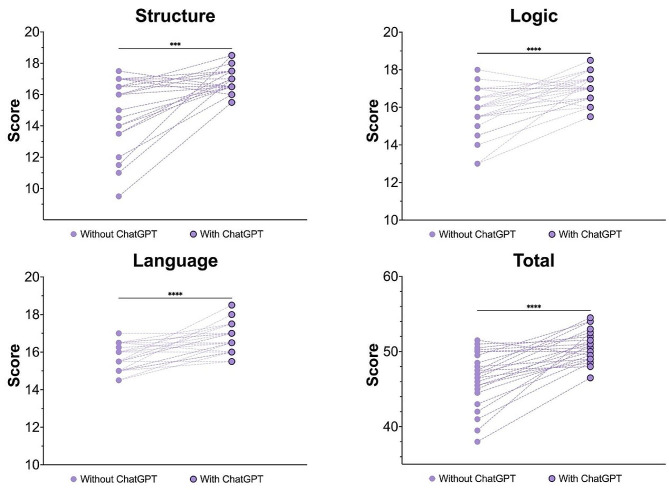
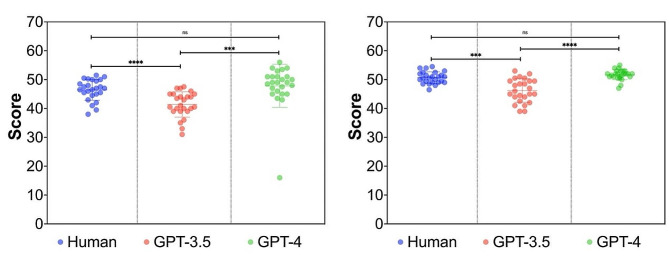
- Manual total scores rose from 46.45 ± 3.59 to 50.68 ± 2.03 after ChatGPT use, an improvement of 4.23 points (95% CI 2.64, 5.82); ChatGPT-3.5 total scores increased by 4.82 points (95% CI 2.47, 7.17), and ChatGPT-4 total scores by 3.84 points (95% CI 0.83, 6.85).
- Manual scoring improved significantly in structure, logic, language, and total score (all p < 0.001); ChatGPT-3.5 scoring improved significantly in all dimensions and total score (all p < 0.05); ChatGPT-4 scoring improved significantly in structure, logic, and total score (all p < 0.05), but not language (β 1.02, 95% CI −0.15, 2.19, p = 0.10).
- ChatGPT-3.5 scores differed significantly from manual grading, while ChatGPT-4 scores did not differ significantly from manual grading, suggesting ChatGPT-4 may assist teachers in grading.
- Questionnaire feedback: 92% reported improved writing quality, 84% reported language-skill advancement, 76% saw ChatGPT as useful for academic research/literature review, and 100% used it for English polishing.
Methods
- Two-stage pre-post study with 25 third-year medical students from West China School of Medicine, Sichuan University, all non-native English speakers; 27 were initially included and 2 were excluded for late submission.
- Students first wrote an English “mini paper,” then revised it using ChatGPT-3.5 over two weeks; papers were scored before and after by two teachers using blind review (averaged), by ChatGPT-3.5, and by ChatGPT-4.
- Scoring covered structure, logic, and language, each 0–20 for a 60-point total; analysis used Kruskal-Wallis, paired t-test, and univariate/multivariate regression adjusted for gender, plus a 31-item experience questionnaire.
Limitations
- The paper states limitations including language barriers and cultural differences, difficulty with non-English languages, lack of human-like creative thinking and contextual understanding, and concerns about authenticity and credibility of ChatGPT-generated information.
- Participant-reported limitations included difficulty verifying information authenticity (96%), lack of human-like creative thinking (72%), absence of clinical practice insights (52%), and language/cultural differences (40%).
- Evident from the text: this was a small, single-institution pilot with 25 students, a short two-week intervention, no separate control group, and questionnaire outcomes based on self-report.
Model-written summary. Check it against the paper before relying on it.
Integrity signals
Registry
Cites
Statistics
Figures
Verification
Claims the paper makes
5 Valid · 0 Not valid · 18 Not checked · 40 Own results and interpretations
The cited sources support only part of this claim — read each source’s verdict below.
In the paper
“Research has shown that the explanations provided by ChatGPT are more accurate and comprehensive than the explanations of basic principles provided in some standardized higher education exams [8].”
§ Exploring the potential of artificial intelligence to enhance the writing of english academic papers by non-native english-speaking medical students - the educational application of ChatGPT > Introduction
What the sources say
- Partly supportedcites [8] Fijacko N, Gosak L, Stiglic G, Picard CT, John Douma M. Can ChatGPT pass the life support exams without entering the American heart association course? Resuscitation 2023, 185:109732. 36775020 sourceExperimental — accuracy not yet measured
In “To the Editor,” the paper says ChatGPT’s answer rationales were often significantly more detailed than those in the ACLS exam key. It does not say ChatGPT’s explanations were more accurate than the exam key’s, and its comparison concerns life-support exams rather than standardized higher-education exams generally. The paper also reports that ChatGPT did not pass any of the exams. (LLM, conf=0.88)
plain- Asserted: passes — The authors put it forward as true.
- Checkable: passes — It can be checked against evidence.
- Load-bearing: unclear — It is unclear whether the paper’s conclusions depend on it.
- Based: passes — The paper gives a reason why it holds.
- Partly supported
The cited sources support only part of this claim — read each source’s verdict below.
In the paper
“The results of questionnaire indicate ChatGPT can serve as an important educational tool, beneficial in a range of teaching contexts, including online classroom Q&A assistant, virtual tutor and facilitating language learning [24].”
§ Exploring the potential of artificial intelligence to enhance the writing of english academic papers by non-native english-speaking medical students - the educational application of ChatGPT > Discussion
What the sources say
- Partly supportedcites [24] Futterer T Fischer C Alekseeva A Chen X Tate T Warschauer M Gerjets P ChatGPT in education: global reactions to AI innovations Sci Rep 2023 13 1 15310 10.1038/s41598-023-42227-6 37714915 PMC10504368 sourceExperimental — accuracy not yet measured
Our copy supports only the generic part of the claim: the Theoretical background ('Opportunities and risks of ChatGPT for education') frames ChatGPT as 'a learning partner or teaching assistant that gives feedback if good prompts are given by the learners' and notes Khan Academy's use of it as a learning partner. What it does not support is the specific teaching contexts and the evidentiary basis: the paper's actual results (Results, RQ1–RQ3) are topic-model and sentiment analyses of 16.7 million tweets, listing ten education topics (opportunities/limitations, cheating and essays, academia, banning, exams, writing strategies, other AI tools, replicating papers, costs, integration in teaching) — none of them an 'online classroom Q&A assistant', a 'virtual tutor', or language learning. The Discussion ('Limitations and future research') explicitly contrasts its tweet analysis with 'a steady stream of questionnaire-based studies' and calls for future surveys, so the citing sentence's 'results of questionnaire' attribution does not come from this paper. (LLM, conf=0.72)
hedged- Asserted: passes — The authors put it forward as true.
- Checkable: passes — It can be checked against evidence.
- Load-bearing: unclear — It is unclear whether the paper’s conclusions depend on it.
- Based: passes — The paper gives a reason why it holds.
- Rests on an assumption not shown here.
- Partly supported
None of the sources cited for this claim have been checked yet.
In the paper
“When inputted with different languages, ChatGPT may have difficulty in understanding and generating accurate responses.”
§ Exploring the potential of artificial intelligence to enhance the writing of english academic papers by non-native english-speaking medical students - the educational application of ChatGPT > Discussion
What the sources say
- Could not verifycites [29] Albrecht UV Behrends M Schmeer R Matthies HK von Jan U Usage of multilingual mobile translation applications in clinical settings JMIR Mhealth Uhealth 2013 1 1 e4 10.2196/mhealth.2268 25100677 PMC4114476 sourceExperimental — accuracy not yet measured
Our copy of Albrecht et al. (2013) evaluates only the phrase-based iPad translation app 'xprompt' among nursing staff at Hannover Medical School; no passage mentions ChatGPT, large language models, or generative AI (searched: ChatGPT/artificial intelligence/language model/automatic translation accuracy; multilingual input/different languages/understanding/generating accurate responses). The nearest content — Results, 'At times, the desired target language was not available' and Methods > The Application, which describes a fixed set of 800 pre-translated phrases in 23 languages rather than free-form multilingual text generation — concerns a different technology and cannot support or contradict a claim about ChatGPT's multilingual performance. (LLM, conf=0.75)
- Not checked yetcites [30] Beh TH Canty DJ English and Mandarin translation using Google Translate software for pre-anaesthetic consultation Anaesth Intensive Care 2015 43 6 792 3 26603812
hedgedstates a possible cause- Asserted: passes — The authors put it forward as true.
- Checkable: passes — It can be checked against evidence.
- Load-bearing: unclear — It is unclear whether the paper’s conclusions depend on it.
- Based: passes — The paper gives a reason why it holds.
- Could not verify
The cited sources support only part of this claim — read each source’s verdict below.
In the paper
“In medical education, where accuracy and reliability of knowledge are paramount, the inability to guarantee the truthfulness of the information poses a significant challenge [32–34].”
§ Exploring the potential of artificial intelligence to enhance the writing of english academic papers by non-native english-speaking medical students - the educational application of ChatGPT > Discussion
What the sources say
- Not checked yetcites [32] Haque MU, Dharmadasa I, Sworna ZT, Rajapakse RN, Ahmad H. I think this is the most disruptive technology: Exploring Sentiments of ChatGPT Early Adopters using Twitter Data. ArXiv 2022, abs/2212.05856.
- Partly supportedcites [33] Cooper G Examining Science Education in ChatGPT: an exploratory study of Generative Artificial Intelligence J Sci Edu Technol 2023 32 444 52 10.1007/s10956-023-10039-y sourceExperimental — accuracy not yet measured
In “RQ1: How Did ChatGPT Answer Questions Related to Science Education?” (page not provided), Cooper says ChatGPT’s output can lack supporting evidence and present a single truth without sufficient qualifications. That supports the concern about reliability, but the paper discusses science education, not the specific challenge posed in medical education. (LLM, conf=0.86)
- Could not verifycites [34] Yu C, Zong H, Chen Y, Zhou Y, Liu X, Lin Y, Li J, Zheng X, Min H, Shen B. PCAO2: an ontology for integration of prostate cancer associated genotypic, phenotypic and lifestyle data. Brief Bioinform 2024, 25(3). PMC10982949 38557678 sourceExperimental — accuracy not yet measured
The Introduction discusses AI models as black boxes and the need for trustworthy, transparent systems in precision medicine. The Discussion mentions large language models, but neither section addresses ChatGPT-generated information being untruthful or the resulting challenge in medical education (searched for ChatGPT, truthfulness, accuracy and reliability). (LLM, conf=0.76)
plain- Asserted: passes — The authors put it forward as true.
- Checkable: passes — It can be checked against evidence.
- Load-bearing: unclear — It is unclear whether the paper’s conclusions depend on it.
- Based: passes — The paper gives a reason why it holds.
The cited sources support only part of this claim — read each source’s verdict below.
In the paper
“Despite its potential benefits of using ChatGPT in medical education, it also has limitations, such as language barriers and cultural differences [29, 30].”
§ Exploring the potential of artificial intelligence to enhance the writing of english academic papers by non-native english-speaking medical students - the educational application of ChatGPT > Discussion
What the sources say
- Partly supportedcites [29] Albrecht UV Behrends M Schmeer R Matthies HK von Jan U Usage of multilingual mobile translation applications in clinical settings JMIR Mhealth Uhealth 2013 1 1 e4 10.2196/mhealth.2268 25100677 PMC4114476 sourceExperimental — accuracy not yet measured
Our copy of Albrecht et al. (2013) supports only the generic content: the Abstract Background states that 'Communication between patients and medical staff can be challenging if both parties have different cultural and linguistic backgrounds', and the Introduction elaborates the disadvantages of language barriers and differing cultural background for patient-nurse communication. However, the paper is an evaluation of the xprompt mobile translation app on nursing wards at Hannover Medical School; it nowhere mentions ChatGPT, large language models, or medical education as a setting, so the specific attribution — that these are limitations of ChatGPT in medical education — is not in the source. The citing sentence extends a clinical patient-provider communication finding to a different technology and a different domain (education). (LLM, conf=0.65)
- Not checked yetcites [30] Beh TH Canty DJ English and Mandarin translation using Google Translate software for pre-anaesthetic consultation Anaesth Intensive Care 2015 43 6 792 3 26603812
plain- Asserted: passes — The authors put it forward as true.
- Checkable: passes — It can be checked against evidence.
- Load-bearing: unclear — It is unclear whether the paper’s conclusions depend on it.
- Based: passes — The paper gives a reason why it holds.
- Partly supported
24 more claims
Create a free account to see all 63 claims and to verify the 29 references still open.
- Probably not a substantial claim. 24
- It may state two separate claims as one. 15
- The quote only partly states this claim. 3
Claims other papers make about this one
Each is checked against this paper’s own text: does it say what the citing paper says it does?
The cited source doesn’t support the claim as written.
In the citing paper
“The content generated by GAI lacks personalization tailored to individual needs.”
From Applications, Challenges, and Prospects of Generative Artificial Intelligence Empowering Medical Education: Scoping Review (2025) · cites this paper as [28]
Checked by a reasoning model — may be wrong.
Experimental — accuracy not yet measuredThe source backs part of the claim, not all of it — or backs it for a different population, condition or comparison.
In the citing paper
“Previous research confirms that usefulness and usability are key to technology adoption in medical education [45].”
From Development of a Clinical Clerkship Mentor Using Generative AI and Evaluation of Its Effectiveness in a Medical Student Trial Compared to Student Mentors: 2-Part Comparative Study (2025) · cites this paper as [45]
Experimental — accuracy not yet measuredThe source backs part of the claim, not all of it — or backs it for a different population, condition or comparison.
In the citing paper
“A recent TAM-based study found that students are more willing to use LLM chatbots when they perceive them as useful and user-friendly [45].”
From Development of a Clinical Clerkship Mentor Using Generative AI and Evaluation of Its Effectiveness in a Medical Student Trial Compared to Student Mentors: 2-Part Comparative Study (2025) · cites this paper as [45]
Experimental — accuracy not yet measuredThe source backs part of the claim, not all of it — or backs it for a different population, condition or comparison.
In the citing paper
“When students use GAI tools like ChatGPT, they often receive writing suggestions that lack the creativity and depth of human-generated content.”
From Applications, Challenges, and Prospects of Generative Artificial Intelligence Empowering Medical Education: Scoping Review (2025) · cites this paper as [28]
Experimental — accuracy not yet measuredThe source backs part of the claim, not all of it — or backs it for a different population, condition or comparison.
In the citing paper
“This limitation mainly manifests in the generated text, which often adopts similar writing patterns and standardized language, struggling to incorporate personalized perspectives or creative expressions [28].”
From Applications, Challenges, and Prospects of Generative Artificial Intelligence Empowering Medical Education: Scoping Review (2025) · cites this paper as [28]
Experimental — accuracy not yet measured
4 more claims about this paper
Create a free account to see every claim other papers make about this one.
Self-check
Percentages, sums and reported differences re-computed from the paper’s own numbers.
Each contradiction between two passages listed here was confirmed by an independent check.
Rated minor: it would not touch a result — a value no result rests on, a p-value that stays on the same side of the significance level, or a conflict that is clerical, resolved elsewhere in the paper, or outside its own findings.
In the paper
§ Exploring the potential of artificial intelligence to enhance the writing of english academic papers by non-native english-speaking medical students - the educational application of ChatGPT > Results > Experience questionnaire
“This indicates that most participants viewed the role of ChatGPT in medical education positively, with only a minority being pessimistic.”
§ Exploring the potential of artificial intelligence to enhance the writing of english academic papers by non-native english-speaking medical students - the educational application of ChatGPT > Results > Experience questionnaire
“Regarding attitudes towards the role of ChatGPT in medical education, 24% of participants had an optimistic view, actively embracing its role, while 52% had a generally positive attitude, and 24% held a neutral stance.”
Citations
Cites
Kung, T. H., Cheatham, M., Medenilla, A., Sillos, C., De Leon, L., Elepaño, C., Madriaga, M., Aggabao, R., Diaz-Candido, G., Maningo, J., et al. (2023) · PLOS Digital Health · doi:10.1371/journal.pdig.0000198 · Cited by 4,115 · cited 1×
“Since its inception, ChatGPT has been widely applied in medicine domain, especially after testing, it can demonstrate the medical level that meets the requirements of passing the United States Medical Licensing Exam [6].”
BackgroundKung, T. H., Cheatham, M., ChatGPT, Medenilla, A., Sillos, C., De Leon, L., Elepaño, C., Madriaga, M., Aggabao, R., Diaz-Candido, G., et al. (2022) · doi:10.1101/2022.12.19.22283643 · Cited by 4,115
Large language models encode clinical knowledge
Singhal, K., Azizi, S., Tu, T., Mahdavi, S. S., Wei, J., Chung, H. W., Scales, N., Tanwani, A., Cole-Lewis, H., Pfohl, S., et al. (2023) · Nature · doi:10.1038/s41586-023-06291-2 · Cited by 4,083 · cited 1×
“Large language models (LLMs) are artificial intelligence (AI) tools that have remarkable ability to understand and generate text [1, 2].”
BackgroundLarge Language Models Encode Clinical Knowledge
Singhal, K., Azizi, S., Tu, T., Mahdavi, S. S., Wei, J., Chung, H. W., Scales, N., Tanwani, A., Cole-Lewis, H., Pfohl, S., et al. (2022) · arXiv · doi:10.48550/arxiv.2212.13138 · Cited by 4,083 · cited 1×
“Large language models (LLMs) are artificial intelligence (AI) tools that have remarkable ability to understand and generate text [1, 2].”
BackgroundBAİDOO-ANU, D., & OWUSU ANSAH, L. (2023) · Journal of AI · doi:10.61969/jai.1337500 · Cited by 3,939
Sallam, M. (2023) · Healthcare · doi:10.3390/healthcare11060887 · Cited by 3,126 · cited 1×
“It can provide personalized learning experience according to the preference style of medical students [7].”
BackgroundBaidoo-Anu, D., & Owusu Ansah, L. (2023) · doi:10.2139/ssrn.4337484 · Cited by 3,004 · cited 1×
“ChatGPT can also deliver personalized educational guidance based on individual student needs, enhancing adaptive learning strategies [27].”
BackgroundGilson, A., Safranek, C. W., Huang, T., Socrates, V., Chi, L., Taylor, R. A., & Chartash, D. (2023) · JMIR Medical Education · doi:10.2196/45312 · Cited by 2,078 · cited 1×
“Therefore, many researchers believe that Chat-GPT may improve students’ problem-solving ability and reflective learning [9].”
BackgroundExamining Science Education in ChatGPT: An Exploratory Study of Generative Artificial Intelligence
Cooper, G. (2023) · Journal of Science Education and Technology · doi:10.1007/s10956-023-10039-y · Cited by 1,263
BioGPT: generative pre-trained transformer for biomedical text generation and mining
Luo, R., Sun, L., Xia, Y., Qin, T., Zhang, S., Poon, H., & Liu, T.-Y. (2022) · Briefings in Bioinformatics · doi:10.1093/bib/bbac409 · Cited by 1,150 · cited 1×
“LLMs can be used to generate and modify text content and language styles, and can be applied to the quality improvement of scientific papers [12, 13].”
Background
Cited by
Pham, T. D., Karunaratne, N., Exintaris, B., Liu, D., Lay, T., Yuriev, E., & Lim, A. (2025) · Medical Education · doi:10.1111/medu.15746 · Cited by 100
Large Language Models in Worldwide Medical Exams: Platform Development and Comprehensive Analysis
Zong, H., Wu, R., Cha, J., Wang, J., Wu, E., Li, J., Zhou, Y. K., Zhang, C., Feng, W.-Z., & Shen, B. (2024) · Journal of Medical Internet Research · doi:10.2196/66114 · Cited by 101
“In a previous study [16], we illustrated how LLMs like ChatGPT effectively assist with enhancing students’ academic writing quality and facilitating teachers’grading processes.”
Self-citationXia, Q., Li, W., Yang, Y., Weng, X., & Chiu, T. K. F. (2025) · Computers and Education: Artificial Intelligence · doi:10.1016/j.caeai.2025.100455 · Cited by 45
Ma, T. (2024) · Computers and Education Artificial Intelligence · doi:10.1016/j.caeai.2024.100336 · Cited by 81
Zgambo, M., Costello, M., Buhlmann, M., Maldon, J., Anyango, E., & Adama, E. A. (2025) · Nurse Education Today · doi:10.1016/j.nedt.2025.106796 · Cited by 48
ChatGPT in Academic Writing: A Scientometric Analysis of Literature Published Between 2022 and 2023
Lendvai, G. F. (2025) · Journal of Empirical Research on Human Research Ethics · doi:10.1177/15562646251350203 · Cited by 60
“Scholars noted the increase in productivity, drafting assistance (especially in the case of non-English authors (Fatima et al., 2024; Li et al., 2024)), improvement in ef fi - ciency and patient outcomes (Ambrosio et al., 2023; Carnino et al., 2024; Levin et al., 2023; Li, 2023a; Li et al., 2024;…”
Roveta, A., Castello, L. M., Massarino, C., Francese, A., Ugo, F., & Maconi, A. (2025) · AI · doi:10.3390/ai6090227 · Cited by 62
“5 and GPT-4 improved both human-graded and automated assessment scores in medical essays ( p 0.05), indicating that generative models may assist in formative evaluation of linguistic and argumentative competence [79].”
InfluentialPan, G., & Ni, J. (2024) · BMC Medical Education · doi:10.1186/s12909-024-05871-8 · Cited by 37
“Li et al. demonstrated that large language models could enhance the academic writing proficiency of non-native English students in China, with most students showing a positive attitude toward these models [19].”
BackgroundLin, Y., Luo, Z., Ye, Z., Zhong, N., Zhao, L., Zhang, L., Li, X., Chen, Z., & Chen, Y. (2025) · JMIR Medical Education · doi:10.2196/71125 · Cited by 58
“Thus, prolonged reliance on such tools may weaken their independent writing skills and hinder their ability to engage with complex topics that require critical thinking and practical expertise [28].”
InfluentialEffects of GenAI Interventions on Student Academic Performance: A Meta-Analysis
Gu, J., & Yan, Z. (2025) · Journal of Educational Computing Research · doi:10.1177/07356331251349620 · Cited by 30
CASSAI, A. D., Dost, B., Augoustides, J. G., Azamfirei, L., Alanoğlu, Z., Azi, L. M. T. D. A., Calvache, J. A., Černý, V., Hert, S. G. D., Eldawlatly, A. A., et al. (2026) · British Journal of Anaesthesia · doi:10.1016/j.bja.2026.01.029 · Cited by 37
Khojasteh, L., Kafipour, R., Pakdel, F., & Mukundan, J. (2025) · BMC Medical Education · doi:10.1186/s12909-025-06753-3 · Cited by 24
“This approach ensures that medical students are equipped not only with the technical proficiency to utilize AI but also the critical thinking and evaluative judgment necessary to discern when and how to use these tools responsibly in medical practice [5, 18].”
Garcia, M. B. (2025) · International Journal of Human-Computer Interaction · doi:10.1080/10447318.2025.2499158 · Cited by 31
“Recently, a new AI tool powered by a large language model (LLM) called ChatGPT has attracted the attention of the scientific community (Bozkurt et al., 2024; Li et al., 2024; Miller et al., 2025; Pigg, 2024).”
New Insights into Valve Hemodynamics
Marom, G., & Einav, S. (2020) · Rambam Maimonides Medical Journal · doi:10.5041/rmmj.10400 · Cited by 22
Aldighrir, W. M. (2024) · Current Psychology · doi:10.1007/s12144-024-06862-0 · Cited by 31
ChatGPT and the development of core language skills: An exploratory study of EFL college students
Al-Obaydi, L. H., Pikhart, M., & Hossain, M. K. (2025) · Contemporary Educational Technology · doi:10.30935/cedtech/17242 · Cited by 41
Appliances of Generative AI-Powered Language Tools in Academic Writing: A Scoping Review
Raitskaya, L., & Тихонова, Е. В. (2024) · Journal of language and Education · doi:10.17323/jle.2024.24181 · Cited by 29
“…or even native speakers as they may avoid weaknesses in their submissions related to the language quality… Assistive tools that improve writing skills Li et al., 2024 The results from the participants’ two-week unrestricted usage of the AI model ChatGPT to enhance their assignments indicated a…”
Ebihara, H., Kasai, H., Shimizu, I., Shikino, K., Tajima, H., Kimura, Y., & Ito, S. (2025) · JMIR Medical Education · doi:10.2196/76702 · Cited by 10
“A recent TAM-based study found that students are more willing to use LLM chatbots when they perceive them as useful and user-friendly [45].”
Medina, W. A. A., Velásquez, C. H. F., Olivares-Zegarra, S., Morales-Romero, G., Quispe-Andía, A., Aybar-Bellido, I., Palacios-Huaraca, C., Aldana-Trejo, F., & Alvarado-Bravo, N. (2024) · International Journal of Learning Teaching and Educational Research · doi:10.26803/ijlter.23.12.19 · Cited by 23
The Role of English Language and AI in Scientific Writing: Ethical and Academic Implications
Zangana, H. M., Amelia, P., Mustafa, F. M., & Li, S. (2025) · Advances in computational intelligence and robotics book series · doi:10.4018/979-8-3373-4252-8.ch005 · Cited by 10
Understanding Reader Perception Shifts upon Disclosure of AI Authorship
Nakano, H., Takezawa, J., Matulic, F., Yang, C.-L., & Yatani, K. (2026) · ACM International Conference on Intelligent User Interfaces (IUI) · doi:10.1145/3742413.3789076 · Cited by 27
Non-native speakers of English or ChatGPT: Who thinks better?
Shormani, M. Q. (2025) · F1000Research · doi:10.12688/f1000research.161306.2 · Cited by 5
A Dataset for Evaluating Large Language Models on Chinese National Medical Licensing Examinations
Zong, H., Cha, J., Wang, J., Song, Y., Zhao, Y., Shi, M., & Shen, B. (2026) · Scientific Data · doi:10.1038/s41597-026-07261-9 · Cited by 8
Self-citationThe challenges and strategies of Chinese postgraduate students in academic writing
Wen, C., Chen, M., & Yan, F. (2025) · Cogent Education · doi:10.1080/2331186x.2025.2488544 · Cited by 14
“At the same time, students can leverage a myriad of technological tools and software, including notably, advanced language models such as ChatGPT (Hwang et al., 2023; Li et al., 2024), while adhering to the highest academic norms and integrity.”
(2025) · FWU Journal of Social Sciences · doi:10.51709/19951272/spring2025/1 · Cited by 15
Artificial intelligence as an equaliser: How ChatGPT empowers academics in the Global South
Sharma, D. (2025) · Tropical Doctor · doi:10.1177/00494755251369621 · Cited by 6
Wu, R., Zong, H., Feng, W., Zhang, K., Li, J., Wu, E., Tang, T., Zhan, C., Liu, X., Zhou, Y., et al. (2024) · Computational and Structural Biotechnology Journal · doi:10.1016/j.csbj.2024.08.015 · Cited by 5
“Recent advancements in AI, particularly in large language models, have shown the potential for addressing these challenges by synthesising medical knowledge [49 – 51].”
BackgroundSelf-citationLin, P., Deng, Q., & Zhou, Y. (2026) · Computers and Education: Artificial Intelligence · doi:10.1016/j.caeai.2025.100534 · Cited by 4
Enhancing Writing Skills with AI: Personalized Feedback Mechanisms for English Learners
Dasam, S., Goriparthi, P., Manchanda, M., Nowbattula, P. K., Subhashini, R., & Ponni Valavan, M. (2024) · International Conference on Artificial Intelligence and Quantum Computation-Based Sensor Application (ICAIQSA) · doi:10.1109/icaiqsa64000.2024.10882253 · Cited by 4
Zangana, H. M., Amelia, P., Luckyardi, S., Mustafa, F. M., & Li, S. (2025) · IGI Global eBooks · doi:10.4018/979-8-3373-4862-9.ch008 · Cited by 4
Zhu, L., Su, Y., Xu, S., & Liu, K. (2025) · Computer Assisted Language Learning · doi:10.1080/09588221.2025.2599152 · Cited by 6
ChatGPT-4o as an automated scoring tool for writing assessment: Strengths and weaknesses
Karaçeper, R. D., & Kıray, G. (2026) · International Journal of Assessment Tools in Education · doi:10.21449/ijate.1701871 · Cited by 7
“This finding confirms the higher consistency between human raters with comparably higher scores than that of ChatGPT-4 models (Li et al. , 2024; Quah et al. , 2024; Shermis, 2024; Uyar & Büyükahıska, 2025; Xiao et al. , 2024; Yancey et al. , 2023), but do not support the higher level of inter-rater…”
Artificial Intelligence and Academic-Based Writing Pedagogy
Oyenuga, M. O. (2026) · Advances in computational intelligence and robotics book series · doi:10.4018/979-8-3373-5601-3.ch001 · Cited by 5
Tang, W. K.-W., & Zhang, X.-Y. (2026) · Computers and Education Artificial Intelligence · doi:10.1016/j.caeai.2026.100595 · Cited by 27
Tinajero, C. A. C. (2025) · European Journal of Pediatric Surgery · doi:10.1055/a-2722-3871 · Cited by 6
“50,74 When choosing projects, prioritize use cases that measurably bene fi t underserved families or clinicians, such as language-matched instructions, multilingual curricula, or social determinants detection in notes.”
Garcia, M. (2025) · SSRN Electronic Journal · doi:10.2139/ssrn.5242823 · Cited by 3
The impact of ChatGPT on orthopedic residents’ scientific writing: A quasi-experimental study
Kumar, R., P., A. K. H. P. P., Selvam, A. A., Dhamu, I. M., & Balasubramanian, N. (2025) · Journal of Clinical Orthopaedics and Trauma · doi:10.1016/j.jcot.2025.103116 · Cited by 4
融合AI的医学英语教学模式构建研究:理论基础、模式特征与实践路径
Yang, M., & Liang, L. (2026) · 香港文理研究院学报 · doi:10.71290/jas01020008 · Cited by 2
A systematic review of AI-assisted academic writing: Tools, measures, and effects
Meng, Q., Xie, Y.-N., & Lu, D. (2026) · Journal of English for Academic Purposes · doi:10.1016/j.jeap.2026.101726 · Cited by 11
Hwang, M., Lee, E., & Lee, H.-K. (2025) · The Journal of AsiaTEFL · doi:10.18823/asiatefl.2025.22.1.1.1 · Cited by 9
“…2023), correcting English grammar, spelling, and punctuation (Han et al., 2023; Li et al., 2024), obtaining feedback and evaluations on their English writing (Han et al., 2023; Li, 2024; Long, 2024), and editing and refining their texts (Han et al., 2023; Li et al., 2024; Zeng & Mahmud, 2023).”
InfluentialGoverning AI-Driven Agriculture: Policy, Ethics, and the Role of Language in Knowledge Transfer
Zangana, H. M., Amelia, P., Luckyardi, S., Mustafa, F. M., & Li, S. (2025) · IGI Global eBooks · doi:10.4018/979-8-3373-4862-9.ch011 · Cited by 1
Kuribayashi, T., Chinen, T., Nagai, S., Shigeta, K., Fujirai, Y., & Uda, H. (2025) · Cureus · doi:10.7759/cureus.91443 · Cited by 2
“Some studies have reported the benefits of ChatGPT in writing English publications for nonnative English speakers [17,18].”
Cheng, P.-J., Hu, F., Chen, L.-Y., Liu, J.-Y., Wu, J., & Chen, W. (2025) · Taiwan Journal of Ophthalmology · doi:10.4103/tjo.tjo-d-25-00072 · Cited by 1
Maphosa, M., Khoza, L. T., Tlomatsana, C., & Pitjo, W. (2025) · Communications in computer and information science · doi:10.1007/978-3-032-11733-5_27 · Cited by 3
Ghafar, Z. N., & Raheem, B. R. (2025) · Journal of Language and Pragmatics Studies. · doi:10.58881/jlps.v4i3.141 · Cited by 6
“…areas of life, especially in education, learning English and other foreign languages, including academic writing, many studies have addressed several topics in these area (Chen & Gong, 2025; Alvarado & Andrade, 2025; Aljuaid, 2024; Li et al, 2024; Schmohl et al, 2020; Suryanto et al., 2025).”
Alqurashi, N. A., & Hamed, D. M. (2026) · SAGE Open · doi:10.1177/21582440261419890 · Cited by 1
“While recent work highlights the grammatical and lexical fluency of outputs from large language models (Kasneci et al., 2023; J. Li et al., 2024), scholars caution that such fluency is algorithmic rather than acquisitional, lacking any experiential, pedagogical, or epistemic grounding (Dentella et…”
Ren, K., Weng, Q., Chen, Q., Li, H., Xie, D., Zeng, C., Wei, J., Lei, G., & Wang, Y. (2026) · Journal of Orthopaedic Surgery and Research · doi:10.1186/s13018-026-06844-x · Cited by 1
“About 92% of students acknowledged advancements in their writing quality and 76% recognized the contribution of ChatGPT [40].”
A Study on the Application of AI-Assisted Grading Systems in Chinese Writing Instruction
Amuti, A. ·., & Bai, A. (2025) · International Conference on Information Education and Artificial Intelligence (ICIEAI) · doi:10.1145/3799457.3799484 · Cited by 1
“As shown in Figure 4, the entire pipeline forms a top-down hierarchical data flow that ensures the corpus meets the required standards in terms of content, structure, and labels [10].”
Moeiniasl, H. (2026) · Assessing Writing · doi:10.1016/j.asw.2026.101061 · Cited by 2
Wu, Z., Halim, H. B. A., & Saad, M. R. M. (2025) · Proceedings of The International Conference on Modern Research in Education Teaching and Learning · doi:10.33422/icmetl.v4i1.769 · Cited by 6
“Real-time feedback and customized support are provided by AI technologies like ChatGPT, which are essential for non-native speakers looking to advance their language proficiency (Li, 2024).”
The Digital Wordsmith: AI-Assisted Disclosures and Crowdfunding SuccessPreprint
Bai, J. J., Cao, Y., Liu, M., & Wan, C. (2024) · SSRN Electronic Journal · doi:10.2139/ssrn.5041035 · Cited by 3
Carneiro, M. M. (2024) · Women & Health · doi:10.1080/03630242.2025.2445890 · Cited by 1
“The use of ChatGPT in fact has resulted in better academic English writing skills in Chinese medical students (Li et al. 2024).”
The Silent Author in Urology: Quantifying Large Language Model Influence at the Corpus LevelPreprint
Arezki, A., Tsui, J. M. G., & Kassouf, W. (2025) · medRxiv · doi:10.1101/2025.07.21.25331681 · Cited by 1
“However, some proponents of LLMs argue that its use can increase accessibility of scientific communication, particularly for non-native English speakers and inexperienced researchers [4].”
Resignificando las vulnerabilidades de la escritura académica en mujeres
de la Cerda, C., Valdés, Y. G., Lizama, P. S. R., Verdejo, T., & Aguilar, C. L. C. (2024) · Revista Internacional de Educación y Análisis Social Crítico Mañé Ferrer & Swartz · doi:10.51896/easc.v2i2.709
Balraj, B. M. (2025) · SocArXiv (OSF Preprints) · doi:10.31235/osf.io/nhc9u_v1
ChatGPT in English Learning: A Machine Learning Perspective
Park, S. (2025) · The Korean Association of General Education · doi:10.46392/kjge.2025.19.2.191
“These studies have explored ChatGPT’s ability to engage students, provide personalized feedback, and assist in writing tasks (Ali et al., 2023; Li et al., 2024; Won et al., 2023), but there remains a significant gap in quantitative, data-driven approaches to understanding its full potential in…”
Shumeiko, N., & Spišiaková, M. (2025) · Advances in computational intelligence and robotics book series · doi:10.4018/979-8-3373-0969-9.ch001 · Cited by 3
Vicente, L., & Cabitza, F. (2025) · Lecture notes in computer science · doi:10.1007/978-3-031-93838-2_5 · Cited by 5
Artificial intelligence in scientific publishing: what are the opportunities and pitfalls?
Boxer, E. (2025) · Veterinary Record · doi:10.1002/vetr.5743
Kano, Y. (2025) · Cureus · doi:10.7759/cureus.91683
“…San Francisco, CA) and Gemini (Google LLC, Mountain View, CA) as “personal, round-the-clock English tutors" [16], the application of which is likely to facilitate academic writing in English by non-native English speaking professionals, has now made the language issue largely surmountable [15].”
Analyzing Teachers' Feedback and Challenges on Students' Speaking Skills at Smp Negeri 16 Mataram
Rais, M. H., Ariawan, S., Suhandra, I. R., & Septiyana, H. (2025) · Sinergi International Journal of Education · doi:10.61194/education.v3i3.514
“Understanding these issues can help teachers develop better strategies to enhance students' speaking skills (Li et al., 2024).”
Shadan, M., Chhapra, H. U., & Mashooq, F. N. (2025) · Cogent Education · doi:10.1080/2331186x.2025.2563991
“Li et al. (2024) reported that 84% of students experienced noticeable improvements in their language skills after using technology-assisted learning tools, highlighting the potential of such interventions to enhance knowledge acquisition.”
AI-Supported Feedback for Writing: A Multi-Dimensional Evaluation Framework
Kemal, S., Süzan, D., Öztüfekçi, A., & Eşfer, S. (2025) · Advances in computational intelligence and robotics book series · doi:10.4018/979-8-3373-7579-3.ch011
The Impact of Artificial Intelligence on English Language Learning Challenges and Opportunities
Alhatemi, Q. M. M., Najm, A. H., & Howeidi, K. I. (2025) · Lecture notes in networks and systems · doi:10.1007/978-3-031-90893-4_67 · Cited by 2
Halder, A. N., Sultana, S., Hasan, R., & Ahmed, S. (2025) · Indian Journal of Marketing · doi:10.17010/ijom/2025/v55/i10/175611
Application and Prospect of ChatGPT in Medical Imaging Education
蔡, 一. (2025) · Advances in Clinical Medicine · doi:10.12677/acm.2025.1572005
Zhang, Y., Song, J., Bi, C., Zheng, X., Xu, Z., Cao, D., & Shen, B. (2026) · Journal of Medical Internet Research · doi:10.2196/88614 · Cited by 2
“These LLMs have shown significant potential in various medical fields, including rare disease diagnosis [13], sepsis management [14], and medical education [15].”
Self-citationSelvi, B., & Aldım, Ü. F. (2025) · Fırat Üniversitesi Sosyal Bilimler Dergisi · doi:10.18069/firatsbed.1697645
Xu, L. (2025) · Applied Mathematics and Nonlinear Sciences · doi:10.2478/amns-2025-1091
Empowering Writing through AIGC in Higher Education: A Systematic Review
Hou, D., Tian, K., Zhang, W., Li, K., & Cheng, W. (2025) · International Conference on Distance Education and Learning (ICDEL) · doi:10.1109/icdel65868.2025.11193567 · Cited by 3
“The studies by Li et al. [1] on medical disciplines and López-Mártinez et al. [9]on creative writing respectively demonstrate AIGC applications in different fields, yet fail to conduct comparative analysis between these domains.”
Cainoy, J. P. (2025) · Advances in computational intelligence and robotics book series · doi:10.4018/979-8-3373-7386-7.ch007 · Cited by 1
Báez, M. C. T., & Marín-Navarro, L. C. (2025) · Tradumàtica tecnologies de la traducció · doi:10.5565/rev/tradumatica.510 · Cited by 1
“…have thus far been the primary beneficiaries of their use (Ashraf & Ashfaq, 2023; Biswas, 2023; Kitamura, 2023), although recent studies have also examined their application in scholarly and scientific communication more broadly (Pollesello & Paap, 2023; Salvagno et al., 2023; Li et al. 2024).”
DRPMKB1.0: A Comprehensive Knowledge Base for an AI-Oriented Drug Repositioning Prediction Model
Zheng, X., Bi, C., Bo, W., Zhang, Y., Song, J., Du, J., Hu, S., Feng, J., Yang, L., & Shen, B. (2025) · Journal of Chemical Information and Modeling · doi:10.1021/acs.jcim.5c01945 · Cited by 1
Self-citationSafdar, A., Iftikhar, H., Arshad, H. A., Anwar, M., Khan, A. Q., & Kanwal, S. (2025) · VAWKUM Transactions on Computer Sciences · doi:10.21015/vtcs.v13i2.2278
Li, J., Wang, Z., Peng, Z., Chen, J., Jin, X., Zheng, L., Yang, Y., Tang, T., Zhu, Q., Deng, Q., et al. (2026) · Research Square · doi:10.21203/rs.3.rs-8493291/v1
Self-citationExploring the Adoption of AI Tools Among PhD Students at Ibn Tofail University: A Quantitative Study
Bentatou, N., & Lemqeddem, H. A. (2026) · Advances in computational intelligence and robotics book series · doi:10.4018/979-8-3373-3436-3.ch010
Cisel, M., Antognelli, P., & Laudier, N. (2026) · Scientometrics · doi:10.1007/s11192-026-05568-3
Villegas, S. B. V., & Lopez, K. R. (2026) · International Conference on Image Processing and Capsule Networks (ICIPCN) · doi:10.1109/icipcn67432.2026.11438427
Pan, M. X., Xie, D., & Zhang, J. (2026) · Humanities and Social Sciences Communications · doi:10.1057/s41599-026-07167-2 · Cited by 1
“Li et al. (2024) demonstrated the effectiveness of using ChatGPT to enhance the academic writing performance of medical under-graduates in China.”
Zulkarnain, Z., Mahfud, T., Karim, S., Amsal, A. Y., Aditya, A. W., Mahsun, M., Kusuma, B. J., Kango, R., & Gozali, G. (2025) · Jurnal Hasil Inovasi Masyarakat · doi:10.70310/jhim.2025.03021284
Gan, W., Liu, Y., Lin, A., Tang, B., Jiang, A., Chang, Q., Zhu, L., Mou, W., Zeng, D., Xiao, M., et al. (2026) · BMC Medical Education · doi:10.1186/s12909-026-09084-z · Cited by 1
“They are often regarded as having stronger performance in academic writing support, logical structuring, and multilingual processing, which may align more closely with the needs of medical students engaged in research and education [32, 33].”
Sprachbarrieren in der Wissenschaft
Friederichs, H. (2026) · doi:10.59350/zz0p3-1en32
Sprachbarrieren in der Wissenschaft
Friederichs, H. (2026) · doi:10.59350/kz7sv-n7p95
Shen, Y., Li, F., Zhang, Q. P., Zhang, Y., Ren, Y., Liu, W. T., & Liu, Y. (2026) · BMC Medical Education · doi:10.1186/s12909-026-09472-5 · Cited by 2
“The stimulus text was a peer-reviewed original research article published in The BMJ in 2024: “Effect of laughter exercise versus 0.1% sodium hyaluronic acid on ocular surface discomfort in dry eye disease: non-inferiority randomized controlled trial” (Li et al., 2024) [22].”
InfluentialLiu, J., & Hubbard, K. (2026) · NABE Journal of Research and Practice · doi:10.1080/26390043.2026.2674633
Pan, Y.-L., Yu, P.-F., Yin, X.-L., Hong-sheng, Y., Long, X., & Tong, Q. (2026) · Educational Technology Research and Development · doi:10.1007/s11423-026-10659-2 · Cited by 2
Николаевна, Г. С., & Кокнова, Т. (2026) · Pedagogy Theory & Practice · doi:10.30853/ped20260136
Students′ Voices on Artificial Intelligence: Uncovering the Dependency Paradox in Academic Writing
Jannah, S. M., Putro, N. H. P. S., Andriyanti, E., Hidayat, N., Mokay, M. M., Rahmawati, R. N., Nursalam, Suprianti, G. A. P., & Safa, B. S. S. (2026) · Human Behavior and Emerging Technologies · doi:10.1155/hbe2/7738557 · Cited by 2
Zhang, J., Liu, Y., & Wang, B. (2026) · Medicine · doi:10.1097/md.0000000000049849
“[27-30]”
Singh, R. G., Chow, K. M., Dong, H., Wong, H., Fung, M., Myers, P. S., Wong, L. L. C., Lai, P., Ngai, C. S. B., Koon, A. C., et al. (2026) · Journal of English for Academic Purposes · doi:10.1016/j.jeap.2026.101729 · Cited by 2
Human-AI collaborative assessment in central Asian EFL classrooms: An action research study
Sarsenbayeva, N., Bizhigitova, E., Orazkeldiyeva, Z., Sadykova, A., Alimbekova, R., Absadikova, I., & Avasi, V. (2026) · Social Sciences & Humanities Open · doi:10.1016/j.ssaho.2026.103280 · Cited by 1
Nomlala, L. (2026) · Multidisciplinary Science Journal · doi:10.31893/multiscience.2027138
“AI’s real value is not theoretical: a recent study on LLM-assisted academic papers found significant improvements in language, logical coherence, and overall paper structure when compared to control papers without AI assistance (Li et al., 2024).”
Li, A., Chen, S., Gu, X., Zhou, F., Sun, X., Xu, X., Liu, M., & Wang, S. (2026) · New Ideas in Psychology · doi:10.1016/j.newideapsych.2026.101291
GenAI Assessment and Language Equity: Drawing the Line between Support and Substitution
Li, G. (2026) · Journal of Academic Ethics · doi:10.1007/s10805-026-09760-1 · Cited by 3
“Students are not told whether an “expression” mark is assessing the communi - cation of an argument that is already there, or the linguistic form as a skill in its own right (Li et al., 2024 ; Prakash et al., 2025 ; Warschauer et al., 2023 ).”
The Impact of AI-Assisted Learning Tools on Students’ Academic Writing Performance
Ishtiaq, M., Naseem, A., & Akbar, G. (2026) · The regional tribune. · doi:10.55737/trt/v-vii.336
Khan, M. A. (2026) · Integrated Journal for Research in Arts and Humanities · doi:10.55544/ijrah.6.5.2
Bharmal, S., Blair, E., & Page, M. (2026) · Journal of Primary Health Care · doi:10.1071/hc26070
Ethical Use of Artificial Intelligence in Research Publication: A Scoping Review
Dakhesh, S., Khademizadeh, S., Atlasi, R., Zareivenovel, M., & Ouchi, A. (2026) · International Journal of Health Policy and Management · doi:10.34172/ijhpm.9759
“25,26 These tools improve efficiency.”
Generative artificial intelligence and the transformation of medical education: a scoping review
Zhao, J., Yang, K., Gao, H., & Jiang, G. (2026) · Frontiers in Education · doi:10.3389/feduc.2026.1907589 · Cited by 1
Self-citationCha, J., Zhao, Y., & Zong, H. (2026) · JMIR Medical Education · doi:10.2196/95342
“There is growing interest in using LLMs as virtual teaching tools for medical students [26-29].”
Self-citation
Metadata
- Authors
- Li, J., Zong, H., Wu, E., Wu, R., Peng, Z., Zhao, J., Yang, L., Xie, H., & Shen, B.
- Affiliations
- Sichuan University (CN)
- Corresponding author
- Xie, Hong
- Shen, Bairong
- Venue
- BMC Medical Education
- Published
- 2024-07-09
- Volume
- 24
- Issue
- 1
- Pages
- 736-736
- ISSN
- 1472-6920 (ISSN-L)
- PMC
- PMC11232216
- OpenAlex
- W4400475545
- Cited by
- 104
- References
- 34
- Citations by year
- 2026: 41 · 2025: 51 · 2024: 11
- FWCI
- 38.73
- Type
- journal article
- Language
- en
- Open access
- gold
- doi.org
- Licence
- cc-by
- creativecommons.org/licenses/by/4.0 (tdm)
- creativecommons.org/licenses/by/4.0 (vor)
- Locations
- BMC Medical Education (publishedVersion, cc-by)
- PubMed Central (publishedVersion, cc-by)
- PubMed (publishedVersion)
- DOAJ (DOAJ: Directory of Open Access Journals) (submittedVersion)
- Funders
- Fundamental Research Funds for the Central Universities (2023SCU12057)
- National Natural Science Foundation of China (32070671)
- Topics
- Social Sciences › Education › Artificial Intelligence in Education
- Health Sciences › Medicine › Health Informatics › Artificial Intelligence in Healthcare and Education
- Social Sciences › Arts and Humanities › Language and Linguistics › EFL/ESL Teaching and Learning
- Keywords
- ChatGPT, large language models, English academic writing, non-native English speakers, medical students, writing support, AI scoring, automated essay evaluation, writing revision, student feedback
- MeSH terms
- Artificial Intelligence, China, Education, Medical, Undergraduate, Female, Humans, Language, Male, Students, Medical, Writing
About these checks
Registry, retraction, Cites and statistics results are computed, not judged, with one exception: a printed reference that no index lists is read once by a model before it counts as a citation error. Claims are extracted by a model and kept only when their quote appears verbatim in the text; each cited source is then checked, with a model’s help, for whether it says what the claim relies on. Those verdicts can be wrong — read the claim’s quote and the cited source before relying on one.
The claim verdicts this report counts are experimental: their accuracy is not yet measured.
A language model drew the claims from the paper on 2026-10-06, under version 3 of the claim definition (model deepseek-v4.1-flash, prompt extract-v3).
A second model labelled each claim on 2026-10-06 (model jev-1.13-20260917, definition revision gold-guideline-v0.2).
Cited sources are checked with a language model’s help (gpt-6-sol and qwen3.8-omni-flash).
Statistics and arithmetic are recomputed, not judged.
Confidence bands are shown only for fields calibrated on our annotated test set. None is calibrated yet, so no band is shown.
What counts as a claim ›How we measure confidence ›How we check this ›
Are you an author, or do you see a problem with this page? Request a review
Data sources
Bibliographic data: Semantic Scholar, OpenAlex, Crossref.
Contains information from the Semantic Scholar Academic Graph Datasets, made available under the ODC Attribution License (ODC-BY 1.0).
Semantic Scholar’s data is described in: Kinney, R., et al. (2023). The Semantic Scholar Open Data Platform. arXiv:2301.10140.
