

Exploring the potential of artificial intelligence to enhance the writing of english academic papers by non-native english-speaking medical students - the educational application of ChatGPT
Open accessThe DOI matches its Crossref record; 36 of the 39 references it cites were found in a registry or an index; 7 of the 36 sources its claims cite were checked for support.
Abstract
Background: Academic paper writing holds significant importance in the education of medical students, and poses a clear challenge for those whose first language is not English. This study aims to investigate the effectiveness of employing large language models, particularly ChatGPT, in improving the English academic writing skills of these students. Methods: A cohort of 25 third-year medical students from China was recruited. The study consisted of two stages. Firstly, the students were asked to write a mini paper. Secondly, the students were asked to revise the mini paper using ChatGPT within two weeks. The evaluation of the mini papers focused on three key dimensions, including structure, logic, and language. The evaluation method incorporated both manual scoring and AI scoring utilizing the ChatGPT-3.5 and ChatGPT-4 models. Additionally, we employed a questionnaire to gather feedback on students’ experience in using ChatGPT. Results: After implementing ChatGPT for writing assistance, there was a notable increase in manual scoring by 4.23 points. Similarly, AI scoring based on the ChatGPT-3.5 model showed an increase of 4.82 points, while the ChatGPT-4 model showed an increase of 3.84 points. These results highlight the potential of large language models in supporting academic writing. Statistical analysis revealed no significant difference between manual scoring and ChatGPT-4 scoring, indicating the potential of ChatGPT-4 to assist teachers in the grading process. Feedback from the questionnaire indicated a generally positive response from students, with 92% acknowledging an improvement in the quality of their writing, 84% noting advancements in their language skills, and 76% recognizing the contribution of ChatGPT in supporting academic research. Conclusion: The study highlighted the efficacy of large language models like ChatGPT in augmenting the English academic writing proficiency of non-native speakers in medical education. Furthermore, it illustrated the potential of these models to make a contribution to the educational evaluation process, particularly in environments where English is not the primary language.
Overview
CoChat Summary
TL;DR
This pilot study found that a two-week ChatGPT-3.5 revision intervention improved Chinese non-native English-speaking medical students’ English mini-paper scores across manual, ChatGPT-3.5, and ChatGPT-4 evaluations. ChatGPT-4 scoring did not differ significantly from manual grading, suggesting possible grading-support potential.
Key findings
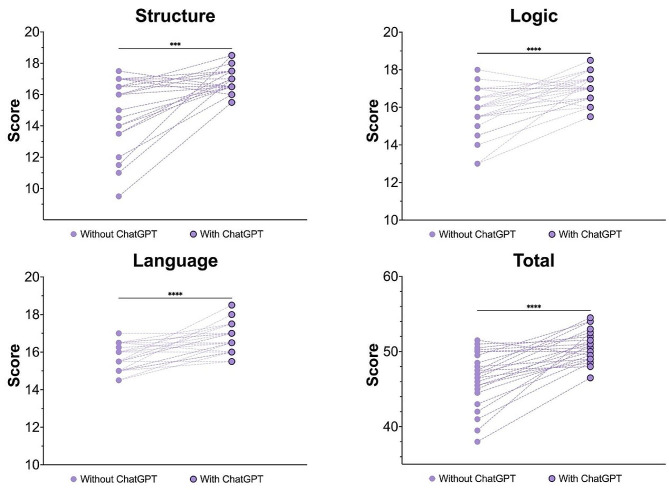
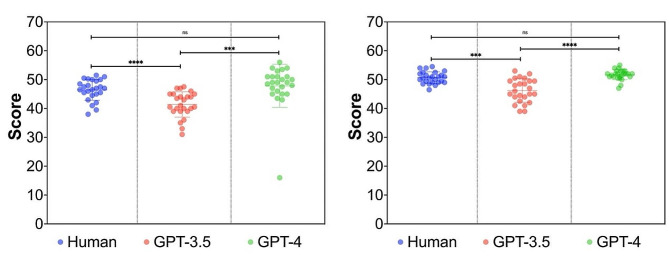
- Manual total scores rose from 46.45 ± 3.59 to 50.68 ± 2.03 after ChatGPT use, an improvement of 4.23 points (95% CI 2.64, 5.82); ChatGPT-3.5 total scores increased by 4.82 points (95% CI 2.47, 7.17), and ChatGPT-4 total scores by 3.84 points (95% CI 0.83, 6.85).
- Manual scoring improved significantly in structure, logic, language, and total score (all p < 0.001); ChatGPT-3.5 scoring improved significantly in all dimensions and total score (all p < 0.05); ChatGPT-4 scoring improved significantly in structure, logic, and total score (all p < 0.05), but not language (β 1.02, 95% CI −0.15, 2.19, p = 0.10).
- ChatGPT-3.5 scores differed significantly from manual grading, while ChatGPT-4 scores did not differ significantly from manual grading, suggesting ChatGPT-4 may assist teachers in grading.
- Questionnaire feedback: 92% reported improved writing quality, 84% reported language-skill advancement, 76% saw ChatGPT as useful for academic research/literature review, and 100% used it for English polishing.
Methods
- Two-stage pre-post study with 25 third-year medical students from West China School of Medicine, Sichuan University, all non-native English speakers; 27 were initially included and 2 were excluded for late submission.
- Students first wrote an English “mini paper,” then revised it using ChatGPT-3.5 over two weeks; papers were scored before and after by two teachers using blind review (averaged), by ChatGPT-3.5, and by ChatGPT-4.
- Scoring covered structure, logic, and language, each 0–20 for a 60-point total; analysis used Kruskal-Wallis, paired t-test, and univariate/multivariate regression adjusted for gender, plus a 31-item experience questionnaire.
Limitations
- The paper states limitations including language barriers and cultural differences, difficulty with non-English languages, lack of human-like creative thinking and contextual understanding, and concerns about authenticity and credibility of ChatGPT-generated information.
- Participant-reported limitations included difficulty verifying information authenticity (96%), lack of human-like creative thinking (72%), absence of clinical practice insights (52%), and language/cultural differences (40%).
- Evident from the text: this was a small, single-institution pilot with 25 students, a short two-week intervention, no separate control group, and questionnaire outcomes based on self-report.
Model-written summary. Check it against the paper before relying on it.
Integrity signals
Registry
Cites
Statistics
Figures
Verification
Claims the paper makes
5 Valid · 0 Not valid · 18 Not checked · 40 Own results and interpretations
The cited sources support only part of this claim — read each source’s verdict below.
In the paper
“Research has shown that the explanations provided by ChatGPT are more accurate and comprehensive than the explanations of basic principles provided in some standardized higher education exams [8].”
§ Exploring the potential of artificial intelligence to enhance the writing of english academic papers by non-native english-speaking medical students - the educational application of ChatGPT > Introduction
What the sources say
- Partly supportedcites [8] Fijacko N, Gosak L, Stiglic G, Picard CT, John Douma M. Can ChatGPT pass the life support exams without entering the American heart association course? Resuscitation 2023, 185:109732. 36775020 sourceExperimental — accuracy not yet measured
In “To the Editor,” the paper says ChatGPT’s answer rationales were often significantly more detailed than those in the ACLS exam key. It does not say ChatGPT’s explanations were more accurate than the exam key’s, and its comparison concerns life-support exams rather than standardized higher-education exams generally. The paper also reports that ChatGPT did not pass any of the exams. (LLM, conf=0.88)
plain- Asserted: passes — The authors put it forward as true.
- Checkable: passes — It can be checked against evidence.
- Load-bearing: unclear — It is unclear whether the paper’s conclusions depend on it.
- Based: passes — The paper gives a reason why it holds.
- Partly supported
The cited sources support only part of this claim — read each source’s verdict below.
In the paper
“The results of questionnaire indicate ChatGPT can serve as an important educational tool, beneficial in a range of teaching contexts, including online classroom Q&A assistant, virtual tutor and facilitating language learning [24].”
§ Exploring the potential of artificial intelligence to enhance the writing of english academic papers by non-native english-speaking medical students - the educational application of ChatGPT > Discussion
What the sources say
- Partly supportedcites [24] Futterer T Fischer C Alekseeva A Chen X Tate T Warschauer M Gerjets P ChatGPT in education: global reactions to AI innovations Sci Rep 2023 13 1 15310 10.1038/s41598-023-42227-6 37714915 PMC10504368 sourceExperimental — accuracy not yet measured
Our copy supports only the generic part of the claim: the Theoretical background ('Opportunities and risks of ChatGPT for education') frames ChatGPT as 'a learning partner or teaching assistant that gives feedback if good prompts are given by the learners' and notes Khan Academy's use of it as a learning partner. What it does not support is the specific teaching contexts and the evidentiary basis: the paper's actual results (Results, RQ1–RQ3) are topic-model and sentiment analyses of 16.7 million tweets, listing ten education topics (opportunities/limitations, cheating and essays, academia, banning, exams, writing strategies, other AI tools, replicating papers, costs, integration in teaching) — none of them an 'online classroom Q&A assistant', a 'virtual tutor', or language learning. The Discussion ('Limitations and future research') explicitly contrasts its tweet analysis with 'a steady stream of questionnaire-based studies' and calls for future surveys, so the citing sentence's 'results of questionnaire' attribution does not come from this paper. (LLM, conf=0.72)
hedged- Asserted: passes — The authors put it forward as true.
- Checkable: passes — It can be checked against evidence.
- Load-bearing: unclear — It is unclear whether the paper’s conclusions depend on it.
- Based: passes — The paper gives a reason why it holds.
- Rests on an assumption not shown here.
- Partly supported
None of the sources cited for this claim have been checked yet.
In the paper
“When inputted with different languages, ChatGPT may have difficulty in understanding and generating accurate responses.”
§ Exploring the potential of artificial intelligence to enhance the writing of english academic papers by non-native english-speaking medical students - the educational application of ChatGPT > Discussion
What the sources say
- Could not verifycites [29] Albrecht UV Behrends M Schmeer R Matthies HK von Jan U Usage of multilingual mobile translation applications in clinical settings JMIR Mhealth Uhealth 2013 1 1 e4 10.2196/mhealth.2268 25100677 PMC4114476 sourceExperimental — accuracy not yet measured
Our copy of Albrecht et al. (2013) evaluates only the phrase-based iPad translation app 'xprompt' among nursing staff at Hannover Medical School; no passage mentions ChatGPT, large language models, or generative AI (searched: ChatGPT/artificial intelligence/language model/automatic translation accuracy; multilingual input/different languages/understanding/generating accurate responses). The nearest content — Results, 'At times, the desired target language was not available' and Methods > The Application, which describes a fixed set of 800 pre-translated phrases in 23 languages rather than free-form multilingual text generation — concerns a different technology and cannot support or contradict a claim about ChatGPT's multilingual performance. (LLM, conf=0.75)
- Not checked yetcites [30] Beh TH Canty DJ English and Mandarin translation using Google Translate software for pre-anaesthetic consultation Anaesth Intensive Care 2015 43 6 792 3 26603812
hedgedstates a possible cause- Asserted: passes — The authors put it forward as true.
- Checkable: passes — It can be checked against evidence.
- Load-bearing: unclear — It is unclear whether the paper’s conclusions depend on it.
- Based: passes — The paper gives a reason why it holds.
- Could not verify
The cited sources support only part of this claim — read each source’s verdict below.
In the paper
“In medical education, where accuracy and reliability of knowledge are paramount, the inability to guarantee the truthfulness of the information poses a significant challenge [32–34].”
§ Exploring the potential of artificial intelligence to enhance the writing of english academic papers by non-native english-speaking medical students - the educational application of ChatGPT > Discussion
What the sources say
- Not checked yetcites [32] Haque MU, Dharmadasa I, Sworna ZT, Rajapakse RN, Ahmad H. I think this is the most disruptive technology: Exploring Sentiments of ChatGPT Early Adopters using Twitter Data. ArXiv 2022, abs/2212.05856.
- Partly supportedcites [33] Cooper G Examining Science Education in ChatGPT: an exploratory study of Generative Artificial Intelligence J Sci Edu Technol 2023 32 444 52 10.1007/s10956-023-10039-y sourceExperimental — accuracy not yet measured
In “RQ1: How Did ChatGPT Answer Questions Related to Science Education?” (page not provided), Cooper says ChatGPT’s output can lack supporting evidence and present a single truth without sufficient qualifications. That supports the concern about reliability, but the paper discusses science education, not the specific challenge posed in medical education. (LLM, conf=0.86)
- Could not verifycites [34] Yu C, Zong H, Chen Y, Zhou Y, Liu X, Lin Y, Li J, Zheng X, Min H, Shen B. PCAO2: an ontology for integration of prostate cancer associated genotypic, phenotypic and lifestyle data. Brief Bioinform 2024, 25(3). PMC10982949 38557678 sourceExperimental — accuracy not yet measured
The Introduction discusses AI models as black boxes and the need for trustworthy, transparent systems in precision medicine. The Discussion mentions large language models, but neither section addresses ChatGPT-generated information being untruthful or the resulting challenge in medical education (searched for ChatGPT, truthfulness, accuracy and reliability). (LLM, conf=0.76)
plain- Asserted: passes — The authors put it forward as true.
- Checkable: passes — It can be checked against evidence.
- Load-bearing: unclear — It is unclear whether the paper’s conclusions depend on it.
- Based: passes — The paper gives a reason why it holds.
The cited sources support only part of this claim — read each source’s verdict below.
In the paper
“Despite its potential benefits of using ChatGPT in medical education, it also has limitations, such as language barriers and cultural differences [29, 30].”
§ Exploring the potential of artificial intelligence to enhance the writing of english academic papers by non-native english-speaking medical students - the educational application of ChatGPT > Discussion
What the sources say
- Partly supportedcites [29] Albrecht UV Behrends M Schmeer R Matthies HK von Jan U Usage of multilingual mobile translation applications in clinical settings JMIR Mhealth Uhealth 2013 1 1 e4 10.2196/mhealth.2268 25100677 PMC4114476 sourceExperimental — accuracy not yet measured
Our copy of Albrecht et al. (2013) supports only the generic content: the Abstract Background states that 'Communication between patients and medical staff can be challenging if both parties have different cultural and linguistic backgrounds', and the Introduction elaborates the disadvantages of language barriers and differing cultural background for patient-nurse communication. However, the paper is an evaluation of the xprompt mobile translation app on nursing wards at Hannover Medical School; it nowhere mentions ChatGPT, large language models, or medical education as a setting, so the specific attribution — that these are limitations of ChatGPT in medical education — is not in the source. The citing sentence extends a clinical patient-provider communication finding to a different technology and a different domain (education). (LLM, conf=0.65)
- Not checked yetcites [30] Beh TH Canty DJ English and Mandarin translation using Google Translate software for pre-anaesthetic consultation Anaesth Intensive Care 2015 43 6 792 3 26603812
plain- Asserted: passes — The authors put it forward as true.
- Checkable: passes — It can be checked against evidence.
- Load-bearing: unclear — It is unclear whether the paper’s conclusions depend on it.
- Based: passes — The paper gives a reason why it holds.
- Partly supported
24 more claims
Create a free account to see all 63 claims and to verify the 29 references still open.
- Probably not a substantial claim. 24
- It may state two separate claims as one. 15
- The quote only partly states this claim. 3
Claims other papers make about this one
Each is checked against this paper’s own text: does it say what the citing paper says it does?
The cited source doesn’t support the claim as written.
In the citing paper
“The content generated by GAI lacks personalization tailored to individual needs.”
From Applications, Challenges, and Prospects of Generative Artificial Intelligence Empowering Medical Education: Scoping Review (2025) · cites this paper as [28]
Checked by a reasoning model — may be wrong.
Experimental — accuracy not yet measuredThe source backs part of the claim, not all of it — or backs it for a different population, condition or comparison.
In the citing paper
“Previous research confirms that usefulness and usability are key to technology adoption in medical education [45].”
From Development of a Clinical Clerkship Mentor Using Generative AI and Evaluation of Its Effectiveness in a Medical Student Trial Compared to Student Mentors: 2-Part Comparative Study (2025) · cites this paper as [45]
Experimental — accuracy not yet measuredThe source backs part of the claim, not all of it — or backs it for a different population, condition or comparison.
In the citing paper
“A recent TAM-based study found that students are more willing to use LLM chatbots when they perceive them as useful and user-friendly [45].”
From Development of a Clinical Clerkship Mentor Using Generative AI and Evaluation of Its Effectiveness in a Medical Student Trial Compared to Student Mentors: 2-Part Comparative Study (2025) · cites this paper as [45]
Experimental — accuracy not yet measuredThe source backs part of the claim, not all of it — or backs it for a different population, condition or comparison.
In the citing paper
“When students use GAI tools like ChatGPT, they often receive writing suggestions that lack the creativity and depth of human-generated content.”
From Applications, Challenges, and Prospects of Generative Artificial Intelligence Empowering Medical Education: Scoping Review (2025) · cites this paper as [28]
Experimental — accuracy not yet measuredThe source backs part of the claim, not all of it — or backs it for a different population, condition or comparison.
In the citing paper
“This limitation mainly manifests in the generated text, which often adopts similar writing patterns and standardized language, struggling to incorporate personalized perspectives or creative expressions [28].”
From Applications, Challenges, and Prospects of Generative Artificial Intelligence Empowering Medical Education: Scoping Review (2025) · cites this paper as [28]
Experimental — accuracy not yet measured
4 more claims about this paper
Create a free account to see every claim other papers make about this one.
Self-check
Percentages, sums and reported differences re-computed from the paper’s own numbers.
Each contradiction between two passages listed here was confirmed by an independent check.
Rated minor: it would not touch a result — a value no result rests on, a p-value that stays on the same side of the significance level, or a conflict that is clerical, resolved elsewhere in the paper, or outside its own findings.
In the paper
§ Exploring the potential of artificial intelligence to enhance the writing of english academic papers by non-native english-speaking medical students - the educational application of ChatGPT > Results > Experience questionnaire
“This indicates that most participants viewed the role of ChatGPT in medical education positively, with only a minority being pessimistic.”
§ Exploring the potential of artificial intelligence to enhance the writing of english academic papers by non-native english-speaking medical students - the educational application of ChatGPT > Results > Experience questionnaire
“Regarding attitudes towards the role of ChatGPT in medical education, 24% of participants had an optimistic view, actively embracing its role, while 52% had a generally positive attitude, and 24% held a neutral stance.”
Citations
Cites
Kung, T. H., Cheatham, M., Medenilla, A., Sillos, C., De Leon, L., Elepaño, C., Madriaga, M., Aggabao, R., Diaz-Candido, G., Maningo, J., et al. (2023) · PLOS Digital Health · doi:10.1371/journal.pdig.0000198 · Cited by 4,115 · cited 1×
“Since its inception, ChatGPT has been widely applied in medicine domain, especially after testing, it can demonstrate the medical level that meets the requirements of passing the United States Medical Licensing Exam [6].”
BackgroundKung, T. H., Cheatham, M., ChatGPT, Medenilla, A., Sillos, C., De Leon, L., Elepaño, C., Madriaga, M., Aggabao, R., Diaz-Candido, G., et al. (2022) · doi:10.1101/2022.12.19.22283643 · Cited by 4,115
Large language models encode clinical knowledge
Singhal, K., Azizi, S., Tu, T., Mahdavi, S. S., Wei, J., Chung, H. W., Scales, N., Tanwani, A., Cole-Lewis, H., Pfohl, S., et al. (2023) · Nature · doi:10.1038/s41586-023-06291-2 · Cited by 4,083 · cited 1×
“Large language models (LLMs) are artificial intelligence (AI) tools that have remarkable ability to understand and generate text [1, 2].”
BackgroundLarge Language Models Encode Clinical Knowledge
Singhal, K., Azizi, S., Tu, T., Mahdavi, S. S., Wei, J., Chung, H. W., Scales, N., Tanwani, A., Cole-Lewis, H., Pfohl, S., et al. (2022) · arXiv · doi:10.48550/arxiv.2212.13138 · Cited by 4,083 · cited 1×
“Large language models (LLMs) are artificial intelligence (AI) tools that have remarkable ability to understand and generate text [1, 2].”
BackgroundBAİDOO-ANU, D., & OWUSU ANSAH, L. (2023) · Journal of AI · doi:10.61969/jai.1337500 · Cited by 3,939
Sallam, M. (2023) · Healthcare · doi:10.3390/healthcare11060887 · Cited by 3,126 · cited 1×
“It can provide personalized learning experience according to the preference style of medical students [7].”
BackgroundBaidoo-Anu, D., & Owusu Ansah, L. (2023) · doi:10.2139/ssrn.4337484 · Cited by 3,004 · cited 1×
“ChatGPT can also deliver personalized educational guidance based on individual student needs, enhancing adaptive learning strategies [27].”
BackgroundGilson, A., Safranek, C. W., Huang, T., Socrates, V., Chi, L., Taylor, R. A., & Chartash, D. (2023) · JMIR Medical Education · doi:10.2196/45312 · Cited by 2,078 · cited 1×
“Therefore, many researchers believe that Chat-GPT may improve students’ problem-solving ability and reflective learning [9].”
BackgroundExamining Science Education in ChatGPT: An Exploratory Study of Generative Artificial Intelligence
Cooper, G. (2023) · Journal of Science Education and Technology · doi:10.1007/s10956-023-10039-y · Cited by 1,263
BioGPT: generative pre-trained transformer for biomedical text generation and mining
Luo, R., Sun, L., Xia, Y., Qin, T., Zhang, S., Poon, H., & Liu, T.-Y. (2022) · Briefings in Bioinformatics · doi:10.1093/bib/bbac409 · Cited by 1,150 · cited 1×
“LLMs can be used to generate and modify text content and language styles, and can be applied to the quality improvement of scientific papers [12, 13].”
BackgroundSong, C., & Song, Y. (2023) · Frontiers in Psychology · doi:10.3389/fpsyg.2023.1260843 · Cited by 717 · cited 1×
“Students received AI-assisted instruction exhibited improved proficiency in multiple aspects of writing, organization, coherence, grammar, and vocabulary [15].”
Haleem, A., Javaid, M., & Singh, R. P. (2022) · BenchCouncil Transactions on Benchmarks, Standards and Evaluations · doi:10.1016/j.tbench.2023.100089 · Cited by 694 · cited 1×
“Another concern is the authenticity and credibility of the information generated by ChatGPT [31, 32].”
BackgroundChatGPT - Reshaping medical education and clinical management
Khan, R. A., Jawaid, M., Khan, A. R., & Sajjad, M. (2023) · Pakistan Journal of Medical Sciences · doi:10.12669/pjms.39.2.7653 · Cited by 628 · cited 1×
“ChatGPT’s expansive knowledge base and advanced natural language processing capability enable it to effectively answer students’ inquiries and offer valuable literature resources and writing advice [25].”
BackgroundThe benefits and challenges of chatgpt: An overview
Deng, J., & Lin, Y. (2023) · Frontiers in Computing and Intelligent Systems · doi:10.54097/fcis.v2i2.4465 · Cited by 611 · cited 1×
“For language learning, it offers real-time translation and grammar correction, aiding learners in improving their language skills through evaluation and feedback [26].”
BackgroundChatGPT and the future of medical writing
Biswas, S. (2023) · Radiology · doi:10.1148/radiol.223312 · Cited by 571 · cited 2×
“LLMs can be used to generate and modify text content and language styles, and can be applied to the quality improvement of scientific papers [12, 13].”
BackgroundPreiksaitis, C., & Rose, C. (2023) · JMIR Medical Education · doi:10.2196/48785 · Cited by 552 · cited 1×
“Furthermore, ongoing discussions about ethics and data security in AI applications highlight the need for continued vigilance and improvement [28].”
BackgroundWei, L. (2023) · Frontiers in Psychology · doi:10.3389/fpsyg.2023.1261955 · Cited by 536 · cited 1×
“Additionally, AI mediated instruction can positively impacts English learning achievement and self-regulated learning [16].”
BackgroundKorngiebel, D. M., & Mooney, S. D. (2021) · npj Digital Medicine · doi:10.1038/s41746-021-00464-x · Cited by 259
ChatGPT in education: global reactions to AI innovations
Fütterer, T., Fischer, C., Alekseeva, A., Chen, X., Tate, T., Warschauer, M., & Gerjets, P. (2023) · Scientific Reports · doi:10.1038/s41598-023-42227-6 · Cited by 242 · cited 1×
“Statistical analyses were performed using the R software package (version 4.2.0, The R Foundation, Boston, MA, USA), Graph Pad Prism 9 (GraphPad Software, CA, USA), and Empower (X&Y Solutions Inc., Boston, MA, USA) [23].”
MethodInfluentialD’Lima, G. M., Winsler, A., & Kitsantas, A. (2014) · The Journal of Educational Research · doi:10.1080/00220671.2013.823366 · Cited by 214
Can ChatGPT pass the life support exams without entering the American heart association course?
Fijačko, N., Gosak, L., Štiglic, G., Picard, C. T., & John Douma, M. (2023) · Resuscitation · doi:10.1016/j.resuscitation.2023.109732 · Cited by 206 · cited 1×
“Research has shown that the explanations provided by ChatGPT are more accurate and comprehensive than the explanations of basic principles provided in some standardized higher education exams [8].”
BackgroundHaque, M. U., Dharmadasa, I., Sworna, Z. T., Rajapakse, R. N., & Ahmad, H. (2022) · arXiv · doi:10.48550/arxiv.2212.05856 · Cited by 203 · cited 2×
“In medical education, where accuracy and reliability of knowledge are paramount, the inability to guarantee the truthfulness of the information poses a significant challenge [32–34].”
BackgroundMassey, P. A., Montgomery, C., & Zhang, A. S. (2023) · Journal of the American Academy of Orthopaedic Surgeons · doi:10.5435/jaaos-d-23-00396 · Cited by 190 · cited 1×
“For example, there were clear evidences that version 4 achieved better test results than version 3.5 in professional knowledge exams in disciplines such as orthope-dics [35], dermatology [36], and ophthalmology [37].”
BackgroundInfluentialMedical education in china: progress in the past 70 years and a vision for the future
Wang, W. (2021) · BMC Medical Education · doi:10.1186/s12909-021-02875-6 · Cited by 167 · cited 1×
“China is a non-native English-speaking country with a large population of medical students, so it is necessary to provide medical education and offer relevant courses, especially to cultivate their ability to write English academic papers [10].”
BackgroundUnderstanding the Capabilities, Limitations, and Societal Impact of Large Language Models
Tamkin, A., Brundage, M., Clark, J., & Ganguli, D. (2021) · arXiv · doi:10.48550/arxiv.2102.02503 · Cited by 135 · cited 1×
“Large language models (LLMs) are artificial intelligence (AI) tools that have remarkable ability to understand and generate text [1, 2].”
BackgroundZong, H., Li, J., Wu, E., Wu, R., Lu, J., & Shen, B. (2024) · BMC Medical Education · doi:10.1186/s12909-024-05125-7 · Cited by 114 · cited 1×
“Trained with substantial amounts of textual data, LLMs have demonstrated their capability to perform diverse tasks, such as question answering, machine translation, and writing [3, 4].”
BackgroundSelf-citationLanguage Translation Apps in Health Care Settings: Expert Opinion
Panayiotou, A., Gardner, A., Williams, S., Zucchi, E., Mascitti-Meuter, M., Goh, A. M., You, E., Chong, T. W., Logiudice, D., Lin, X., et al. (2019) · JMIR mHealth and uHealth · doi:10.2196/11316 · Cited by 114 · cited 1×
“LLMs can also perform language translation [13, 17].”
Kuśnierz, C., Rogowska, A. M., & Pavlova, I. (2020) · International Journal of Environmental Research and Public Health · doi:10.3390/ijerph17165729 · Cited by 100 · cited 1×
“In order to mitigate any potential biases, we implemented gender correction techniques, which encompassed statistical adjustments to accommodate these gender variations [20–22].”
MethodLewandowski, M., Łukowicz, P., Świetlik, D., & Barańska-Rybak, W. (2024) · Clinical and Experimental Dermatology · doi:10.1093/ced/llad255 · Cited by 97 · cited 1×
“For example, there were clear evidences that version 4 achieved better test results than version 3.5 in professional knowledge exams in disciplines such as orthope-dics [35], dermatology [36], and ophthalmology [37].”
BackgroundInfluentialImproved Performance of ChatGPT-4 on the OKAP Examination: A Comparative Study with ChatGPT-3.5
Teebagy, S., Colwell, L., Wood, E., Yaghy, A., & Faustina, M. (2023) · Journal of Academic Ophthalmology · doi:10.1055/s-0043-1774399 · Cited by 86 · cited 1×
“For example, there were clear evidences that version 4 achieved better test results than version 3.5 in professional knowledge exams in disciplines such as orthope-dics [35], dermatology [36], and ophthalmology [37].”
BackgroundInfluentialUsage of Multilingual Mobile Translation Applications in Clinical Settings
Albrecht, U.-V., Behrends, M., Matthies, H. K., & von Jan, U. (2013) · JMIR mhealth and uhealth · doi:10.2196/mhealth.2268 · Cited by 60 · cited 1×
“Despite its potential benefits of using ChatGPT in medical education, it also has limitations, such as language barriers and cultural differences [29, 30].”
BackgroundChatGPT in Medical Education and Research: A Boon or a Bane?
Jeyaraman, M., K, S. P., Jeyaraman, N., Nallakumarasamy, A., Yadav, S., & Bondili, S. K. (2023) · Cureus · doi:10.7759/cureus.44316 · Cited by 58 · cited 1×
“However, their usage must be accompanied by careful and critical evaluation [19].”
BackgroundVeras, M., Dyer, J.-O., Rooney, M., Barros Silva, P. G., Rutherford, D., & Kairy, D. (2023) · JMIR Research Protocols · doi:10.2196/51873 · Cited by 47 · cited 1×
“Moreover, it can automatically evaluate and score the level of medical writing, and provide modification suggestions for improvement [18].”
BackgroundWu, C., Zhang, Y.-W., & Li, A. W. (2023) · BMC Medical Education · doi:10.1186/s12909-023-04574-w · Cited by 44 · cited 1×
“However, the ability of these non-native English-speaking medical students in writing English papers is relatively limited, and they need continuous training and improvement [11].”
BackgroundSaxena, S., Wright, W. S., & Khalil, M. K. (2024) · BMC Medical Education · doi:10.1186/s12909-024-05494-z · Cited by 43 · cited 1×
“In order to mitigate any potential biases, we implemented gender correction techniques, which encompassed statistical adjustments to accommodate these gender variations [20–22].”
MethodEnglish and Mandarin translation using Google Translate software for pre-anaesthetic consultation.
Beh, T., & Canty, D. J. (2015) · PubMed · Cited by 23
Li, J., Tang, T., Wu, E., Zhao, J., Zong, H., Wu, R., Feng, W., Zhang, K., Wang, D., Qin, Y., et al. (2024) · International Journal of Surgery · doi:10.1097/js9.0000000000001290 · Cited by 19 · cited 1×
“ChatGPT exhibits considerable potential in medical paper writing, assist in literature retrieval, data analysis, knowledge synthesis and other aspects [14].”
BackgroundSelf-citationYu, C., Zong, H., Chen, Y., Zhou, Y., Liu, X., Lin, Y., Li, J., Zheng, X., Min, H., & Shen, B. (2024) · Briefings in Bioinformatics · doi:10.1093/bib/bbae136 · Cited by 13 · cited 1×
“In medical education, where accuracy and reliability of knowledge are paramount, the inability to guarantee the truthfulness of the information poses a significant challenge [32–34].”
BackgroundSelf-citationLi, J., Erman, W., Tang, T., Zhang, Z. H., Zhang, C., Zong, H., Shen, B., & Wei, Q. (2024) · European Urology · doi:10.1016/s0302-2838(24)00760-7 · Cited by 5
Self-citation
Cited by
Pham, T. D., Karunaratne, N., Exintaris, B., Liu, D., Lay, T., Yuriev, E., & Lim, A. (2025) · Medical Education · doi:10.1111/medu.15746 · Cited by 100
Large Language Models in Worldwide Medical Exams: Platform Development and Comprehensive Analysis
Zong, H., Wu, R., Cha, J., Wang, J., Wu, E., Li, J., Zhou, Y. K., Zhang, C., Feng, W.-Z., & Shen, B. (2024) · Journal of Medical Internet Research · doi:10.2196/66114 · Cited by 101
“In a previous study [16], we illustrated how LLMs like ChatGPT effectively assist with enhancing students’ academic writing quality and facilitating teachers’grading processes.”
Self-citationXia, Q., Li, W., Yang, Y., Weng, X., & Chiu, T. K. F. (2025) · Computers and Education: Artificial Intelligence · doi:10.1016/j.caeai.2025.100455 · Cited by 45
Ma, T. (2024) · Computers and Education Artificial Intelligence · doi:10.1016/j.caeai.2024.100336 · Cited by 81
Zgambo, M., Costello, M., Buhlmann, M., Maldon, J., Anyango, E., & Adama, E. A. (2025) · Nurse Education Today · doi:10.1016/j.nedt.2025.106796 · Cited by 48
Metadata
- Authors
- Li, J., Zong, H., Wu, E., Wu, R., Peng, Z., Zhao, J., Yang, L., Xie, H., & Shen, B.
- Affiliations
- Sichuan University (CN)
- Corresponding author
- Xie, Hong
- Shen, Bairong
- Venue
- BMC Medical Education
- Published
- 2024-07-09
- Volume
- 24
- Issue
- 1
- Pages
- 736-736
- ISSN
- 1472-6920 (ISSN-L)
- PMC
- PMC11232216
- OpenAlex
- W4400475545
- Cited by
- 104
- References
- 34
- Citations by year
- 2026: 41 · 2025: 51 · 2024: 11
- FWCI
- 38.73
- Type
- journal article
- Language
- en
- Open access
- gold
- doi.org
- Licence
- cc-by
- creativecommons.org/licenses/by/4.0 (tdm)
- creativecommons.org/licenses/by/4.0 (vor)
- Locations
- BMC Medical Education (publishedVersion, cc-by)
- PubMed Central (publishedVersion, cc-by)
- PubMed (publishedVersion)
- DOAJ (DOAJ: Directory of Open Access Journals) (submittedVersion)
- Funders
- Fundamental Research Funds for the Central Universities (2023SCU12057)
- National Natural Science Foundation of China (32070671)
- Topics
- Social Sciences › Education › Artificial Intelligence in Education
- Health Sciences › Medicine › Health Informatics › Artificial Intelligence in Healthcare and Education
- Social Sciences › Arts and Humanities › Language and Linguistics › EFL/ESL Teaching and Learning
- Keywords
- ChatGPT, large language models, English academic writing, non-native English speakers, medical students, writing support, AI scoring, automated essay evaluation, writing revision, student feedback
- MeSH terms
- Artificial Intelligence, China, Education, Medical, Undergraduate, Female, Humans, Language, Male, Students, Medical, Writing
About these checks
Registry, retraction, Cites and statistics results are computed, not judged, with one exception: a printed reference that no index lists is read once by a model before it counts as a citation error. Claims are extracted by a model and kept only when their quote appears verbatim in the text; each cited source is then checked, with a model’s help, for whether it says what the claim relies on. Those verdicts can be wrong — read the claim’s quote and the cited source before relying on one.
The claim verdicts this report counts are experimental: their accuracy is not yet measured.
A language model drew the claims from the paper on 2026-10-06, under version 3 of the claim definition (model deepseek-v4.1-flash, prompt extract-v3).
A second model labelled each claim on 2026-10-06 (model jev-1.13-20260917, definition revision gold-guideline-v0.2).
Cited sources are checked with a language model’s help (gpt-6-sol and qwen3.8-omni-flash).
Statistics and arithmetic are recomputed, not judged.
Confidence bands are shown only for fields calibrated on our annotated test set. None is calibrated yet, so no band is shown.
What counts as a claim ›How we measure confidence ›How we check this ›
Are you an author, or do you see a problem with this page? Request a review
Data sources
Bibliographic data: Semantic Scholar, OpenAlex, Crossref.
Contains information from the Semantic Scholar Academic Graph Datasets, made available under the ODC Attribution License (ODC-BY 1.0).
Semantic Scholar’s data is described in: Kinney, R., et al. (2023). The Semantic Scholar Open Data Platform. arXiv:2301.10140.
