

The DOI matches its Crossref record; 34 of the 35 references it cites were found in a registry or an index.
Artificial intelligence in medical education - perception among medical students
Open accessPublished version of a preprint
Abstract
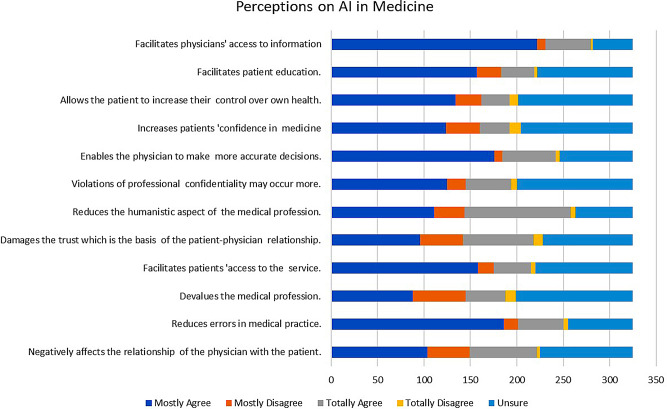
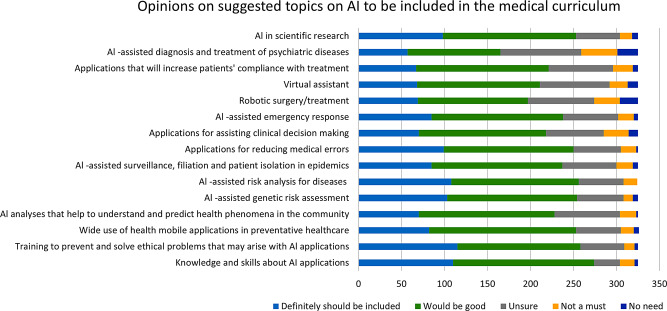
Background: As Artificial Intelligence (AI) becomes pervasive in healthcare, including applications like robotic surgery and image analysis, the World Medical Association emphasises integrating AI education into medical curricula. This study evaluates medical students’ perceptions of ‘AI in medicine’, their preferences for AI training in education, and their grasp of AI’s ethical implications in healthcare. Materials & methods: A cross-sectional study was conducted among 325 medical students in Kerala using a pre-validated, semi structured questionnaire. The survey collected demographic data, any past educational experience about AI, participants’ self-evaluation of their knowledge and evaluated self-perceived understanding of applications of AI in medicine. Participants responded to twelve Likert-scale questions targeting perceptions and ethical aspects and their opinions on suggested topics on AI to be included in their curriculum. Results & discussion: AI was viewed as an assistive technology for reducing medical errors by 57.2% students and 54.2% believed AI could enhance medical decision accuracy. About 49% agreed that AI could potentially improve accessibility to healthcare. Concerns about AI replacing physicians were reported by 37.6% and 69.2% feared a reduction in the humanistic aspect of medicine. Students were worried about challenges to trust (52.9%), patient-physician relationships (54.5%) and breach of professional confidentiality (53.5%). Only 3.7% felttotally competent in informing patients about features and risks associated with AI applications. Strong demand for structured AI training was expressed, particularly on reducing medical errors (76.9%) and ethical issues (79.4%). Conclusion: This study highlights medical students’ demand for structured AI training in undergraduate curricula, emphasising its importance in addressing evolving healthcare needs and ethical considerations. Despite widespread ethical concerns, the majority perceive AI as an assistive technology in healthcare. These findings provide valuable insights for curriculum development and defining learning outcomes in AI education for medical students.
Overview
The claims and statistics of this paper haven’t been checked yet.
Run the check — free, no account needed. It reads the open-access text and checks the sources it cites.
Integrity signals
Registry
Cites
Statistics
Figures
Verification
Claims the paper makes
The claims and statistics of this paper haven’t been checked yet.
Run the check — free, no account needed. It reads the open-access text and checks the sources it cites.
Claims other papers make about this one
Each is checked against this paper’s own text: does it say what the citing paper says it does?
The source backs part of the claim, not all of it — or backs it for a different population, condition or comparison.
In the citing paper
“Structured AI training was highly valued, with 243 out of 325 respondents (74.8%) highlighting its role in reducing medical errors”
From Is it time to introduce an artificial intelligence curriculum in undergraduate medical education? medical students’ perspectives: a systematic review and meta-analysis (2026) · cites this paper as [46]
Experimental — accuracy not yet measuredThe source backs part of the claim, not all of it — or backs it for a different population, condition or comparison.
In the citing paper
“AI’s perceived potential to reduce diagnostic errors (57.2% in India) [46]”
From Is it time to introduce an artificial intelligence curriculum in undergraduate medical education? medical students’ perspectives: a systematic review and meta-analysis (2026) · cites this paper as [46]
Experimental — accuracy not yet measuredThe cited source says what the claim attributes to it.
In the citing paper
“258 out of 325 respondents (79.4%) emphasizing its relevance to ethical decision-making [46].”
Self-check
Percentages, sums and reported differences re-computed from the paper’s own numbers.
The self-check needs the paper’s full text.
Citations
Cites
Dermatologist-level classification of skin cancer with deep neural networks
Esteva, A., Kuprel, B., Novoa, R. A., Ko, J., Swetter, S. M., Blau, H. M., & Thrun, S. (2017) · Nature · doi:10.1038/nature21056 · Cited by 14,362
Gulshan, V., Peng, L., Coram, M., Stumpe, M. C., Wu, D., Narayanaswamy, A., Venugopalan, S., Widner, K., Madams, T., Cuadros, J., et al. (2016) · JAMA · doi:10.1001/jama.2016.17216 · Cited by 7,697
Convolutional neural networks: an overview and application in radiology
Yamashita, R., Nishio, M., Do, R. K. G., & Togashi, K. (2018) · Insights into Imaging · doi:10.1007/s13244-018-0639-9 · Cited by 4,682 · cited 2×
“Many of the medical students interviewed in this study said that the anxiety they felt about being “dis-placed” by AI technologies in radiology would discourage them from considering the field for specialisation [14, 31–33].”
BackgroundArtificial intelligence in radiology
Hosny, A., Parmar, C., Quackenbush, J., Schwartz, L. H., & Aerts, H. J. W. L. (2018) · Nature Reviews Cancer · doi:10.1038/s41568-018-0016-5 · Cited by 3,803
The potential for artificial intelligence in healthcare
Davenport, T., & Kalakota, R. (2019) · Future Healthcare Journal · doi:10.7861/futurehosp.6-2-94 · Cited by 3,800
Ehteshami Bejnordi, B., Veta, M., Johannes van Diest, P., van Ginneken, B., Karssemeijer, N., Litjens, G., van der Laak, J. A. W. M., and the CAMELYON16 Consortium, Hermsen, M., Manson, Q. F., et al. (2017) · JAMA · doi:10.1001/jama.2017.14585 · Cited by 3,293
Ethics Guidelines for Trustworthy AI
Cannarsa, M. (2021) · The Cambridge Handbook of Lawyering in the Digital Age · doi:10.1017/9781108936040.022 · Cited by 2,095
Privacy and artificial intelligence: challenges for protecting health information in a new era
Murdoch, B. (2021) · BMC Medical Ethics · doi:10.1186/s12910-021-00687-3 · Cited by 991
(1983) · Springer eBooks · doi:10.1007/978-3-662-12405-5 · Cited by 758
Medical students' attitude towards artificial intelligence: a multicentre survey
Pinto dos Santos, D., Giese, D., Brodehl, S., Chon, S. H., Staab, W., Kleinert, R., Maintz, D., & Baeßler, B. (2019) · European Radiology · doi:10.1007/s00330-018-5601-1 · Cited by 754
Research works printed but not linked: 3
- Turing AM. Computing Machinery and Intelligence. Parsing the Turing Test. Dordrecht: Springer Netherlands; 2009;23–65.
- Artificial intelligence in medical applications and ethical problems: knowledge and thoughts of medical students Survey form used in: Civaner MM, Uncu Y, Bulut F, Chalil EG, Tatlı A. Artificial intelligence in medical education: a cross-sectional needs assessment. BMC Medical Education. 2022;22(1):772. mcivaner@gmail.com. · DOI · Paper page
- Augmented Intelligence in Health Care. AMA AI, Board Report. 2018. https://www.ama-assn.org/system/files/2019-08/ai-2018-board-report.pdf.
Cited by
Sorted by citations
Items 101–185 of 185
Ninomiya, S., Yamamoto, K., Mieno, E., Anai, H., Uemura, N., Kobayashi, T., Tanigawa, M., Hirano, T., Saito, I., Hanada, T., et al. (2025) · Research Square · doi:10.21203/rs.3.rs-7504189/v1
Yukish, H. Y., Singh, S., Yurchenko, N. B., & Fedoryka, N. Z. (2025) · Art of Medicine · doi:10.21802/artm.2025.4.36.94
Artificial Intelligence: Health Sector’s ally or an Opportunist?
Bhat, A. A., Malik, D., Kumar, N., Patni, M. A., & Srinivasamurthy, S. K. (2025) · Research Journal of Pharmacy and Technology · doi:10.52711/0974-360x.2025.00857
Artificial Intelligence in Psychiatric Teaching and Training
Tom, A., Reddy, B. S. C., & Math, S. B. (2026) · Springer eBooks · doi:10.1007/978-981-95-1845-6_21
Zhu¹, Y., Qiao², B., Ouyang¹, S., Yan¹, C., Li, X., Qi¹, Z., Tao, R., Zhang, Y., & Xu, Y. (2026) · Research Square · doi:10.21203/rs.3.rs-8110352/v1
Lamberts, M., Brinkman, W., van Goor, H., Tebbes, M., & Smits, M. (2026) · doi:10.2196/preprints.93854
Ortiz, A. M., Rebollo, E. C., & Alonso, R. Q. (2026) · doi:10.2196/preprints.94495
Esen, G., & Esen, E. (2026) · Research Square · doi:10.21203/rs.3.rs-8977743/v1
Alharbi, M. M., Alharbi, E. M., Albishi, M., & Alharthi, M. W. (2026) · Letters in Medical Sciences · doi:10.4103/lms.lms_16_25
Morriss, S., Awad, A., Morgan, V. A., & Wong, C. (2026) · Australasian Journal of Dermatology · doi:10.1111/ajd.70091
Chen, X., Chen, R., Xu, J., Xirefu, M., & Rong, J. (2026) · doi:10.2196/preprints.96215
Naffi, N., Bahlouli, Y. E., Fortier, N., Doumbouya, M. B., Shakeraneh, S., Faraj, D. A., Grégoire, J., Beaulieu, N., & Whelan, K. (2026) · Médiations et médiatisations · doi:10.52358/mm.vi25.507
Clark, C., Jerskey, B. A., & Fogler, J. (2026) · Journal of Pediatric Psychology · doi:10.1093/jpepsy/jsag027
Nursing students’ anxiety level regarding the use of artificial ıntelligence
Acavut, G., ÖZPOLAT, E., Agbı, K., Hassan, N., Alı, A., & Alpaslan, T. (2026) · Acta Paulista de Enfermagem · doi:10.37689/acta-ape/2026ao000102i · Cited by 1
Akkarakaran, V. J., & Chakkalackal, J. J. (2026) · International Journal of Health Sciences and Research · doi:10.52403/ijhsr.20260433
Frejoli, V. D. C., & Assad, S. G. B. (2026) · Research Society and Development · doi:10.33448/rsd-v15i5.50992
Bahri, A. E., Razıne, R., Hilali, S. E., Messaoud, S., Tachfouti, N., Mechita, N. B., & Obtel, M. (2026) · Research Square · doi:10.21203/rs.3.rs-9538324/v1
Visci, P., Sirago, G., Lupelli, F., Solarino, B., Dell'Erba, A., & Ferorelli, D. (2026) · Research Square · doi:10.21203/rs.3.rs-8959011/v1
Krasniqi, E., Kasumi, A., Kuçi, A., Murić, E., Ahmeti, E., Naka, L., & Boshnjaku, A. (2026) · BMC Medical Education · doi:10.1186/s12909-026-09373-7
Annweiler, C., Hazzan, M., Moulin, T., Riou, B., Staccini, P., Humbert, M. J. C., & Laffont, I. (2026) · Santé Publique · doi:10.3917/spub.262.0011
Khan, M. M., Shon, R., Yoon, J., Chien, I., Pouraryan, A., Zahraee, S., Mehranpour, P., Chakravarty, N., Immadisetty, S., Ninan, D., et al. (2026) · doi:10.2196/preprints.100784
Alshahrani, A. M., Ibrahim, I. A. E., Jibo, A. M., Alshahrani, A. F., Alshahrani, K. H. S., Alshahrani, K. H. S., Alqarni, G. A. M., Alghamdi, M. A. S., Almarhabi, A. M., Almuawi, M. T. M., et al. (2026) · BMC Medical Education · doi:10.21203/rs.3.rs-9602069/v1
Chouhan, K., Jangir, K., & Mathur, M. (2026) · Cureus · doi:10.7759/cureus.109790
Yesupatham, S. T., Kumari, A., & Suryanarayana, R. (2026) · Cureus · doi:10.7759/cureus.109794
Tunç, H., ÖKCÜ, Ö., Turan, O., & Koç, Y. (2026) · Journal of Health and Allied Sciences NU · doi:10.25259/jhasnu_263_2025
Chen, L., Liu, W., & Zhou, Y. (2026) · Frontiers in Public Health · doi:10.3389/fpubh.2026.1824962 · Cited by 2
AI in Health Informatics Through the Eyes of Medical Students
Leventi, N., & Vodenicharova, A. (2026) · International Congress on Human-Computer Interaction, Optimization and Robotic Applications (ICHORA) · doi:10.1109/ichora69329.2026.11537163
Rincón, E. H. H., Bastidas, J. C. K., Acevedo, S. B., & Florez, N. C. R. (2026) · Journal of Investigative Medicine · doi:10.1177/10815589261460883
Joshi, H. M., Shukla, A. B., & Panchal, P. J. (2026) · Cureus · doi:10.7759/cureus.110458
Evaluation of Medical Student Cultivation Quality Using a Hybrid Expert-Data Driven Approach
Yang, X., Shao, Y., Feng, J., Zhang, C., & Sun, P. (2026) · International Conference on Integrated Intelligence and Communication Systems (ICIICS) · doi:10.1109/iciics67880.2026.11483616
ETHICAL ASPECTS OF ARTIFICIAL INTELLIGENCE IN MEDICINE: A SYSTEMATIC REVIEW
Musiał, M., Matusik, A., Kasprzycka, K., Spaczyńska-Kwiatkowska, M., Niedziela, W., Mielniczek, Z., Szwed, A., Slowik, K., & Matoga, G. (2026) · International Journal of Innovative Technologies in Social Science · doi:10.31435/ijitss.2(50).2026.5652
Shallal, T. M. A. (2026) · doi:10.2196/preprints.104548
Elabbasy, L. M., Albouch, A. H., Alhabashi, R. S., & Ghanam, S. D. (2026) · Advanced Health Science and Technology Journal · doi:10.4103/ahstj.ahstj_44_25
Rizwan, M., & Khalid, A. M. (2026) · HITEC medical and dental journal. · doi:10.69884/hmdj.5.2.3456
Assessment Of Risk Factors Associated With Hypertension Among Medical Students
Adil, S., Nudrat, F., Javed, F., Noor, E., Abdullah, M., Aurangzaib, M. Z., Soban, M., Eman, N. U., Fatima, S., Asmat, F., et al. (2026) · HITEC medical and dental journal. · doi:10.69884/hmdj.5.2.7658
Medical Education In Transition: Preparing Tomorrow’s Doctors For A Digital World
(Retd), M. G. P. H. U. D. H., & Haider, S. M. A. (2025) · HITEC medical and dental journal. · doi:10.69884/hmdj.5.2.9653
Волосовець, О. П., Naumenko, O. M., Кучеренко, І. І., Tsymbaliuk, R. S., Vygovska, O. V., Kryvopustov, S. P., Кramarov, S. O., Burlaka, I. A., Khomenko, V., & Kuznetsov, O. (2026) · Eastern Ukrainian Medical Journal · doi:10.21272/eumj.2026;14(2);348-361
Srivastava, A. K., Singh, A. K., Pandey, A., & Satapathy, G. C. (2026) · International Journal of Health Sciences and Research · doi:10.52403/ijhsr.20260629
Pawde, P., Solanke, P., & Dhage, S. (2026) · International Journal of Community Medicine and Public Health · doi:10.18203/2394-6040.ijcmph20262276
Disclosure of AI Use in Radiology: Patient Perspectives and Preferences
Briody, H., Singh, S., O’Shea, A., Dunne, R., Morrin, M. M., Cahir, C., & Healy, N. A. (2026) · Radiology · doi:10.1148/radiol.260450
Kudmate, G. D., Kazi, Y. K., & Gokhe, S. S. B. (2026) · National Journal of Medical Research · doi:10.55489/njmr.160320261320
Bui, M. T., Le, H. M., Luong, T. P., Vu, H. A., Trần, T. A., Ngo, T. P. L., Bui, D. L., Bui, T. H., Nguyen, D. C., Ngo, T. B., et al. (2026) · JMIR Formative Research · doi:10.2196/95867
Basu, S., Ravi, S., Roy, A., Kumari, A., & Shashi Kumar, M. (2026) · Medical Journal Armed Forces India · doi:10.1016/j.mjafi.2026.06.002
Revolutionising Medical Higher Education: A Narrative Review of AI Adoption and Its Implications
Hysaj, A., Khan, S. A., Hamam, D., & Khan, A. A. (2026) · Lecture notes in computer science · doi:10.1007/978-3-032-31418-5_17
Gao, Y.-P., Shu, J., Wang, D., Lv, W., Ding, Y., & Zeng, L. (2026) · Research Square · doi:10.21203/rs.3.rs-9843034/v1
Bridging the Gap: Assessing Medical Students Readiness for Artificial Intelligence in Healthcare
Arun, J. P., Aruna, D., & Kattuparambil, J. J. (2026) · Amrita Journal of Medicine · doi:10.4103/amjm.amjm_104_25
Benkaddour, M., Boukricha, S., Brahmi, H., Abbadi, A., Kassmi, K., Messaoudi, A., & Benkaddour, A. (2026) · Lecture notes in networks and systems · doi:10.1007/978-3-032-18897-7_24
Lamberts, M., Brinkman, W., van Goor, H., Tebbes, M., & Smits, M. (2026) · JMIR AI · doi:10.2196/93854
Beyond acceptance: bounded use of AI and VR in orthopedic education
Lyu, X., Zhao, Y., Cai, S., & Zhang, J. (2026) · Frontiers in Medicine · doi:10.3389/fmed.2026.1856528
Singh, G., Khanna, T., & Malhotra, R. (2026) · Research Square · doi:10.21203/rs.3.rs-9907255/v1
Majeed, H. M., Al‐Ganmi, A. H. A., Abdulyemmah, A. D., Mohammed, T. R., Hassan, A. F., Al-Waeli, H. R., & Alsolais, A. (2026) · F1000Research · doi:10.12688/f1000research.184799.1
Zhang, W., Han, J., Han, X., Xu, H., Wang, L., Lin, T., Tan, P., Peng, Z., & Zheng, X. (2026) · JMIR Medical Education · doi:10.2196/89411 · Cited by 1
Linde, P., Singh, B. P., Neu, M., Gollrad, J., Bischoff, M., Sarria, G. R., Linge, A., Wielenberg, N., Hillebrecht, A., Höng, L., et al. (2026) · Strahlentherapie und Onkologie · doi:10.1007/s00066-026-02575-4
Popa, D. I., Levai, C. M., Buleu, F. N., Burtic, S.-R., Militaru, M., Jugănaru, I., & Bratu, M. L. (2026) · International Medical Education · doi:10.3390/ime5030066
Jaimes, J. J. B., Castañeda, A. K. T., Mejía, Ó. A. A., & Jiménez, A. L. (2026) · Frontiers in Education · doi:10.3389/feduc.2026.1894187
Das, S., Ghosh, S., & Das, A. (2026) · The Journal of Clinical and Scientific Research · doi:10.4103/jcsr.jcsr_21_25
Türkseven, Ç. H., Sarı, B., AYDEMİR, H. C., Şengül, M., & Mızrak, M. (2026) · Journal of Health Sciences and Medicine · doi:10.32322/jhsm.1939919
Perceptions and attitudes of medical students toward AI in anatomy learning
Hoja, I. M., Mistareehi, A. J., Mahmoud, W. A., Abumadi, D., Isied, M., Ghozlan, H. H., Mustafa, A., & (6837737), M. Z. A. (2026) · BMC Medical Education · doi:10.1186/s12909-026-10085-1
de Araújo, B. L., Fernandes, C. N. G. C., Guerra, E. H. B., dos Santos, I. C. S., de Oliveira, S., & de Souza, J. P. N. (2026) · Caderno Pedagógico · doi:10.54033/cadpedv23n8-001
Tamin, M. F. H., Amin, M. R., Salim, M., & Shefa, M. A. (2026) · Social Science Research Journal · doi:10.67664/ssrj.v3i1.62
Cheevaidsarakul, P., & Lertvivatpong, N. (2026) · Journal of Southeast Asian Medical Research · doi:10.55374/jseamed.v10.304
Artificial Intelligence-Assisted Medical Education: Usability, Benefits and Ethical Evaluation
Çaloğlu, A. S., Durna, H., Ergen, Z. N., & Başer, A. (2026) · Journal of Medical Education and Family Medicine · doi:10.62425/jmefm.1888807
Naser, A. Y., Almasri, A. A., & Alsharif, A. A. (2026) · Digital Health · doi:10.1177/20552076261479039
Srinivasan, R., Caube, F. D. M., Punt, C., Bolander, S., Bowker, B., Brownlee, L., Forest, C. P., Juarez, L., Kenney, A., King, M. R., et al. (2026) · The Journal of Physician Assistant Education · doi:10.1097/jpa.0000000000000784
Kaplan, T., Wang, K., Bichsel, O., Bacchi, S., & Gheihman, G. (2026) · Neurology Education · doi:10.1212/ne9.0000000000200351
Liu, H., Xue, J., Shang, X., Wang, W., Wang, Y., Li, A., & Cheng, H. (2026) · Behavioral Sciences · doi:10.3390/bs16091458
Alamro, A. (2026) · Saudi Journal for Health Sciences · doi:10.4103/sjhs.sjhs_63_26
Canbay, F. Ç., Çitil, E. T., & Amanak, K. (2026) · Research Square · doi:10.21203/rs.3.rs-10411366/v1
D'Aquino, E. H. (2026) · IntechOpen eBooks · doi:10.5772/intechopen.1017665
Artificial Intelligence in Prehospital Tele-Emergency Medicine: A Survey of Acceptance and Attitudes
Durdova, N., Schmidt, M., Schröder, H., Thoma, P., Groß, D., & Wilhelmy, S. (2026) · Healthcare · doi:10.3390/healthcare14172753
Khoshgoftar, Z., Ghaiyoomi, S., & Alaee, A. (2026) · Journal of Education and Health Promotion · doi:10.4103/jehp.jehp_719_25
Use of artificial intelligence in education and training of radiology
Cevallos, M. B. M., Lam, C. B. M., López-Pino, M. J., Moreno, A. M. M., & López, D. F. V. (2026) · Frontiers in Radiology · doi:10.3389/fradi.2026.1899739 · Cited by 1
Thuy, L. T., Nguyen, G. H., Nguyen, H. T. Y., Huynh, L. T., & Doan, C. T. K. (2026) · The Asia Pacific Scholar · doi:10.29060/taps.2026-11-4/oa3725
Escandón‐Barbosa, D., & Salas, J. (2026) · SSRN Electronic Journal · doi:10.2139/ssrn.7404235
Wang, J., Jia, Z., Wu, K., Liu, P., Du, J., & Li, L. (2026) · Journal of Assisted Reproduction and Genetics · doi:10.1007/s10815-026-04006-w
Alazrae’i, M., Mahfouz, I. A., Al-sarayreh, Z., Jraisat, J., Abood, F. A. A., Nwairan, N., & Lallas, R. (2026) · JMIR Formative Research · doi:10.2196/97072
Weiss, S. (2026) · AJP Advances in Physiology Education · doi:10.1152/advan.00179.2026
Neelamana, S. K., Dirie, A. M., Saju, D., Prasad, V. G., John, D., & Jose, W. M. (2026) · Frontiers in Education · doi:10.3389/feduc.2026.1925011
Chelly, S., Layouni, S., Loubiri, I., Mansia, M., & Ghali, H. (2026) · International Medical Education · doi:10.3390/ime5030096
Kassem, A. A., Mohamed, S. F., Aboraya, A. A., & Hashish, A. (2026) · Tanta Medical Journal · doi:10.4103/tmj.tmj_117_25
Kulkarni, D. S. J., Nagamoti, J. M., & Sunil Kumar, D. (2026) · Research Square · doi:10.21203/rs.3.rs-10933698/v1
Sarı, M., İmrek, Y., & Tufan, A. E. (2026) · Frontiers in Medicine · doi:10.3389/fmed.2026.1965749
Aviles-Antezana, K., Soto, A., Hernández-Patiño, I., Vela-Ruiz, J. M., & Lama-Valdivia, J. E. (2026) · Frontiers in Artificial Intelligence · doi:10.3389/frai.2026.1940222
Metadata
- Authors
- Jackson, P., Ponath Sukumaran, G., Babu, C., Tony, M. C., Jack, D. S., Reshma, V. R., Davis, D., Kurian, N., & John, A.
- Affiliations
- Pushpagiri Medical College (IN)
- Venue
- BMC Medical Education
- Published
- 2024-07-27
- Volume
- 24
- Issue
- 1
- Pages
- 804-804
- ISSN
- 1472-6920 (ISSN-L)
- PMC
- PMC11283685
- OpenAlex
- W4401046213
- Cited by
- 185
- References
- 35
- Citations by year
- 2026: 110 · 2025: 63 · 2024: 12
- FWCI
- 17.30
- Type
- journal article
- Language
- en
- Open access
- gold
- doi.org
- Locations
- BMC Medical Education (publishedVersion, cc-by)
- Research Square (acceptedVersion, cc-by)
- PubMed Central (publishedVersion, cc-by)
- PubMed (publishedVersion)
- DOAJ (DOAJ: Directory of Open Access Journals) (submittedVersion, cc-by-sa)
- Topics
- Health Sciences › Medicine › Health Informatics › Artificial Intelligence in Healthcare and Education
- Social Sciences › Education › Innovations in Medical Education
- Social Sciences › Education › Artificial Intelligence in Education
- Keywords
- artificial intelligence in healthcare, medical students' perceptions, ethics of AI in healthcare, medical errors, physician-patient trust, professional secrecy, AI training needs, undergraduate medical education
- MeSH terms
- Adult, Artificial Intelligence, Attitude of Health Personnel, Cross-Sectional Studies, Curriculum, Education, Medical, Education, Medical, Undergraduate, Female, Humans, India, Male, Surveys and Questionnaires, Students, Medical, Young Adult
About these checks
Registry, retraction, Cites and statistics results are computed, not judged, with one exception: a printed reference that no index lists is read once by a model before it counts as a citation error. Claims are extracted by a model and kept only when their quote appears verbatim in the text; each cited source is then checked, with a model’s help, for whether it says what the claim relies on. Those verdicts can be wrong — read the claim’s quote and the cited source before relying on one.
Statistics and arithmetic are recomputed, not judged.
Confidence bands are shown only for fields calibrated on our annotated test set. None is calibrated yet, so no band is shown.
What counts as a claim ›How we measure confidence ›How we check this ›
Are you an author, or do you see a problem with this page? Request a review
