

The DOI matches its Crossref record; 1 of the 1 references it cites were found in a registry or an index.
Developing clinical reasoning along the cognitive continuum: a mixed methods evaluation of a novel Clinical Diagnosis Assessment
Open accessAbstract
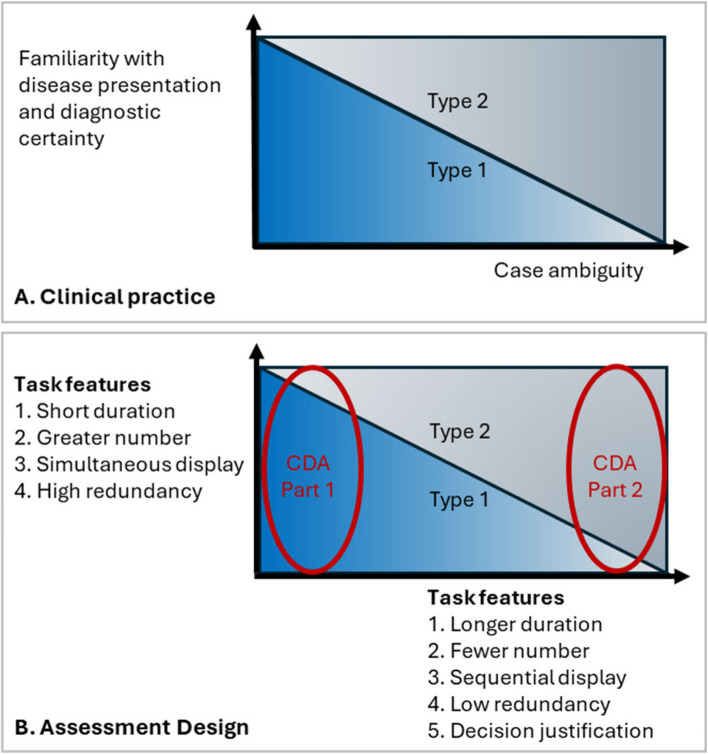
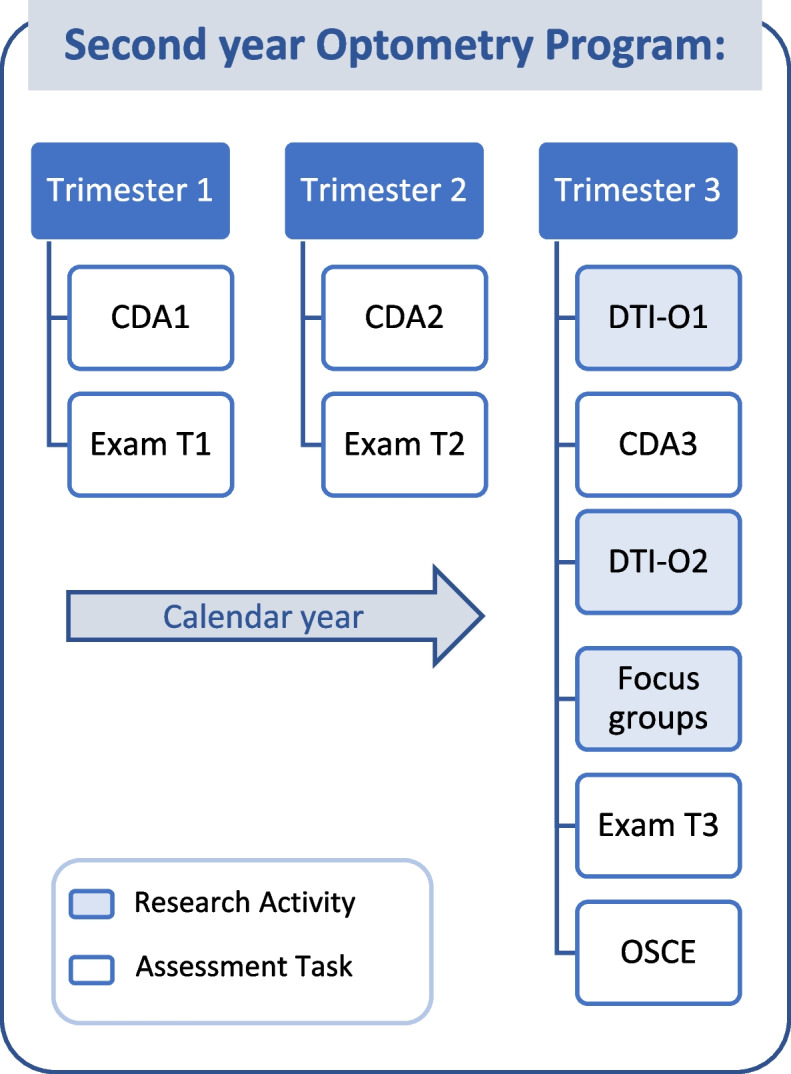
BACKGROUND: Clinical reasoning is a professional capability required for clinical practice. In preclinical training, clinical reasoning is often taught implicitly, and feedback is focused on discrete outcomes of decision-making. This makes it challenging to provide meaningful feedback on the often-hidden metacognitive process of reasoning to address specific clinical reasoning difficulties. Therefore, we designed the Clinical Diagnosis Assessment, an assessment for learning, to explicitly train Type 1 and Type 2 reasoning skills in optometry students. Decision justification was included to prompt reflective practice and expose metacognitive reasoning. By manipulating assessment task features, we aimed to broaden students' experience with clinical reasoning strategies and identify specific clinical reasoning challenges. METHODS: The Clinical Diagnosis Assessment was designed with two parts; to explicitly train Type 1 and Type 2 clinical reasoning strategies respectively. A validated clinical reasoning measure, the Diagnostic Thinking Inventory for Optometry was used to measure change in clinical reasoning skill. Clinical Diagnosis Assessment and Diagnostic Thinking Inventory scores were quantitatively compared against written exams and OSCEs. Focus groups explored student perception and approach to the assessment. RESULTS: = 0.184). Diagnostic Thinking Inventory scores increased after studying for the Clinical Diagnosis Assessment (p < .01). Four themes were identified through qualitative analysis: an authentic task prompting development of key skills required for the workplace; execution of CR strategies; exposing CR difficulties; and motivation to seek holistic feedback to improve future practice. CONCLUSIONS: The assessment exposed students underlying thinking, allowing identification of a range of clinical reasoning difficulties such as semantic transformation, prioritization, management planning, cognitive bias and managing diagnostic uncertainty. Better understanding of clinical reasoning difficulties will allow targeted remediation and inform curriculum design. The Clinical Diagnosis Assessment improves clinical reasoning skill, while promoting execution and awareness of discreet clinical reasoning strategies.
Overview
The claims and statistics of this paper haven’t been checked yet.
Run the check — free, no account needed. It reads the open-access text and checks the sources it cites.
Integrity signals
Registry
Cites
Statistics
Figures
Verification
Claims the paper makes
The claims and statistics of this paper haven’t been checked yet.
Run the check — free, no account needed. It reads the open-access text and checks the sources it cites.
Claims other papers make about this one
Each is checked against this paper’s own text: does it say what the citing paper says it does?
The source backs part of the claim, not all of it — or backs it for a different population, condition or comparison.
In the citing paper
“These attributes may develop through sustained engagement with difficult problems in which easy answers are unavailable 37 .”
From AI-induced never-skilling in medical education (2026) · cites this paper as [37]
Experimental — accuracy not yet measured
Self-check
Percentages, sums and reported differences re-computed from the paper’s own numbers.
The self-check needs the paper’s full text.
Citations
Cites
A Universal Model of Diagnostic Reasoning
Croskerry, P. (2009) · Academic Medicine · doi:10.1097/acm.0b013e3181ace703 · Cited by 1,016
Research works printed but not linked: 53
- Croskerry P. Clinical cognition and diagnostic error: applications of a dual process model of reasoning. Adv Health Sci Educ Theory Pract. 2009;14(Suppl 1):27–35. · DOI · Paper page
- Watsjold BK, Ilgen JS, Regehr G. An Ecological Account of Clinical Reasoning. Acad Med. 2022;97(11S):S80–6. · DOI
- Faucher C, Tardif J, Chamberland M. Optometrists’ Clinical Reasoning Made Explicit: A Qualitative Study. Optometry and Vision Science. 2012;89(12). · DOI
- Gruppen LD. Clinical Reasoning: Defining It, Teaching It, Assessing It. Studying It West J Emerg Med. 2017;18(1):4–7. · DOI
- Smith ER, DeCoster J. Dual-process models in social and cognitive psychology: Conceptual integration and links to underlying memory systems. Pers Soc Psychol Rev. 2000;4(2):108–31. · DOI
- Norman G, Young M, Brooks L. Non-analytical models of clinical reasoning: the role of experience. Med Educ. 2007;41(12):1140–5.
- Pelaccia T, Tardif J, Triby E, Charlin B. An analysis of clinical reasoning through a recent and comprehensive approach: the dual-process theory. Med Educ Online. 2011;16. · DOI
- Croskerry P. Context is everything or how could I have been that stupid? Healthc Q. 2009;12 Spec No Patient:e171–6. · DOI
- Koufidis C, Manninen K, Nieminen J, Wohlin M, Silén C. Unravelling the polyphony in clinical reasoning research in medical education. J Eval Clin Pract. 2021;27(2):438–50. · DOI
- Custers EJ. Medical education and cognitive continuum theory: an alternative perspective on medical problem solving and clinical reasoning. Acad Med. 2013;88(8):1074–80. · DOI
- Eva KW, Hatala RM, LeBlanc VR, Brooks LR. Teaching from the clinical reasoning literature: combined reasoning strategies help novice diagnosticians overcome misleading information. Med Educ. 2007;41(12):1152–8. · DOI
- Hammond KR, Hamm RM, Grassia J, Pearson T. Direct comparison of the efficacy of intuitive and analytical cognition in expert judgment. IEEE Trans Syst Man Cybern. 1987;17(5):753–70. · DOI
- Moulton C-aE, Regehr G, Mylopoulos M, MacRae HM. Slowing down when you should: a new model of expert judgment. Academic medicine : journal of the Association of American Medical Colleges. 2007;82(10 Suppl):S109-S16. · DOI
- Whelehan DF, Conlon KC, Ridgway PF. Medicine and heuristics: cognitive biases and medical decision-making. Ir J Med Sci. 2020;189(4):1477–84. · DOI
- Berthet V, de Gardelle V. The heuristics-and-biases inventory: An open-source tool to explore individual differences in rationality. Front Psychol. 2023;14:1145246. · DOI
- Yesudian RI, Yesudian PD. A new model for categorizing cognitive biases and debiasing strategies in dermatology. Int J Dermatol. 2023;62(2):137–42. · DOI
- Croskerry P. Achieving quality in clinical decision making cognitive strategies and detection of bias. Acad Emerg Med. 2002;9(11):1184–204. · DOI · Paper page
- Faucher C, Dufour-Guindon MP, Lapointe G, Gagnon R, Charlin B. Assessing clinical reasoning in optometry using the script concordance test. Clin Exp Optom. 2016;99(3):280–6. · DOI
- Sundling V, Stene HA, Eide H, Hugaas OE. Identifying decisions in optometry: A validation study of the decision identification and classification taxonomy for use in medicine (DICTUM) in optometric consultations. Patient Educ Couns. 2019;102(7):1288–95. · DOI
- Edgar AK, Ainge L, Backhouse S, Armitage JA. A cohort study for the development and validation of a reflective inventory to quantify diagnostic reasoning skills in optometry practice. BMC Med Educ. 2022;22(1):536. · DOI
- Parkins DJ, Shah B, Benwell MJ, Evans BJW, Edgar DF. Design and use of vignettes to investigate referral decision-making by optometrists. J Optom. 2021;14(4):346–54. · DOI
- Shah R, Edgar DF, Evans BJW. A comparison of standardised patients, record abstraction and clinical vignettes for the purpose of measuring clinical practice. Ophthalmic Physiol Opt. 2010;30(3):209–24. · DOI
- Jindal A, Ctori I, Fidalgo B, Dabasia P, Balaskas K, Lawrenson JG. Impact of optical coherence tomography on diagnostic decision-making by UK community optometrists: a clinical vignette study. Ophthalmic Physiol Opt. 2019;39(3):205–15. · DOI
- Edgar AK, Macfarlane S, Kiddell EJ, Armitage JA, Wood-Bradley RJ. The perceived value and impact of virtual simulation-based education on students’ learning: a mixed methods study. BMC Med Educ. 2022;22(1):823. · DOI
- Edgar AK, Armitage JA, Arambewela-Colley N, Chong LX, Narayanan A. Virtual simulated international placements as an innovation for internationalisation in undergraduate programs: a mixed methods study. BMC Med Educ. 2023;23(1):258. · DOI
- Edgar A, Estaphan S, Chong L, Ainge L, Corrigan G. Making reasoning visible through process mapping in digitally simulated clinical reasoning assessments: microanalysis of optometry students’ reasoning. Focus on Health Professional Education: A multi-disciplinary journal. 2024;25(4):38–46. · DOI
- Marcum JA. An integrated model of clinical reasoning: dual-process theory of cognition and metacognition. Journal of Evaluation in Clinical Practice. 2012;18(1365–2753 (Electronic)):954–61. · DOI · Paper page
- Parodis I, Andersson L, Durning SJ, Hege I, Knez J, Kononowicz AA, et al. Clinical Reasoning Needs to Be Explicitly Addressed in Health Professions Curricula: Recommendations from a European Consortium. International Journal of Environmental Research and Public Health. 2021; 18(21). · DOI · Paper page
- Cooper N, Bartlett M, Gay S, Hammond A, Lillicrap M, Matthan J, et al. Consensus statement on the content of clinical reasoning curricula in undergraduate medical education. Med Teach. 2021;43(2):152–9. · DOI
- Royce CS, Hayes MM, Schwartzstein RM. Teaching Critical Thinking: A Case for Instruction in Cognitive Biases to Reduce Diagnostic Errors and Improve Patient Safety. Acad Med. 2019;94(2):187–94. · DOI · Paper page
- van der Vleuten CPM, Schuwirth LWT. Assessment in the context of problem-based learning. Adv Health Sci Educ Theory Pract. 2019;24(5):903–14. · DOI
- Sam AH, Wilson R, Westacott R, Gurnell M, Melville C, Brown CA. Thinking differently - Students’ cognitive processes when answering two different formats of written question. Med Teach. 2021;43(11):1278–85. · DOI
- Jackson JM, Skelton JA, Peters TR. Medical Students’ Clinical Reasoning During a Simulated Viral Pandemic: Evidence of Cognitive Integration and Insights on Novices’ Approach to Diagnostic Reasoning. Medical Science Educator. 2020;30(2):767–74. · DOI
- Schuwirth LWT, Durning SJ, King SM. Assessment of clinical reasoning: three evolutions of thought. 2020;7(3):191–6.
- Williams RG, Klamen DL. Examining the diagnostic justification abilities of fourth-year medical students. Acad Med. 2012;87(8):1008–14. · DOI
- Tayce JD, Saunders AB. The Use of a Modified Script Concordance Test in Clinical Rounds to Foster and Assess Clinical Reasoning Skills. J Vet Med Educ. 2022;49(5):556–9.
- Forsberg E, Georg C, Ziegert K, Fors U. Virtual patients for assessment of clinical reasoning in nursing – a pilot study. Nurse Educ Today. 2011;31(8):757–62. · DOI
- Power A, Lemay JF, Cooke S. Justify Your Answer: The Role of Written Think Aloud in Script Concordance Testing. Teach Learn Med. 2017;29(1):59–67. · DOI
- Elstein AS, Schwarz A. Evidence Base Of Clinical Diagnosis: Clinical Problem Solving And Diagnostic Decision Making: Selective Review Of The Cognitive Literature. BMJ: British Medical Journal. 2002;324(7339):729–32. · DOI
- Hussain A, Oestreicher J. Clinical decision-making: heuristics and cognitive biases for the ophthalmologist. Surv Ophthalmol. 2018;63(1):119–24. · DOI
- Audetat MC, Laurin S, Dory V, Charlin B, Nendaz MR. Diagnosis and management of clinical reasoning difficulties: Part II. Clinical reasoning difficulties: Management and remediation strategies. Med Teach. 2017;39(8):797–801. · DOI
- Norman GR, Brooks LR, Colle CL, Hatala RM. The Benefit of Diagnostic Hypotheses in Clinical Reasoning: Experimental Study of an Instructional Intervention for Forward and Backward Reasoning. Cogn Instr. 1999;17(4):433–48. · DOI
- Audetat MC, Laurin S, Dory V, Charlin B, Nendaz MR. Diagnosis and management of clinical reasoning difficulties: Part I. Clinical reasoning supervision and educational diagnosis. Med Teach. 2017;39(8):792–6. · DOI
- Croskerry P. A Model for Clinical Decision-Making in Medicine. Medical Science Educator. 2017;27(S1):9–13. · DOI
- Ishizuka K, Shikino K, Tamura H, Yokokawa D, Yanagita Y, Uchida S, et al. Hybrid PBL and Pure PBL: Which one is more effective in developing clinical reasoning skills for general medicine clerkship?-A mixed-method study. PLoS ONE. 2023;18(1): e0279554. · DOI
- Ponce OA, Pagán-Maldonado N. Mixed Methods Research in Education: Capturing the Complexity of the Profession. International Journal of Educational Excellence. 2015;1(1):111–35. · DOI
- Bordage G, Grant J, Marsden P. Quantitative assessment of diagnostic ability. Med Educ. 1990;24(5):413–25. · DOI
- Hodges B, McIlroy JH. Analytic global OSCE ratings are sensitive to level of training. Med Educ. 2003;37(11):1012–6. · DOI
- Double KS, Birney DP. Reactivity to Measures of Metacognition. Front Psychol. 2019;10:2755. · DOI
- Durning SJ, Artino AR Jr, Pangaro LN, van der Vleuten C, Schuwirth L. Perspective: redefining context in the clinical encounter: implications for research and training in medical education. Acad Med. 2010;85(5):894–901. · DOI
- Eva KW. On the generality of specificity. Med Educ. 2003;37(7):587–8. · DOI
- Plackett R, Kassianos AP, Kambouri M, Kay N, Mylan S, Hopwood J, et al. Online patient simulation training to improve clinical reasoning: a feasibility randomised controlled trial. BMC Med Educ. 2020;20(1):245. · DOI
- Croskerry P. The feedback sanction. Acad Emerg Med. 2000;7(11):1232–8. · DOI
Cited by
Sorted by citations
AI-induced never-skilling in medical education
Ke, Y., Jin, L., Ong, J. C. L., Thirunavukarasu, A. J., Car, J., Cheung, C. Y., Tham, Y. C., Ting, D. S. W., Ong, M. E. H., Compton, S., et al. (2026) · Nature Medicine · doi:10.1038/s41591-026-04438-y · Cited by 71
Metadata
- Authors
- Ainge, L. E., Edgar, A. K., Kirkman, J. M., & Armitage, J. A.
- Affiliations
- Deakin University (AU)
- Corresponding author
- Ainge, Lucinda E.
- Venue
- BMC Medical Education
- Published
- 2025-01-08
- Volume
- 25
- Issue
- 1
- Pages
- 31-31
- ISSN
- 1472-6920 (ISSN-L)
- PMC
- PMC11708177
- OpenAlex
- W4406152889
- Cited by
- 11
- References
- 1
- Citations by year
- 2026: 8 · 2025: 3
- FWCI
- 14.85
- Type
- journal article
- Language
- en
- Open access
- gold
- doi.org
- Licence
- Locations
- BMC Medical Education (publishedVersion, cc-by-nc-nd)
- PubMed Central (publishedVersion, cc-by-nc-nd)
- PubMed (publishedVersion)
- DOAJ (DOAJ: Directory of Open Access Journals) (submittedVersion, cc-by-sa)
- Figshare (submittedVersion, cc-by-nc-nd)
- Topics
- Health Sciences › Medicine › Family Practice › Clinical Reasoning and Diagnostic Skills
- Social Sciences › Education › Innovations in Medical Education
- Health Sciences › Medicine › Ophthalmology › Ophthalmology and Visual Health Research
- Keywords
- clinical reasoning, assessment for learning, metacognition, optometry students, justification of decisions, reflective practice, cognitive biases, diagnostic uncertainty, remediation, curriculum development, preclinical training
- MeSH terms
- Clinical Reasoning, Clinical Competence, Cognition, Educational Measurement, Female, Humans, Male, Focus Groups
About these checks
Registry, retraction, Cites and statistics results are computed, not judged, with one exception: a printed reference that no index lists is read once by a model before it counts as a citation error. Claims are extracted by a model and kept only when their quote appears verbatim in the text; each cited source is then checked, with a model’s help, for whether it says what the claim relies on. Those verdicts can be wrong — read the claim’s quote and the cited source before relying on one.
Statistics and arithmetic are recomputed, not judged.
Confidence bands are shown only for fields calibrated on our annotated test set. None is calibrated yet, so no band is shown.
What counts as a claim ›How we measure confidence ›How we check this ›
Are you an author, or do you see a problem with this page? Request a review
