

Enhancing undergraduate nursing informatics literacy through design-based learning: a mixed-methods participatory action research study
Open accessThe DOI matches its Crossref record; 45 of the 45 references it cites were found in a registry or an index; 13 of the 37 sources its claims cite were checked for support.
Abstract
BACKGROUND: Rapid advances in healthcare technologies and hospital informatization have prompted the need for enhanced nursing informatics literacy among undergraduate nursing students. Traditional nursing curricula often lack authentic, design-oriented learning experiences that integrate nursing, computer science, and information technology. AIM: This four-year participatory action research study aimed to explore the effectiveness of a Design-Based Learning (DBL) approach in improving undergraduate nursing students' informatics literacies within a "Nursing Informatics" course. METHODS: This study adopted a participatory action research design with a convergent mixed-methods approach. From 2020 to 2024, a total of 622 undergraduate nursing students at a comprehensive university in China were recruited through total population sampling from an iterative, DBL-enhanced "Nursing Informatics" course. Students tackled real-world clinical informatics problems through iterative cycles of investigation, design, and redesign. Pre- and post-course informatics literacy scores were measured using a validated 28-item, 5-point Likert scale questionnaire (total score range: 28-140). Paired t-tests and Bayesian modeling assessed improvements over time, while focus group interviews provided qualitative insights into students' learning experiences. RESULTS: Across all four cohorts, informatics literacy scores improved significantly (p < 0.001). The 2018 cohort's mean score increased from 73.13 ± 13.38 to 86.55 ± 12.21 (Cohen's d = 2.21), and by 2021 cohort, scores rose from 73.17 ± 15.15 to 92.47 ± 12.07 (Cohen's d = 3.07). Bayesian analysis confirmed that yearly improvements were credible, with posterior intervals excluding zero. Qualitative themes revealed enhanced interdisciplinary thinking, informatics skill mastery, stronger professional identity, and improved teamwork capabilities, suggesting that the observed quantitative gains represented meaningful, transformative learning experiences. CONCLUSIONS: Implementing a DBL approach within the "Nursing Informatics" curriculum significantly enhanced undergraduate nursing students' informatics literacy and fostered deeper engagement, critical thinking, and interdisciplinary collaboration. These findings underscore the value of authentic, design-oriented instructional strategies in preparing future nurses for increasingly informatics-driven clinical environments. Further research is recommended to compare DBL with alternative pedagogical models and assess long-term impacts on professional practice. CLINICAL TRIAL NUMBER: Not applicable. This study did not involve a clinical trial.
Overview
CoChat Summary
TL;DR
This four-year participatory action research study integrated Design-Based Learning (DBL) into an undergraduate “Nursing Informatics” course and evaluated its impact on informatics literacy. Across four cohorts, pre–post scores improved significantly, with qualitative themes indicating gains in interdisciplinary thinking, skill mastery, professional identity, and teamwork.
Key findings
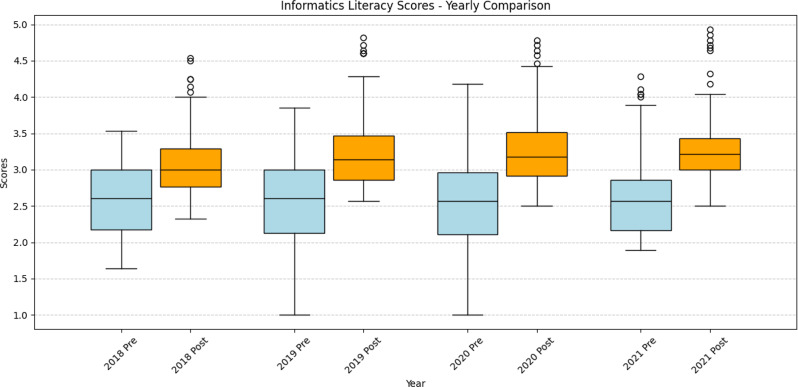
- Informatics literacy improved significantly in every cohort (p < 0.001). The 2018 cohort rose from 73.13 ± 13.38 to 86.55 ± 12.21 (Cohen’s d = 2.21); the 2021 cohort rose from 73.17 ± 15.15 to 92.47 ± 12.07 (Cohen’s d = 3.07).
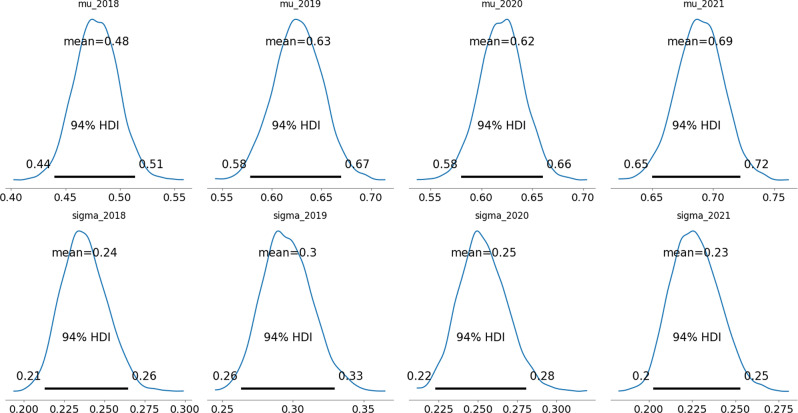
- Bayesian modeling showed positive yearly improvements with 94% HDIs excluding zero: posterior mean improvement 0.478 (94% HDI 0.440–0.514) in 2018, 0.626 (0.579–0.670) in 2019, 0.620 (0.580–0.660) in 2020, and 0.689 (0.650–0.722) in 2021.
- Focus group analysis yielded four themes: interdisciplinary thinking; integration of theory and practice through informatics skill mastery; professional identity development; and teamwork and leadership.
- The authors conclude that DBL enhanced informatics literacy and fostered deeper engagement, critical thinking, and interdisciplinary collaboration.
Methods
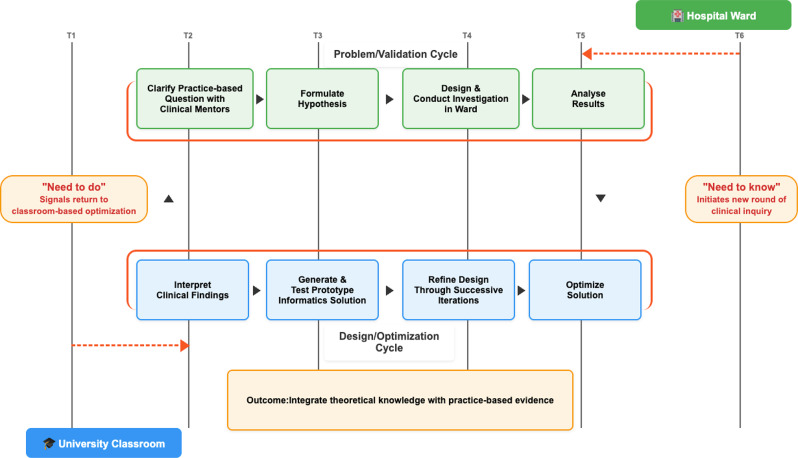
- Participatory action research using a “Plan-Act-Observe-Reflect” framework, with a convergent mixed-methods design across four iterative cycles from 2020 to 2024, preceded by a six-month preparatory phase.
- A total of 622 undergraduate nursing students at one comprehensive university in China were included through total population sampling; participants were 510 women (81.99%) and 112 men (18.01%), mean age 20.43 ± 0.61 years. Twenty-two stakeholders also participated.
- Informatics literacy was measured pre- and post-course with the validated 28-item, 5-point Likert SANICS (total score range 28–140; Chinese version Cronbach’s α = 0.93, test-retest r = 0.88). Paired t-tests, Cohen’s d, and Bayesian modeling with 94% HDIs were used; focus groups after the fourth round included 10 students and 6 educators and were analyzed with qualitative content analysis.
Limitations
- The paper states that the study was conducted at a single institution, potentially limiting generalizability; it lacked a control group receiving traditional instruction, making it difficult to attribute all improvements solely to DBL; and COVID-19 may have influenced learning conditions and student experiences across cohorts.
- The text makes evident that informatics literacy was measured by self-assessment/perceived competency rather than objective performance, and focus groups were conducted only after the fourth cycle, limiting qualitative comparison across cycles.
- The paper recommends future multi-site designs, comparison groups, and longitudinal follow-up, indicating that long-term retention and practice impacts were not assessed here.
Model-written summary. Check it against the paper before relying on it.
Integrity signals
Registry
Cites
Statistics
Figures
Verification
Claims the paper makes
8 Valid · 4 Not valid · 14 Not checked · 74 Own results and interpretations
The cited sources that could be checked couldn’t confirm or dispute this claim.
In the paper
“However, these methods are typically limited to predefined scenarios that lack the complexity of authentic, real-world informatics challenges.”
§ Enhancing undergraduate nursing informatics literacy through design-based learning: a mixed-methods participatory action research study > Background
What the sources say
- Could not verifycites [12] 12. Johnsen HM, et al. Teaching clinical reasoning and decision-making skills to nursing students: Design, development, and usability evaluation of a serious game. Int J Med Informatics. 2016;94:39–48. 10.1016/j.ijmedinf.2016.06.014. sourceExperimental — accuracy not yet measured
Section 3.4 reports that participants found this serious game's scenario realistic and its tasks adequately complex; Section 4.1 likewise describes it as clinically relevant. Neither passage assesses whether problem-based learning, simulations, and serious games are typically limited to predefined scenarios or fail to capture real-world informatics challenges. (LLM, conf=0.74)
- Not checked — no full text of the sourcecites [13] 13. Chiang VC, Chan SS. An evaluation of advanced simulation in nursing: a mixed-method study. Collegian. Elsevier. 2014;21(4):257–65. 10.1016/j.colegn.2013.05.003. source
plain- Asserted: passes — The authors put it forward as true.
- Checkable: passes — It can be checked against evidence.
- Load-bearing: passes — The paper’s conclusions depend on it.
- Based: passes — The paper gives a reason why it holds.
- Could not verify
The cited sources that could be checked couldn’t confirm or dispute this claim.
In the paper
“Design-Based Learning (DBL) offers a pedagogical framework that directly addresses these limitations through its iterative cycles of design, testing, and reflection around authentic problems [14, 15].”
§ Enhancing undergraduate nursing informatics literacy through design-based learning: a mixed-methods participatory action research study > Background
What the sources say
- Not checked — no full text of the sourcecites [14] 14. Phillips JM, Resnick J, Boni MS, Bradley P, Grady JL, Ruland JP, Stuever NL. Voices of innovation: Building a model for curriculum transformation. Int J Nurs Educ Scholarsh. 2013. 10.1515/ijnes-2012-0008. source
- Could not verifycites [15] 15. Ghasemi MR, Moonaghi HK, Heydari A. Strategies for sustaining and enhancing nursing students’ engagement in academic and clinical settings: a narrative review. Korean J Med Educ. 2020;32(2):103–17. 10.3946/kjme.2020.159. sourceExperimental — accuracy not yet measured
The Results sections on collaborative strategies discuss team-based and service-based learning, but do not address Design-Based Learning. Searches for “Design-Based Learning” and its claimed iterative cycles found no passage describing DBL, design, testing, and reflection around authentic problems. Page numbers were not available in our copy. (LLM, conf=0.76)
plainstates a cause- Asserted: passes — The authors put it forward as true.
- Checkable: passes — It can be checked against evidence.
- Load-bearing: passes — The paper’s conclusions depend on it.
- Based: passes — The paper gives a reason why it holds.
The cited sources that could be checked couldn’t confirm or dispute this claim.
In the paper
“Recent systematic reviews demonstrate that many undergraduate nursing students exhibit inadequate information literacy levels, potentially compromising their preparedness for clinical practice in digital healthcare settings [4, 5].”
§ Enhancing undergraduate nursing informatics literacy through design-based learning: a mixed-methods participatory action research study > Background
What the sources say
- Not checked — no full text of the sourcecites [4] 4. Nes AA, et al. Technological literacy in nursing education: A scoping review. J Prof Nursing: Official J Am Association Colleges Nurs. 2021;37(2):320–34. 10.1016/j.profnurs.2021.01.008. source
- Could not verifycites [5] 5. Saban M, et al. A comparative vignette study: evaluating the potential role of a generative AI model in enhancing clinical decision-making in nursing. J Adv Nurs. 2024. 10.1111/jan.16101. sourceExperimental — accuracy not yet measured
The Introduction reports deficiencies in clinical decision-making among novice nurses and new graduates, not inadequate information literacy among undergraduate students. The Methods describe a vignette study assessing clinical decision-making, rather than a systematic review. Searches for information literacy and preparedness in digital healthcare settings found no passage addressing the claim. (LLM, conf=0.76)
boostedstates a possible cause- Asserted: passes — The authors put it forward as true.
- Checkable: passes — It can be checked against evidence.
- Load-bearing: passes — The paper’s conclusions depend on it.
- Based: passes — The paper gives a reason why it holds.
The sources with a verdict support this claim; the rest weren’t checked yet, have no full text we could read, or their verdicts aren’t rated yet.
In the paper
“Compared to traditional lecture-based approaches, DBL provided a dynamic, iterative framework that fostered deeper engagement and critical thinking [33, 34].”
§ Enhancing undergraduate nursing informatics literacy through design-based learning: a mixed-methods participatory action research study > Discussion > Educational trasformation through DBL
What the sources say
- Not checked — no full text of the sourcecites [33] 33. Shin I, et al. The effect of problem-based learning in nursing education: a meta-analysis. Adv Health Sci Educ. 2013;18:1103–20. 10.1007/s10459-012-9436-2. source
- Supportedcites [34] 34. Xugang, Zhang, et al. Application of Design-Based learning and Outcome-Based education in basic industrial engineering teaching: A new teaching method. Sustainability. 2021. 10.3390/SU13052632. source
The Introduction describes DBL as an iterative cycle distinct from traditional teaching and links it to higher-level critical thinking. The Results report more active participation and teacher–student interaction in the experimental class than in the control class, supporting the engagement comparison. (LLM, conf=0.88)
plainstates a cause- Asserted: passes — The authors put it forward as true.
- Checkable: passes — It can be checked against evidence.
- Load-bearing: passes — The paper’s conclusions depend on it.
- Based: passes — The paper gives a reason why it holds.
A result the paper reports from its own data — it cites no other source for it, so there is none to check. The quote shows it is in the paper.
In the paper
“Students struggled to integrate their nursing knowledge with informatics skills, producing projects that focused narrowly on technical functions without considering nursing workflows.”
§ Enhancing undergraduate nursing informatics literacy through design-based learning: a mixed-methods participatory action research study > Methods > Study design
plain- Asserted: passes — The authors put it forward as true.
- Checkable: passes — It can be checked against evidence.
- Load-bearing: passes — The paper’s conclusions depend on it.
- Based: passes — The paper gives a reason why it holds.
45 more claims
Create a free account to see all 100 claims and to verify the 6 references still open.
- It may state two separate claims as one. 35
- Probably not a substantial claim. 26
Self-check
Percentages, sums and reported differences re-computed from the paper’s own numbers.
Each contradiction between two passages listed here was confirmed by an independent check.
Rated minor: it would not touch a result — a value no result rests on, a p-value that stays on the same side of the significance level, or a conflict that is clerical, resolved elsewhere in the paper, or outside its own findings.
In the paper
§ Enhancing undergraduate nursing informatics literacy through design-based learning: a mixed-methods participatory action research study > Methods > Study design
“Beginning in September 2020, four consecutive PAR cycles were launched to implement, evaluate, and continuously optimize the DBL strategy.”
§ Enhancing undergraduate nursing informatics literacy through design-based learning: a mixed-methods participatory action research study > Methods > Study design
“First Cycle (Feb 2021 - Jun 2021):Initial DBL Implementation”
Citations
Cites
The Action Research Planner: Doing Critical Participatory Action Research
Kemmis, S., McTaggart, R., & Nixon, R. (2014) · doi:10.1007/978-981-4560-67-2 · Cited by 4,207
Methodological challenges in qualitative content analysis: A discussion paper
Graneheim, U. H., Lindgren, B.-M., & Lundman, B. (2017) · Nurse Education Today · doi:10.1016/j.nedt.2017.06.002 · Cited by 3,195 · cited 1×
“Qualitative content analysis [27] guided the data analysis, and coding was performed using Python QualCoder software [28].”
Metrics for evaluating performance and uncertainty of Bayesian network models
Marcot, B. G. (2012) · Ecological Modelling · doi:10.1016/j.ecolmodel.2012.01.013 · Cited by 380 · cited 1×
“Bayesian modeling was used to estimate the posterior distributions of the mean differences (post minus pre) and assess the credibility of observed improvements, with 94% High-Density Intervals (HDIs) used to represent uncertainty [29, 30].”
Artificial intelligence in nursing and midwifery: A systematic review
O'Connor, S., Yan, Y., Thilo, F. J. S., Felzmann, H., Dowding, D., & Lee, J. J. (2023) · Journal of Clinical Nursing · doi:10.1111/jocn.16478 · Cited by 351 · cited 5×
“Teachers saw this as a critical step: “ What impressed me most was watching students apply theoretical frameworks like workflow optimization to develop prototypes for real clinical scenarios ,” Nursing Informatics Teacher 3 remarked.”
InfluentialMixed Methods Research for Nursing and the Health Sciences
(2009) · Wiley eBooks · doi:10.1002/9781444316490 · Cited by 316
Gholami, M., Moghadam, P. K., Mohammadipoor, F., Tarahi, M. J., Sak, M., Toulabi, T., & Pour, A. H. H. (2016) · Nurse Education Today · doi:10.1016/j.nedt.2016.06.007 · Cited by 200 · cited 1×
“This finding aligns with previous studies demonstrating that authentic, learner-centered strategies enhance literacies and professional readiness [36, 37].”
Technological literacy in nursing education: A scoping review
Nes, A. A. G., Steindal, S. A., Larsen, M. H., Heer, H. C., Lærum-Onsager, E., & Gjevjon, E. R. (2021) · Journal of Professional Nursing · doi:10.1016/j.profnurs.2021.01.008 · Cited by 182
The effect of problem-based learning in nursing education: a meta-analysis
Shin, I.-S., & Kim, J.-H. (2013) · Advances in Health Sciences Education · doi:10.1007/s10459-012-9436-2 · Cited by 149 · cited 1×
“Compared to traditional lecture-based approaches, DBL provided a dynamic, iterative framework that fostered deeper engagement and critical thinking [33, 34].”
Johnsen, H. M., Fossum, M., Vivekananda-Schmidt, P., Fruhling, A., & Slettebø, Å. (2016) · International Journal of Medical Informatics · doi:10.1016/j.ijmedinf.2016.06.014 · Cited by 141 · cited 1×
“Current educational approaches, including problem-based learning, simulations, and serious games, have shown promise in enhancing clinical reasoning and procedural skills [12, 13].”
Reflective practice in nursing: A concept analysis
Patel, K. M., & Metersky, K. (2022) · International Journal of Nursing Knowledge · doi:10.1111/2047-3095.12350 · Cited by 127 · cited 1×
“This study employed a participatory action research (PAR) approach following the “Plan-Act-Observe-Reflect” framework to systematically design, implement, and refine a Design-Based Learning (DBL) strategy within a nursing informatics course [22].”
Ghasemi, M. R., Moonaghi, H. K., & Heydari, A. (2020) · Korean Journal of Medical Education · doi:10.3946/kjme.2020.159 · Cited by 112 · cited 1×
“Design-Based Learning (DBL) offers a pedagogical framework that directly addresses these limitations through its iterative cycles of design, testing, and reflection around authentic problems [14, 15].”
Mixed Methods Intervention Trials
Creswell, J. W., Fetters, M. D., Plano Clark, V. L., & Morales, A. (2009) · Mixed Methods Research for Nursing and the Health Sciences · doi:10.1002/9781444316490.ch9 · Cited by 99 · cited 1×
“PAR was selected as the methodological framework because of its iterative nature and proven effectiveness in nursing education for enhancing pedagogical methods and bridging theory-practice gaps [23].”
Doing Critical Participatory Action Research: The ‘Planner’ Part
Kemmis, S., McTaggart, R., & Nixon, R. (2013) · Springer eBooks · doi:10.1007/978-981-4560-67-2_5 · Cited by 97
Darvish, A., Bahramnezhad, F., Keyhanian, S., & Navidhamidi, M. (2014) · Global Journal of Health Science · doi:10.5539/gjhs.v6n6p11 · Cited by 95 · cited 1×
“These outcomes include substantial reductions in medication errors and improvements in care coordination efficiency [9].”
The evolving role of nursing informatics in the era of artificial intelligence
Nashwan, A. J., Cabrega, J. A., Othman, M. I., Khedr, M. A., Osman, Y. M., El‐Ashry, A. M., Naif, R., & Mousa, A. A. (2025) · International Nursing Review · doi:10.1111/inr.13084 · Cited by 93 · cited 1×
“By contrast, community health practice demands competencies in population health databases, telehealth platforms, and health information exchange systems [7, 8].”
Saban, M., & Dubovi, I. (2025) · Journal of Advanced Nursing · doi:10.1111/jan.16101 · Cited by 87
Baran, E., & Uygun, E. (2016) · Australasian Journal of Educational Technology · doi:10.14742/ajet.2551 · Cited by 84 · cited 1×
“Rooted in constructivist theory, DBL engages students in cultivating creativity, interdisciplinary integration, and higher-order thinking [17].”
Nilsen, E. R., Stendal, K., & Gullslett, M. K. (2020) · BMC Health Services Research · doi:10.1186/s12913-020-05287-2 · Cited by 78 · cited 4×
“By contrast, community health practice demands competencies in population health databases, telehealth platforms, and health information exchange systems [7, 8].”
InfluentialTransforming nursing education in response to the Future of Nursing 2020–2030 report
Sumpter, D., Blodgett, N., Beard, K., & Howard, V. (2022) · Nursing Outlook · doi:10.1016/j.outlook.2022.02.007 · Cited by 76 · cited 1×
“This process aligns with constructivist learning theory, where knowledge is actively constructed through experience and reflection [35].”
Effect of design-based learning on improving computational thinking
Jun, S., Han, S., & Kim, S. (2016) · Behaviour & Information Technology · doi:10.1080/0144929x.2016.1188415 · Cited by 66 · cited 1×
“This approach supports nursing informatics literacy by requiring students to identify clinical needs, synthesize interdisciplinary knowledge, develop practical prototypes, and address ethical considerations including privacy and security throughout the design process [18, 19].”
A Design-Based Learning Approach for Fostering Sustainability Competency in Engineering Education
Huang, Z., Peng, A., Yang, T., Deng, S., & He, Y. (2020) · Sustainability · doi:10.3390/su12072958 · Cited by 58 · cited 1×
“While extensively utilized in engineering and medical education, DBL application in nursing informatics education remains limited [20, 21].”
Jouparinejad, S., Foroughameri, G., Khajouei, R., & Farokhzadian, J. (2020) · BMC Medical Informatics and Decision Making · doi:10.1186/s12911-020-01244-5 · Cited by 57
Zhang, X., Ma, Y., Jiang, Z., Chandrasekaran, S., Wang, Y., & Fonkoua Fofou, R. (2021) · Sustainability · doi:10.3390/su13052632 · Cited by 53 · cited 1×
“Compared to traditional lecture-based approaches, DBL provided a dynamic, iterative framework that fostered deeper engagement and critical thinking [33, 34].”
(2009) · PubMed · Cited by 49
Contemporary Integrative Review in Simulation-Based Learning in Nursing
Rajaguru, V., & Park, J. (2021) · International Journal of Environmental Research and Public Health · doi:10.3390/ijerph18020726 · Cited by 44 · cited 1×
“This approach supports nursing informatics literacy by requiring students to identify clinical needs, synthesize interdisciplinary knowledge, develop practical prototypes, and address ethical considerations including privacy and security throughout the design process [18, 19].”
Azizan, S. A., & Abu Shamsi, N. (2022) · Frontiers in Education · doi:10.3389/feduc.2022.860097 · Cited by 38 · cited 1×
“These dimensions are increasingly emphasized in international nursing education standards, underscoring the relevance of DBL for preparing digitally literate nurse leaders in a global context [42].”
Raghunathan, K., McKenna, L., & Peddle, M. (2023) · DIGITAL HEALTH · doi:10.1177/20552076231179051 · Cited by 37 · cited 1×
“Specifically, 71.1% lack confidence in electronic medical records usage, 55% rate their computing skills as inadequate, and only 40.84% perceive themselves as informatics-competent [6].”
InfluentialAn evaluation of advanced simulation in nursing: A mixed-method study
Chiang, V. C. L., & Chan, S. S. C. (2014) · Collegian · doi:10.1016/j.colegn.2013.05.003 · Cited by 28 · cited 1×
“Current educational approaches, including problem-based learning, simulations, and serious games, have shown promise in enhancing clinical reasoning and procedural skills [12, 13].”
Effects of Blended Simulation on Nursing Students’ Critical Thinking Skills: A Quantitative Study
Sterner, A., Sköld, R., & Andersson, H. (2023) · SAGE Open Nursing · doi:10.1177/23779608231177566 · Cited by 27 · cited 1×
“Similar patterns have been observed in other nursing education reforms, where repeated cycles enhanced both teaching quality and student engagement [38].”
Experiential learning in practice: An ethnographic study among nursing students and preceptors
Rodríguez-García, M., Medina-Moya, J. L., González-Pascual, J. L., & Cardenete-Reyes, C. (2018) · Nurse Education in Practice · doi:10.1016/j.nepr.2017.11.001 · Cited by 27 · cited 1×
“The transition to DBL required substantial faculty development to shift from didactic delivery to facilitating inquiry-based learning [39].”
Aul, K., Bagnall, L., Bumbach, M. D., Gannon, J., Shipman, S., McDaniel, A., & Keenan, G. (2021) · SAGE Open Nursing · doi:10.1177/2377960821998524 · Cited by 20 · cited 1×
“These findings align with a growing body of literature advocating for active, problem-based pedagogies in nursing and health informatics education [31, 32].”
Fabbro, L. D., Mitchell, C., & Shaw, J. (2015) · Journal of Nursing Education · doi:10.3928/01484834-20150218-12 · Cited by 19 · cited 1×
“This resistance reflects deeper issues about student expectations and learning comfort zones in higher education contexts where traditional assessment-driven approaches predominate [40].”
Shi, D., Song, H., DiStefano, C., Maydeu-Olivares, A., McDaniel, H. L., & Jiang, Z. (2019) · Multivariate Behavioral Research · doi:10.1080/00273171.2018.1514484 · Cited by 19 · cited 1×
“Bayesian modeling was used to estimate the posterior distributions of the mean differences (post minus pre) and assess the credibility of observed improvements, with 94% High-Density Intervals (HDIs) used to represent uncertainty [29, 30].”
Teaching Information Literacy in Nursing Using Blended Learning Pedagogy
Liou, S., Yu, W.-C. W., Tsai, H., et al. (2015) · Creative Education · doi:10.4236/ce.2015.613145 · Cited by 17 · cited 1×
“This integration enables nurses to function effectively in technology intensive healthcare environments where patient safety and evidence-based practice are paramount [10].”
Voices of Innovation: Building a Model for Curriculum Transformation
Phillips, J. M., Resnick, J., Boni, M. S., Bradley, P., Grady, J. L., Ruland, J. P., & Stuever, N. L. (2013) · International Journal of Nursing Education Scholarship · doi:10.1515/ijnes-2012-0008 · Cited by 17
Lu, Y.-C. A., Lee, S.-H., Hsu, M.-Y., Shih, F.-F., Yen, W.-J., Huang, C.-Y., Li, P.-C., Hung, C.-Y., Chuang, H.-L., & Kuo, C.-P. (2022) · International Journal of Environmental Research and Public Health · doi:10.3390/ijerph192315825 · Cited by 16 · cited 1×
“These findings align with a growing body of literature advocating for active, problem-based pedagogies in nursing and health informatics education [31, 32].”
Decoding machine learning in nursing research: A scoping review of effective algorithms
Choi, J., Lee, H., & Kim‐Godwin, Y. (2025) · Journal of Nursing Scholarship · doi:10.1111/jnu.13026 · Cited by 15 · cited 1×
“The rapid digitization of healthcare systems has fundamentally transformed nursing practice environments [1].”
van Velzen, M., Boru, A., Sarton, E., & de Beaufort, A. J. (2024) · Medical Teacher · doi:10.1080/0142159x.2024.2305713 · Cited by 13 · cited 1×
“Despite its recognized importance of informatics literacy, traditional nursing education strategies continue to emphasize theoretical instruction and task-oriented technical training [11].”
Chan, R. R., & Schaffrath, M. (2017) · Nurse Education in Practice · doi:10.1016/j.nepr.2016.12.003 · Cited by 13 · cited 1×
“The systematic documentation of implementation challenges offers a practical roadmap for institutions considering similar pedagogical transformations in nursing informatics education [43, 44].”
Wang, Z., Wen, N., Ren, Y., et al. (2024) · Journal of Advanced Nursing · doi:10.1111/jan.16433 · Cited by 12 · cited 1×
“Additionally, it includes professional responsibility in digital data handling and effective ICT utilization in direct patient care delivery [3].”
Macdiarmid, R., Winnington, R., Cochrane, T., & Merrick, E. (2021) · Nurse Education in Practice · doi:10.1016/j.nepr.2021.102965 · Cited by 12 · cited 1×
“This requires students to systematically evaluate clinical evidence, technical specifications, and regulatory guidelines during prototype development [16].”
Hertz, J. (2020) · 2018 ASEE Annual Conference & Exposition Proceedings · doi:10.18260/1-2--30217 · Cited by 11 · cited 1×
“The establishment of a joint college-hospital teaching base in Cycle 2 proved instrumental in addressing logistical constraints, while the iterative PAR approach enabled rapid identification and resolution of emerging barriers [41].”
Lin, C.-C., Han, C.-Y., Wu, M.-L. (., Hsiao, P.-R., Wang, L.-H., & Chen, L.-C. (2021) · Nurse Education Today · doi:10.1016/j.nedt.2021.104935 · Cited by 9 · cited 1×
“The systematic documentation of implementation challenges offers a practical roadmap for institutions considering similar pedagogical transformations in nursing informatics education [43, 44].”
Nursing Department, F. O. H. S., Jadmiko, A. W., Department of Medical Education, F. O. M., Mustika, R., Department of Medical Education, F. O. M., Bashiruddin, J., & Department of Medical Education, F. O. M. (2024) · Education in Medicine Journal · doi:10.21315/eimj2024.16.4.9 · Cited by 3 · cited 1×
“This finding aligns with previous studies demonstrating that authentic, learner-centered strategies enhance literacies and professional readiness [36, 37].”
Psychometric Properties of the Self-Assessment of Nursing Informatics Competencies Scale
Sunmoo, Y., Po-Yin, Y., & Suzanne, B. (2009) · Studies in Health Technology and Informatics · doi:10.3233/978-1-60750-024-7-546
Research works printed but not linked: 1
- 24. Kolodner JL. Facilitating the learning of design practices: lessons learned from an Inquiry into science education. National Association of Industrial and Technical Teacher Educators. J Indust Teach Educ. 2002;39(3):9–40. http://scholar.lib.vt.edu/ejournals/JITE/.
Cited by
Curasma, R. P., Sapallanay-Gomez, N. N., Yarasca, U. C., Acra-Despradel, C., & Ponce-Aranibar, M. D. P. (2026) · Education Sciences · doi:10.3390/educsci16060929 · Cited by 1
Nursing Informatics and Undergraduate Nursing Curricula: A Scoping Review
Reid, L., Button, D., Breaden, K., & Brommeyer, M. (2026) · Nursing Reports · doi:10.3390/nursrep16020042 · Cited by 2
“…later, recognition of the context specific applications of nursing informatics, that exist across a range of clinical settings, requires a nuanced approach, which can “more effectively bridge the gap between educational preparation and practice requirements in nursing informatics [144] (p. 2).”
InfluentialRen, Y., & Li, C. (2026) · Frontiers in Medicine · doi:10.3389/fmed.2026.1867526
Li, G., JIANG, J., Ma, Y., et al. (2026) · Nurse Education Today · doi:10.1016/j.nedt.2026.107388
Muehlbauer, M. K., Colander, S., Husson, N. M., Morouse, K., & Forman, T. M. (2026) · Journal of Professional Nursing · doi:10.1016/j.profnurs.2026.08.020
Metadata
- Authors
- Shen, M., Feng, Z., Shen, Y., & Shi, Z.
- Affiliations
- Zhejiang Shuren University (CN)
- Corresponding author
- Shen, Mingyan
- Feng, Zhixian
- Shen, Yanping
- Shi, Zuxin
- Venue
- BMC Nursing
- Published
- 2025-10-14
- Volume
- 24
- Issue
- 1
- Pages
- 1268-1268
- ISSN
- 1472-6955 (ISSN-L)
- PMC
- PMC12523023
- OpenAlex
- W4415151316
- Semantic Scholar
- 019e7061129e553ef3a2a41780703aa1b5da6a19
- Cited by
- 12
- References
- 42
- Citations by year
- 2026: 12
- FWCI
- 12.48
- Type
- journal article
- Language
- en
- Open access
- gold
- doi.org
- Licence
- cc-by-nc-nd
- creativecommons.org/licenses/by-nc-nd/4.0 (tdm)
- creativecommons.org/licenses/by-nc-nd/4.0 (vor)
- Locations
- BMC Nursing (publishedVersion, cc-by-nc-nd)
- Europe PMC (PubMed Central) (publishedVersion, cc-by-nc-nd)
- PubMed (publishedVersion)
- DOAJ (DOAJ: Directory of Open Access Journals) (submittedVersion, cc-by-sa)
- Funders
- Department of Education of Zhejiang Province (JGBA2024419)
- Zhejiang Shuren University (yk 202401)
- 2023 University-Level Blended First-Class Course Construction Project of Zhejiang Shuren University
- Topics
- Social Sciences › Education › Digital literacy in education
- Social Sciences › Library and Information Sciences › Library Science and Information Literacy
- Social Sciences › Education › Innovations in Medical Education
- Keywords
- design-based learning, undergraduate nursing education, interdisciplinary learning, professional identity, teamwork skills, critical thinking, hospital informatization, student learning experience
About these checks
Registry, retraction, Cites and statistics results are computed, not judged, with one exception: a printed reference that no index lists is read once by a model before it counts as a citation error. Claims are extracted by a model and kept only when their quote appears verbatim in the text; each cited source is then checked, with a model’s help, for whether it says what the claim relies on. Those verdicts can be wrong — read the claim’s quote and the cited source before relying on one.
The claim verdicts this report counts are experimental: their accuracy is not yet measured.
A language model drew the claims from the paper on 2026-10-11, under version 3 of the claim definition (model deepseek-v4.1-flash, prompt extract-v3).
A second model labelled each claim on 2026-10-11 (model jev-1.13-20260917, definition revision gold-guideline-v0.2).
Cited sources are checked with a language model’s help (gpt-6-sol).
Statistics and arithmetic are recomputed, not judged.
Confidence bands are shown only for fields calibrated on our annotated test set. None is calibrated yet, so no band is shown.
What counts as a claim ›How we measure confidence ›How we check this ›
Are you an author, or do you see a problem with this page? Request a review
Data sources
Bibliographic data: Semantic Scholar, OpenAlex, Crossref.
Contains information from the Semantic Scholar Academic Graph Datasets, made available under the ODC Attribution License (ODC-BY 1.0).
Semantic Scholar’s data is described in: Kinney, R., et al. (2023). The Semantic Scholar Open Data Platform. arXiv:2301.10140.
