

The DOI matches its Crossref record; 22 of the 22 references it cites were found in a registry or an index.
Population-based geographic access to endocrinologists in the United States, 2012
Open accessAbstract
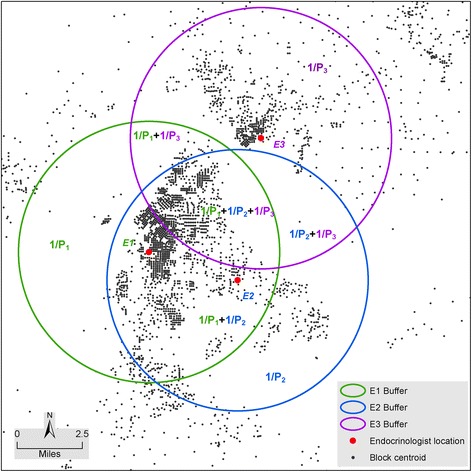
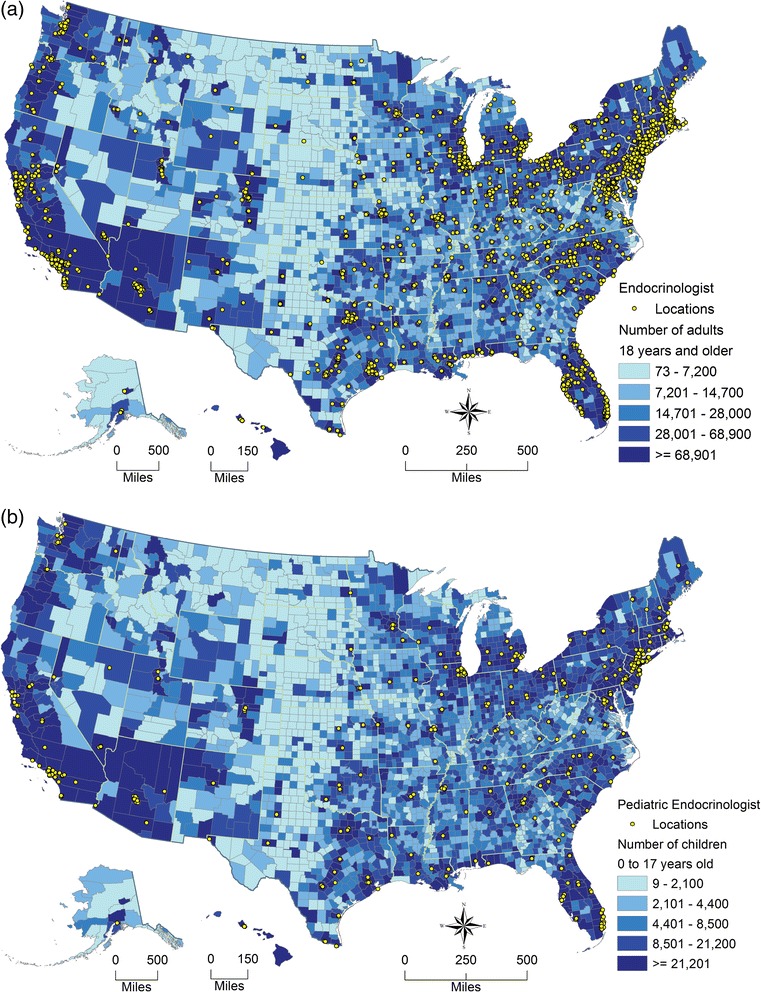
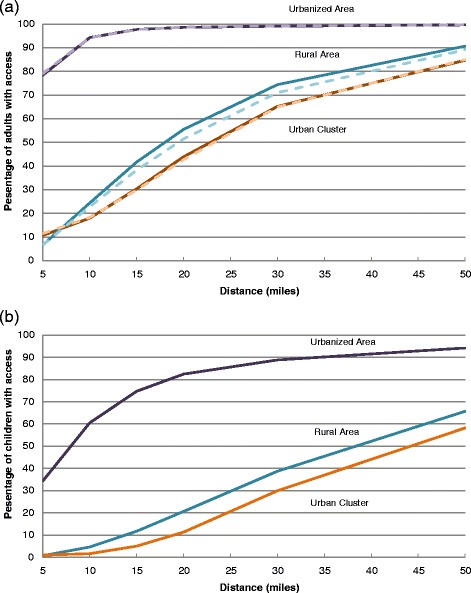
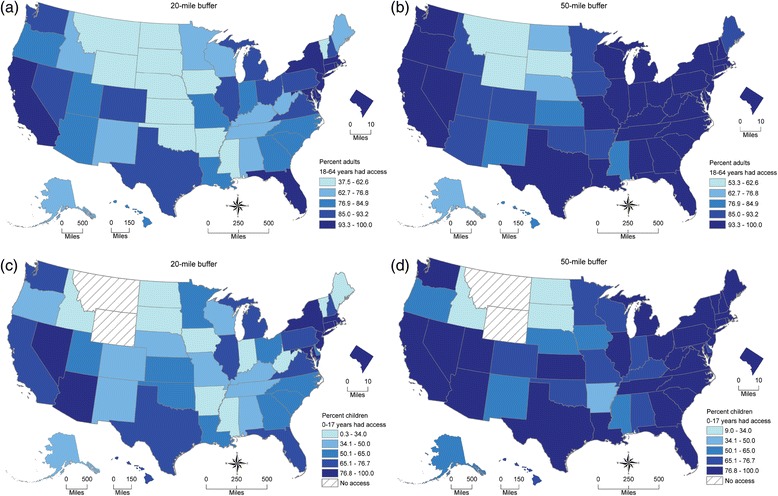
BACKGROUND: Increases in population and life expectancy of Americans may result in shortages of endocrinologists by 2020. This study aims to assess variations in geographic accessibility to endocrinologists in the US, by age group at state and county levels, and by urban/rural status, and distance. METHODS: We used the 2012 National Provider Identifier Registry to obtain office locations of all adult and pediatric endocrinologists in the US. The population with geographic access to an endocrinologist within a series of 6 distance radii, centered on endocrinologist practice locations, was estimated using the US Census 2010 block-level population. We assumed that persons living within the same circular buffer zone of an endocrinologist location have the same geographic accessibility to that endocrinologist. The geographic accessibility (the percentage of the population with geographic access to at least one endocrinologist) and the population-to-endocrinologist ratio for each geographic area were estimated. RESULTS: By using 20 miles as the distance radius, geographic accessibility to at least one pediatric/adult endocrinologist for age groups 0-17, 18-64, and ≥ 65 years was 64.1%, 85.4%, and 82.1%. The overall population-to-endocrinologist ratio within 20 miles was 39,492:1 for children, 29,887:1 for adults aged 18-64 years, and 6,194:1 for adults aged ≥ 65 years. These ratios varied considerably by state, county, urban/rural status, and distance. CONCLUSIONS: This study demonstrates that there are geographic variations of accessibility to endocrinologists in the US. The areas with poorer geographic accessibility warrant further study of the effect of these variations on disease prevention, detection, and management of endocrine diseases in the US population. Our findings of geographic access to endocrinologists also may provide valuable information for medical education and health resources allocation.
Overview
The claims and statistics of this paper haven’t been checked yet.
Run the check — free, no account needed. It reads the open-access text and checks the sources it cites.
Integrity signals
Registry
Cites
Statistics
Figures
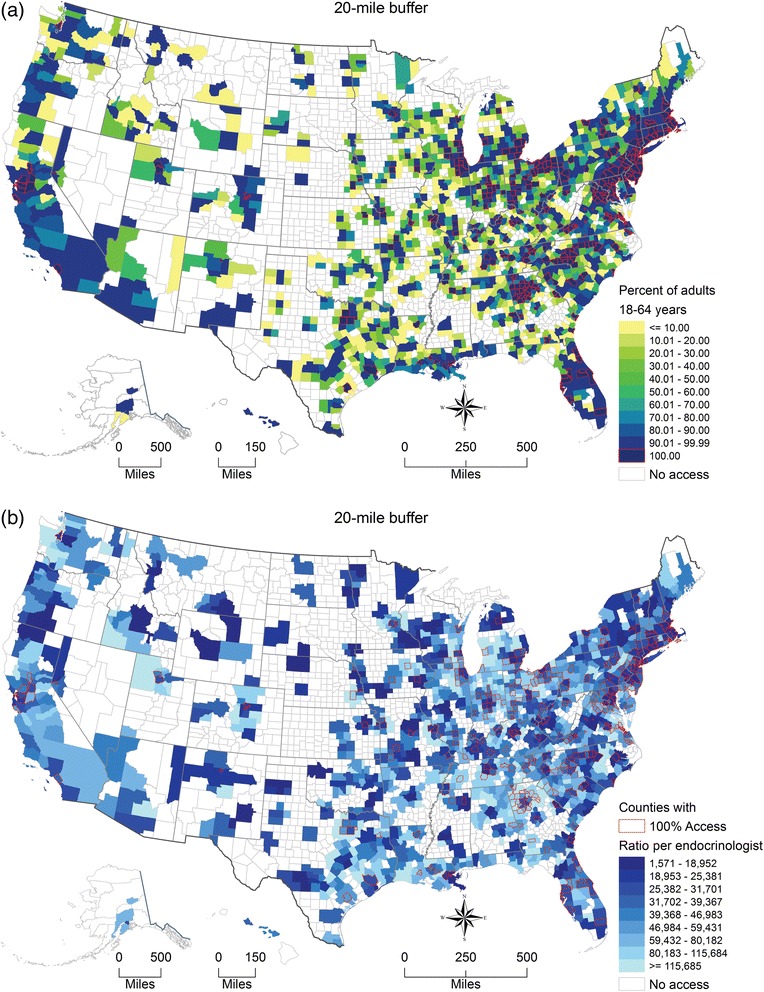
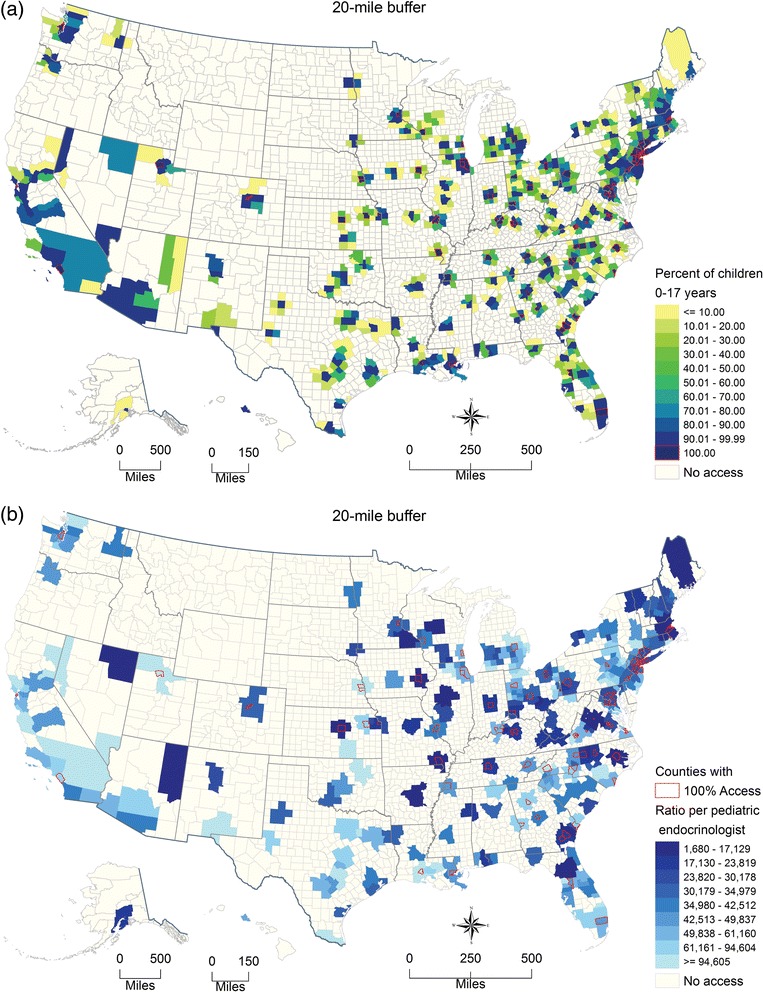
Verification
Claims the paper makes
The claims and statistics of this paper haven’t been checked yet.
Run the check — free, no account needed. It reads the open-access text and checks the sources it cites.
Claims other papers make about this one
Each is checked against this paper’s own text: does it say what the citing paper says it does?
In the citing paper
“There is also substantial US nationwide variations in geographic accessibility to endocrinologists at both county and state levels, as well as disparities in access to an endocrinologist within a reasonable driving distance, by urban/rural status and by age (27).”
From Regional trends and disparities in newer GLP1 receptor agonist initiation among real‐world adult patients eligible for obesity treatment (2025) · cites this paper as [27]
Self-check
Percentages, sums and reported differences re-computed from the paper’s own numbers.
The self-check needs the paper’s full text.
Citations
Cites
Prevalence of Childhood and Adult Obesity in the United States, 2011-2012
Ogden, C. L., Carroll, M. D., Kit, B. K., & Flegal, K. M. (2014) · JAMA · doi:10.1001/jama.2014.732 · Cited by 8,072
Penchansky, R., & Thomas, J. W. (1981) · Medical Care · doi:10.1097/00005650-198102000-00001 · Cited by 3,743
Luo, W., & Wang, F. (2003) · Environment and Planning B Planning and Design · doi:10.1068/b29120 · Cited by 1,802
Spatial accessibility of primary care: concepts, methods and challenges
Guagliardo, M. F. (2004) · International Journal of Health Geographics · doi:10.1186/1476-072x-3-3 · Cited by 1,537
Luo, W., & Qi, Y. (2009) · Health & Place · doi:10.1016/j.healthplace.2009.06.002 · Cited by 1,298
Ecological Fallacies and the Analysis of Areal Census Data
Openshaw, S. (1984) · Environment and Planning A Economy and Space · doi:10.1068/a160017 · Cited by 646
A three-step floating catchment area method for analyzing spatial access to health services
Wan, N., Zou, B., & Sternberg, T. (2012) · International Journal of Geographical Information Systems · doi:10.1080/13658816.2011.624987 · Cited by 485
Prevalence of Diabetes in U.S. Youth in 2009: The SEARCH for Diabetes in Youth Study
Pettitt, D. J., Talton, J. W., Dabelea, D., Divers, J., Imperatore, G., Lawrence, J. M., Liese, A. D., Linder, B. L., Mayer‐Davis, E. J., Pihoker, C., et al. (2013) · Diabetes Care · doi:10.2337/dc13-1838 · Cited by 428
Delamater, P. L. (2013) · Health & Place · doi:10.1016/j.healthplace.2013.07.012 · Cited by 365
A Literature Review of the Use of GIS-Based Measures of Access to Health Care Services
Higgs, G. (2004) · Health Services and Outcomes Research Methodology · doi:10.1007/s10742-005-4304-7 · Cited by 344
Research works printed but not linked: 2
- Health, United States, 2012: With Special Feature on Emergency Care. [ http://www.ncbi.nlm.nih.gov/books/NBK148940/toc/ ].
- Cromley EK, McLafferty SL. Analyzing access to health services. In: GIS and Public Health. 2nd ed. New York: The Guilford Press; 2012. p. 303–37.
Cited by
Sorted by citations
Social determinants of health and diabetes: A scientific review
Hill-Briggs, F., Adler, N. E., Berkowitz, S. A., Chin, M. H., Gary-Webb, T. L., Navas-Acien, A., Thornton, P. L., & Haire-Joshu, D. (2021) · Diabetes Care · doi:10.2337/dci20-0053 · Cited by 1,732
Nimri, R., Battelino, T., Laffel, L. M., Slover, R. H., Schatz, D., Weinzimer, S. A., Dovc, K., Danne, T., Phillip, M., NextDREAM Consortium, et al. (2020) · Nature Medicine · doi:10.1038/s41591-020-1045-7 · Cited by 242
Hassan, S., Gujral, U. P., Quarells, R. C., Rhodes, E., Shah, M. K., Obi, J., Lee, W.-H., Shamambo, L., Weber, M. B., & Narayan, K. M. V. (2023) · The Lancet Diabetes & Endocrinology · doi:10.1016/s2213-8587(23)00129-8 · Cited by 133
The Use of Diabetes Technology to Address Inequity in Health Outcomes: Limitations and Opportunities
Agarwal, S., Simmonds, I., & Myers, A. K. (2022) · Current Diabetes Reports · doi:10.1007/s11892-022-01470-3 · Cited by 105
Hill‐Briggs, F., Ephraim, P. L., Vrany, E. A., Davidson, K. W., Pekmezaris, R., Salas‐Lopez, D., Alfano, C. M., & Gary‐Webb, T. L. (2022) · Current Diabetes Reports · doi:10.1007/s11892-022-01454-3 · Cited by 90
Metadata
- Authors
- Lu, H., Holt, J. B., Cheng, Y. J., Zhang, X., Onufrak, S., & Croft, J. B.
- Affiliations
- Centers for Disease Control and Prevention (US)
- Corresponding author
- Lu, Hua
- Venue
- BMC Health Services Research
- Published
- 2015-06
- Volume
- 15
- Issue
- 1
- Pages
- 541-541
- ISSN
- 1472-6963 (ISSN-L)
- PMC
- PMC4672571
- OpenAlex
- W2191992790
- Cited by
- 121
- References
- 22
- Citations by year
- 2026: 11 · 2025: 19 · 2024: 13 · 2023: 18 · 2022: 16 · 2021: 9 · 2020: 16 · 2019: 9 · 2018: 3 · 2017: 4 · 2016: 3
- FWCI
- 5.75
- Type
- journal article
- Language
- en
- Open access
- gold
- doi.org
- Licence
- Locations
- BMC Health Services Research (publishedVersion, cc-by)
- PubMed Central (publishedVersion, cc-by)
- PubMed (publishedVersion)
- Topics
- Health Sciences › Medicine › Public Health, Environmental and Occupational Health › Global Health Workforce Issues
- Social Sciences › Economics, Econometrics and Finance › Economics and Econometrics › Healthcare Policy and Management
- Social Sciences › Gender Studies › Diversity and Career in Medicine
- Keywords
- pediatric endocrinology, urban-rural disparities, health workforce distribution, healthcare resource allocation, endocrine disorders
- MeSH terms
- Adolescent, Adult, Aged, Child, Child, Preschool, Endocrinology, Female, Health Services Accessibility, Humans, Infant, Infant, Newborn, Male, Middle Aged, Residence Characteristics, United States, Rural Health Services, Urban Health Services, Censuses, Young Adult
About these checks
Registry, retraction, Cites and statistics results are computed, not judged, with one exception: a printed reference that no index lists is read once by a model before it counts as a citation error. Claims are extracted by a model and kept only when their quote appears verbatim in the text; each cited source is then checked, with a model’s help, for whether it says what the claim relies on. Those verdicts can be wrong — read the claim’s quote and the cited source before relying on one.
Statistics and arithmetic are recomputed, not judged.
Confidence bands are shown only for fields calibrated on our annotated test set. None is calibrated yet, so no band is shown.
What counts as a claim ›How we measure confidence ›How we check this ›
Are you an author, or do you see a problem with this page? Request a review
